Nestler 23 R · Volume 1
Nestler 23 R — Volume 1 — The Model
Albert Nestler of Lahr, the Rietz system, the 'R' that added a reciprocal scale, and the Einstein story

Figure 1 — The front of a Nestler 23 R: K at the top, A, then the slide with B, the red reciprocal scale CI and C, then D and the L scale along the bottom. The slide’s A/B and C/D scales run on past their ends in red “extended” graduations — 0.8–0.9 at the left and up to 120 and 11 at the right. Image: “Rechenschieber Nestler 23R” by Lokilech, CC BY-SA 3.0, via Wikimedia Commons, https://commons.wikimedia.org/w/index.php?curid=11319217.
1.1 About This Volume
The Nestler 23 R is a 25 cm simplex rule of mahogany faced with white celluloid, laid out in the Rietz system that became the standard engineering arrangement in continental Europe for half a century. I own a 23 R. This volume covers the maker, the Rietz layout and Nestler’s part in it, what the “R” in the model number means, the variants and their dates, the claim that Albert Einstein favoured this rule, and the markings that date an example. Vol 2 goes through every scale and the construction; Vol 3 covers use and care. The firm’s place among the great makers is in the History unit, Vol 3.
1.1.1 Depth-Index: The Three-Volume 23 R Unit
Table 1 — Depth-Index: The Three-Volume 23 R Unit
| Vol | Title | Primary Content |
|---|---|---|
| 1 | The Model (this volume) | Albert Nestler AG, Max Rietz, the 23 and 23 R, variants, Einstein, dating an example |
| 2 | Anatomy and the Full Scale Set | K, A, B, CI, C, D, L; the slide-back S, S&T, T; edge scales, gauge marks, cursor, construction |
| 3 | Using It, and Caring for It | Worked examples checked by calculation; celluloid and mahogany, cleaning, what never to use |
1.2 Albert Nestler of Lahr
Albert Nestler founded his firm in 1878 in Lahr, in Baden on the western edge of the Black Forest, and it remained in the slide-rule business for a hundred years, until production ended in 1978 (Following the Rules; International Slide Rule Museum). Nestler built its own dividing engines to engrave scales; its earliest stocks are said to have come from Dennert & Pape of Hamburg (later Aristo), before Nestler made its own (Following the Rules). Like other German makers it also produced drawing instruments, drawing machines and measuring rules — the 1938 catalogue’s title page lists drawing machines, drawing tables, pantographs and scale rules alongside slide rules.
By the 1890s Nestler was supplying rules in quantity to students of the Technische Hochschule in Stuttgart, and in 1898 it commissioned the Stuttgart professor Ernst Hammer to write a booklet that could go out with its instruments and “largely replace the spoken instruction” that a lecturer would otherwise have to give (Hammer, 1898, preface). That booklet, Der logarithmische Rechenschieber und sein Gebrauch, became the ancestor of Nestler’s own instruction book of the same title, which reached a third, enlarged edition in 1942 (Nestler, 1942).
1.3 The Rietz System
In 1902 the German engineer Max Rietz proposed an arrangement of scales that rearranged the four-scale Mannheim rule: it added a cube scale K above the A scale, brought the uniform logarithm scale L to the front below D, and gave the back of the slide a sine scale S, a tangent scale T and, between them, a combined small-angle scale S&T (International Slide Rule Museum; Nestler, 1942). Nestler took up the layout the same year, and Rietz’s registered design, D.R.G.M. 181110, appears on Nestler’s early Rietz rules; Nestler’s own patent D.R.P. 173660, applied for on 26 April 1905 and granted on 27 July 1906, was engraved alongside it (International Slide Rule Museum; Hamann, Nestler-Rietz 23).
The Rietz layout was simple, compact and enough for nearly all engineering arithmetic, and it was adopted by almost every German maker — Faber-Castell, Dennert & Pape (Aristo) and others all sold “System Rietz” rules (History unit, Vol 3). Nestler’s own catalogue of 1911 called its System Rietz rule “Gangbarster Rechenschieber!” — the best-selling slide rule — and offered it in mahogany with white celluloid scales at six lengths, from the 15 cm No. 22 through the 25 cm No. 23 to the 100 cm No. 24b (Figure 2).
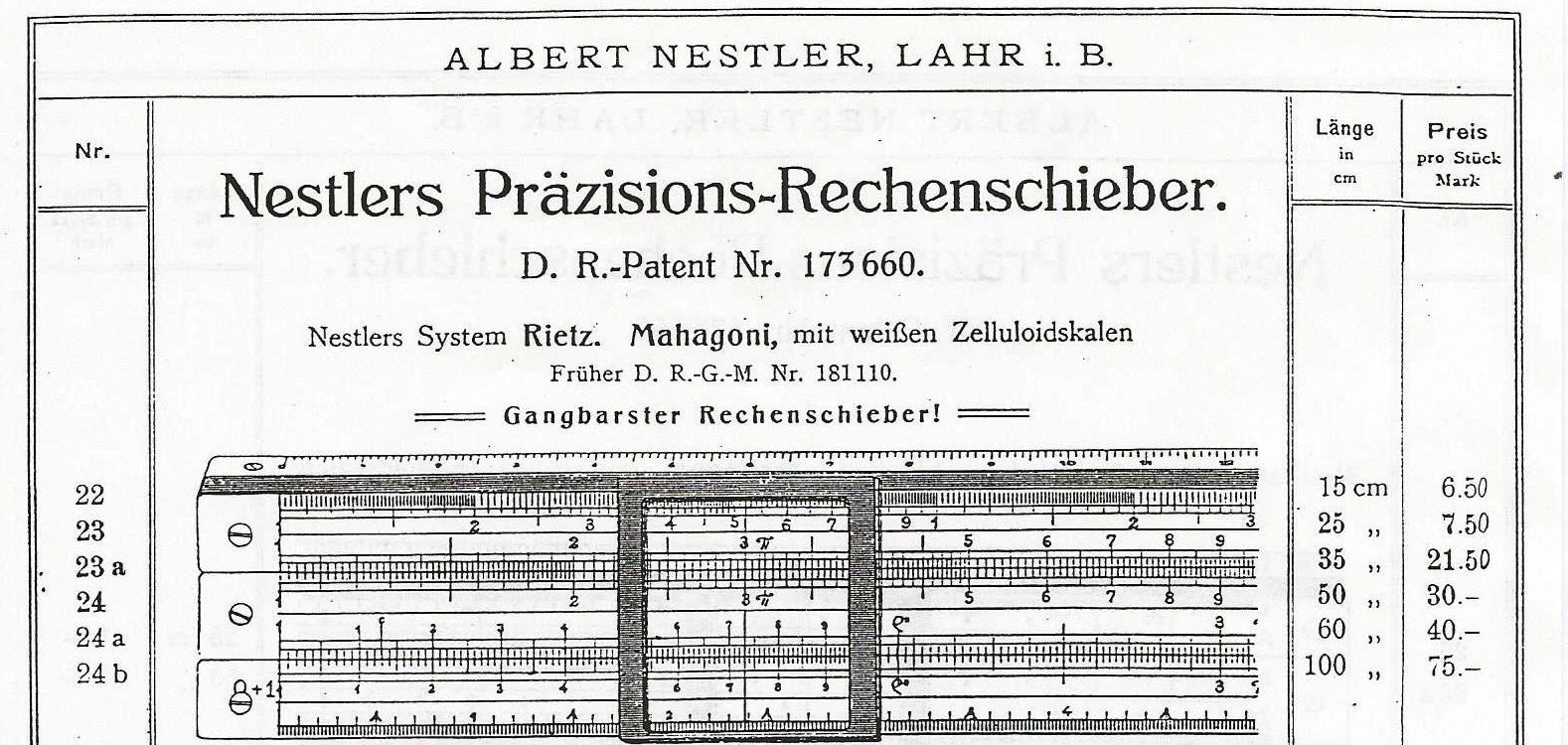
Figure 2 — Nestler’s 1911 catalogue entry for the System Rietz: “D. R.-Patent Nr. 173660. Nestlers System Rietz. Mahagoni, mit weißen Zelluloidskalen. Früher D.R.-G.-M. Nr. 181110. Gangbarster Rechenschieber!” The No. 23 is the 25 cm model, priced at 7.50 marks. Image: Albert Nestler, 1911 catalogue, via the International Slide Rule Museum, https://sliderulemuseum.com/Nestler.shtml.
1.4 What the “R” Means
The No. 23 and the No. 23 R are not the same rule. The plain No. 23 is the original System Rietz: K, A, B, C, D and L, with no reciprocal scale. The 23 R adds a red reciprocal scale, CI, down the middle of the slide, and extends the main scales past their ends. Nestler’s pre-war catalogue says so directly, under the heading “Nestlers Original-Modell ‘Rietz’. Mahagoni, mit weißen Zelluloidskalen — mit Reziprok- und Überteilung” — with reciprocal and extended scales — and explains the point of it: besides all the properties of the original Rietz system, the reciprocal scale allows calculations such as a·b·c or a·b/c to be made “with a single setting of the slide” (Nestler, catalogue c. 1938). Hamann reads the “R” the same way (Hamann, Nestler-Rietz 23R/3).
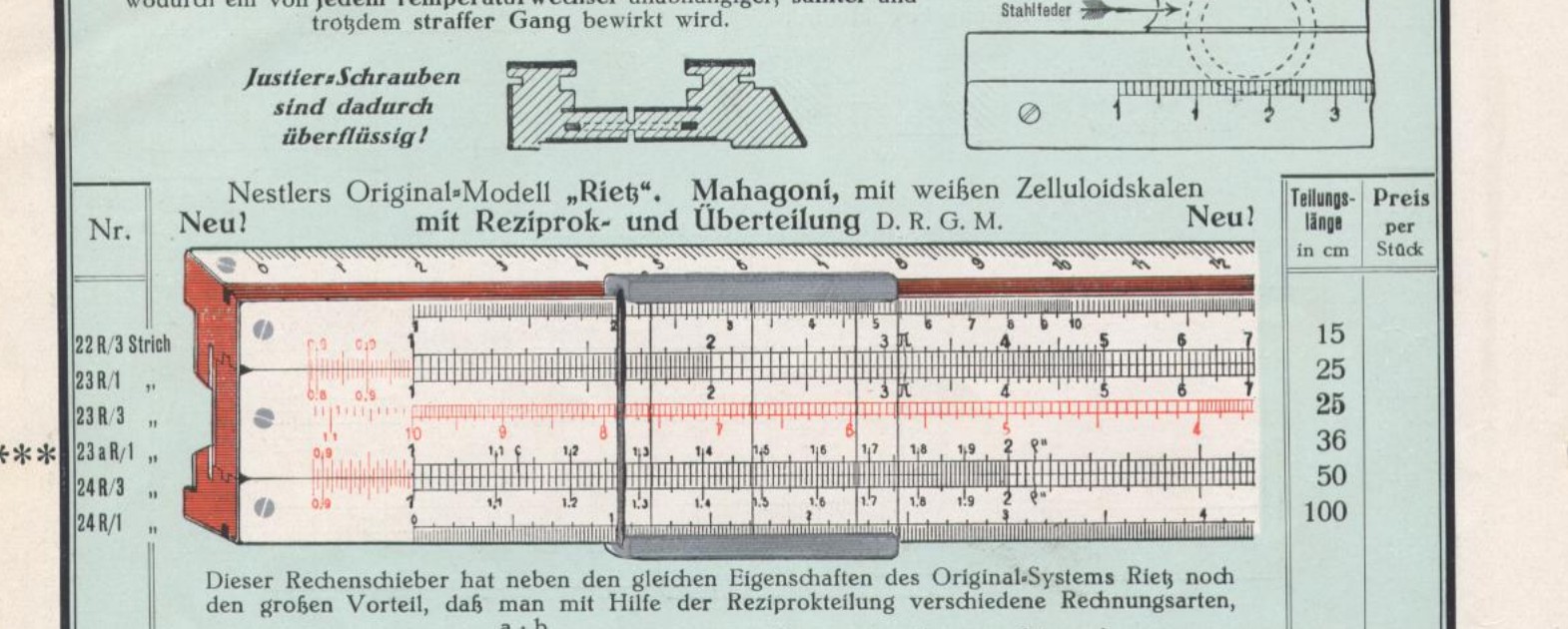
Figure 3 — The R models as Nestler announced them, marked “Neu!”: 22 R/3 (15 cm), 23 R/1 and 23 R/3 (25 cm), 23a R/1 (36 cm), 24 R/3 (50 cm) and 24 R/1 (100 cm). The cross-section above shows the stock’s sprung tongue-and-groove (D.R.P. 410565), and the drawing shows the red CI scale on the slide and the red extended graduations. Image: Albert Nestler A.-G., catalogue c. 1938, scan courtesy of Jürgen Nestler, via the International Slide Rule Museum, https://sliderulemuseum.com/Catalogs/Nestler_1938_Catalogue_CourtesyOfJuergenNestler.pdf.
The suffix after the stroke describes the cursor: /1 for a cursor with one hairline, /3 for one with three (“Läufer mit 1 Strich”, “Läufer mit 3 Strich” in the catalogue). So a 23 R/3 is the 25 cm Rietz with reciprocal scale and a three-line cursor. The same catalogue’s page of plain System Rietz rules lists 23/1 and 23/3 at the same 25 cm length.
1.5 Variants and Dates
The 23 R was made over a long period and changed in detail. What the sources record:
- A catalogue “new” in the 1930s. The catalogue in Figure 3, which the International Slide Rule Museum files as 1938, presents the R models as new. Christian Hamann dates his two 23 R/3 rules to about 1930 and 1940 (Hamann, Nestler-Rietz 23R/3). Some archive listings place 23 R rules much earlier, c. 1906–1913, but those dates rest on the No. 23 lineage and on the patent marks rather than on a dated example, and they are hard to reconcile with a catalogue announcing the R model as new. The safest summary is that the 23 R belongs to the interwar and wartime decades, with production continuing afterwards.
- Version A (Hamann, c. 1930). Mahogany body with the celluloid scale strips glued and secured with small screws; a millimetre scale (30–56 cm) in the groove under the slide; a glass cursor held between two metal profiles, without a side frame; black cardboard case. Hamann notes the same rule was sold by the Berlin dealer Gebr. Wichmann as its model 1418 R III (Hamann, Nestler-Rietz 23R/3, Version A).
- Version B (Hamann, c. 1940). Scales glued only, no inner groove scale, and a framed cursor — the type in Figure 1 (Hamann, Nestler-Rietz 23R/3).
- 23 RF. A variant marked “23 RF” on the case is recorded, with slightly changed extended scales; neither Hamann nor the International Slide Rule Museum explains the “F” with certainty (Hamann; International Slide Rule Museum).
- Wartime service. A 23 R in the Following the Rules collection, dated 1937–1945, has a Kriegsmarine acceptance stamp — eagle in an oak-leaf ring with the letter M — on its case (Following the Rules, data sheet MJS-p-0128).
- Dealers’ names. Retailers sometimes had their names engraved on the rule; one 23 R in the museum’s reference collection carries “Th. Zlocha, Wien” beside the model stamp in the groove (International Slide Rule Museum, S250; Figure 6).
By the early 1960s Nestler had moved to a four-digit numbering system. Its 1967 English catalogue lists the 25 cm engineers’ Rietz as No. 0232 in wood and No. 0238 in Nestler’s plastic, Anagit, with a school Rietz No. 0239 also in Anagit (Nestler, catalogue 1967; an Anagit 0239 with date code 5 62 is recorded by the museum). A rule marked “23 R” therefore predates that renumbering. Later plastic Rietz rules are a different model number, not a late 23 R.
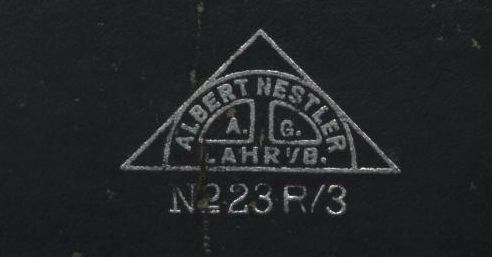
Figure 4 — The triangle trademark and model number blocked on the case of a 23 R/3. Image: International Slide Rule Museum, Nestler gallery, gift of Jürgen Nestler, https://sliderulemuseum.com/Nestler.shtml.
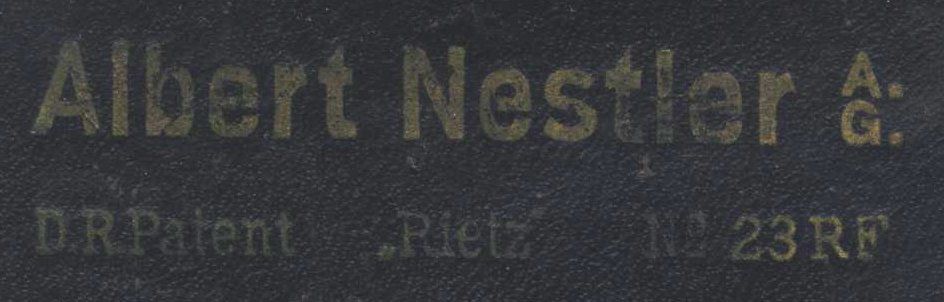
Figure 5 — A different case style, for a 23 RF: “Albert Nestler A.G. — D.R.Patent ‘Rietz’ Nº 23RF”. Image: International Slide Rule Museum, Nestler gallery (S420), https://sliderulemuseum.com/Nestler.shtml.
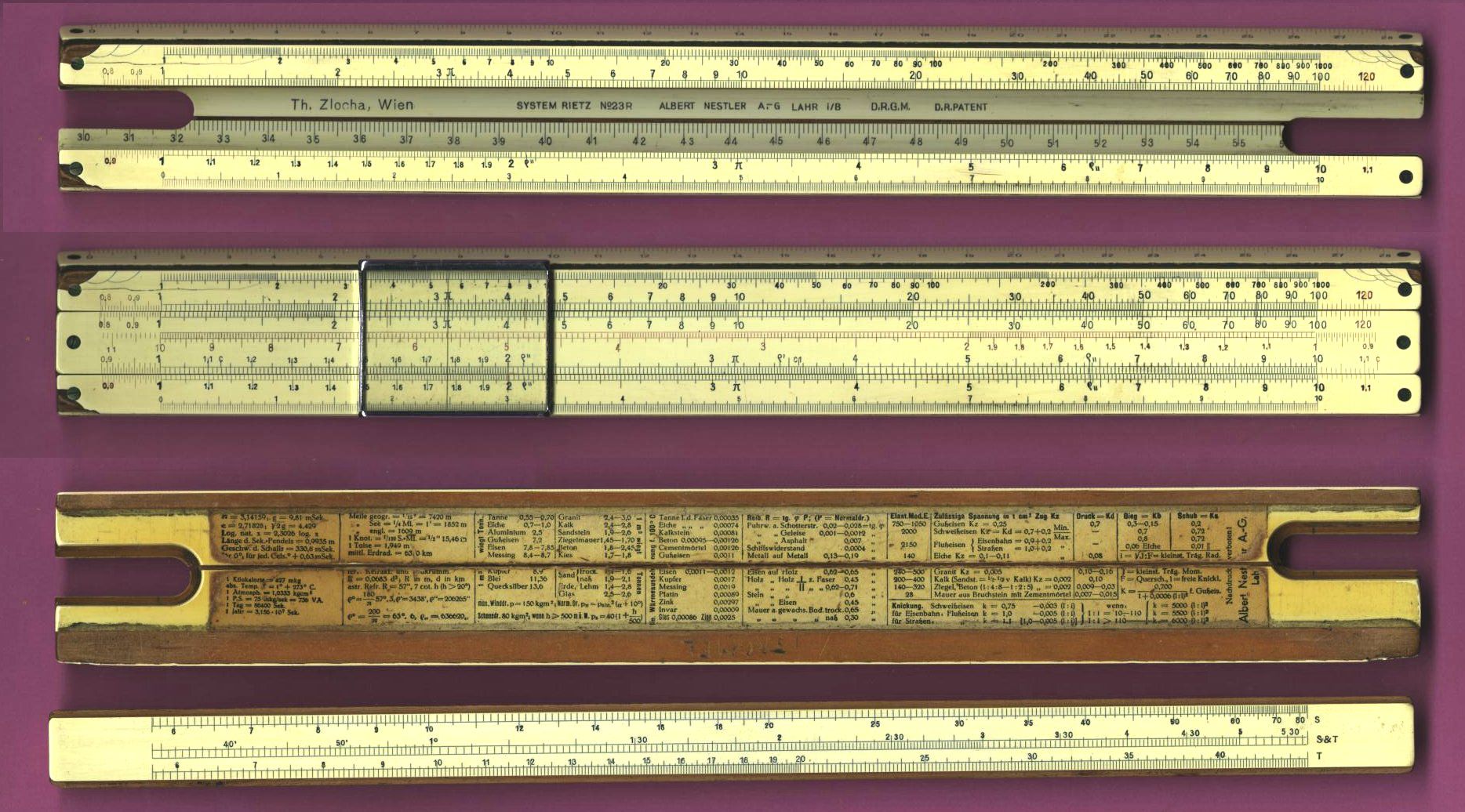
Figure 6 — An early-construction 23 R with the slide out (top) and in place (bottom). The groove carries the model stamp, here with the Vienna dealer’s name “Th. Zlocha, Wien” added, and the inner millimetre scale continuing from 30 cm; small screws hold the ends of the celluloid strips. Fine cracks have opened in the celluloid around the upper-left screw. Image: International Slide Rule Museum, reference collection S250, https://sliderulemuseum.com/Nestler.shtml.
1.6 The Einstein Story
Nestler’s reputation in English-speaking collecting rests partly on a famous name. The Oughtred Society’s introductory publication All About Slide Rules states that Albert Einstein favoured the Nestler in his work, “particularly the No. 23R”, and the same claim is made for Wernher von Braun (Following the Rules, citing the Oughtred Society). Dealers have taken it up enthusiastically, and 23 Rs are routinely listed as “Einstein’s slide rule”.
The claim should be read as reputation, not established fact. In the research for this unit no primary evidence was found — no letter, inventory, photograph of Einstein with the rule, museum object with Einstein provenance, or Nestler advertisement making the claim. The Smithsonian’s own Nestler 23 R, for instance, has a documented history of its own: its donor bought it in a bookshop in Argentina around 1940. A German physicist of Einstein’s generation may well have used a German Rietz rule, and Nestler was one of the leading makers of them; but the specific attachment to “the No. 23R” appears in collector literature without a cited source. The History unit’s mention of Einstein (Vol 3) is to be read in the same light.
1.7 Dating an Example
Unlike Faber-Castell, Nestler did not put date stamps on its 23 R rules; date codes appear only on the later four-digit models (International Slide Rule Museum). A 23 R is dated from its construction and markings:
- The groove stamp. With the slide pulled out, the floor of the groove carries a line such as “SYSTEM RIETZ — No 23R — ALBERT NESTLER A-G LAHR i/B — D.R.PATENT”. The model number and suffix (23 R, 23 RF), and any dealer’s name, are recorded here (Figure 6).
- Scale attachment. Small screws through the celluloid strips into the wood point to Hamann’s earlier version; glued-only strips to the later one.
- The groove scale. A millimetre scale (30–56 cm) alongside the stamp in the groove is an early feature.
- The cursor. A glass held between two metal profiles with no side frame is early; a fully framed glass cursor is later. Count the hairlines — one or three — to confirm the /1 or /3 suffix.
- The back of the stock. The table of physical constants, its language and units, and the presence of the end cut-outs for reading the slide’s reverse scales (Vol 2).
- The extended scales. The ranges of the red extended graduations changed between versions (the museum notes this for the 23 RF).
- The case. Cardboard sleeve or case style, the triangle trademark, the lettering (“D.R.Patent ‘Rietz’”), any military acceptance stamp.
- Patent marks. D.R.P. 173660 and D.R.G.M. 181110 on the rule or case; and on the stock, the sprung construction of D.R.P. 410565, which the pre-war catalogue says made adjusting screws unnecessary.
The date of my 23 R is not yet known.
Sources
- Albert Nestler A.-G. Catalogue (c. 1938; filed as 1938 by the museum), pages on System Rietz 23/1, 23/3 and the “Original-Modell Rietz” 22R–24R with reciprocal and extended scales; D.R.P. 410565 spring construction. Scan courtesy of Jürgen Nestler: https://sliderulemuseum.com/Catalogs/Nestler_1938_Catalogue_CourtesyOfJuergenNestler.pdf
- Albert Nestler A.-G. Nestler Slide Rules, English catalogue (1967): four-digit model numbers, Anagit plastic. https://sliderulemuseum.com/Catalogs/Nestler_1967_Catalog.pdf. In this site’s Reference Library.
- Albert Nestler A.-G. Der logarithmische Rechenschieber und sein Gebrauch, 3rd ed. (1942), §§ 23–25 on System Rietz No. 23. https://rlp.museum-digital.de/data/rlp/resources/documents/202307/12102503974.pdf. In this site’s Reference Library.
- Hammer, Ernst. Der logarithmische Rechenschieber und sein Gebrauch (Stuttgart, 1898), preface. Universitätsbibliothek Paderborn: https://digital.ub.uni-paderborn.de/download/pdf/7348225.pdf. In this site’s Reference Library.
- Hamann, Christian. “Nestler-Rietz 23R/3” (Versions A and B) and “Nestler-Rietz Model 23”, Berliner Hochschule für Technik: https://public.bht-berlin.de/hamann/sliderules/nestri.html ; https://public.bht-berlin.de/hamann/sliderules/nestri1.html ; https://public.bht-berlin.de/hamann/sliderules/nest23.html
- International Slide Rule Museum, Nestler gallery (1911 catalogue page; 23 R, 23 RF and 23 R/3 entries; patent dates; four-digit models with date codes): https://sliderulemuseum.com/Nestler.shtml
- Following the Rules (collection catalogue), “Nestler, Germany” (founding 1878, end of production 1978, the Oughtred Society’s Einstein and von Braun statements) and data sheet MJS-p-0128 (Kriegsmarine-stamped 23 R): https://followingtherules.info/nestler-germany.html ; https://followingtherules.info/data-sheet-mjs-p-0128.html
- Smithsonian Institution, National Museum of American History, “Nestler 23R Simplex Slide Rule”, object 1991.0445.01 (provenance as given in the museum’s online record: bought in Argentina c. 1940, gift of Richard R. Lombardi): https://americanhistory.si.edu/collections/object/nmah_1215060
- The Einstein attribution is reported here as stated in collector literature; no primary source for it was located.
Comments (0)