Nestler 23 R · Volume 3
Nestler 23 R — Volume 3 — Using It, and Caring for It
Rietz methods worked on the 23 R, and how to keep celluloid on mahogany from shrinking, cracking and losing its engraving
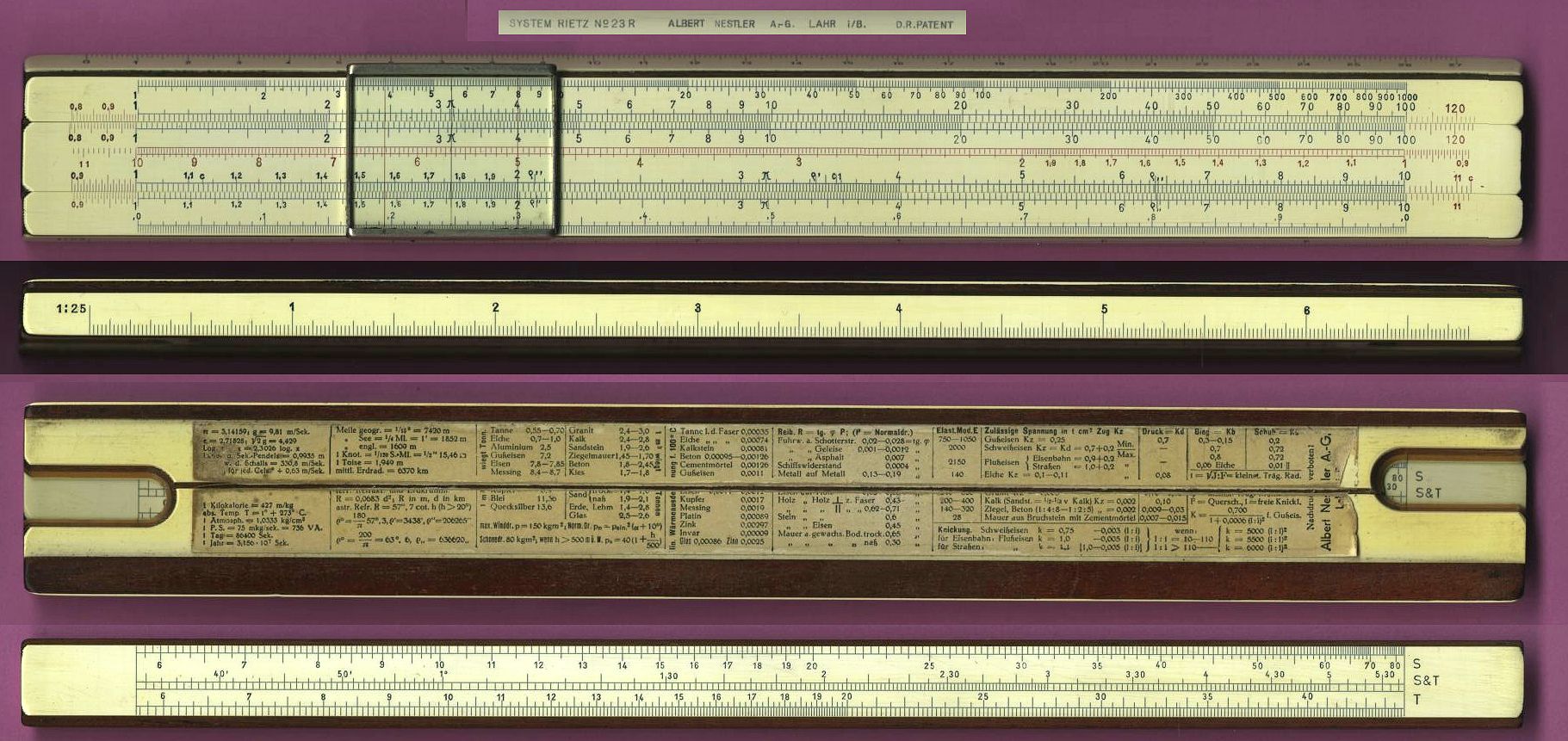
Figure 1 — A 23 R donated to the museum by Jürgen Nestler, every face shown. The celluloid has aged to ivory-yellow and the mahogany has darkened — the normal appearance of an old celluloid-on-wood rule. Image: International Slide Rule Museum, Nestler gallery, donated by Jürgen Nestler, https://sliderulemuseum.com/Nestler.shtml.
3.1 About This Volume
The first part of this volume works through calculations that use the 23 R’s own scales — the reciprocal CI, the cube scale K, L, and the trigonometric scales on the back of the slide in degrees and minutes — following the methods in Nestler’s 1942 instruction book. Every number has been checked by calculation; the rule’s reading and the exact value are both given. The second part covers care: the 23 R is celluloid on mahogany, two materials that age in different ways, and most of the damage seen on old Rietz rules was done by cleaning them with the wrong thing.
3.2 Multiplication, Division and the CI Scale
2.4 × 3.15 = 7.56. Set the left index of C over 2.4 on D, move the hairline to 3.15 on C, and read 7.56 on D. Exact: 7.56. The digit count follows the manual’s P − 1 rule (Vol 2): one-digit times one-digit, read to the right of the slide index, gives 1 + 1 − 1 = one digit before the point.
Three factors in one slide setting: 2.5 × 3.2 × 1.15 = 9.2. This is the calculation the R model was introduced for (Vol 1). Put the hairline on 2.5 on D and bring 3.2 on CI under it. The left index of C now stands over 8.0 on D — dividing by the reciprocal of 3.2 is multiplying by 3.2 — so move the hairline straight to 1.15 on C and read 9.20 on D. Exact: 9.2. Without CI the same calculation needs two slide settings.
Reciprocals. With the slide at zero, CI over C is a table of reciprocals: 3.2 on C has 0.3125 over it on CI (exact 0.3125).
3.3 Squares, Cubes and Logarithms
3.7² = 13.7. Hairline on 3.7 on D; read 13.7 on A. Exact: 13.69.
2.3³ = 12.2. Hairline on 2.3 on D; read 12.17 on K. Exact: 12.167.
∛50 = 3.68. Hairline on 50 on K (the middle decade, 10–100); read 3.684 on D. Exact: 3.6840. For cube roots the number is split into groups of three digits from the decimal point, and the leading group chooses the decade of K: 50 has one group of two digits, so the middle decade.
7.5^(3/2) = 20.5. Hairline on 7.5 on A; read 20.5 on K. Exact: 20.540. Combining A and K this way gives the powers 3/2 and 2/3 with one setting.
lg 3.7 = 0.568. Hairline on 3.7 on D; read 0.568 on L. Exact: 0.5682.
3.4 Gauge Marks
Area of a circle. Diameter 4.8 cm. Set the c mark on C over 4.8 on D; over the index of B, A reads 18.1 cm². Exact: π × 4.8²/4 = 18.096.
Minutes to radians. An angle of 2° 30′ is 150′. Set the ρ′ mark on C (3438) over 1.5 on D; under the index of C, D reads 0.0436. Exact: 150/3437.7 = 0.04363 rad. The ρ″ mark does the same for seconds.
3.5 Trigonometry: Two Ways to Use the Back of the Slide
The trigonometric scales are on the reverse of the slide, in degrees and minutes. Nestler’s manual gives two ways to use them (Nestler, 1942, § 92).
3.5.1 Slide reversed
Draw the slide right out, turn it over so that its S, S&T and T scales face up and read left to right, and push it back in with its ends flush with the stock. The scales now act as tables read with the cursor against D:
Table 1 — Draw the slide right out, turn it over so that its S, S&T and T scales face up and read left to right, and push it back in with its ends flush with the stock. The scales now act as tables read with the cursor against D
| Wanted | Hairline on | Read on D | Rule | Exact |
|---|---|---|---|---|
| sin 40° | S 40° | 0.643 | 0.643 | 0.64279 |
| sin 30° | S 30° | 0.500 | 0.500 | 0.50000 |
| cos 50° = sin 40° | S 40° | 0.643 | 0.643 | 0.64279 |
| tan 25° | T 25° | 0.466 | 0.466 | 0.46631 |
| sin 2° 30′ ≈ tan 2° 30′ | S&T 2° 30′ | 0.0436 | 0.0436 | 0.043619 / 0.043661 |
Sines read on S begin “0.” and small-angle values on S&T begin “0.0” (Vol 2). A cosine is the sine of the complement; a cotangent is the reciprocal of a tangent, read on CI if the slide is in its normal position or by division.
The reversed slide also multiplies by a sine directly. Nestler’s example: the area of a triangle with sides 6 m and 8.5 m enclosing an angle of 52° is ½ × 6 × 8.5 × sin 52° = 25.5 × sin 52°. With the slide reversed, set the right-hand end of S (90°) over 25.5 on D, then move the hairline to 52° on S and read 20.1 m² on D. Exact: 25.5 × 0.78801 = 20.09 (Nestler, 1942, § 94, Example 197).
The same method gives the forces on a 130 kg barrel rolled up a board inclined at 25°: set S 90° over 1.3 on D; under S 25° read 54.9 kg along the slope, and under S 65° (the complement, since cos 25° = sin 65°) read 118 kg pressing on the board. Exact: 130 × sin 25° = 54.94; 130 × cos 25° = 117.82 (Nestler, 1942, Example 198).
3.5.2 Slide face up, read through the cut-out
The 23 R’s stock has a cut-out at each end of its back, with an index line, so that a sine can be found without removing the slide. With the slide in its normal position, find the angle on S through the cut-out at the right-hand end (as the rule is seen from the front), and move the slide to the right until the angle sits under the index line. Turn the rule face up: the sine is on C under the right-hand end mark of the stock scales, and the cosecant is on D under the left index of C (Nestler, 1942, § 92).
sin 30° by the cut-out. Set 30° on S under the index line. On the front, C reads 0.500 at the right-hand end, and D reads 2.00 under C’s left index — cosec 30°. Exact: 0.5 and 2.
The cut-out method leaves the slide displaced by exactly log sin α, which is why the sine appears at the end of the rule. It is quicker for a single value; the reversed-slide method is better for a series.
3.6 Caring for Celluloid on Mahogany
The 23 R combines two materials that fail in different ways, glued together, with steel parts in the groove and cursor. Understanding each is the key to looking after the rule.
Celluloid is cellulose nitrate plasticised with camphor — “the first thermoplastic”, as Holland’s Faber-Castell catalogue calls it — and it is chemically unstable. Over decades the camphor slowly evaporates and the nitrate breaks down. The visible results on old slide rules are:
- Yellowing. White celluloid ages to cream and then ivory-yellow (Figure 1). This is a change in the material itself, not dirt on the surface, and it cannot be cleaned off.
- Shrinkage. As camphor is lost, the celluloid shrinks — slightly, but against a wooden core that does not. The strips can pull away from their ends, scales can creep out of alignment with each other, and on old rules the celluloid sometimes stands proud of the wood or the ends of the slide and stock no longer match. The screws that Nestler put through the ends of the strips on early 23 Rs were there to resist this (Vol 2).
- Cracking. Shrinkage concentrated at a fixed point opens fine cracks, often around screws or at the ends of the strips (Vol 1, Figure 6).
- Off-gassing. Decomposing cellulose nitrate gives off acidic nitrogen oxides. In a closed space these attack nearby metal — the steel springs, the cursor fittings — and accelerate the decay of other celluloid.
Mahogany is a stable wood, but it still takes up and gives off moisture. Damp swells it, so the slide binds; dry heat shrinks it, so the slide goes loose; uneven changes can warp the stock or the slide. Water also weakens the glue line between wood and celluloid.
Steel — the springs in the groove (Nestler’s D.R.P. 410565) and the cursor’s springs and screws — rusts in damp and in the acid vapour from aged celluloid.
The engraving — black and red pigment filling cuts in the celluloid — is the most easily lost part. It is removed by solvents and worn out by abrasives.
3.6.1 Cleaning
- Dry first. Pull out the slide and brush the scales, the groove and the cut-outs with a soft brush. Remove loose grit before anything damp touches the rule.
- Barely damp, then dry. Wipe the celluloid with a soft cloth or cotton bud just damp with water and a trace of mild soap, working along the scales. Wipe again with a cloth just damp with clean water and dry at once. Do not let water stand on the rule, run into the groove, or reach the bare wood at the ends and back. Never immerse it.
- Pencil and grime usually lift with patience and the same barely-damp cloth. A soft white vinyl eraser, used gently, takes pencil off celluloid; test it first at an end, away from the figures, because it can dull the surface.
- The wood. Exposed mahogany at the ends and edges needs only dusting; if it is dry and pale, a very small amount of a clear paste wax or furniture wax, kept well away from the celluloid and engraving, can be rubbed in and buffed. Never use oil on the wood — it migrates under the celluloid and attacks the glue.
- The back table. The printed constants on the back are as vulnerable as the scales; treat them the same way.
Never use on a celluloid rule:
- Acetone, nail-polish remover, MEK, ethyl or butyl acetate, lacquer thinner, cellulose thinners. These dissolve celluloid outright; a single wipe leaves a softened, smeared surface and takes the engraving with it.
- Alcohol of any kind — methylated spirit, isopropanol, surgical spirit, alcohol wipes, alcohol-based glass or lens cleaners, hand sanitiser. Alcohols soften and craze cellulose nitrate and lift the pigment from the graduations.
- Abrasives — scouring powders and creams, toothpaste, metal polish, “magic eraser” melamine sponges, cutting car polish, fine abrasive paper. They remove the engraving fill, flatten the surface and, on a rule whose celluloid is already thin, can cut through it.
- Bleach, hydrogen peroxide or “whitening” treatments to reverse yellowing. They do not restore the original white and they further degrade the nitrate.
- Penetrating oils, WD-40, silicone sprays, ammonia or household spray cleaners. Their carriers attack celluloid and their residues soak into the wood.
- Heat. Celluloid softens at modest temperatures and is highly flammable. Keep the rule away from radiators, hot lamps, sunny windowsills and open flame, and never try to flatten a warped slide by heat.
3.6.2 The slide and its fit
A 23 R’s slide is meant to move smoothly against the light pressure of the springs. If it is stiff, the cause is usually dirt in the groove or swelling of the wood, not lack of lubricant. Clean the groove and the edges of the slide dry, and let the rule stand for a day or two at normal room humidity. If it is still stiff, rub the tongue edges of the slide — not the faces — with a little hard wax, such as a plain paraffin candle or a beeswax block, and polish off the excess. Avoid oils and greases: they soak into the mahogany, gather grit and can creep under the celluloid. The springs in the groove need no lubrication; if they show rust, it can be lifted with a dry stiff brush, taking care not to bend them.
A slide that is now loose because the celluloid has shrunk or the wood dried out cannot be corrected by any adjustment on this model — Nestler’s sprung groove was designed precisely so that there are no adjusting screws (Vol 2).
3.6.3 The cursor
The cursor glass can be cleaned with water and a soft cloth, but take it off the rule first if it will come off easily, so that no liquid runs onto the celluloid; never spray a glass cleaner near the rule. Wipe the metal frame and rails dry. The hairline is engraved in the glass and is not easily harmed, but the pigment in it can be washed out by alcohol. If the cursor is stiff, do not bend its springs; clean the edges of the stock where it runs instead.
3.6.4 Storage
- Keep the rule at an even room temperature and moderate humidity, out of direct sun.
- Store it in its cardboard case or wrapped loosely in acid-free tissue in a drawer — not sealed in a plastic bag or airtight box, where the vapours from the celluloid concentrate and accelerate its decay and the corrosion of the steel.
- Keep it away from other celluloid objects that are visibly decomposing (crazed, sticky, smelling sharply acidic), and away from rubber bands, which stain celluloid.
- Store it flat, with the slide in place, so that the wood is held straight.
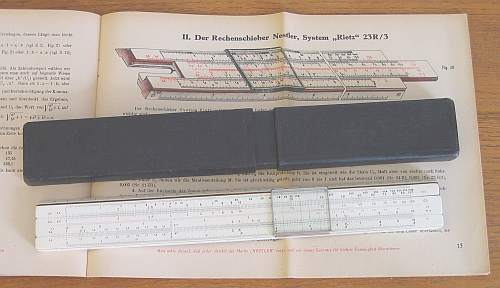
Figure 2 — A later 23 R/3 with its cardboard case, on the page of Nestler’s 40-page introductory booklet for its Rietz and Darmstadt rules that describes “Der Rechenschieber Nestler, System ‘Rietz’ 23R/3”. Image: Christian Hamann, slide-rule collection, Berliner Hochschule für Technik, https://public.bht-berlin.de/hamann/sliderules/nestri.html.
Sources
- Albert Nestler A.-G. Der logarithmische Rechenschieber und sein Gebrauch, 3rd ed. (1942): digit-count rules (§§ 37, 48), the Rietz sine methods by reversed slide and by cut-out (§ 92), small angles (§ 93), Examples 197–198 (§ 94). https://rlp.museum-digital.de/data/rlp/resources/documents/202307/12102503974.pdf. In this site’s Reference Library.
- Albert Nestler A.-G. Catalogue (c. 1938): the reciprocal scale’s purpose; the sprung, screwless groove. https://sliderulemuseum.com/Catalogs/Nestler_1938_Catalogue_CourtesyOfJuergenNestler.pdf. In this site’s Reference Library.
- Holland, Peter. Rechenschieber von Faber-Castell, 8th ed. (2020), chapter on materials (celluloid as cellulose nitrate and camphor). https://sliderulemuseum.com/Catalogs/Rechenschieber_AWFaberCastell_SlideRules_byPeterHolland_ed8.pdf
- International Slide Rule Museum, Nestler gallery (screws on 23 R/3 scales “used to prevent shrinkage”). https://sliderulemuseum.com/Nestler.shtml
- Hamann, Christian. “Nestler-Rietz 23R/3” (booklet “Einführung in die Anwendung der NESTLER Rechenschieber RIETZ und DARMSTADT”, 40 pages, 106 exercises). https://public.bht-berlin.de/hamann/sliderules/nestri.html
- The behaviour of cellulose nitrate (camphor loss, shrinkage, yellowing, acidic off-gassing, solubility in ketones, esters and alcohols) is standard conservation knowledge for early plastics; the care advice above applies it to a celluloid-faced wooden rule.
- Every numerical example was recomputed: 2.4 × 3.15 = 7.56; 2.5 × 3.2 = 8.0, × 1.15 = 9.2; 1/3.2 = 0.3125; 3.7² = 13.69; 2.3³ = 12.167; ∛50 = 3.6840; 7.5^1.5 = 20.540; lg 3.7 = 0.56820; π × 4.8²/4 = 18.096 (4.8/1.1284 = 4.2539, squared 18.096); 150/3437.75 = 0.043633; sin 40° = 0.64279; tan 25° = 0.46631; sin 2.5° = 0.043619, tan 2.5° = 0.043661; 25.5 × sin 52° = 20.094; 130 × sin 25° = 54.940, 130 × cos 25° = 117.82; sin 30° = 0.5, cosec 30° = 2.
Comments (0)