Nestler 23 R · Volume 2
Nestler 23 R — Volume 2 — Anatomy and the Full Scale Set
Seven scales on the face, three on the back of the slide, rulers on the edges, and a mahogany stock with steel springs
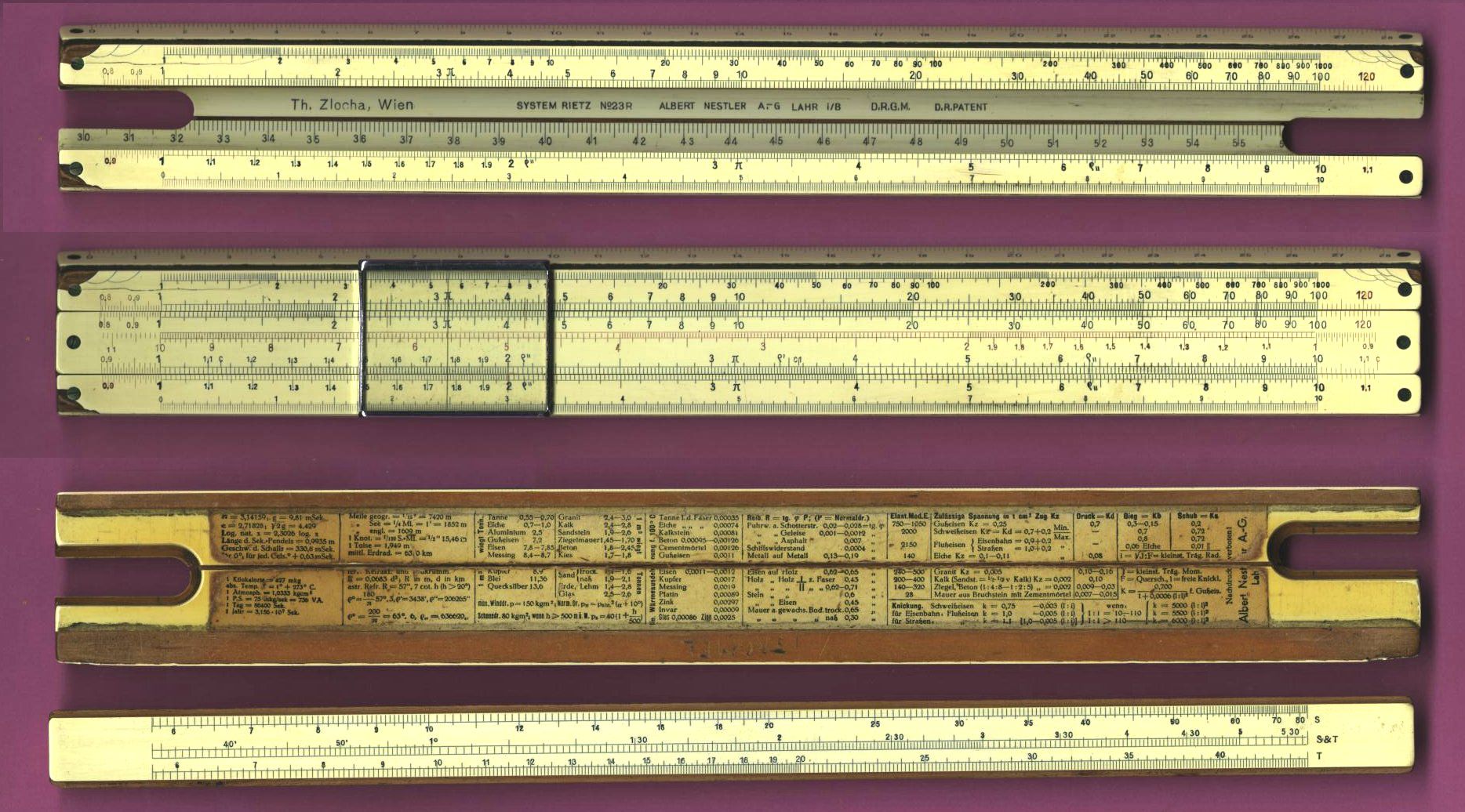
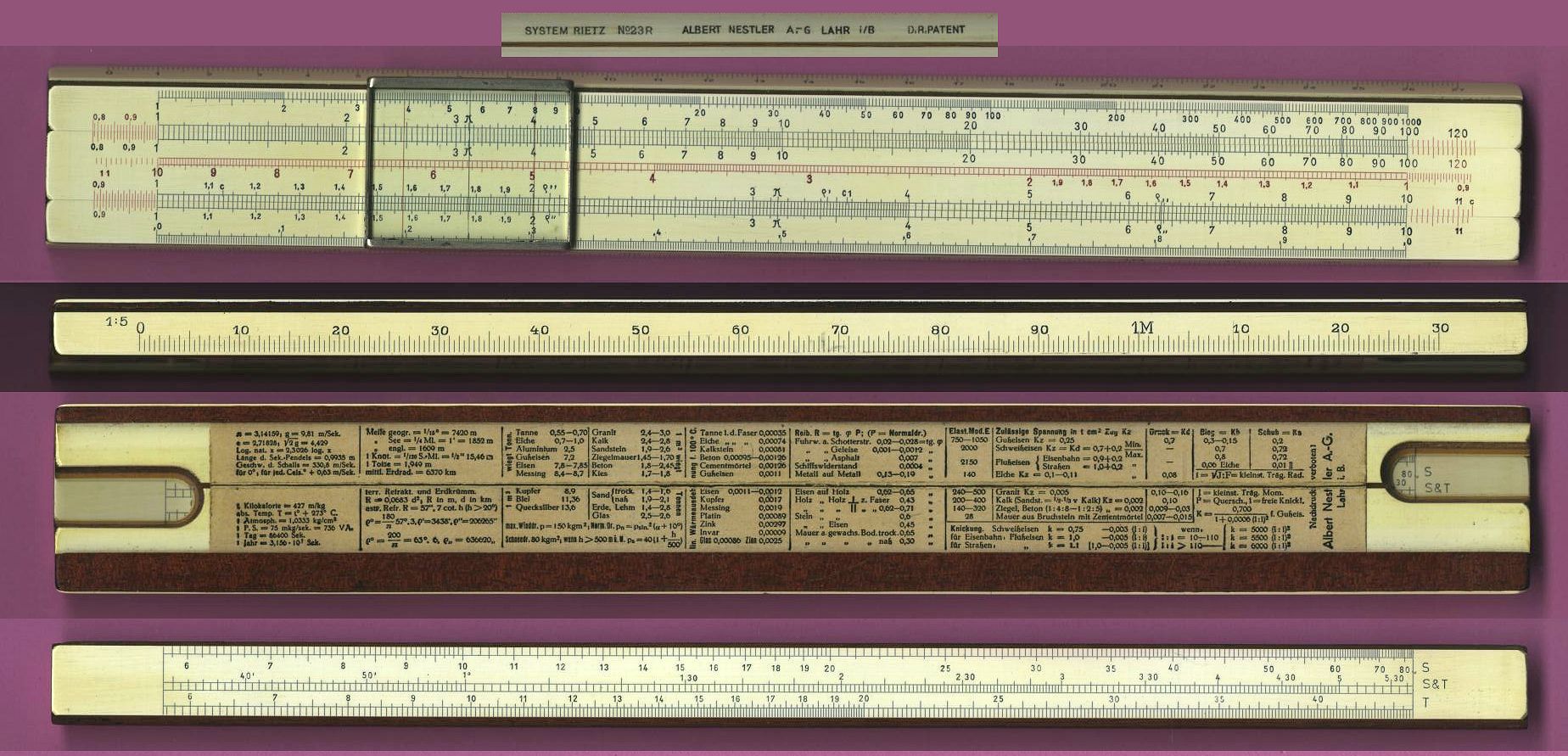
Figure 1 — A 23 R from every side, top to bottom: the stamp from the groove (“System Rietz No 23R — Albert Nestler A-G Lahr i/B — D.R.Patent”); the front; the edge with its 1:25 map scale; the back of the stock with the table of constants and a cut-out at each end; and the reverse of the slide, with the S, S&T and T scales. Image: International Slide Rule Museum, Nestler gallery, donated by Jürgen Nestler, https://sliderulemuseum.com/Nestler.shtml.
2.1 About This Volume
The 23 R is a simplex rule — scales on one face only — and its whole scale set can be listed in a line: K, A, [B, CI, C], D, L on the front, and [S, S&T, T] on the back of the slide. What makes it interesting is how much the Rietz arrangement gets out of those ten scales, and how the rule is built: a mahogany stock faced with celluloid, a sprung groove, rulers on the edges, and windows in the back for reading the slide’s reverse. This volume describes each part. The general theory of the scales is in the Using Slide Rules unit, Vols 2–4; operating examples specific to this rule are in Vol 3.
2.2 Construction
2.2.1 Stock and slide
The body is mahogany with strips of white celluloid glued to the working faces — Nestler’s catalogues describe every Rietz model the same way, “Mahagoni, mit weißen Zelluloidskalen” (Nestler, catalogues 1911 and c. 1938). The scales were engraved into the celluloid and filled with black or red pigment. Mahogany was chosen for stability; celluloid gave a bright, smooth, easily engraved surface; and the combination dominated premium rule-making for half a century (History unit, Vol 3).
On the earlier version, small screws at the ends of the celluloid strips back up the glue (Vol 1, Figure 6). Hamann’s later example has glued strips only (Hamann, Nestler-Rietz 23R/3). The museum’s notes on one 23 R/3 say the screws were “used to prevent shrinkage” — that is, to stop the celluloid creeping as it aged (International Slide Rule Museum). Vol 3 explains why that was necessary.
The stock is a single piece of wood, not two rails, with a dovetailed groove for the slide. Nestler’s pre-war catalogue explains its patented feature: every rule of the period was made “with our new gluing, D.R.P. 410565”, fitted with round, recessed, elastic steel springs that kept the slide’s motion smooth and firm regardless of temperature changes — so that “adjusting screws are thereby unnecessary” (Nestler, catalogue c. 1938; cross-section in Vol 1, Figure 3). The springs sit in the groove; they matter for care, because they are steel and can rust.
2.2.2 The edges and the groove
The 23 R is also a ruler (Nestler, 1942, § 25):
- the bevelled top edge carries a plain millimetre scale, 0–27 cm;
- the straight edge carries a scale marked 1 : 25, in which 4 cm is the unit — at a map scale of 1:25,000, one kilometre is 4 cm, so the rule reads map distances directly in kilometres (divide by 10 for 1:2,500, multiply by 10 for 1:250,000);
- on early examples, the floor of the groove carries a further millimetre scale from 30 to about 56 cm, so that a line longer than the rule can be measured by drawing the slide out (Hamann, Version A);
- also in the groove, visible only with the slide removed, is the model stamp: “SYSTEM RIETZ — No 23R — ALBERT NESTLER A-G LAHR i/B — D.R.PATENT”, sometimes with a dealer’s name.
2.2.3 The back of the stock
The back is a table of physical constants and engineering data — π and its multiples, gravitational acceleration, the mechanical equivalent of heat, specific gravities, unit conversions, strength-of-materials formulae — of the kind Nestler’s manual describes for its rules generally (Nestler, 1942, § 24). At each end of the back is a cut-out exposing the reverse of the slide, with an index line beside it; Vol 3 shows how it is used to read sines and tangents without turning the slide over.
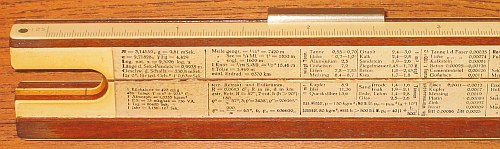
Figure 2 — The back of an early 23 R/3: the constants table, the mahogany of the stock showing at the edges, and the cut-out at the left end through which the slide’s reverse scales are read against an index line. Image: Christian Hamann, slide-rule collection, Berliner Hochschule für Technik, https://public.bht-berlin.de/hamann/sliderules/nestri1.html.
2.3 The Front: Seven Scales
Nestler’s own manual names the scales differently from the modern convention: O1 and O2 for the upper body and slide scales (A and B), U1 and U2 for the lower (D and C), “C” for the cube scale and “R” for the reciprocal (Nestler, 1942, §§ 24–25). The rule itself is labelled with figures, not letters. The modern names are used here.
Table 1 — The Front: Seven Scales
| Scale | Where | Function | Range |
|---|---|---|---|
| K | upper edge of stock | x³ (cubes) | 1–1000, three decades |
| A | upper stock | x² (squares) | 1–100, two decades; red extensions 0.8–0.9 and 100–120 |
| B | slide, upper | x² | as A |
| CI | slide, centre (red) | 1/x | 10 to 1, right to left, with red extensions |
| C | slide, lower | x | 1–10; red extensions 0.9 and 10–11 |
| D | lower stock | x | 1–10; red extensions as C |
| L | lower edge of stock | lg x (mantissa) | 0 to 1, uniform |
K sits at the very top, its three decades each a third of the length of D, so a number set on D with the cursor has its cube above it on K, and a number on K its cube root below it on D. K was Rietz’s main addition; the manual says it lets cubes and cube roots be found “faster than with No. 14”, Nestler’s plain Mannheim rule (Nestler, 1942, § 23).
CI is the “R” of the model number (Vol 1). Running right to left in red, it gives reciprocals against C and, more usefully, lets a product of three factors be found with a single setting of the slide.
The extended scales — the red graduations that continue A and B a little below 1 and above 100, and C, D and CI past their ends — let a calculation that lands just past an index be read without resetting the slide. They were advertised as the other half of the R model’s novelty: “mit Reziprok- und Überteilung” (Nestler, catalogue c. 1938).
L runs along the bottom of the stock, uniformly divided from 0 to 1, giving the mantissa of the common logarithm of any number set on D.
Figure 3 — The left half of the face of an early 23 R. Visible are the red extended graduations at the left of A, B and C/D, the red CI scale reading 10, 9, 8 … from the left, the “c” mark just past 1.1 on C, and the “ρ″” mark just past 2 on C and D. Image: International Slide Rule Museum, reference collection S250, https://sliderulemuseum.com/Nestler.shtml.
2.3.1 Gauge marks
Several constants are marked on the scales (visible in Vol 1, Figure 1, and Figure 3 above):
- π on A, B, C and D.
- c = √(4/π) = 1.128 on C, and c1 = √(40/π) = 3.568, for circle areas: with the c mark set to a diameter on D, the area appears on A over the index of B.
- ρ′ = 3438 (minutes in a radian, at 3.438 on C and D) and ρ″ = 206 265 (seconds in a radian, at 2.063), for converting small angles in minutes or seconds to radians — the natural companion to a rule whose trigonometric scales are in degrees and minutes.
- Q + 1 and P − 1. Some 23 Rs carry these marks near the left end of the lower scales. They are reminders of a digit-counting rule given in the manual: the product of a number with m digits and one with n digits has m + n digits, or m + n − 1 when the result is read to the right of the slide’s index (P − 1); a quotient has m − n digits when read at the right-hand index of the slide and m − n + 1 at the left-hand one (Q + 1). The manual adds that a practised calculator finds the decimal point by estimation anyway (Nestler, 1942, §§ 37, 48).
2.4 The Back of the Slide: S, S&T, T
Turned over, the slide carries three trigonometric scales, all divided in degrees and minutes (sexagesimal), unlike the decimal degrees of later rules:
Table 2 — Turned over, the slide carries three trigonometric scales, all divided in degrees and minutes (sexagesimal), unlike the decimal degrees of later rules
| Scale | Function | Range | Graduation |
|---|---|---|---|
| S | sine | 5° 44′ to 90° | 5′ steps to 10°, then 10′ to 20°, coarser above |
| S&T | sine and tangent of small angles | 0° 34′ to 5° 44′ | marked 40′, 50′, 1°, 1°30′ … 5°30′ |
| T | tangent | 5° 43′ to 45° |
All three are keyed to the C/D decade: S is graduated as 25 · (lg sin α + 1) cm, so a sine read from it begins “0.” (between 0.1 and 1), while S&T values begin “0.0” (Nestler, 1942, §§ 92–93). The manual is specific about this, because on Nestler’s older Mannheim rule the sine scale is keyed to the two-decade A scale and runs from 0° 34′ — Rietz moved the small angles onto their own scale and gained a decade of precision. For small angles sin α and tan α agree closely enough to share S&T; for angles near 90°, the cosine or cotangent is found from the complement.
There are two ways to use these scales (Vol 3): pull the slide out, turn it over and reinsert it, so that S, S&T and T lie against the body scales; or leave the slide face-up and set the angle against the index line in the end cut-out, reading the result on the front.
2.5 The Cursor
The cursor is glass, with a hairline engraved on its underside, carried in metal. Two forms are recorded on 23 Rs: on early examples the glass is held between two metal profiles at top and bottom without a side frame; on later ones it sits in a complete metal frame (Figure 1; Hamann, Nestler-Rietz 23R/3). The metal rails at top and bottom grip the edges of the stock; any springs in them are steel, and like the springs in the groove can rust.
The model-number suffix gives the number of hairlines: /1 has a single central line, /3 has three (Vol 1). On three-line cursors of this period the two outer lines are usually set for circle areas — with the centre line on a diameter on D, an outer line marks the area on A — but the specific use on a given cursor should be checked against its own spacing.
Sources
- Albert Nestler A.-G. Der logarithmische Rechenschieber und sein Gebrauch, 3rd ed. (1942): §§ 23–25 (Rietz scales, edge rulers, 1:25 scale), §§ 37 and 48 (P − 1 and Q + 1), §§ 92–93 (S and S&T ranges and keying). https://rlp.museum-digital.de/data/rlp/resources/documents/202307/12102503974.pdf. In this site’s Reference Library.
- Albert Nestler A.-G. Catalogues of 1911 (via the International Slide Rule Museum) and c. 1938 (mahogany with white celluloid; reciprocal and extended scales; D.R.P. 410565 spring construction). https://sliderulemuseum.com/Catalogs/Nestler_1938_Catalogue_CourtesyOfJuergenNestler.pdf
- Hamann, Christian. “Nestler-Rietz 23R/3”, Versions A and B (scales, rulers, inner groove scale, cursor types, screws, cardboard case). https://public.bht-berlin.de/hamann/sliderules/nestri.html ; https://public.bht-berlin.de/hamann/sliderules/nestri1.html
- International Slide Rule Museum, Nestler gallery (23 R, 23 R/3, 23 RF entries; groove stamps; screws against shrinkage). https://sliderulemuseum.com/Nestler.shtml
- Gauge values checked by calculation: √(4/π) = 1.1284, √(40/π) = 3.5682, 180 × 60/π = 3437.7, 180 × 3600/π = 206 264.8; sin⁻¹ 0.1 = 5.7392° = 5° 44′ 21″; sin⁻¹ 0.01 = 0.5730° = 0° 34′ 23″; tan⁻¹ 0.1 = 5.7106° = 5° 42′ 38″; 25 · (lg sin 40° + 1) = 20.20 cm, matching the manual’s figure.
Comments (0)