Faber-Castell 2/83N · Volume 1
Faber-Castell 2/83N Novo-Duplex — Volume 1 — The Model
Faber-Castell's last and most elaborate engineering rule: where it came from, how it changed, and how to date an example
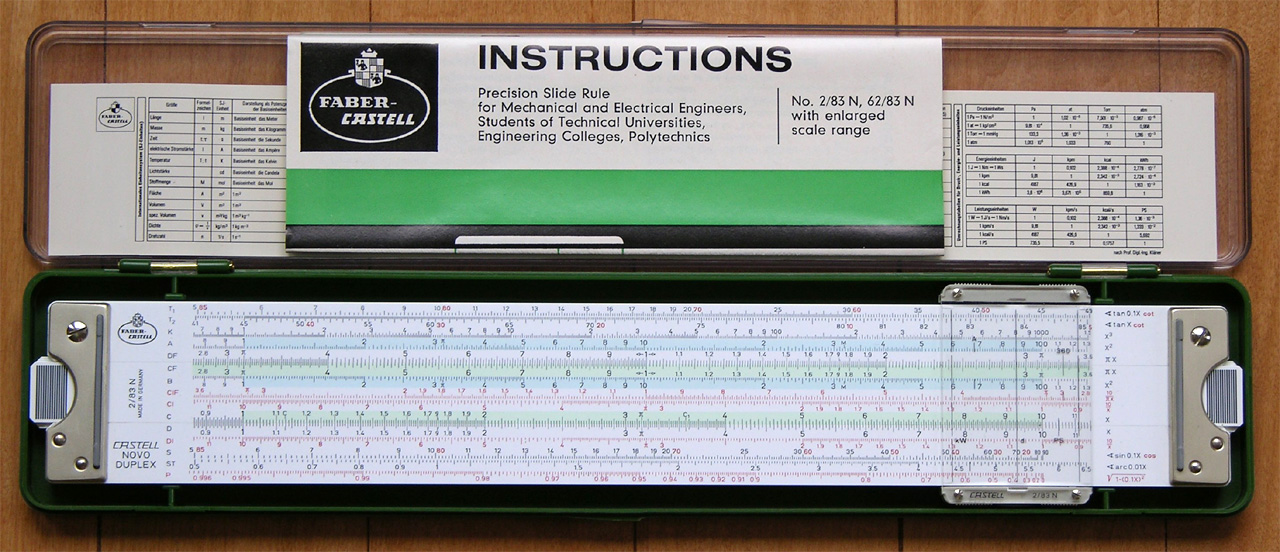
Figure 1 — A complete 2/83N set as it left the shop: the rule in its clear hinged plastic case, the English “Instructions — Precision Slide Rule for Mechanical and Electrical Engineers” booklet, and the plastic reference card. Image: Stefan Vorkoetter, “Faber-Castell 2/83N Novo-Duplex”, https://www.stefanv.com/calculators/fc283n.html.
1.1 About This Volume
The Faber-Castell 2/83N Novo-Duplex is the slide rule that collectors most often name as the summit of the form: a full-size duplex rule carrying 31 scales, colour-banded, self-labelled with the formula of every scale, made of moulded plastic at the very end of the slide-rule era. I own a 2/83N. This volume is about the model itself — the firm that made it, the predecessor it grew out of, the years it was made, what came in the box, and the markings that date a particular example. The scales are taken one by one in Vol 2; operation and care are in Vol 3. For Faber-Castell’s place among the great makers, and the Darmstadt system that its engineering rules descend from, see the History unit, Vol 3.
1.1.1 Depth-Index: The Three-Volume 2/83N Unit
Table 1 — Depth-Index: The Three-Volume 2/83N Unit
| Vol | Title | Primary Content |
|---|---|---|
| 1 | The Model (this volume) | Faber-Castell and Geroldsgrün, the 2/83 and 2/83N, production dates, the boxed set, dating an example |
| 2 | Anatomy and the Full Scale Set | All 31 scales front and back, the W root scales, P, the LL family, cursor marks, materials |
| 3 | Using It, and Caring for It | Worked examples checked by calculation; cleaning Geroplast, the cursor, lubrication, storage |
1.2 Faber-Castell and the Geroldsgrün Works
The firm began as a pencil workshop founded by Kaspar Faber at Stein, near Nuremberg, in 1761, and took its name from his son Anton Wilhelm Faber. In 1898 the heiress Ottilie von Faber married Count Alexander zu Castell-Rüdenhausen, and the family name — and in time the firm’s — became Faber-Castell (Holland, 2020). The History unit, Vol 3, covers this lineage and the firm’s wooden rules in more detail.
Slide rules were made not at Stein but at the company’s works in Geroldsgrün, in Upper Franconia, from 1892 until production ended in about 1977 (Holland, 2020). Over those eighty-five years the materials changed in clear stages: boxwood to the 1920s; celluloid-faced pearwood from the 1920s to 1956; laminated wood for the top engineering series; and, from 1952, an injection-moulded polystyrene that the company called Geroplast, named after Geroldsgrün itself (Holland, 2020). Every 2/83N is a Geroplast rule. The original German instructions for the Novo-Duplex say so in as many words — “Sie sind aus dem idealen Werkstoff Geroplast gefertigt” — and go on to call the material highly elastic, unbreakable with sensible handling, unaffected by moisture and resistant to most chemicals, with one important caveat about solvents that Vol 3 takes up (Faber-Castell, Anleitung Novo-Duplex, c. 1970).
Faber-Castell’s duplex rules — scales on both faces, with a cursor that wraps right round the body — began in 1961, and within that line the Novo-Duplex was the most complex rule the company ever made (International Slide Rule Museum, Faber-Castell gallery). Peter Holland’s catalogue places the duplex models in the 2/xx series: plastic rules with 25 cm scales, usually 48 mm wide, joined at the ends by strap braces. The final generation, the 2/xxN series, kept the 25 cm scale length but widened the stock to 57 mm to make room for more scales (Holland, 2020).
1.3 From the 2/83 to the 2/83N
The 2/83N had a direct predecessor, the 2/83 Novo-Duplex without the “N”. Holland gives its production as 1962–1972, and it was also sold in the United States under the Dietzgen name as the 1741 (Holland, 2020). Christian Hamann’s collection records two versions of it: an earlier one with a June 1963 production code, and a later one dated October 1970, which differs in having the S and ST scales in the opposite order, rubber feet on the end braces and a redesigned cursor (Hamann, Novo-Duplex 2/83). The 2/83 already carried the features that define the family — the doubled-length W root scales on the back, the Pythagorean P scale, a full set of log-log scales, and the formula of each scale printed at its right-hand end.
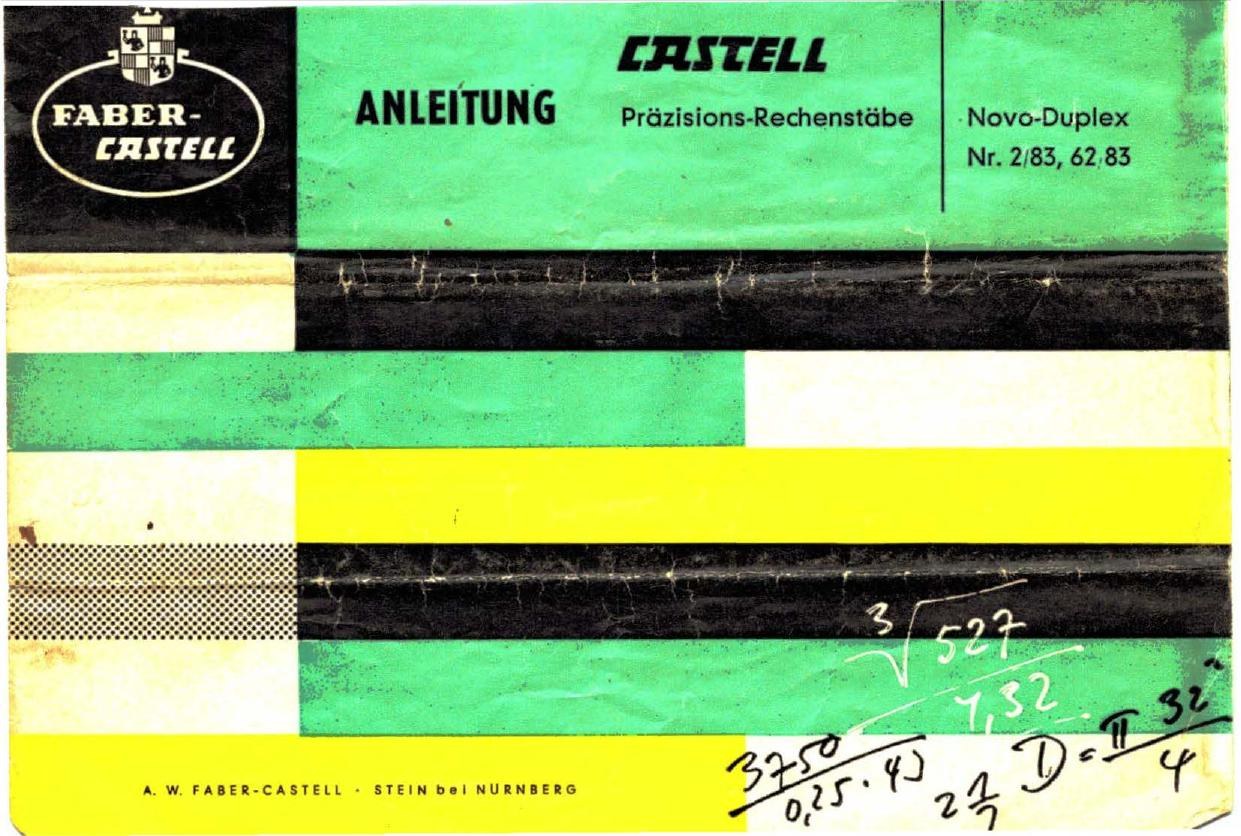
Figure 2 — The cover of the German “Anleitung” for the predecessor model, the Novo-Duplex 2/83 and its pocket version 62/83, in Faber-Castell’s green-and-white house style. The method text inside was carried over, with additions, into the 2/83N booklet. Image: scan of A. W. Faber-Castell, “Anleitung — Präzisions-Rechenstäbe Novo-Duplex Nr. 2/83, 62/83” (c. 1970), hosted by fiala.cc, http://fiala.cc/wp-content/uploads/2015/07/1970-Faber-Castell-Novo-Duplex-2-83-Anleitung.pdf.
The 2/83N replaced it. Its own instruction booklet opens by explaining the change in the voice of a company answering its customers: users of the earlier rule had suggested, “in a spirit of constructive criticism”, that the arrangement of the scales on both faces be improved, and the development department had obliged. “Apart from numerous minor improvements, the scales A, B, DI (on the front) and LL00, CI, D and LL0 (on the back) have been added” (Faber-Castell, Instructions 2/83N). In other words the N model gained a conventional pair of square scales, a fixed reciprocal scale, a fourth pair of log-log scales for exponents very close to zero, and a second C/D/CI group on the back so that the root and exponential scales could be worked without turning the rule over. That brought the count to the famous 31.
Holland dates the 2/83N to 1969–1975 (Holland, 2020). Other sources place the bulk of production a little later: Stefan Vorkoetter gives roughly 1972 to 1975, Hamann’s example carries the code for March 1974, and owners reporting on Vorkoetter’s page have read stamps for 1975 and, on late stock, 1976 (Vorkoetter; Hamann, Novo-Duplex 2/83N). Holland’s ranges for the two models overlap from 1969 to 1972, so both were evidently on sale for a time.
A pocket twin was made alongside it. The 62/83N carries the same 31 scales at half the length (12.5 cm), and the 2/83N instructions cover both rules in one booklet (Faber-Castell, Instructions 2/83N). Holland also lists an overhead-projector version and a large demonstration rule made for teaching with the 2/83N (Holland, 2020).
1.4 The End of the Line
The 2/83N arrived at exactly the wrong moment. Pocket electronic calculators with scientific functions appeared in the early 1970s and swept the slide rule out of engineering offices within a few years (History unit, Vol 5). Faber-Castell’s own response was a hybrid: the TR series of slide rules with a four-function calculator built into the back, whose serial numbers record production from 1972 (Holland, 2020). When the scientific calculator arrived, users stopped turning the rule over, and slide-rule production at Geroldsgrün ended in about 1977 (International Slide Rule Museum; Holland, 2020).
The 2/83N therefore had a short commercial life, but a long afterlife. Unsold stock remained in the company’s hands for decades, and from about 2012 until early 2018 Faber-Castell sold new old stock 2/83Ns directly through its online shop, for roughly €75–€89 (Vorkoetter, and readers’ reports on his page). Many of the “mint in box” examples now in collections came from that source, which is why a mint 2/83N is far less rare than a mint example of most other rules of the period. Its reputation was amplified by Clifford Stoll’s 2006 Scientific American article “When Slide Rules Ruled”, which Vorkoetter quotes as calling it “the finest and most beautiful slide rule ever made”.
1.5 What Came in the Box
The 2/83N was sold as a set, and the contents help to date and place an example:
- The case. The classic presentation is a clear rigid plastic box with hinge pins, the rule held in a coloured tray (Figure 1). Hamann’s 1974 example and Vorkoetter’s both came this way. Later new-old-stock rules were supplied in a green cardboard box, and at least one example in a leather case has been recorded (Vorkoetter, and readers’ reports).
- The instructions. Usually German; English booklets exist and were often supplied as photocopies with late stock. An export version sold in Spanish-speaking markets is printed “Novo-Biplex” on the instructions (Vorkoetter; Faber-Castell, Instrucciones 2/83N).
- The reference card. A plastic card of physical constants and conversion factors. One recorded type has SI units on one side and set-theory symbols on the other; later stock carried mathematical formulae (Vorkoetter; Hamann).
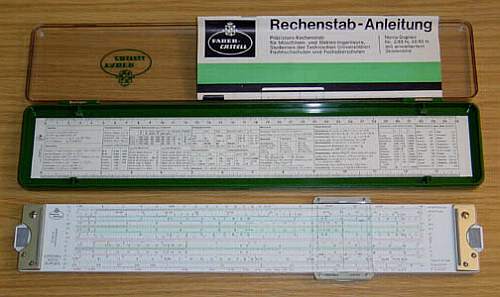
Figure 3 — A German-market 2/83N set (production code 3 74, March 1974): rule, clear case, “Rechenstab-Anleitung” booklet and the ruler-card of physical constants and conversion factors. Image: Christian Hamann, slide-rule collection, Berliner Hochschule für Technik, https://public.bht-berlin.de/hamann/sliderules/fcndx.html.
1.6 Telling a 2/83N from a 2/83
The two Novo-Duplex models look alike at a glance. The quick checks:
- The model mark. The left end of the front reads “2/83 N” (with a space) and “MADE IN GERMANY” beside the Faber-Castell logo, with “CASTELL NOVO-DUPLEX” below (Vol 2, Figure 2). The cursor bar is also marked “2/83 N”.
- The A and B scales. The 2/83N has pale-blue-banded A and B square scales on the front; the 2/83 does not.
- The DI scale. A red DI reciprocal scale directly under D on the front is an N feature.
- Four pairs of log-log scales. The back of the 2/83N carries LL00–LL03 above and LL0–LL3 below; the 2/83 has three of each.
- Width. The N stock is 57 mm wide against 48 mm (Holland, 2020).
1.7 Dating an Example
Faber-Castell stamped most of its rules with a blind date stamp — numbers pressed into the plastic or wood without ink. Holland’s catalogue gives the key (Holland, 2020):
Table 2 — Faber-Castell stamped most of its rules with a blind date stamp — numbers pressed into the plastic or wood without ink. Holland's catalogue gives the key (Holland, 2020)
| Period | Form of the stamp |
|---|---|
| 1920–1929 | one digit for the year, then the month |
| 1930–1957 | two digits for the year, then the month |
| 1958–1977 | three or four digits, month first: MYY or MMYY |
So for a 2/83N the stamp reads month then year: 374 is March 1974, 1075 October 1975, 176 January 1976. On linear duplex rules Holland says the stamp is mostly found on one of the end edges of the stock; owners of 2/83Ns have also described it as pressed into the end of the slide (Vorkoetter). The practical advice is to examine all the end faces — both ends of both stator halves and both ends of the slide — under a raking light, because an uninked impression in white plastic is easy to miss. A missing stamp is not in itself evidence of anything; Holland notes that not every rule carries one.
Other clues are weaker but corroborate:
- Logo and name. From the early 1960s the company name appears as “Faber-Castell”, hyphenated and upright; “CASTELL” in italic appears on the cursor and slide ends (Holland, 2020). Holland warns that logos alone are not a reliable dating aid.
- Cursor. Two cursor designs are reported on 2/83Ns, one of them with four adjusting screws (Vorkoetter, readers’ reports). Hamann’s comparison of the 2/83 versions shows that Faber-Castell did change cursors within a model’s life, so the style of the cursor is worth recording alongside the date stamp.
- Packaging. A clear hinged case points to the main production run; a green cardboard box suggests late stock or the post-2012 new-old-stock sales.
1.7.1 What to record on this rule
The date of my 2/83N is not yet known; the stamp, the cursor style and the packaging together should place it within the 1969–1976 window.
Sources
- Holland, Peter. Rechenschieber von Faber-Castell, 8th ed. (2020), bilingual catalogue; production ranges for the 2/83 (1962–1972) and 2/83N (1969–1975), materials, Geroplast, blind-date-stamp key. Hosted by the International Slide Rule Museum: https://sliderulemuseum.com/Catalogs/Rechenschieber_AWFaberCastell_SlideRules_byPeterHolland_ed8.pdf. In this site’s Reference Library.
- A. W. Faber-Castell. Instructions — Precision Slide Rule No. 2/83N, 62/83N with enlarged scale range (English text, transcription at http://www.sliderules.info/pdf/fc-283n-eng.pdf; HTML at https://udel.edu/~mm/sliderule/manuals/2-83N/manual/). In this site’s Reference Library.
- A. W. Faber-Castell. Anleitung — Präzisions-Rechenstäbe Novo-Duplex Nr. 2/83, 62/83 (c. 1970), scan at http://fiala.cc/wp-content/uploads/2015/07/1970-Faber-Castell-Novo-Duplex-2-83-Anleitung.pdf. In this site’s Reference Library.
- A. W. Faber-Castell. Regla de cálculo de precisión Novo-Biplex No. 2/83N, 62/83N (Spanish text), http://www.sliderules.info/pdf/fc-283n-esp.pdf. In this site’s Reference Library.
- Vorkoetter, Stefan. “Faber-Castell 2/83N Novo-Duplex”, https://www.stefanv.com/calculators/fc283n.html (production c. 1972–1975; date-code reports; packaging; NOS sales 2012–2018; Stoll quotation).
- Hamann, Christian. Slide-rule collection pages for the Novo-Duplex 2/83 (versions A and B) and 2/83N, Berliner Hochschule für Technik: https://public.bht-berlin.de/hamann/sliderules/fcndx1.html and https://public.bht-berlin.de/hamann/sliderules/fcndx.html
- International Slide Rule Museum, Faber-Castell gallery (duplex rules from 1961; 2/83N as the most complex Faber-Castell rule; 31 scales): https://sliderulemuseum.com/Faber.shtml
- Stoll, Clifford. “When Slide Rules Ruled”, Scientific American 294 (5), May 2006.
- Dates in this volume are as stated by these sources; where they differ (the 2/83N’s start date in particular), the range of reported dates is given rather than a single figure.
Comments (0)