Faber-Castell 2/83N · Volume 2
Faber-Castell 2/83N Novo-Duplex — Volume 2 — Anatomy and the Full Scale Set
Thirty-one scales, the doubled-length W root scales, the Pythagorean P scale and the cursor that carries a reading round the rule
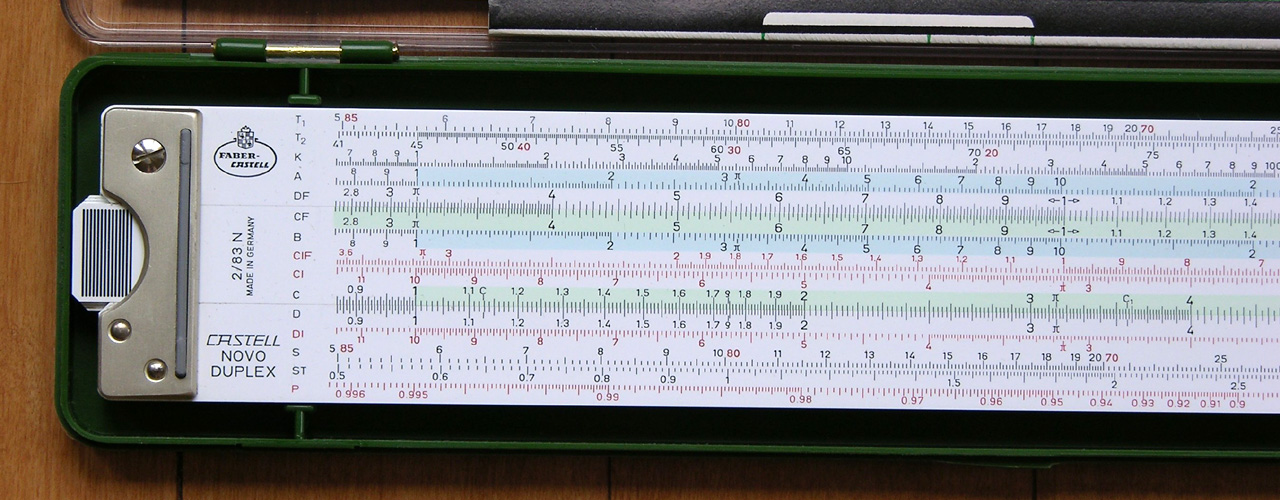
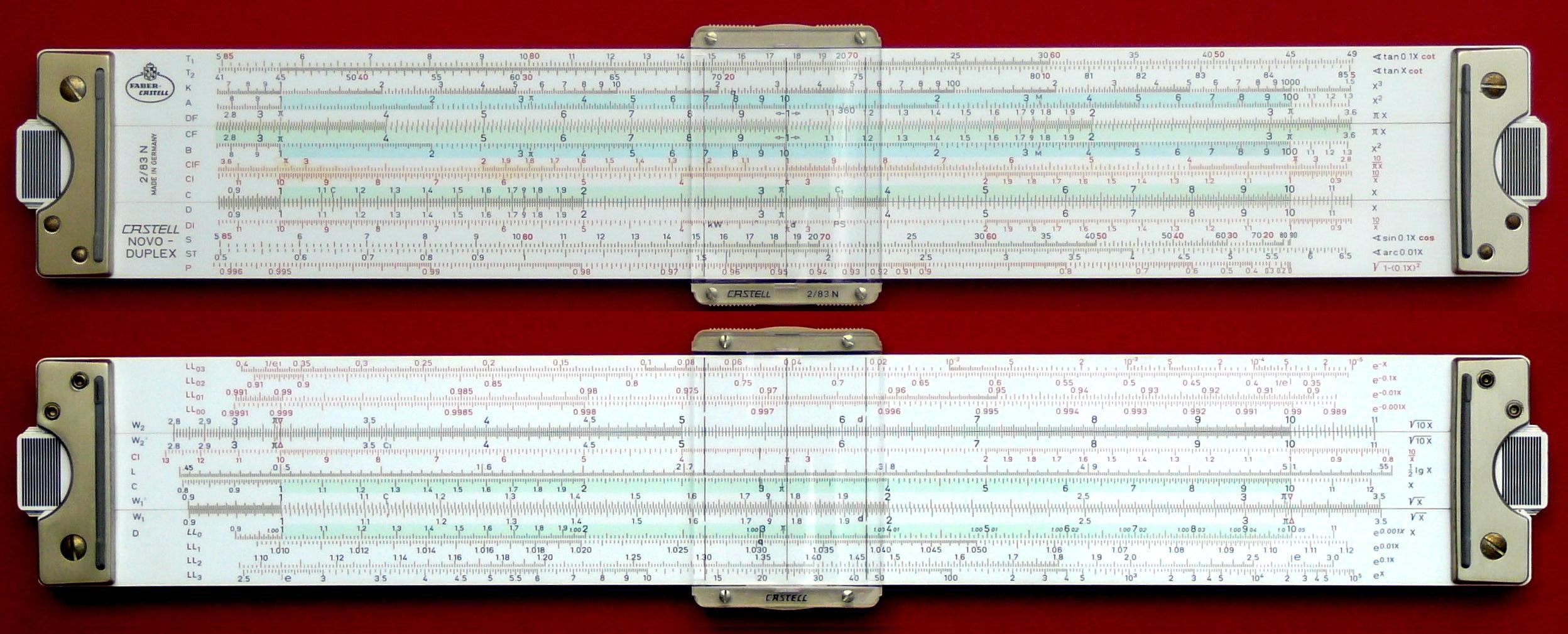
Figure 1 — Both faces of a 2/83N: the front (top) with its trigonometric, square, cube, folded and reciprocal scales, and the back (bottom) with the eight log-log scales and the four W root scales. The coloured bands are pale blue for the square scales and mint green for the basic scales. Image: “F-C 2-83N” by Jörn Lütjens, CC BY-SA 3.0, via Wikimedia Commons, https://commons.wikimedia.org/w/index.php?curid=19366215.
2.1 About This Volume
The 2/83N carries more scales than almost any other linear rule made for general sale, and every one of them is labelled twice: by name at the left end and by formula at the right. This volume walks through the instrument physically — body, slide, end braces, cursor — and then through all 31 scales, face by face, saying what each computes and which scale it is read against. The arithmetic of using them is in Vol 3; the general theory of C/D, A/B, K, LL and trigonometric scales is in the Using Slide Rules unit, Vols 2–4, and is not repeated here.
2.2 The Physical Rule
The 2/83N is a duplex rule of open-frame construction: two stator halves, upper and lower, held a fixed distance apart by metal end braces, with the slide running between them. The whole body and slide are injection-moulded Geroplast, Faber-Castell’s name for its polystyrene (Vol 1). The rule is about 38 cm long, 5.7 cm wide and 0.6 cm thick, with a scale length of 25 cm — the standard “10-inch” length (Vorkoetter).
Each end brace is a metal bracket screwed to both stator halves, with a ribbed plastic grip on its outer face (Figure 2). The screws are not decorative: loosening them allows the two halves to be squared up to each other and the slide tension to be set, then tightened again. Hamann notes that the later Novo-Duplex rules gained rubber feet on these braces, so the rule rests on the desk without the scales touching it (Hamann, Novo-Duplex 2/83).
The graduations and figures are coloured — black for ordinary scales, red for scales that run right-to-left — over coloured bands that group related scales: pale blue behind the A and B square scales, mint green behind C, D and (on the back) the C/D pair and the W1 scales. The colour fill is the vulnerable part of the rule: the maker’s own care note says that strong solvents “are at all events liable to attack the colouring-agents applied to the graduation-marks, even if they do not actually harm the material itself” (Faber-Castell, Instructions 2/83N). Vol 3 returns to this.
Figure 2 — The left end of the front. Every scale is named here — T1, T2, K, A, DF on the upper stator; CF, B, CIF, CI, C on the slide; D, DI, S, ST, P on the lower stator — next to the model mark “2/83 N, MADE IN GERMANY” and “CASTELL NOVO-DUPLEX”. The end brace, with its two screws per stator half and ribbed grip, is at far left. Image: Stefan Vorkoetter, https://www.stefanv.com/calculators/fc283n.html.
2.3 The Front Face: Fifteen Scales
The front is laid out around the familiar C and D pair, with every scale keyed to them. The table follows the rule from top to bottom. “x” is the reading on C or D; red scales are marked (red).
Table 1 — The Front Face: Fifteen Scales
| Scale | Where | Formula (as printed) | Range and use |
|---|---|---|---|
| T1 | upper stator | tan 0.1x (cot in red) | Tangent 5.71°–45°, read on D; red figures give the cotangent |
| T2 | upper stator | tan x (cot in red) | Tangent 45°–84.29°, read on D (values 1–10) |
| K | upper stator | x³ | Cubes, three decades 1–1000 |
| A | upper stator | x² | Squares, two decades 1–100 (pale blue band) |
| DF | upper stator | πx | D folded at π |
| CF | slide | πx | C folded at π |
| B | slide | x² | Square scale on the slide (pale blue) |
| CIF | slide (red) | 1 : πx | Reciprocal of CF |
| CI | slide (red) | 1 : x | Reciprocal of C |
| C | slide | x | Basic scale (mint green) |
| D | lower stator | x | Basic fixed scale (mint green) |
| DI | lower stator (red) | 1 : x | Fixed reciprocal of D |
| S | lower stator | sin 0.1x (cos in red) | Sine 5.74°–90° read on D; red figures give the cosine |
| ST | lower stator | arc 0.01x | Small angles 0.573°–5.73°, where sin ≈ tan ≈ arc |
| P | lower stator (red) | √(1 − (0.1x)²) | The Pythagorean scale, read against D in the range 0.1–1 |
Three features of the front deserve comment.
Decimal degrees. All the angle scales — T1, T2, S, ST — are divided decimally (e.g. 21.8°), not in degrees and minutes. This was the modern German practice of the time, and it makes the trigonometric scales easy to combine with ordinary arithmetic (Faber-Castell, Instructions 2/83N).
Two tangent scales on the stator. Putting T1 and T2 on the fixed body, not the slide, means a tangent can be read straight off D with the cursor, and — more usefully — that the slide is free to multiply by the tangent in the same setting. T2 extends the tangent directly to 84.29°, where most rules make the operator use the cotangent of the complement.
The Pythagorean scale P. P is the 2/83N’s signature. It gives y = √(1 − x²) for x read on D between 0.1 and 1. In trigonometric terms, if D holds sin α, P gives cos α at the same cursor position, and vice versa — so a sine read on S becomes a cosine without ever reading the angle. The scale is most finely divided near 1, exactly where an ordinary cosine reading is least precise: at D = 0.1 it reads 0.995, and the graduations near its left-hand end resolve the fourth decimal place. It also gives a direct route to the magnitude of a vector from one component, and — via the identity x = √(1 − y²) — square roots of numbers just below 1 with extra precision (Faber-Castell, Instructions 2/83N; examples in Vol 3).
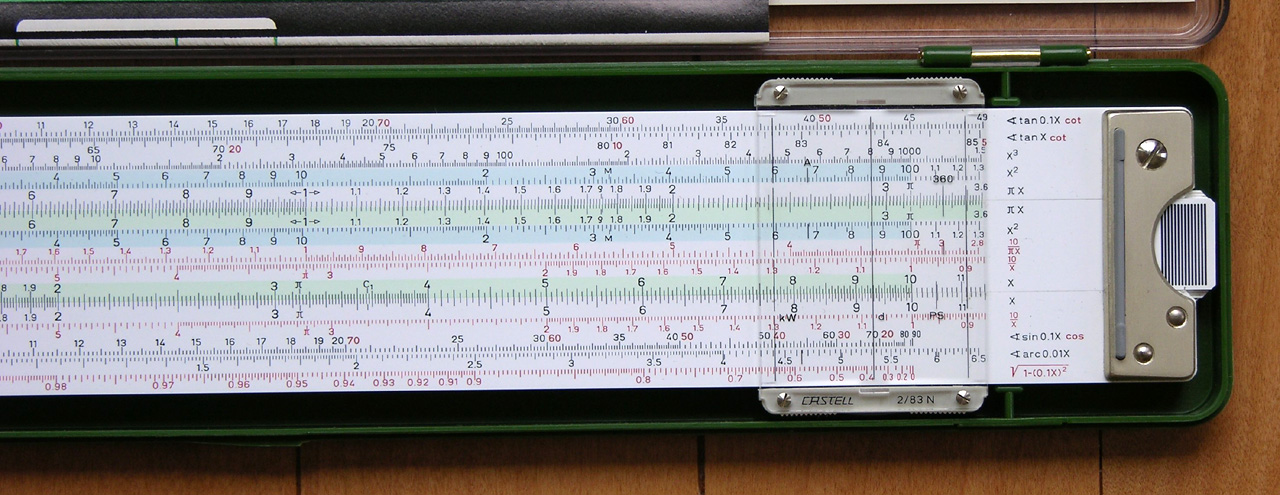
Figure 3 — The right end of the front: the formula column that makes the 2/83N “self-documenting”, and the cursor with its “CASTELL 2/83 N” bar. Note the red extended graduations running past 10 at the right of C, D, CI and DI, for continuing a calculation just over the end of a scale. Image: Stefan Vorkoetter, https://www.stefanv.com/calculators/fc283n.html.
2.4 The Back Face: Sixteen Scales
Turning the rule over shows the scales that made the Novo-Duplex famous: the W root scales and a complete set of log-log scales in both directions.
Table 2 — The Back Face: Sixteen Scales
| Scale | Where | Formula (as printed) | Range and use |
|---|---|---|---|
| LL03 | upper stator (red) | e^−x | e^−1 to e^−10: 0.368 down to about 0.00005 |
| LL02 | upper stator (red) | e^−0.1x | 0.905 to 0.368 |
| LL01 | upper stator (red) | e^−0.01x | 0.990 to 0.905 |
| LL00 | upper stator (red) | e^−0.001x | 0.999 to 0.990 |
| W2 | upper stator | √(10x) | Square roots, 3.16–10, on a 50 cm graduation |
| W2′ | slide | √(10x) | The same, on the slide |
| CI | slide (red) | 1 : x | Reciprocal, for working with the back scales |
| L | slide | ½ lg x | Mantissa scale, uniform, keyed to the W scales |
| C | slide | x | Basic scale (mint green) |
| W1′ | slide | √x | Square roots, 1–3.16, on the slide |
| W1 | lower stator | √x | Square roots, 1–3.16 (mint green) |
| D with LL0 | lower stator | x; e^0.001x | Basic scale, also serving as LL0 (see below) |
| LL1 | lower stator | e^0.01x | 1.010 to 1.105 |
| LL2 | lower stator | e^0.1x | 1.105 to 2.718 |
| LL3 | lower stator | e^x | 2.718 to about 22,000 |
The instructions give the overall reach as 1.00088 to 60,000 for the positive log-log scales and 0.00002 to 0.999 for the negative ones, counting the extended graduations at the ends (Faber-Castell, Instructions 2/83N). The log-log scales, unlike every other scale on the rule, carry their decimal point with them: “1.04” on LL1 means 1.04 and nothing else.
2.4.1 How “31 scales” is counted
The International Slide Rule Museum and Faber-Castell’s literature give the 2/83N 31 scales; Ron Manley’s sliderules.info counts 30. The difference is LL0. Because e^0.001x is so nearly equal to 1 + 0.001x — the deviation is only 0.000005 up to e^0.003 — Faber-Castell did not give it a separate line. Instead it is “incorporated in scale D”: from about 1.004 onwards the true value is printed in small oblique figures to the right of the D graduations (Faber-Castell, Instructions 2/83N). Counting LL0 as a scale gives 15 + 16 = 31; counting only the printed lines gives 30.
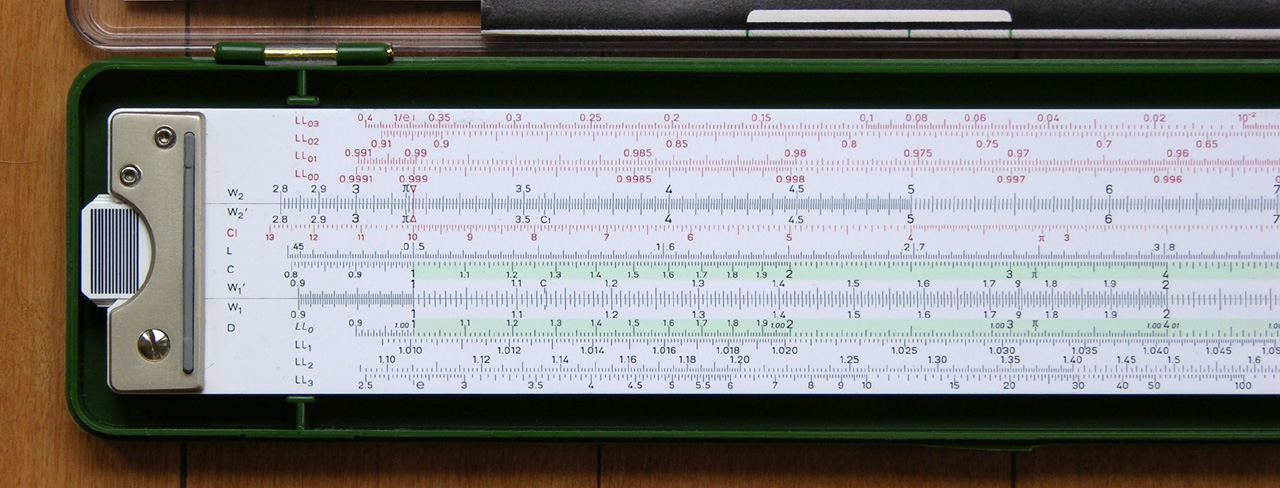
Figure 4 — The left end of the back, showing the order of the sixteen back scales. The W2/W2′ pair straddles the upper edge of the slide and the W1′/W1 pair the lower edge, so that each fixed root scale meets its sliding twin. Image: Stefan Vorkoetter, https://www.stefanv.com/calculators/fc283n.html.
2.4.2 The W root scales
The W scales are the 2/83N’s way of getting the precision of a 50 cm rule out of a 25 cm one. A single decade, 1 to 10, is split in two and each half is graduated at double length: W1 and W1′ run from 1 to √10 (about 3.16), W2 and W2′ from √10 to 10, each over the full 25 cm. The instructions describe them as running “from 1 to 3.3 at the bottom and from 3 to 10 at the top”, the overlaps allowing a calculation to continue across the join (Faber-Castell, Instructions 2/83N). Hamann summarises the effect plainly: the rule “has the precision of a 50 cm slide rule” (Hamann, Novo-Duplex 2/83N).
Because a W scale is a root scale, the same cursor setting reads a number on W and its square on C or D. Used against each other — W1 against W1′, W2 against W2′ — the W scales also multiply and divide directly at doubled resolution. The rule for which scale gives the answer is short: set with the black index and the result is on the fixed W scale adjacent to the second factor; set with the red index mark and it is on the fixed W scale opposite (Faber-Castell, Instructions 2/83N; worked in Vol 3). The graduations are finer, too: from 1 to 2 every 0.01 is marked, with a short centre stroke at each 0.005.
2.4.3 The L scale and the back C/D
On most rules L sits on the front. On the 2/83N it is on the back of the slide, laid out as ½ lg x so that it works with the W scales: set a number on W1 or W2 and read its four-figure common logarithm on L, with the characteristic taken from the dividing mark (Faber-Castell, Instructions 2/83N). The back C, D and CI scales — new on the N model — let a log-log or root result be multiplied or divided at once without turning the rule over.
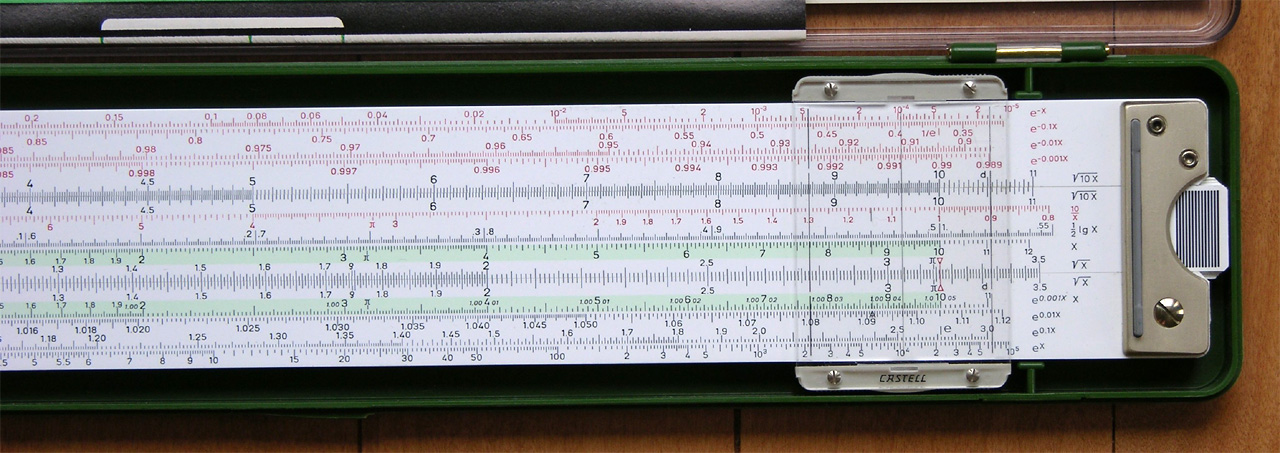
Figure 5 — The right end of the back with its formula column, and the back of the cursor with its own set of short marks. Image: Stefan Vorkoetter, https://www.stefanv.com/calculators/fc283n.html.
2.5 Gauge Marks
Several constants are marked on the scales so they can be set without hunting (Faber-Castell, Instructions 2/83N):
- π on C, D, CI, CF, DF, CIF and all four W scales.
- ρ = π/180 = 0.01745 on C, D, W1 and W1′, for converting degrees to radians: set C 1 over ρ on D and every angle on C has its radian measure beneath it on D.
- e = 2.71828 on LL2 and LL3.
- Correction marks on the ST scale between 4° and 6°, because above about 4° sin, tan and the radian measure separate by more than the scale can ignore. The tangent mark sits to the right of the angle graduation (tan > arc), the sine mark to the left.
2.6 The Cursor
The cursor is a double cursor: two clear windows, front and back, joined at top and bottom so that the hairline on one face lines up exactly with the hairline on the other. That is what makes the duplex principle work — a value set on W1 at the back can be read on the front without any transfer of numbers. The instructions call the windows Plexiglas; the top and bottom bars on most 2/83N cursors are held by four small screws, which allow the two windows to be aligned with each other (Figure 6; Vorkoetter, readers’ reports).
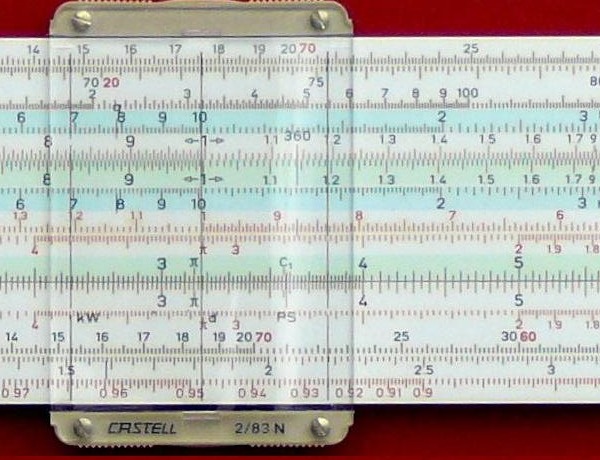
Figure 6 — The front of the cursor. Besides the long central hairline there are short marks at upper left for circle areas, a “360” mark at upper right for the factor 3.6, and a pair of lower marks over the D scale labelled kW and PS. Image: detail of “F-C 2-83N” by Jörn Lütjens, CC BY-SA 3.0, via Wikimedia Commons, https://commons.wikimedia.org/w/index.php?curid=19366215.
The front of the cursor carries:
- the long central hairline, used for every ordinary setting;
- red side marks at the left and right edges, for reaching values on the extended red graduations that the central line cannot reach;
- two short lines at upper left for the area of a circle: set the central line on a diameter on D (or C) and read the area on A (or B) under the short lines; a third short upper line relates to CI for cylinder volumes;
- a “360” mark at upper right for direct calculation with the factor 3.6 — kilometres per hour to metres per second, or interest by the day on a 360-day year;
- a pair of lower marks, kW and PS, for converting between kilowatts and metric horsepower (Pferdestärke, 1 PS = 0.7355 kW).
The back of the cursor repeats the long hairline and adds its own circle-area marks: an interrupted line at right set to a diameter on W1 or W2, with the area read under short marks at lower left on C or D (Faber-Castell, Instructions 2/83N). The English booklet calls the power marks “HP” and “kW”, but the cursor itself reads PS, and the spacing is for the metric horsepower.
The instructions describe how to take the cursor off for cleaning without disturbing its adjustment: press the two cheeks apart at the notched lower edge, pulling the side of the cheek down with a thumb to release the fastening, then spring the windows apart just enough to slide the cursor off over the top of the rule. When it goes back on, the face with the five index marks must be on the front of the rule (Faber-Castell, Instructions 2/83N). Vol 3 adds the cautions.
Sources
- A. W. Faber-Castell. Instructions — Precision Slide Rule No. 2/83N, 62/83N with enlarged scale range (English text): scale list with formulas, W-scale graduation and index rules, LL ranges, LL0 incorporated in D, gauge marks, cursor marks and removal, care note. http://www.sliderules.info/pdf/fc-283n-eng.pdf ; HTML at https://udel.edu/~mm/sliderule/manuals/2-83N/manual/. In this site’s Reference Library.
- Hamann, Christian. “Faber-Castell Novo-Duplex 2/83N” and “Novo-Duplex 2/83 (Version B)”, scale formulas and production codes, Berliner Hochschule für Technik: https://public.bht-berlin.de/hamann/sliderules/fcndx.html ; https://public.bht-berlin.de/hamann/sliderules/fcndx1.html
- Vorkoetter, Stefan. “Faber-Castell 2/83N Novo-Duplex” (dimensions, colour bands, cursor types), https://www.stefanv.com/calculators/fc283n.html
- Manley, Ron. “Faber Castell — 2/83N”, Slide Rules (30-scale count; D & LL0), http://www.sliderules.info/collection/10inch/020/1021-fabercastell-2-83n.htm
- International Slide Rule Museum, Faber-Castell gallery (31 scales; hairlines 360, d, A, kW, PS), https://sliderulemuseum.com/Faber.shtml
- Scale ranges were checked by calculation: tan⁻¹ 0.1 = 5.71°, tan⁻¹ 10 = 84.29°, sin⁻¹ 0.1 = 5.74°, 0.01 rad = 0.573°, √10 = 3.162, e^−10 = 0.0000454, e^10 = 22,026, √(1 − 0.1²) = 0.995, 1 PS = 0.73550 kW.
Comments (0)