Using Slide Rules · Volume 5
Using a Slide Rule — Volume 5 — Reading Circular and Cylindrical Rules
How operation changes when the scale is bent into a circle or wound onto a cylinder
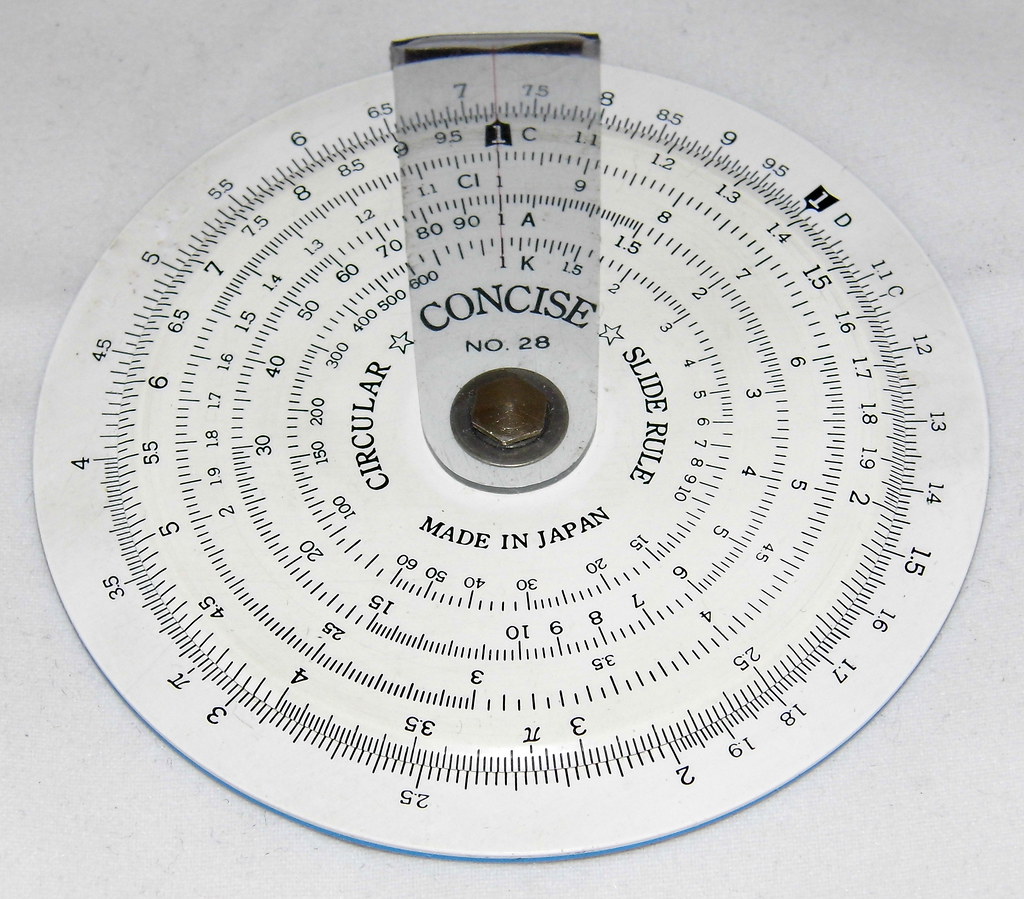
Figure 1 — A pocket circular rule packs the same scales as a straight rule onto a dial that never runs off its own end. “Vintage Concise Model 28 Circular Slide Rule, Made In Japan, Circa 1960s” by France1978 is licensed under CC BY-SA 2.0. To view a copy of this license, visit https://creativecommons.org/licenses/by-sa/2.0/.
5.1 About This Volume
The first four volumes of this unit taught a single instrument: the straight slide rule, with its body, slide, and cursor (see Vol 1 for the parts). Everything there — multiplication on C and D, the off-scale reset (Vol 2), the squares and cubes of A and K (Vol 3), the trig and log scales (Vol 4) — assumed a scale laid out in a straight line. This final volume asks what changes when that line is curved: bent into a closed circle, or wound as a helix around a cylinder. The underlying logarithmic principle is identical, but two practical things improve dramatically. A circle has no ends, so the off-scale problem simply vanishes. And a scale wound onto a cylinder can be made enormously long without the instrument growing large, buying one or two extra significant figures. The mechanics of reading and operating these rules — which is what this volume is about — differ enough from a straight rule to deserve their own treatment.
5.1.1 Depth-Index: How to Read & Operate a Slide Rule
Table 1 — Depth-Index: How to Read & Operate a Slide Rule
| Vol | Title | Primary Content |
|---|---|---|
| 1 | Anatomy and the Logarithmic Principle | Parts, why sliding multiplies, reading, sig figs, decimals |
| 2 | Multiplication and Division | C/D, chaining, CI, folded CF/DF, off-scale |
| 3 | Powers and Roots | A/B, K, the log-log (LL) scales, eˣ |
| 4 | Trigonometry and Logarithms | S, ST, T scales, the L mantissa scale, gauge marks |
| 5 | Reading Circular and Cylindrical Rules (this volume) | Wrap-around and spiral scales; Fowler, Otis King, Fuller |
Note — Cross-references appear as “see Vol N.” This volume assumes the reading skills of Vols 1–2 and connects to the per-rule units on the Fowler, Otis King, and Fuller, which cover each instrument in collector-level detail.
5.2 Circular Rules: The Wrap-Around Advantage
A circular slide rule takes the C and D scales of an ordinary rule and bends each into a ring. The single most useful consequence follows immediately from geometry: a circle has no beginning and no end. On a straight rule, the D scale runs from 1 on the left to 10 on the right, and a multiplication whose result exceeds that range runs “off-scale,” forcing the operator to slide the slide back and re-index using the other end of C (the problem worked through in Vol 2). On a circular rule, the “10” mark and the “1” mark are the same point on the dial. A product that would have run off the end of a straight scale simply continues around the circle and is read without any reset at all. For everyday multiplying and dividing, this is the circular rule’s defining convenience.
5.2.1 What’s on the dial, and how it moves
A typical pocket circular rule such as the Concise Model 28 in Figure 1 carries several concentric rings — commonly C and D for multiplication, CI (the reciprocal/inverted scale, see Vol 2), A and B for squares, and K for cubes (Vol 3) — all printed around a common centre. Two parts rotate about that centre:
- A rotating scale disc (the analogue of the slide on a straight rule), and
- A radial cursor: one or more clear arms pivoting from the centre, each carrying a hairline that runs out along a radius.
Multiplication and division are done by rotation rather than by sliding. To multiply, the operator brings a reference index of the moving scale into line with the first factor using the cursor, then rotates to the second factor and reads the product under the hairline. Because the motion is angular, “off the end” is meaningless — the hairline merely sweeps on around the dial. Some designs (Fowler’s, below) reverse the roles, fixing the scales and turning only two cursor hairlines, but the principle is the same: align, rotate, read.
5.2.2 Worked example — a product that wraps
Take 4 × 5 = 20. On a straight rule this is the classic off-scale case: set the left index of C over 4 on D, look for 5 on C, and it has already fallen off the right-hand end of D, so one must re-index from the right. On a circular rule, no such trouble arises. In logarithms the work is
log 4 + log 5 = 0.602 + 0.699 = 1.301.
The C/D ring is one decade long, so one full turn of the dial corresponds to a distance of log 10 = 1.000. Adding log 5 to the log 4 position therefore carries the hairline once around the circle (the 1.000) and 0.301 farther — landing exactly on the 2 mark. The reader supplies the decimal point by estimation (4 × 5 is about 20, not 2 or 200), giving 20. The single trip past the index that a straight rule cannot make, the circle makes for free.
5.2.3 A first-time setup tip
The most common beginner error on a circular rule is losing track of which concentric ring the answer sits on, because several scales crowd together near the hairline. Before doing real work, set the rule to a multiplication whose answer is known — for instance bring the index to 2 on the D ring and rotate to read 2 × 2 = 4 — and deliberately note the color, position, and label of the D ring you are reading. Anchoring on one trusted ring first prevents the classic mistake of reading the product off the A (squares) ring by accident.
5.2.4 Fowler’s pocket circulars
The Fowler calculators, made in Manchester, England, from the early twentieth century, package the circular idea in a pocket-watch case. The scales are read through a glass front, and two knurled knobs at the rim (like a watch’s winding crown) do all the work: one rotates the calculating dial, the other sweeps the cursor hairlines. The watch-in-the-hand form factor made the Fowler a favourite of engineers who wanted no-reset multiplication that fit in a waistcoat pocket. The dedicated Fowler unit covers its many models and scale layouts.
5.3 Spiral-Scale Circulars: Length Without Size
The circular form solves the off-scale problem but, taken plainly, does nothing for precision: a single ring around a small disc is no longer than the scale on a straight rule of similar diameter. The fix is to coil the scale into a spiral of several turns. A spiral packs a very long logarithmic line onto a small disc, and a longer scale means finer graduations and an extra significant figure or two.
The best-known example is the Gilson family of dial rules (the “Atlas” and “Midget” models) made in the United States. On a Gilson, the C/D scale is not a single ring but a spiral winding inward through several revolutions. The cursor carries two indicating marks at different radii, so that the operator can follow the scale from one turn of the spiral to the next: read the result on the turn the hairline currently crosses, and use the second mark to step inward or outward by exactly one revolution when a calculation carries the value onto the adjacent coil. The reward for that extra bookkeeping is roughly four reliable significant figures from a disc that still fits in a coat pocket — appreciably better than a 25 cm straight rule, while keeping the wrap-around, no-reset behaviour of any circular.
5.4 Cylindrical and Helical Rules: Precision by Length
To push precision further still, makers abandoned the flat disc and wound the scale as a helix around a cylinder — the same trick as the spiral, but with no practical limit on how many turns can be stacked along the cylinder’s length. The effective scale length, and with it the precision, can become extraordinary. These are not pocket-multipliers for quick estimates; they are instruments reached for when an answer good to four or five figures is wanted without opening a book of tables.
5.4.1 The Otis King
The Otis King, made by Carbic Ltd. of London from about 1922 to about 1972, is the pocket cylinder. Closed, it is a metal tube the size of a fat fountain pen; in use it telescopes open. Its logarithmic scale is a helix with a decade length of about 66 inches (≈1.7 m) — roughly eleven times the scale of a 6-inch pocket rule — yielding around four significant figures (in practice the literature quotes about 3.5 to 4.5 digits, depending on which part of the scale is read).
Operation is a combination of slide and twist. The instrument has three working parts: a base cylinder with a handle, a movable middle cylinder bearing the helical scale, and a cursor sleeve carrying two reference marks set one decade apart. The cylinder carries the scale in two identical runs meeting at a mark labelled “ONE” — the middle unity. To multiply, the operator holds the handle, sets the lower cursor mark to the first factor by sliding and rotating the cylinder, then moves the upper assembly to bring the index to the second factor, and reads the product under the other cursor mark. Because the scale spirals, every setting is a helical motion — push or pull to travel along the cylinder while turning to travel around it — and the two cursor marks, fixed one decade apart, keep the operator from losing a factor of ten between turns. Model K does multiplication and division; Model L adds a log scale for powers and logarithms. The Otis King unit treats the motions step by step.
5.4.2 The Fuller calculator
The Fuller calculator, patented by Professor George Fuller and made by W. F. Stanley of London from 1878, is the most precise slide rule in common collecting. Its single logarithmic scale is a 50-turn helix wound around a cylinder, about 500 inches — 41 ft 8 in, ≈12.7 m — long. Through the clever way the scale is split and read, it behaves like a straight rule roughly twice that length again, and it can always be read to four significant figures and often to five — accuracy approaching a printed table.
The Fuller has three movable parts working about a central handle: the scale cylinder itself, which slides and rotates over an inner core, and two index pointers — a fixed brass pointer attached to the handle, and a long movable pointer (often a pair of brass rods) that the operator positions. To multiply, the operator sets one pointer to the first factor on the helix, rotates and slides the cylinder to bring the index to the second factor against the other pointer, and reads the result where a pointer crosses the scale. The two pointers, working with the helix, let the user track position across the cylinder’s fifty turns without ambiguity. The dedicated Fuller unit walks through a full calculation.
5.4.3 The Thacher (in brief)
A different route to a long scale is the Thacher calculating instrument (Edwin Thacher, made by Keuffel & Esser from the 1880s). Rather than a continuous helix, the Thacher uses a large cylinder printed with many parallel scale segments, read against a fixed slatted frame around it: the long scale is effectively cut into stripes laid side by side. To read it, the operator rotates the cylinder and slides it endwise until the two scales to be combined lie adjacent on neighbouring bars, then reads the result at their meeting — comfortably four to five significant figures. It is a desk instrument, not a pocket one, but it reaches table-grade precision by the same essential idea: more scale length means more figures.
5.5 Why a Hobbyist Reaches for Each
The choice among these forms is really a trade between speed and figures.
- A pocket circular (Concise, Fowler) is the everyday convenience tool. Three-figure precision, but the wrap-around scale means never re-indexing and never running off the end — fast, fluent multiplying and dividing in the palm of the hand.
- A spiral circular (Gilson) buys a fourth figure while staying flat and pocketable, at the cost of a little turn-counting with the second cursor mark.
- The cylindricals are precision instruments. An Otis King gives about four figures from a pen-sized tube — table-grade accuracy that still rides in a pocket. A Fuller gives four to five figures from its 12.7 m helix — the closest a mechanical analog instrument comes to a printed logarithm table — at the price of a bulky cylinder and a deliberate, two-handed operating motion. A Thacher offers similar precision as a desk instrument.
For the collector or hobbyist, the circulars are the rules to use casually; the cylindricals are the rules to reach for when an answer needs to be right to the fourth place. Together they show how far one idea — bending a logarithmic scale so it has no ends, then making it as long as one likes — could be pushed before electronics made the whole question moot.
Sources
- International Slide Rule Museum (https://sliderulemuseum.com) — circular and cylindrical rule galleries and maker references.
- The Oughtred Society — Slide Rule History and instrument notes (https://www.oughtred.org).
- Otis King, Wikipedia (https://en.wikipedia.org/wiki/Otis_King) — Carbic Ltd. dates, 66-inch helical decade, ~3.5–4.5 digit accuracy, two-cylinder/middle-unity operation.
- Fuller calculator, Wikipedia (https://en.wikipedia.org/wiki/Fuller_calculator) and the University of Queensland Physics Museum — 50-turn helix, ≈500 in / 41 ft 8 in / 12.7 m, four-to-five-figure reading.
- Cylindrical Slide Rules, National Museum of American History, Smithsonian (https://americanhistory.si.edu/collections/object-groups/slide-rules/cylindrical-slide-rules) — Thacher and Fuller construction and reading.
Scale lengths and accuracy figures above are drawn from these sources; where the literature gives a range (notably the Otis King’s 3.5–4.5 digits) the text reports the range rather than a single number. The worked example (4 × 5 = 20) was re-checked: log 4 + log 5 = 1.301, one full turn (1.000) plus 0.301, reading 2 on the decade ring, i.e. 20.
Comments (0)