Using Slide Rules · Volume 2
Using a Slide Rule — Volume 2 — Multiplication and Division
The C and D scales, the inverted CI, the folded CF/DF, and chained calculations
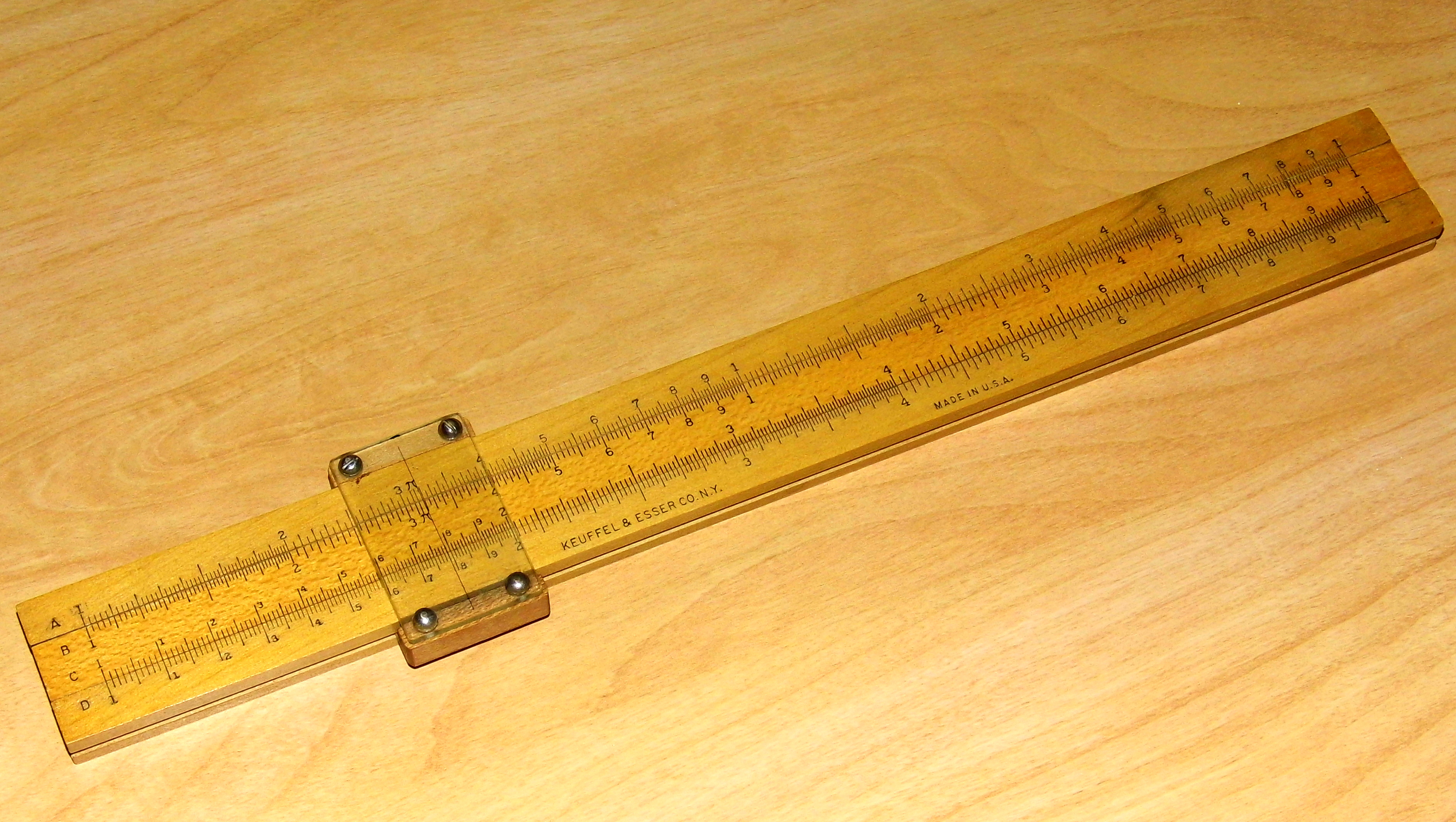
Figure 1 — Everything in this volume happens on the C and D scales of a rule like this Keuffel & Esser. C lives on the moving slide; D lives on the fixed body directly below it. Photo: “Vintage Keuffel & Esser Company Beginner’s Slide Rule, No. 4058C, All Wood Framed Cursor, Made In USA, Circa 1930s (46171984654)” by Joe Haupt from USA is licensed under CC BY-SA 2.0. To view a copy of this license, visit https://creativecommons.org/licenses/by-sa/2.0/.
2.1 About This Volume
Volume 1 explained why a slide rule multiplies: because its scales are laid out by logarithm, adding two lengths adds two logarithms, and adding logarithms multiplies the underlying numbers. This volume turns that principle into muscle memory. It covers the two operations that account for the overwhelming majority of slide-rule work — multiplication and division — using the pair of scales designed for exactly that job, C and D. It then adds three refinements that experienced users reach for constantly: the inverted CI scale, the folded CF and DF scales, and the technique of chaining several operations into one continuous flow without ever writing down an intermediate result.
Throughout, every procedure is given as numbered steps that name which index to set, where to place the cursor, and where to read the answer. Powers, roots, and the logarithmic and trigonometric scales are the business of later volumes.
2.1.1 Depth-Index: The How-to Unit
Table 1 — Depth-Index: The How-to Unit
| Vol | Title | Primary Content |
|---|---|---|
| 1 | Anatomy and the Logarithmic Principle | Parts, why sliding multiplies, reading scales, significant figures, decimals, accuracy |
| 2 | Multiplication and Division (this volume) | C and D, chained operations, the CI inverted scale, folded CF/DF, off-scale resets |
| 3 | Powers and Roots | A/B, K, the log-log (LL) scales, eˣ |
| 4 | Trigonometry and Logarithms | S, ST, T scales, the L mantissa scale, gauge marks |
| 5 | Reading Circular and Cylindrical Rules | Wrap-around and spiral scales; Fowler, Otis King, Fuller |
Note — Cross-references appear as “see Vol N.” This volume assumes only that the reader can locate a number on a single logarithmic scale and estimate a decimal point, both covered in Vol 1.
2.2 The Two Working Scales: C and D
The C and D scales are identical twins. Each is a single-decade logarithmic scale running from 1 on the left (the left index) to 10 on the right (the right index), with 10 marked simply as 1 because it is the start of the next decade. The only difference between them is location: D is engraved on the fixed body (the stator); C is engraved on the sliding centre strip. Because C can slide left or right against D, it acts as a movable ruler of logarithms — and that is the whole mechanism.
Two physical aids make the readings precise. The cursor (the glass or plastic runner carrying the hairline) lets the eye transfer a single position vertically across scales. The indices — the 1 at each end of C — are the reference marks aligned against D to set up a calculation. Knowing which index to use, left or right, is half the skill of multiplication.
2.3 Multiplication on C and D
The basic recipe never changes:
- Place an index of C (the 1 at one end) over the first factor on D.
- Move the cursor hairline to the second factor on C.
- Read the product on D beneath the hairline.
Step 1 lays down a length equal to log(first factor). Step 2 adds a length equal to log(second factor). Step 3 reads back the number whose logarithm is that total length — the product.
2.3.1 Worked example: 2 × 3 = 6
- Set the left index of C (the left-hand 1) directly over 2 on D.
- Slide the cursor until the hairline rests on 3 on C.
- Read the answer on D under the hairline: it falls exactly on 6.
That is the entire operation, and Figure 2 shows precisely this setting — the left index of C parked over the 2 of D, the hairline carried out to 3 on C, and 6 appearing below on D.
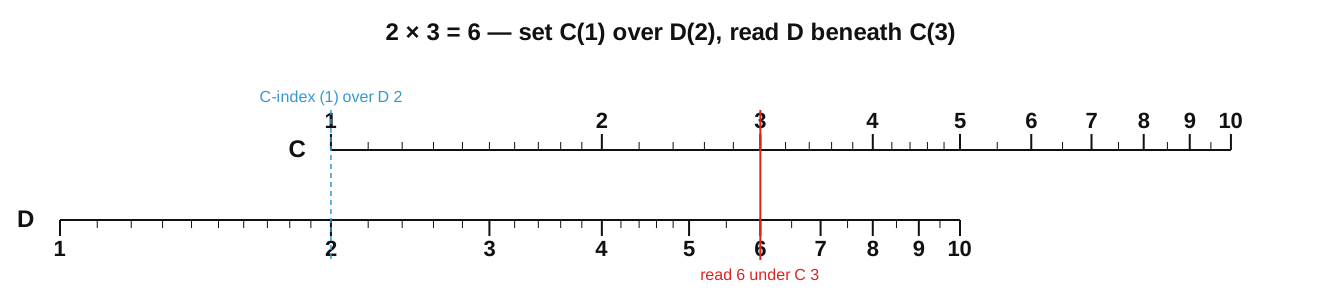
Figure 2 — Multiplying 2 × 3 = 6. The left index of C is set over 2 on D; reading down from 3 on C gives 6 on D. The length log 2 and the length log 3 have been laid end to end, and their sum is log 6. Original diagram by the Slide Rules project.
2.3.2 Worked example: 2.5 × 3.5 = 8.75
The same method handles factors that are not whole numbers; you simply read between the graduations (Vol 1 covers this interpolation).
- Set the left index of C over 2.5 on D.
- Move the hairline to 3.5 on C.
- Read D under the hairline. The hairline lands just short of the 9 mark, on the graduation that reads 8.75.
A quick mental estimate — 2.5 × 3.5 is roughly 2½ × 3½ ≈ 9 — confirms both the digits and the decimal point. The rule supplies the figures 875; the estimate places the point to give 8.75.
2.4 Off-Scale Results and the Two Indices
Notice that in both examples above the product stayed on the D scale — it was less than 10, so the second factor on C still had D printed beneath it. That is not always so. When the running total of the two lengths exceeds the length of one decade, the second factor slides off the right-hand end of D and there is nothing to read. The fix is to start over from the other index.
2.4.1 Worked example: 4 × 5 = 20
- Try the left index of C over 4 on D. Reach for 5 on C — and it projects past the right end of D, into empty space. The product is off-scale.
- Reset using the right index. Place the right index of C (the right-hand 1) over 4 on D instead.
- Move the hairline to 5 on C. Now it falls comfortably over the D scale, on the graduation marked 2.
- Read 2 — and apply decade tracking to place the decimal point.
The rule shows the digit 2, but the answer is plainly not 2. Here the slide rule’s deliberate blindness to decimal points (Vol 1) puts the burden on the operator: a rough estimate, 4 × 5 ≈ 20, tells you the figure 2 means 20. A reliable habit is to track decades explicitly — a single-digit number times a single-digit number lands in the tens, so 4 × 5 → 20. The choice of index never changes the significant figures the rule reports; it changes only whether the answer is readable, and the operator always supplies the decimal point by estimation.
2.5 Division on C and D
Division reverses multiplication, so it reverses the procedure — instead of adding two lengths, the rule subtracts one from another:
- Move the cursor to the dividend on D.
- Slide the divisor on C under the hairline (so the divisor on C sits over the dividend on D).
- Read the quotient on D beneath the C index.
Step 2 subtracts log(divisor) from log(dividend); the index then points at the number whose logarithm is the difference — the quotient.
2.5.1 Worked example: 8 ÷ 2 = 4
- Set the cursor on 8 on D.
- Slide the strip until 2 on C lies under the hairline.
- Look to the left index of C: it now stands over 4 on D. Read 4.
2.5.2 Worked example: 7.5 ÷ 2.5 = 3
- Place the cursor on 7.5 on D.
- Slide 2.5 on C under the hairline.
- The left index of C now sits over 3 on D. Read 3.
In division the index does the reading, where in multiplication it did the setting — the two operations are mirror images. As with multiplication, a quick estimate fixes the decimal point: 7.5 ÷ 2.5 is about 3, so the figure 3 is the whole answer.
2.6 The CI Scale: Inverted C
Most rules carry a third scale that looks like C printed backwards. This is CI — C Inverted — a reciprocal scale that runs right to left, so the mark labelled 2 sits where C’s 5 would be, the 3 sits where C’s 3.33 would be, and so on. At any position, CI reads 1 ÷ (the value C reads there). Its most obvious use is to read reciprocals at a glance: set the cursor on a number on C and read its reciprocal directly above on CI.
Its more powerful use is in multiplication. Because dividing by 1/b is the same as multiplying by b, the CI scale lets you multiply with a division-style setup, and often keep the answer on-scale in a single setting — frequently avoiding the index reset that plain C and D would force.
2.6.1 Worked example: 4 × 5 = 20, using CI
Recall this product ran off the scale on plain C/D and demanded a reset to the right index. With CI it takes one setting:
- Move the cursor to 4 on D.
- Slide the strip until 5 on CI is under the hairline.
- Read the product on D beneath the C index that lands on the scale — here the left index of C sits over 2 on D.
- Apply decade tracking: 4 × 5 → 20.
Reaching the same answer without ever asking “which index?” is exactly why seasoned users keep returning to CI. It is also the foundation of efficient three-factor products, where alternating between C and CI keeps the slide travelling in one direction.
2.7 The Folded Scales: CF and DF
A different remedy for off-scale results is built into the folded scales, CF and DF, found on most duplex and many simplex rules. CF and DF are just C and D, but “cut” and rejoined at π so that π sits at the centre instead of 1 at the ends. They move in lockstep with C and D — CF rides the slide with C, DF is fixed with D — and at every position DF reads exactly π times what D reads directly below it.
This buys two things. First, multiplying by π is instant: set the cursor on any number on D and read π times that number straight across on DF (D = 2 gives DF = 6.28, and so on). Second, and more often used, the fold guarantees that whenever a product falls off the end of D, it is on-scale on DF — so you can read it from the folded scale in the same setting, with no reset to the other index.
2.7.1 Worked example: 2.5 × 6 = 15, read from DF
On plain C/D this product (15, greater than 10) runs off the right end of D and would force a switch to the right index. The folded scales avoid that:
- Set the left index of C over 2.5 on D, exactly as for an ordinary multiplication.
- Reach for 6 on C — it is off the end of D. Instead, move the cursor to 6 on CF.
- Read the answer on DF under the hairline: 15.
Because CF and DF are both shifted by the same log π, the fold cancels out of the product and DF delivers the true answer, 15, while D was still off-scale. The folded scales and the CI scale solve the same nuisance — the off-scale reset — by different means, and a fluent operator chooses whichever keeps the slide moving least.
2.8 Chained Calculations
The slide rule’s greatest practical virtue is that results need not be written down between steps. The cursor holds a partial result while the slide repositions for the next operation, so a string of multiplications and divisions flows continuously. The classic pattern is a × b ÷ c, and the trick is to interleave the divide with the multiply — doing the division first keeps the running value small and on-scale.
2.8.1 Worked example: 3 × 4 ÷ 6 = 2
Read this as (3 ÷ 6) × 4:
- Move the cursor to 3 on D (the first factor).
- Slide 6 on C under the hairline. The rule has now formed 3 ÷ 6 = 0.5, but do not read it — leave the slide where it is.
- Move the cursor to 4 on C (the next factor).
- Read the result on D beneath the hairline: 2.
No intermediate value was written, and the answer never left the scale. A check confirms it: 3 × 4 = 12, and 12 ÷ 6 = 2. Doing the divide first (3 ÷ 6 = 0.5) kept every partial result on-scale; had the chain been attempted as 3 × 4 first, the 12 would have run off D and demanded a reset before the division could even begin. Choosing the order of operations to keep the slide on-scale is the central craft of chained work.
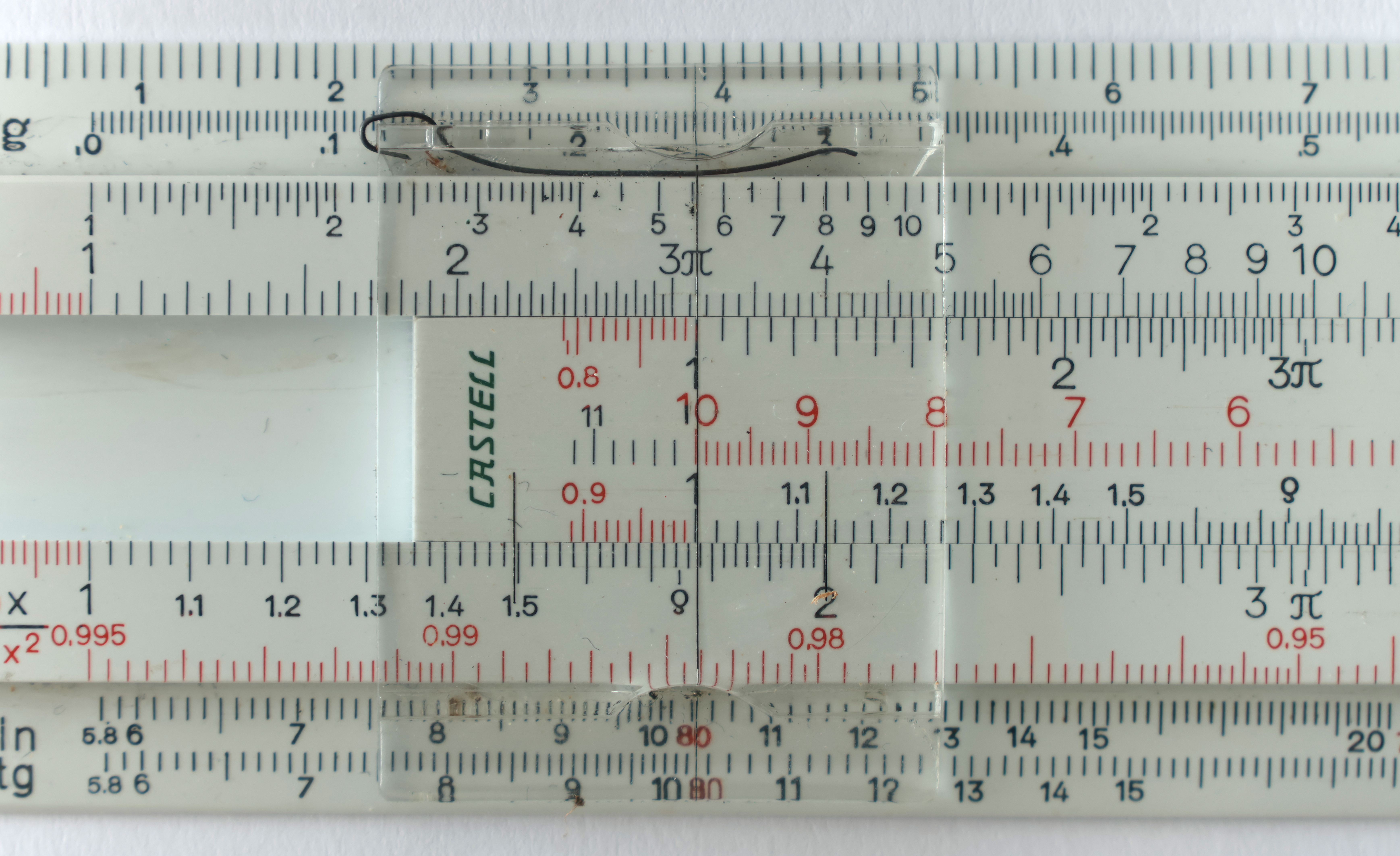
Figure 3 — A close-up of the C (slide) and D (body) scales that carry every operation in this volume, with the cursor hairline poised to transfer a reading between them. Photo: File:Faber Castell 67 54 Darmstadt slide rule 1.jpg by Slashme. License: CC0 (http://creativecommons.org/publicdomain/zero/1.0/deed.en). Via Wikimedia Commons (https://commons.wikimedia.org/wiki/File%3AFaber%20Castell%2067%2054%20Darmstadt%20slide%20rule%201.jpg).

2.9 Putting It Together
With C and D alone, every multiplication and division is within reach; the only real decisions are which index to set and how to track the decimal point by estimate. The CI scale collapses an index reset into a single setting and turns reciprocal-heavy work into ordinary multiplication; the folded CF and DF scales catch off-scale products without a reset and make multiplication by π trivial; and chaining ties the whole repertoire into one fluid motion of cursor and slide. These same C and D scales are also the staging ground for squares, cubes, and roots — the subject of Vol 3 — but the reading habits built here, especially decade tracking and on-scale planning, carry forward to every scale on the rule.
Sources
- International Slide Rule Museum — Illustrated Self-Guided Course on How to Use the Slide Rule and scale references (https://www.sliderulemuseum.com).
- The Oughtred Society — Slide Rule Reference Manual and introductory guides (https://www.oughtred.org).
- Keuffel & Esser, Manual for K&E Slide Rules; Faber-Castell and Pickett instruction manuals (classic maker manuals).
- All worked examples were re-derived from the logarithmic positions of the scales and checked arithmetically by hand.
Comments (0)