Using Slide Rules · Volume 4
Using a Slide Rule — Volume 4 — Trigonometry and Logarithms
Sines, tangents, small angles, and reading common logarithms straight off the rule
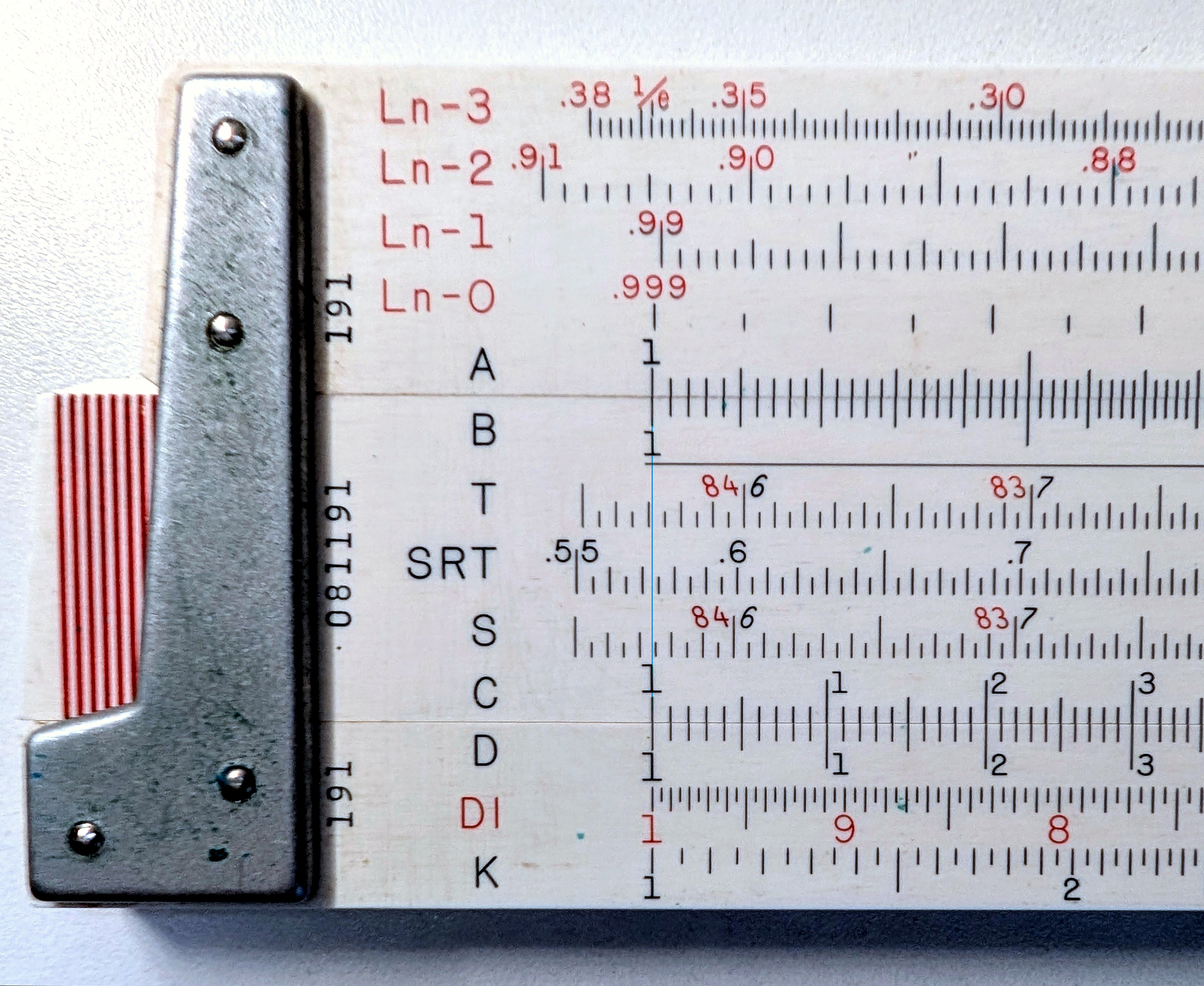
Figure 1 — The trig family in the metal: the S (sine), T (tangent), and combined ST/SRT (small-angle) scales on a K&E Decilon, with the C and D scales they read against. Photo: “K&E Decilon slide rule left end with SRT scale” by Dicklyon is licensed under CC BY-SA 4.0. To view a copy of this license, visit https://creativecommons.org/licenses/by-sa/4.0/.
4.1 About This Volume
The first three volumes of this unit handled pure numbers: multiplying and dividing on C and D (Vol 2), squaring and rooting on A/B and K, and raising to arbitrary powers on the log-log scales (Vol 3). This volume turns to the two remaining families that almost every general-purpose rule carries — the trigonometric scales (S, T, and the small-angle ST or SRT scale) and the L scale, which delivers common (base-10) logarithms directly. The unifying trick is the same one that makes the whole instrument work: a trig scale is just a C/D-style logarithmic scale whose graduations are labelled in degrees instead of in the value of the function, so that the function’s value can be read on the ordinary C or D scale opposite the angle. The L scale is the one exception — it is deliberately not logarithmic, and the reason why is the most instructive idea in the volume.
4.1.1 Depth-Index: The Five-Volume How-To Unit
Table 1 — Depth-Index: The Five-Volume How-To Unit
| Vol | Title | Primary Content |
|---|---|---|
| 1 | Anatomy and the Logarithmic Principle | Parts, why sliding multiplies, reading, sig figs, decimals |
| 2 | Multiplication and Division | C/D, chaining, CI, folded CF/DF, off-scale |
| 3 | Powers and Roots | A/B, K, the log-log (LL) scales, eˣ |
| 4 | Trigonometry and Logarithms (this volume) | S, ST, T scales, the L mantissa scale, gauge marks |
| 5 | Reading Circular and Cylindrical Rules | Wrap-around and spiral scales; Fowler, Otis King, Fuller |
Note — Cross-references appear as “see Vol N.” Each volume is self-contained; this one assumes only that the reader can set the cursor and read C/D to three figures (Vol 1–2).
4.2 The S Scale: Sines Read Directly
The S scale is graduated in degrees and is used to find the sine of an angle. On a typical Mannheim or duplex rule it runs from about 5.74° at one end to 90° at the other. That lower limit is not arbitrary: 5.74° is the angle whose sine is exactly 0.1, and 90° is the angle whose sine is 1.0. The S scale therefore spans exactly the decade of sine values from 0.1 to 1.0 — which is precisely one full length of the C/D scale. The two are made to register against each other.
To take a sine, set the cursor hairline over the angle on S and read the sine on the C scale (on a duplex rule the S scale is often printed to read against C directly; on a simplex rule it lives on the slide and is read against D). The decimal point follows a fixed rule: for any angle the S scale can show, the sine lies between 0.1 and 1.0, so the reading is always “0.something.”
Worked example — sin 30°. Place the hairline on 30 on the S scale and read 0.500 on C. The exact value is 0.5 — the slide rule gives it on the nose.
Worked example — sin 45°. Move the hairline to 45 on S; the C scale reads about 0.707. The exact value is 0.70711, so the three-figure rule answer of 0.707 is correct to the rule’s full precision.
Because sin 90° = 1.0, the 90° mark sits exactly opposite the C index (the “1”). This is a useful sanity check: if the right end of the S scale does not line up with the C index, the cursor or slide has drifted.
4.2.1 Cosines on the same scale
A separate cosine scale is rarely provided, because none is needed. The complementary-angle identity
cos θ = sin(90° − θ)
means any cosine is the sine of the complement. To find cos 60°, read sin 30° = 0.500 (and indeed cos 60° = 0.5). For this reason most S scales are dual-numbered: a second set of figures runs in the opposite direction, increasing from right to left, so that the same graduation that says “30” for sines also says “60” for cosines. The user simply reads the figures that climb the way the angle climbs — black for sine, red (or the reversed set) for cosine on most rules. Either way, the value still comes off C between 0.1 and 1.0.
4.3 The T Scale: Tangents
The T scale does for tangents what S does for sines, and it is built the same way: graduated in degrees, read against C/D. A single T scale typically runs from about 5.71° (the angle whose tangent is 0.1) to 45° (whose tangent is exactly 1.0). Over that span the tangent climbs from 0.1 to 1.0 — again one decade, again one C/D length — and the reading is “0.something.”
Worked example — tan 30°. Hairline on 30 on T, read 0.577 on C. The exact value is 0.57735; the rule’s 0.577 is right to three figures.
Worked example — tan 45°. Hairline on 45 on T; C reads 1.00. Exactly correct: tan 45° = 1, and the 45° mark sits over the C index.
4.3.1 Tangents above 45°
Past 45° the tangent exceeds 1.0 and grows without bound (tan 90° is infinite), so it cannot share the 0.1-to-1.0 decade. Two conventions handle the upper range:
- The reciprocal (CI) method. Because tan θ = 1 ÷ tan(90° − θ) = 1 ÷ cot θ, a tangent above 45° equals the reciprocal of the tangent of its complement. To get tan 60°, find tan 30° = 0.577 and take its reciprocal on the CI scale (see Vol 2), giving 1.732 — the correct value of tan 60°. Equivalently, read the complement’s tangent on C and invert by inspection.
- A second T marking. Many rules print the T scale dual-numbered, exactly like S, with a second set of figures from 45° to about 84.29° (the angle whose tangent is 10). The user reads these against the CI scale (or a reciprocal-labelled set), so the answer comes out between 1 and 10 directly, no inversion needed.
Either way the principle is the same: angles and their complements are mirror images about 45°, and the reciprocal relationship lets a single decade of graduations serve both halves.
4.4 The ST (or SRT) Scale: Small Angles
For angles below about 5.7° both the S and T scales would run off their low ends, and a special scale takes over: the ST scale (sometimes printed SRT, for sine–radian–tangent). It covers roughly 0.57° to 5.7° — the range in which a remarkable simplification holds.
For a small angle θ measured in radians, both sin θ and tan θ are very nearly equal to θ itself. At the top of the range the agreement is already good and it improves rapidly as the angle shrinks. This is why one scale can serve sine, tangent, and radian conversion at once: in this band the three are interchangeable to slide-rule precision.
Worked example — sin 1°. First convert: 1° = π ÷ 180 ≈ 0.017453 radian. The ST scale reads about 0.01745, and that single figure is simultaneously sin 1° (0.0174524), tan 1° (0.0174551), and the angle in radians (0.0174533) — the three differ only in the fifth decimal place, far beyond what the rule can show. Set the hairline on 1 on ST and read 0.01745 on C; the decimal is fixed because every angle on ST has a sine and tangent between 0.01 and 0.1.
The “R” in SRT advertises the radian use directly: setting an angle in degrees on ST and reading C gives that angle in radians, which is handy whenever a formula expects radians rather than degrees.
4.5 The L Scale: Common Logarithms, Read Off the Rule
Every other scale discussed so far is logarithmic — its graduations are spaced by logarithms so that lengths add. The L scale is the opposite: it is uniform, divided into equal parts from 0 to 1 like an ordinary ruler. That is exactly what makes it useful, because the position of a number along the logarithmic D scale already is that number’s logarithm, expressed as a fraction of the scale length. Lay a plain linear scale of 0-to-1 alongside D and it reads that fraction off directly. The L scale is that linear companion.
To find a common (base-10) logarithm, set the cursor over the number on the D scale and read the mantissa — the decimal part of the log — on the L scale. (On many rules L is on the slide and is read against D; on others it is a stator scale read against the D-side hairline. Either way the pairing is D ↔ L.)
Worked example — log 2. Hairline on 2 on D; L reads 0.301. The exact value is log₁₀ 2 = 0.30103, so 0.301 is correct to three figures.
Worked example — log 5. Hairline on 5 on D; L reads 0.699. The exact value is 0.69897. Note the tidy check: log 2 + log 5 = log 10 = 1, and indeed 0.301 + 0.699 = 1.000.
4.5.1 Supplying the characteristic
The L scale gives only the mantissa (the fractional part); the integer part — the characteristic — is supplied by inspection from the size of the number, using the ordinary rules of logarithms:
- A number from 1 to 10 has characteristic 0: log 2 = 0.301.
- A number from 10 to 100 has characteristic 1: log 20 = 1.301.
- A number from 100 to 1000 has characteristic 2: log 200 = 2.301.
- A number below 1 has a negative characteristic: log 0.2 = −1 + 0.301, usually written 9.301 − 10 or 1̄.301.
The mantissa is identical for 2, 20, 200, and 0.002 — only the characteristic changes — which is exactly why the rule needs to read the mantissa only once. Running the process backwards (set a mantissa on L, read the digits on D, then place the decimal by the characteristic) gives the antilogarithm, turning the L scale into a two-way bridge between a number and its logarithm.
4.6 Decimal and Quadrant Care for Trig
The trig scales are forgiving about the decimal point because each one spans a known, fixed decade of output values: S gives 0.1 to 1.0, T (lower range) gives 0.1 to 1.0, and ST gives roughly 0.01 to 0.1. Within those bands the leading zero and decimal place are not in doubt. The cautions are about which value and which units:
- Degrees, not radians, on S and T. The angle graduations are degrees (often with a minutes subdivision). When a formula is stated in radians, convert first — or read the angle’s radian value off ST/SRT for small angles, or divide by the radian gauge mark (below).
- Pick the right set of figures. On dual-numbered S and T scales it is easy to read the cosine figures when the sine was wanted, or the above-45° tangent set when the below-45° set was intended. Confirm that the value is plausible: sines and below-45° tangents must come out less than 1; cosines fall as the angle rises; tangents above 45° exceed 1.
- Quadrant. The scales cover only 0°–90°. Angles in other quadrants are reduced to a first-quadrant equivalent first (for example sin 150° = sin 30°), and the sign is applied by hand — the rule carries magnitudes, not signs.
4.7 Gauge Marks
Most rules carry a few special tick marks, called gauge marks, that stand for constants used so often they earn a permanent home on the scale.
- π ≈ 3.1416 appears on the C and D scales (and usually on A/B). Its purpose is to fold a multiply-by-π into a single setting. Worked example — circumference of a 4-unit-diameter circle. Circumference = π × d. Set the C index over 4 on D, slide the hairline to the π mark on C, and read 12.57 on D (π × 4 = 12.566). One motion, no separate entry of 3.1416.
- ρ′ ≈ 3438 (rho-prime) is the number of arc-minutes in one radian — exactly 10800 ÷ π = 3437.75, rounded to 3438. Dividing a small angle expressed in minutes by ρ′ converts it to radians (and hence, in the small-angle band, to its sine or tangent). It is the minutes-based companion to the ST scale.
- ρ″ ≈ 206265 (rho-double-prime) is the same idea for arc-seconds in one radian (648000 ÷ π = 206264.8), used in astronomy and surveying where angles are quoted in seconds of arc.
- R and the C/C₁ or ”↑/↓” marks. Some rules add a radian mark “R” (placed so that setting it converts degrees to radians) and reciprocal/index marks such as C₁ to ease folded or reciprocal work. Their labelling varies by maker; the rule’s own manual is the authority on which is which.
The common thread is convenience: a gauge mark is simply a constant pre-positioned on the scale so that a frequent multiplication or unit conversion becomes a single cursor move rather than a separate calculation.
Sources
- International Slide Rule Museum — scale descriptions and the Illustrated Self-Guide to the Slide Rule (https://sliderulemuseum.com).
- The Oughtred Society — Slide Rule Reference Manual and introductory guides to the trigonometric and L scales (https://www.oughtred.org).
- Keuffel & Esser, Manual for K&E Slide Rules (Decitrig and Decilon series), and Pickett, How to Use Trig, Log-Log Slide Rules — manufacturer manuals describing S, T, ST/SRT, L, and the gauge marks.
- Standard trigonometric and logarithmic identities; all numerical results above (sin 30° = 0.5, sin 45° = 0.70711, tan 30° = 0.57735, tan 45° = 1, sin 1° ≈ 0.017452, log 2 = 0.30103, log 5 = 0.69897, π = 3.14159, ρ′ = 3437.75, ρ″ = 206264.8) were recomputed and rounded to slide-rule precision.
Where a procedure varies between makers (for example whether L and the trig scales read against C or against D, and how the above-45° tangent range is marked), the text notes the variation rather than asserting one maker’s convention as universal; consult the individual rule’s manual for its exact layout.
Comments (0)