Pickett N-515-T CIE Electronic · Volume 4
Pickett N-515-T Electronic (CIE) — Volume 4 — Working Electronics Problems, and Caring for the Rule
Reactance, resonance, decibels, parallel resistors and impedance on the N-515-T — then cleaning the painted aluminium, the cursor and the leather case
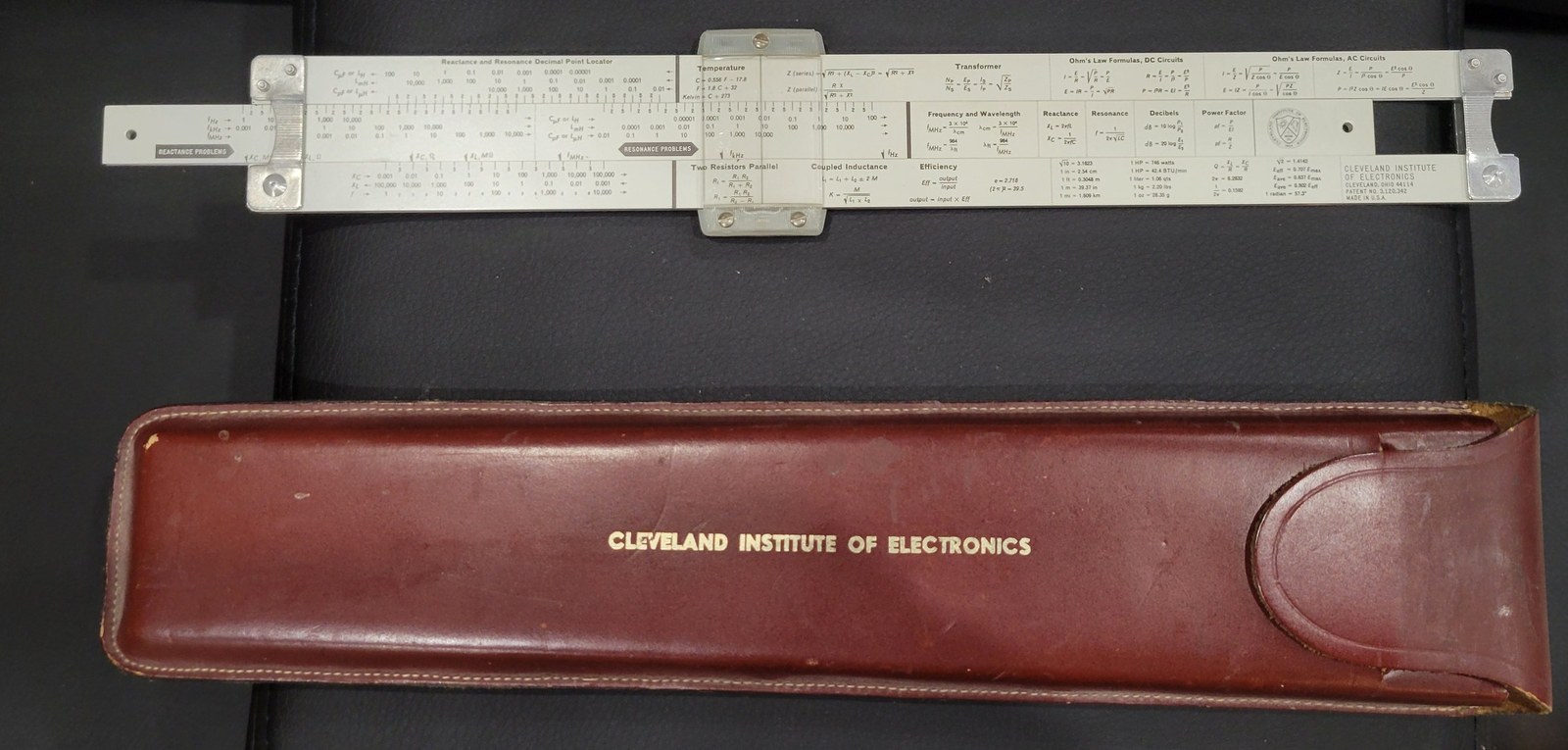
Figure 1 — My N-515-T, back face up, with its case. The working method of the CIE course uses both faces of the rule in every electronics problem: the front for the digits, the back for the decimal point. Photo: my own.
4.1 About This Volume
Volumes 2 and 3 described the two faces. This volume puts them to work on the problems the rule was designed for, in the order the CIE course teaches them, and then turns to looking after the rule: its painted aluminium faces, its plastic cursor and its leather case. Every worked figure here was checked by direct calculation; where an example comes from the CIE course, the course’s own answer is given alongside.
4.2 The Method: Front for Digits, Back for the Decimal Point
The course’s procedure for any reactance or resonance problem has two stages:
- Front face — set the problem on the 2π, CI, H, B, C and D scales and read the significant figures of the answer.
- Back face — set the same problem roughly on the decimal point locator and read its order of magnitude in the unit wanted. Place the decimal point in the front-face digits so that the answer agrees.
The order does not matter; the course often does the locator first. For ordinary multiplication, division, squares and logarithms, the rule is used like any other ten-inch rule, with the decimal point placed by rough estimation (see Using Slide Rules, Vol 1).
Recall the three reactance rules from Volume 2: frequency on the 2π scale (fx); inductance or capacitance on CI (Lx or Cx); inductive reactance on D at the C index (XL), capacitive reactance on C at the D index (XC).
4.3 Reactance Problems
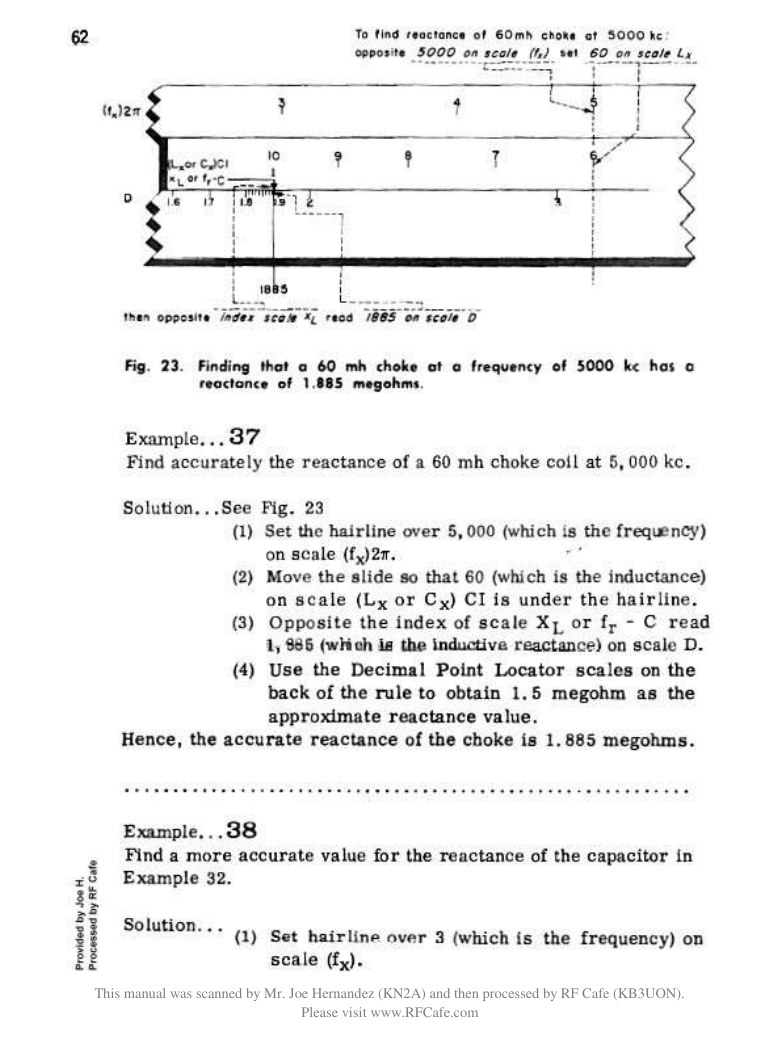
Figure 2 — Part III, page 62: the front-face setting for the reactance of a 60 mH choke at 5,000 kc — hairline over 5 on the (fx) 2π scale, 6 on (Lx or Cx) CI under the hairline, and 1885 read on D at the C index. Image: Cleveland Institute of Electronics, Electronics and Your Slide Rule, Part III, scanned by Joe Hernandez (KN2A), via RF Cafe, https://www.rfcafe.com/references/electrical/Cleveland-Institute-515-T-Slide-Rule-Manuals.htm.
4.3.1 Inductive reactance of a choke (course Example 37)
Problem: the reactance of a 60 mH choke at 5 MHz.
- Set the hairline over 5 on the 2π scale (the frequency, 5,000 kHz).
- Move the slide so that 6 (the 60 mH) on CI is under the hairline.
- Read on D opposite the C index (marked XL): 1885.
- On the back, set the XL problem roughly on the locator: it reads about 1.5 MΩ.
Answer: 1.885 MΩ. Check: XL = 2π × 5 × 10⁶ × 0.060 = 1,884,956 Ω.
4.3.2 Inductive reactance of a small coil
Problem: the reactance of a 2.5 mH coil at 1 kHz.
- Hairline over 1 on the 2π scale.
- 2.5 on CI under the hairline.
- Read on D at the C index: 1571.
- Rough check: 2π × 1,000 × 0.0025 is about 6 × 2.5 = 15.
Answer: 15.7 Ω. Check: 2π × 1,000 × 0.0025 = 15.708 Ω.
4.3.3 Capacitive reactance (course Example 38)
Problem: the reactance of a 0.005 µF capacitor at 3 MHz.
- Hairline over 3 on the 2π scale.
- 5 (the 0.005 µF) on CI under the hairline.
- Read on C opposite the D index (marked XC): 1061.
- The locator (Volume 3) gave about 10 Ω.
Answer: 10.61 Ω. Check: 1 / (2π × 3 × 10⁶ × 5 × 10⁻⁹) = 10.610 Ω.
4.3.4 Capacitive reactance at mains frequency
Problem: the reactance of a 0.1 µF capacitor at 60 Hz.
- Hairline over 6 on the 2π scale.
- 1 on CI under the hairline.
- Read on C opposite the D index: 2653.
- Rough check: 2πfC = 377 × 10⁻⁷ ≈ 3.8 × 10⁻⁵, whose reciprocal is about 26,000.
Answer: 26,500 Ω (26.5 kΩ). Check: 1 / (2π × 60 × 0.1 × 10⁻⁶) = 26,526 Ω.
4.3.5 Working backwards (course Examples 39 and 40)
The same three rules work in any direction. Find L for 4 MΩ of reactance at 3,000 kHz: hairline over 3 on the 2π scale; move the slide so that the right index of C (XL) stands over 4 on D; read 212 on CI under the hairline. The locator says about 0.3 H, so L = 0.212 H. (Check: 4 × 10⁶ / (2π × 3 × 10⁶) = 0.2122 H.) Find f at which 200 pF has 25 Ω of reactance: set the left index of D opposite 25 on C (XC); set the hairline over 2 (the 200 pF) on CI; read 318 on the 2π scale. The locator says about 30 MHz, so f = 31.8 MHz. (Check: 1 / (2π × 25 × 200 × 10⁻¹²) = 31.83 MHz.)
4.4 Resonance Problems
Resonance uses the H scale with B (Volume 2). With the C index (marked fr) set at the frequency on D, an inductance on H has its resonating capacitance on B under the hairline, and vice versa. Without a frequency, set L on H and C on B under the hairline and read the frequency on D at the C index.
4.4.1 Resonant frequency (course Example 43)
Problem: 40 mH in parallel with 0.03 µF; find the resonant frequency.
- Locator first: about 5 kHz (Volume 3).
- Set the hairline over 4 (the 40 mH) on H.
- Move the slide so that 3 (the 0.03 µF) on B is under the hairline.
- Read on D opposite the C index: 459 — or, if 3 was taken on the other half of B, 1453.
B and H are both two-cycle scales, so each number can be set in two places. The course’s rule is to keep the reading that agrees with the locator. 459 → 4,590 Hz agrees with “about 5 kHz”; 1,453 Hz or 14.5 kHz does not, and is spurious. (Check: 1 / (2π√(0.04 × 3 × 10⁻⁸)) = 4,594 Hz; the spurious reading is that × √10 = 14,529.)
Answer: 4.59 kHz.
4.4.2 Capacitance to resonate (course Example 42)
Problem: what capacitance resonates with 350 µH at 200 kHz?
- Set the left index of C (fr) opposite 2 (the 200 kHz) on D.
- Set the hairline over 35 (the 350 µH) on H.
- Read on B under the hairline: 181.
- The locator said about 0.003 µF.
Answer: 0.00181 µF (1,810 pF). Check: 1 / ((2π × 2 × 10⁵)² × 3.5 × 10⁻⁴) = 1.809 × 10⁻⁹ F.
4.4.3 Inductance for an IF transformer
Problem: a 455 kHz intermediate-frequency transformer is tuned by 100 pF; what inductance is needed?
- Set the C index (fr) opposite 4.55 on D.
- Set the hairline over 1 (the 100 pF) on B.
- Read on H under the hairline: 1224.
- Locator: with CpF = 100 and f = 455 kHz, L comes out at about 1,000 µH — so the digits 1224 mean 1,224 µH.
Answer: 1.22 mH. Check: 1 / ((2π × 455,000)² × 100 × 10⁻¹²) = 1.2235 × 10⁻³ H.
4.4.4 A broadcast-band tank
Problem: a 240 µH coil with a 365 pF variable capacitor at full mesh; what is the lowest frequency it tunes?
- Hairline over 24 on H; 365 on B under the hairline (taking the half of B that the locator supports).
- Read on D at the C index: 538.
- Locator: 240 µH with 365 pF resonates at about 500 kHz.
Answer: about 538 kHz, the bottom of the AM broadcast band. (Check: 1 / (2π√(240 × 10⁻⁶ × 365 × 10⁻¹²)) = 537.7 kHz.)
4.5 Other Everyday Problems
4.5.1 Decibels
The L scale, aligned with D, gives common logarithms; the back panel gives the formulas dB = 10 log (P₁/P₂) and dB = 20 log (E₁/E₂).
- Power ratio. An amplifier delivers 50 W for 2 W of drive. Ratio 50/2 = 25. Set the hairline over 2.5 on D, read 0.398 on L; the characteristic of 25 is 1, so log 25 = 1.398. Gain = 10 × 1.398 = 13.98 dB, about 14 dB. (Check: 10 log₁₀ 25 = 13.979.)
- Voltage ratio. A stage turns 0.5 V into 12 V. Ratio 24. Hairline over 2.4 on D, read 0.380 on L; log 24 = 1.380. Gain = 20 × 1.380 = 27.6 dB. (Check: 20 log₁₀ 24 = 27.604.)
4.5.2 Two resistors in parallel
The panel gives Rt = R₁R₂ / (R₁ + R₂). For 470 Ω ∥ 330 Ω: the sum is 800, so Rt = 470 × 330 / 800. Set the C index at 4.7 on D; move the hairline to 3.3 on C; move the slide so 8 on C is under the hairline; read 194 on D at the C index. The rough size is 500 × 300 / 800 ≈ 190. Answer: 194 Ω. (Check: 155,100 / 800 = 193.9.)
The second form, R₁ = RtR₂ / (R₂ − Rt), finds the resistor to put across an existing one. To bring 1,000 Ω down to 600 Ω: R₁ = 600 × 1,000 / 400. Set 4 on C over 6 on D and read 1.5 on D at the C index; the rough size is 600 × 1,000 / 400 ≈ 1,500. Answer: 1,500 Ω. (Check: 1,500 ∥ 1,000 = 1,500,000 / 2,500 = 600.)
4.5.3 Power in a load
How much power does a 470 Ω resistor dissipate across 120 V? The panel gives P = E²/R. Set the hairline over 1.2 on D; A reads 1.44 (the square). Divide by 4.7 with C and D — set 4.7 on B under the hairline over 1.44 on A and read 306 on A at the B index; rough size 14,400 / 470 ≈ 30. Answer: 30.6 W. (Check: 14,400 / 470 = 30.64.)
4.5.4 Impedance of a series circuit
A series circuit has R = 300 Ω and XL = 400 Ω. The phase angle θ satisfies tan θ = 400/300 = 1.333 — greater than 1, beyond the T scale’s 45°, so work with the complement: tan (90° − θ) = 300/400 = 0.75. With the slide’s indices level with D’s, set the hairline over 7.5 on C and read 36.9° on T, so θ = 53.1°. Then Z = XL / sin θ: the hairline over 53.1° on S reads sin θ = 0.800 on C, and 400 ÷ 0.800 on C and D gives 500. Answer: Z = 500 Ω, θ = 53.1°, power factor cos θ = 0.600. (Check: √(300² + 400²) = 500; arctan (4/3) = 53.13°; 300/500 = 0.6.) The panel’s pf = R/Z gives the same 0.6 directly.
4.6 Caring for the Rule
The N-515-T is unusually tolerant of the climate, as the 1967 advertisement claimed — aluminium does not swell, shrink or warp as wood and celluloid do — but its surface is not tough. Everything below follows from three facts about how it is made: the scales are printed onto a painted finish, the cursor is plastic, and the case is vegetable-tanned leather.
The first rule — a working, clean rule needs nothing. Collectors’ guidance consistently puts minimal intervention first: the safest cleaning is the least, and a rule in good order should be dusted and left alone.
4.6.1 The painted aluminium faces
The white finish and the black-and-red printing on it are the most vulnerable part of a Pickett. Pickett’s scales are printed directly on the finish, so anything abrasive — even slightly — will thin or remove graduations.
Do:
- Dust with a soft brush or a dry microfibre cloth.
- For grime, use water with a drop of mild dish soap, on a soft cloth wrung almost dry, a short length at a time; follow with a cloth dampened in plain water, and dry at once. A cotton bud reaches into the end braces and along the slide edges.
- Work along the length of the scales, not across them, with no more pressure than the cloth’s own weight.
Do not:
- Use any abrasive: no scouring pads or Scotch-Brite, no metal polish, no “magic eraser” melamine sponge, no toothpaste. A collector who tried a Scotch-Brite pad on a Pickett removed the scale markings along a section of the rule.
- Use solvents or ammonia cleaners on the faces. A window cleaner has been reported to dissolve a Pickett’s painted surface; acetone, lacquer thinner and similar solvents attack paint and printing inks.
- Try to “restore” chipped, corroded or peeling paint. Nothing reverses it, and cleaning around it lifts more.
- Soak the assembled rule. Some collectors immerse Pickett rules in mild soapy water, but water left under the end braces and in the slide channel invites corrosion of the aluminium and the steel screws and springs; a damp cloth does the same job with less risk.
4.6.2 The slide
A Pickett slide that sticks is usually suffering from grime or a little corrosion along the sliding edges, or from end braces clamped too tightly. Hold the rule by its ends, not the middle — pressure on the stators pinches the slide.
- Clean the slide’s edges and the stator grooves with a barely damp soapy cloth, then dry them.
- Lubricate sparingly, if at all. A dry PTFE (Teflon) lubricant applied to the clean grooves and worked through, with any excess wiped off the faces before it dries, is one collectors’ preference; a very thin film of petroleum jelly on the slide edge is the traditional alternative. Too much of either becomes gummy and collects grit. Keep all lubricants off the cursor — a wet Teflon lubricant has been reported to blister a Pickett cursor’s plastic.
- Adjust tension with the end-brace screws. Loosening them slightly eases a tight slide; the small tension springs under the braces, which give Picketts their slight drag and click, should be left in place.
- Take the rule apart only if necessary, and only after noting how the cursor and braces go back. If the end braces are removed, the two stators must be re-squared so that the C and D indices line up exactly when the slide is centred, before the screws are tightened.
4.6.3 The cursor
The lens is clear plastic, carried in moulded nylon bars; the hairline is on the plastic.
- Clean the lens with a soft cloth dampened in warm water with a trace of dish soap, then dry with a clean microfibre cloth. Most cursors clean well without removal.
- No solvents, no alcohol, no glass cleaners, no polishes. They craze, cloud or soften plastic and can remove the hairline. Do not scrub over the hairline.
- If the cursor must come off for cleaning, note which way round it goes. On reassembly the hairline must be square to the scales: set it on the C and D indices with the slide centred, check the same line at the far end, then tighten the screws evenly. Because the back-face locator needs only rough settings (Volume 3), alignment front-to-back is less critical than on an engineering duplex, but the front-face hairline must be square.
- Do not overtighten the small screws in nylon bars; they strip easily.
4.6.4 The leather case
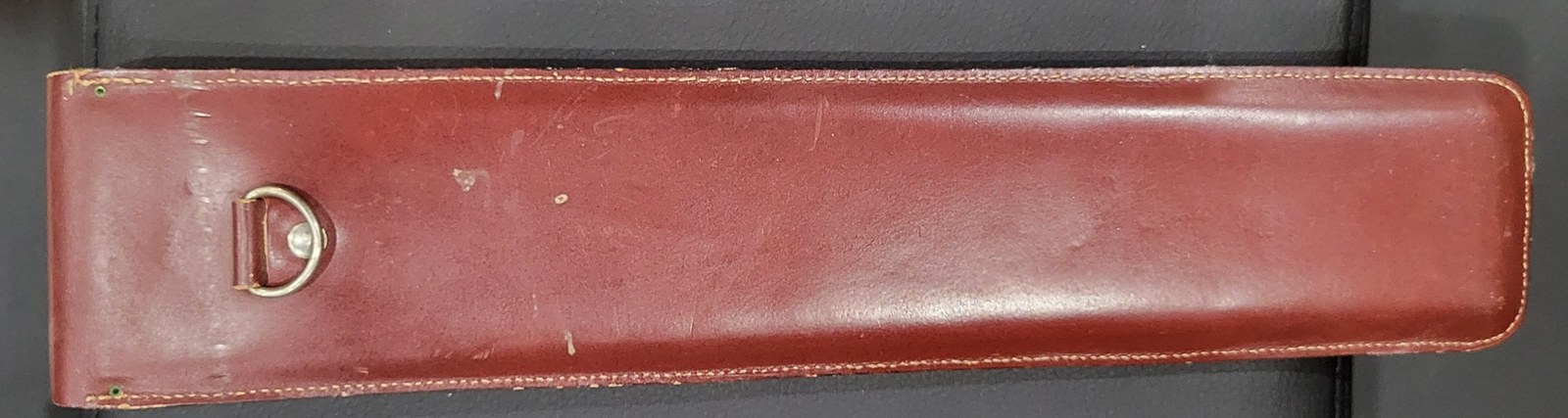
Figure 3 — The back of my case: burgundy top-grain leather, stitched round the edges, with a metal D-ring on a leather tab — the “removable belt loop” fitting that the 1967 advertisement mentions. The scuffs and light marks are typical of a case that has been carried. Photo: my own.
The CIE case is top-grain leather, with gold-stamped lettering, a “Quick-flip” cover and — according to the 1967 advertisement — a “heavy-duty plastic liner.” Museum practice for leather is conservative, and suits a case like this.
- Clean by dusting and, if needed, a cloth barely dampened with water, tested first in an inconspicuous place. Keep water and anything else off the gold stamping, which rubs away easily.
- Go easy on dressings. The Canadian Conservation Institute advises that current museum practice is to minimise the use of dressings, lubricants and cleaners on leather, because of their long-term harm; proper storage matters more. If a dry, stiff case is to be treated at all, use a very small amount of a conservation-grade leather product, tested first, and never neat’s-foot or other oils, which darken leather and stay sticky.
- Red rot. Vegetable-tanned leather can develop red rot, a powdery reddish surface caused by acidic air pollutants; once present it cannot be reversed, and the CCI warns against standard treatments on powdery leather. If a case sheds red powder, keep it dry, handle it little, and consult a conservator.
- Store the case somewhere cool, dark and of steady, moderate humidity — not a damp basement or a hot attic. Leather above roughly 65% relative humidity is at risk of mould.
- Store the rule out of the case for long periods, or check it regularly. Leather holds moisture and gives off acids as it ages, both bad for aluminium and for steel screws and springs; the plastic liner helps but does not seal. The case is for carrying and short-term protection.
- Check the D-ring and its rivet for corrosion; a little dry rubbing with a cloth is enough.
4.6.5 Storage and handling
- Store the rule flat or on edge, out of direct sunlight, which yellows the white finish and fades the red printing.
- Avoid extremes of heat; a car dashboard can soften the plastic cursor.
- Carry the rule in its case with the slide centred and the cursor near the middle, so neither is knocked at the ends.
Sources
- D. L. Geiger, Electronics and Your Slide Rule, Part III, Cleveland Institute of Electronics, October 1966 printing — Topics 26–29, Examples 37–43, the three reactance rules, the spurious H-scale reading (https://www.rfcafe.com/references/electrical/Cleveland-Institute-515-T-Slide-Rule-Manuals.htm). In this site’s Reference Library: Parts I, II, III, IV.
- Cleveland Institute of Electronics, advertisement, Electronics World, August 1967 — the case, liner, belt loop and “all-metal construction” (https://www.rfcafe.com/references/electronics-world/electronics-slide-rule-august-1967-electronics-world.htm).
- Sliderule.ca, “Cleaning Metal Slide Rules” (https://sliderule.ca/metal.htm) and “Cleaning and Caring for your Slide Rule” (https://sliderule.ca/cleaning.htm) — soap and water, the Scotch-Brite and window-cleaner warnings, lubricants, the Teflon-blistered cursor, end-brace tension springs, minimal intervention.
- Canadian Conservation Institute, Care of Alum, Vegetable, and Mineral-tanned Leather, CCI Notes 8/2 (https://www.canada.ca/en/conservation-institute/services/conservation-preservation-publications/canadian-conservation-institute-notes/care-alum-vegetable-mineral-leather.html); Basic Care of Books, CCI Notes 11/7 — red rot; Care of Rawhide and Semi-tanned Leather, CCI Notes 8/4 — mould above about 65% RH.
- Every worked figure was checked by direct calculation: XL(60 mH, 5 MHz) = 1,884,956 Ω; XL(2.5 mH, 1 kHz) = 15.708 Ω; XC(0.005 µF, 3 MHz) = 10.610 Ω; XC(0.1 µF, 60 Hz) = 26,526 Ω; L = 0.2122 H; f = 31.83 MHz; f₀(40 mH, 0.03 µF) = 4,594 Hz and × √10 = 14,529; C = 1.809 nF; L(455 kHz, 100 pF) = 1.2235 mH; f₀(240 µH, 365 pF) = 537.7 kHz; 10 log 25 = 13.979 dB; 20 log 24 = 27.604 dB; 470 ∥ 330 = 193.9 Ω; 1,500 ∥ 1,000 = 600 Ω; 120²/470 = 30.64 W; √(300² + 400²) = 500, arctan (4/3) = 53.13°.
Comments (0)