History · Volume 4
The Story of the Slide Rule — Volume 4 — Round and Cylindrical: The Pursuit of Precision
How curving the scale bought a fourth and fifth significant figure
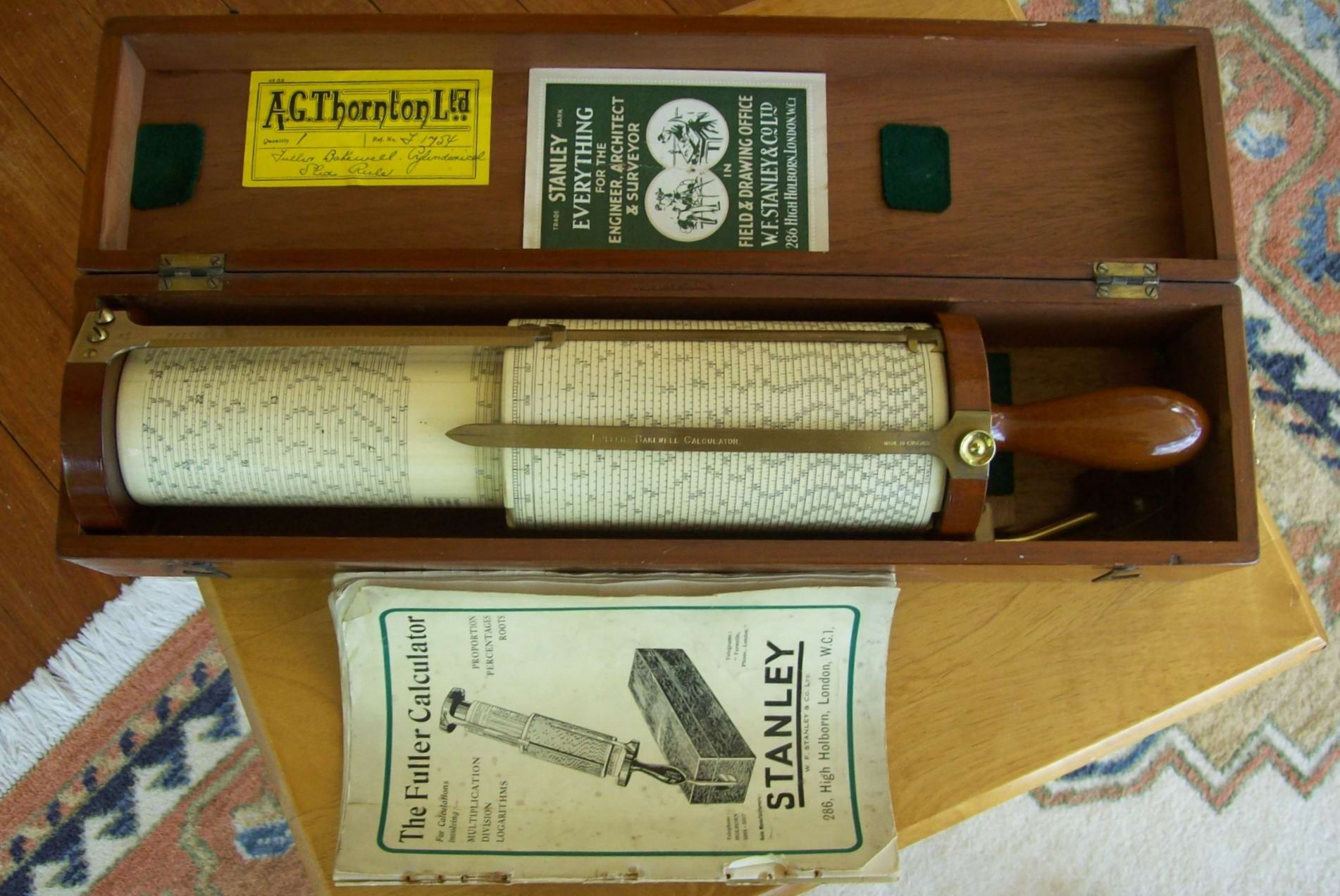
Figure 1 — George Fuller’s calculator: a single logarithmic line some 12.5 m long, wound as a helix around a sliding, rotating cylinder. Compressed into a pocketable instrument, that scale reads four to five significant figures — far beyond what any straight rule of the same bulk could manage. Image: “Fuller’s calculator in case” by Thincat is licensed under CC BY-SA 4.0. To view a copy of this license, visit https://creativecommons.org/licenses/by-sa/4.0/.
4.1 About This Volume
The standard straight slide rule is a compromise. A ten-inch (25 cm) Mannheim is light, cheap, and fast — and it reads to about three significant figures and no more. For most engineering that was plenty; the answer to a beam calculation rarely needs to be known better than one part in a thousand. But some users — surveyors, actuaries, precision engineers, anyone reducing money or land — wanted a fourth or even a fifth figure. This volume is about how instrument-makers gave it to them, not by inventing new mathematics but by a single mechanical trick: make the scale longer, then bend it so it still fits in a pocket. The straight line becomes a circle, a spiral, or a helix wound round a drum, and precision climbs with length.
4.1.1 Depth-Index: The Five-Volume History
Table 1 — Depth-Index: The Five-Volume History
| Vol | Title | Primary Content |
|---|---|---|
| 1 | Logarithms and the First Scales | Napier’s logarithms, Gunter’s line, Oughtred’s rectilinear and circular rules, the Oughtred–Delamain dispute |
| 2 | Specialized Rules and the Mannheim Standard | Coggeshall’s carpenter’s rule, the Soho engine rule, Everard’s gauging rule, Amédée Mannheim’s 1851 standardization and the cursor, boxwood to celluloid |
| 3 | The Golden Age and the Makers | The duplex rule, log-log scales, and the great firms — Keuffel & Esser, Faber-Castell, Nestler, Aristo, Pickett, Hemmi/Post, Thornton |
| 4 | Round and Cylindrical: The Pursuit of Precision (this volume) | Why a curved scale buys accuracy — Fowler, Gilson, Thacher, Fuller, Otis King |
| 5 | Decline and Legacy | The HP-35, Apollo’s Pickett, the collectors, and the Oughtred Society |
Note — Cross-references appear as “see Vol N §M.” Each volume is self-contained; this one assumes no prior reading.
4.2 The Length–Precision Bargain
Every slide rule answers a question by reading a position on a logarithmic scale, and how finely that position can be read depends on one thing above all: how much physical length the scale occupies. The full scale — the numbers 1 through 10 — is stretched across the whole rule, so a longer rule spreads those same numbers across more millimetres, leaving more room between the finest subdivisions.
The rule of thumb is simple. A 25 cm scale resolves to roughly three significant figures. To gain a fourth figure one needs about ten times the length — on the order of 2.5 m — and a fifth would demand 25 m. No one carries a two-metre ruler, let alone a twenty-five-metre one. So the question that drives this entire volume is purely geometric: how does one pack metres of scale into something that fits in a hand?
There is a second, quieter advantage to curving the scale, and it was understood from the very beginning. A straight rule has two ends, and a multiplication can run off one of them — the answer falls past the edge and the user must “reset,” shifting the slide a full scale-length and reading from the other index. A scale bent into a closed circle has no end. The result simply continues around the rim. Oughtred himself had seen this when he laid his logarithmic scales out as rotating concentric rings — his “circles of proportion” — in the 1620s (see Vol 1 §6). The circular form solved the off-scale nuisance three centuries before anyone needed five figures (Oughtred Society; Cajori, 1909). The makers in this volume took that old idea and pushed it for accuracy rather than mere convenience.
4.3 Circular Rules: The Pocket Watch That Calculates
The most natural way to bend a scale is into a single ring, and the most charming expression of that idea is the pocket-watch calculator — a circular slide rule built into a metal case the size and shape of a gentleman’s hunter watch, complete with a winding-style knob and a glazed face beneath which several concentric scales and one or more rotating pointers do the work.
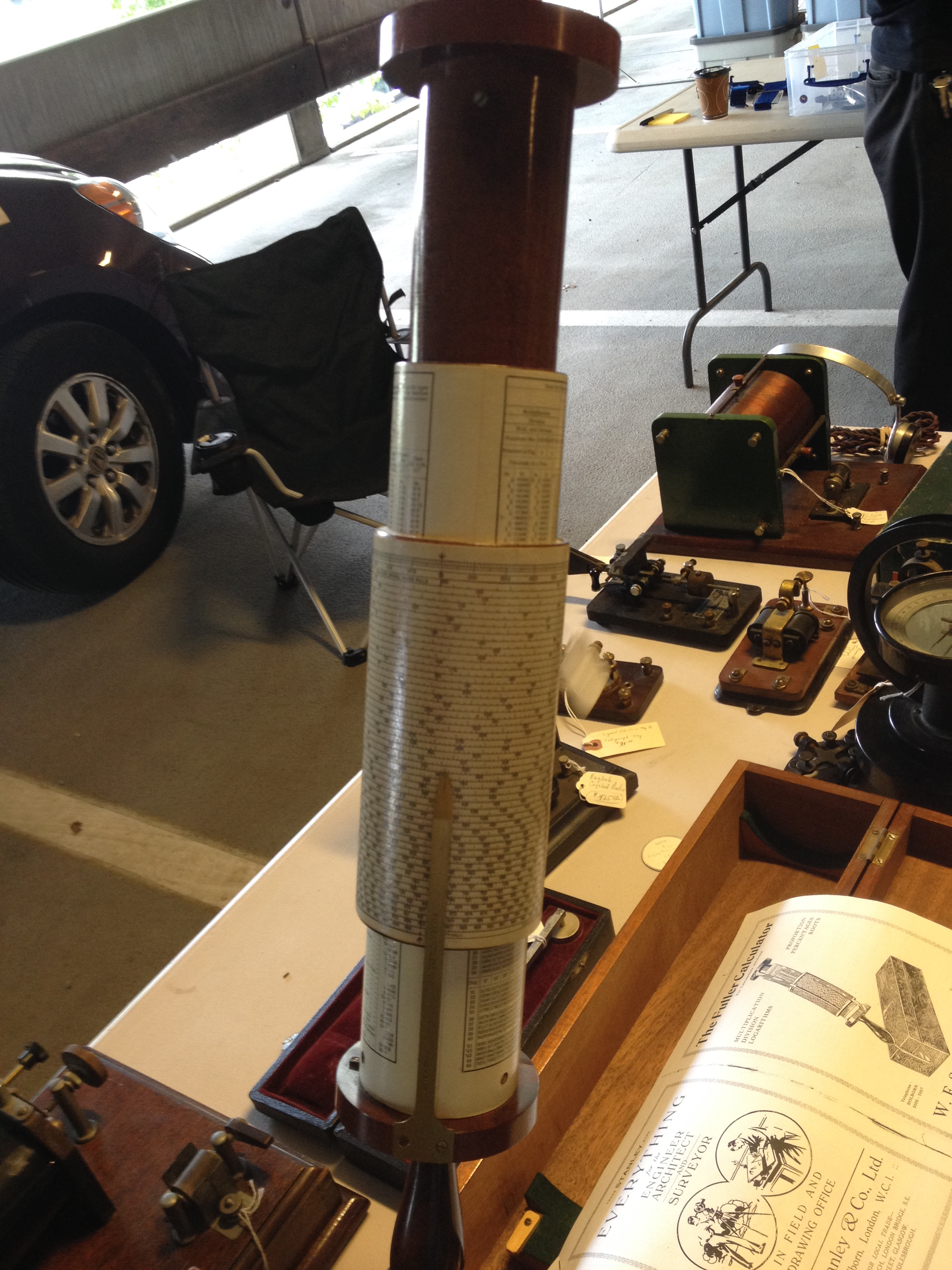
Figure 2 — A circular slide rule. Concentric logarithmic rings rotate about a common centre; a result never runs off the end because the scale closes on itself. The watch-format calculators of Boucher and Fowler shrank this geometry into a pocket case. (A later vintage circular rule stands in for the watch-format originals.) Image: File:Circular slide rule full at MIT flea.agr.jpg by ArnoldReinhold. License: CC BY-SA 4.0 (https://creativecommons.org/licenses/by-sa/4.0). Via Wikimedia Commons (https://commons.wikimedia.org/wiki/File%3ACircular%20slide%20rule%20full%20at%20MIT%20flea.agr.jpg).

The type is usually traced to the French Boucher calculator of the 1870s, a watch-form circular rule that sold widely on the Continent. In Britain the format is associated above all with Fowler & Co. of Manchester, founded by William Henry Fowler, who produced pocket-watch calculators from the late 1890s and refined them across many models well into the twentieth century (Hopp, 1999; Oughtred Society). Their appeal was compactness without sacrifice: by curling the scale into a ring and stacking several concentric rings on the dial, a Fowler packed a usefully long working scale — and several specialized scales besides — into a case that genuinely lived in a waistcoat pocket. The closed circle meant no resets, and the better Fowler models, by reading a single long circular scale, edged toward a fourth significant figure that an ordinary straight rule could not reach. (Fowler’s calculators are the subject of a dedicated unit elsewhere on this site.)
4.4 Spiral Scales: A Longer Line on the Same Disc
A single ring is limited by the diameter of the case: its scale can be no longer than the rim’s circumference. The way past that limit is to abandon the closed ring for a spiral — a logarithmic line that winds inward turn after turn, so that a disc only a few inches across can carry a scale many times its own circumference. Where a circle’s scale length is fixed by its one radius, a spiral’s length is the sum of all its coils.
The maker most identified with this approach in America was the Gilson Slide Rule Company, which from the late 1920s produced inexpensive aluminium dollar-watch-style circular rules in two broad families. The simpler Binary model offered ordinary circular multiplication and division; the more ambitious Atlas carried a long spiral scale that wound around the disc many times, giving it an effective scale length far greater than its modest diameter would suggest and pushing its readable precision toward five figures (International Slide Rule Museum; Hopp, 1999). The Gilson achieved this on a thin metal disc operated by two pivoting pointers — a remarkable amount of accuracy for a rule that often sold for around a dollar.
4.5 Cylindrical Instruments: Winding the Scale Around a Drum
The spiral solved the length problem in two dimensions; the next leap was to use the third. If the long logarithmic line is wound as a helix around a cylinder, or broken into many parallel strips printed along a cylinder’s length, the available scale becomes enormous — limited not by a disc’s diameter but by how many turns or strips the drum will hold. The cylindrical calculators were the high-precision instruments of their age, the tools reached for when a straight rule’s three figures genuinely would not do.
4.5.1 Edwin Thacher’s Calculating Instrument (patented 1881)
The American engineer Edwin Thacher patented his cylindrical calculating instrument in 1881, and it was manufactured in the United States by Keuffel & Esser. Thacher’s design takes the single long scale and slices it into a series of segments printed as parallel bars running the length of a cylinder; an outer cage of triangular bars slides and rotates over an inner drum, and aligning the two reads off the product. By unrolling one continuous scale into many short parallel runs, Thacher achieved an effective scale length on the order of tens of feet — commonly cited as equivalent to a straight rule roughly 60 ft (about 18 m) long — and with it a reliable four to five significant figures (International Slide Rule Museum; Oughtred Society). It was a desk instrument, heavy and substantial, and it found a home with engineers and in commercial offices where accuracy outranked portability.
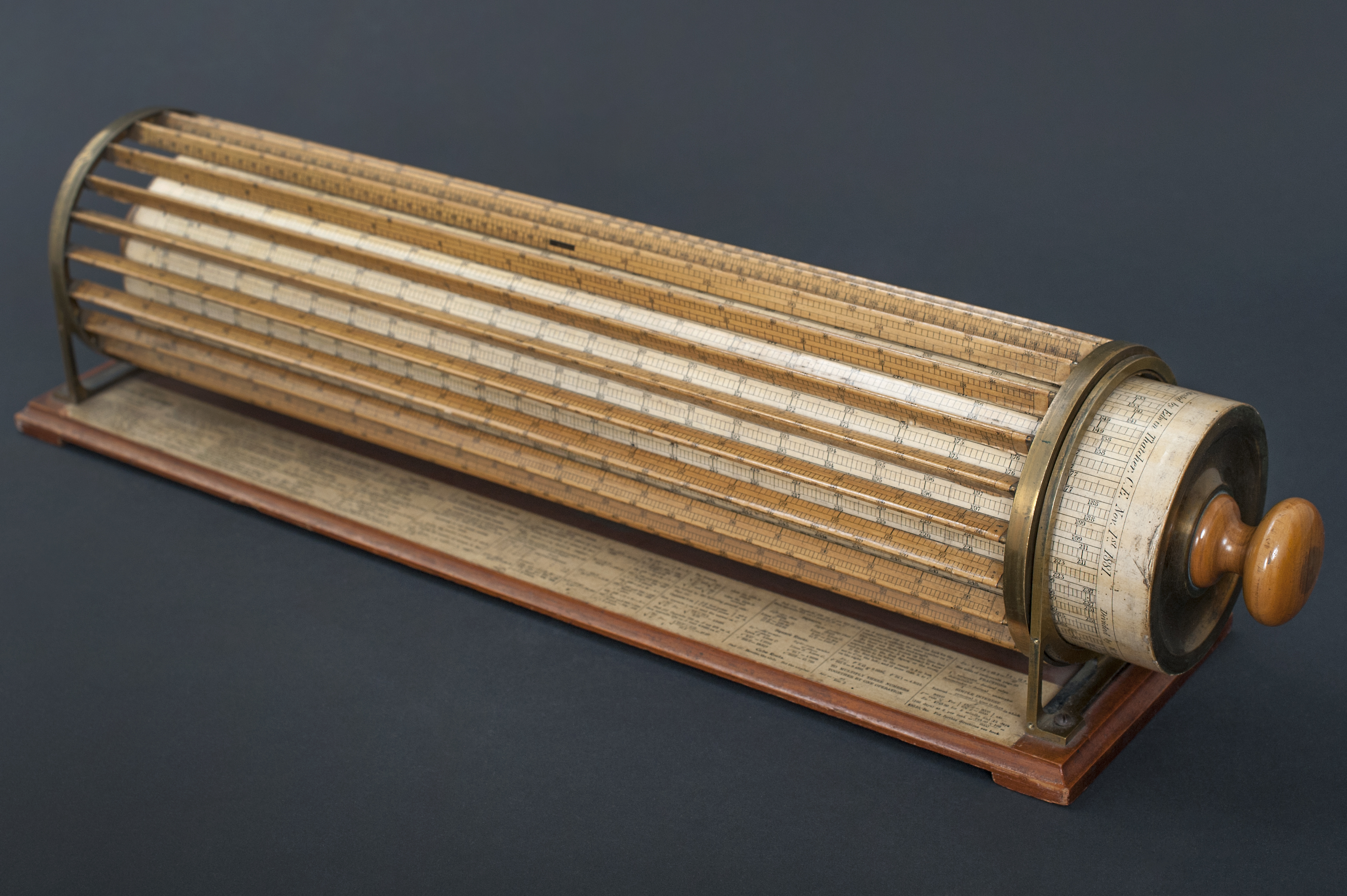
Figure 3 — The Thacher calculator (patented 1881, made by Keuffel & Esser): a single logarithmic scale broken into many parallel segments along a cylinder. The effective scale length, on the order of 18 m, yields four to five significant figures — the precision of a slide rule many feet long, on a desk-sized drum. Image: File:The Thacher Calculator (33148590206).jpg by The U.S. Food and Drug Administration. License: Public domain. Via Wikimedia Commons (https://commons.wikimedia.org/wiki/File%3AThe%20Thacher%20Calculator%20(33148590206).jpg).
.jpg)
4.5.2 George Fuller’s Calculator (patented 1878)
Across the Atlantic, George Fuller, professor of engineering at Queen’s College, Belfast, had patented his own cylindrical calculator in 1878, and it was manufactured by W. F. Stanley of London. Fuller chose the helix: a single continuous logarithmic scale, some 12.5 m (about 41 ft) long, spirals around a cylinder that the user slides and rotates within a holder, with two fixed index pointers to read against (Hopp, 1999; Oughtred Society). The result, shown in this volume’s Figure 1, is one of the most precise slide rules ever sold commercially — good for four to five significant figures — yet small enough to hold in two hands and operate like a telescope. The Fuller stayed in production, remarkably, into the 1970s, outliving most of its straight-ruled cousins because nothing else combined that precision with that portability. (The Fuller has its own dedicated unit on this site.)
4.5.3 The Otis King (Britain, c. 1920s)
The cylindrical idea reached its most pocketable form in the Otis King, designed by Otis Carter Formby King and made by Carbic Ltd of London from about the early 1920s. It is a true pocket cylinder: two cylinders that slide and twist within one another, the working scale a helix roughly 66 in (about 1.7 m) long wound around a tube the size of a fat fountain pen (Hopp, 1999; International Slide Rule Museum). That helical scale — nearly seven times the length of a standard straight rule — lifts the Otis King to about four significant figures while remaining small enough to clip into a jacket pocket. Two models were common: one for multiplication and division, and one adding a log scale for powers and roots. It was, in effect, a Fuller’s precision miniaturized to the size of a cigar. (The Otis King, too, is treated in its own unit.)
4.6 Why It Mattered
The round and cylindrical rules were never the everyday workhorses; the straight Mannheim and the log-log duplex (see Vol 3) outsold them many times over because three figures and a feather’s weight suited most work. But the curved instruments mark the outer reach of what mechanical computation could do before electronics. They show, in brass and aluminium and celluloid, the iron link between scale length and precision — and the ingenuity with which makers defeated the tyranny of the pocket. Bend the line into a ring and it never runs out; coil it into a spiral and a disc holds a yard of scale; wind it into a helix and a hand-held drum rivals a ruler forty feet long. The Fowler in its watch case, the Gilson on its dollar disc, and the Thacher, Fuller, and Otis King on their cylinders are the direct ancestors of the dedicated per-rule units elsewhere on this site — and the proof that the pursuit of one more significant figure was, for three centuries, a problem of geometry rather than arithmetic.
Sources
- Cajori, F. (1909). A History of the Logarithmic Slide Rule and Allied Instruments. New York: Engineering News Publishing.
- Hopp, P. M. (1999). Slide Rules: Their History, Models, and Makers. Mendham, NJ: Astragal Press.
- The Oughtred Society — Slide Rule History (https://www.oughtred.org/history.shtml).
- International Slide Rule Museum — Circular and Cylindrical Slide Rules (https://www.sliderulemuseum.com/).
- Fuller calculator and Thacher calculator, Science Museum Group Collection (https://collection.sciencemuseumgroup.org.uk/).
Specific dates and attributions above are drawn from these sources. Effective-scale-length and significant-figure figures are approximate and vary by model and by how each source measures them; where a value is a round estimate the text says “about” or “on the order of.”
Comments (0)