History · Volume 3
The Story of the Slide Rule — Volume 3 — The Golden Age and the Makers
How the duplex rule and log-log scales turned a tradesman's tool into the engineer's universal instrument (c. 1850–1970)
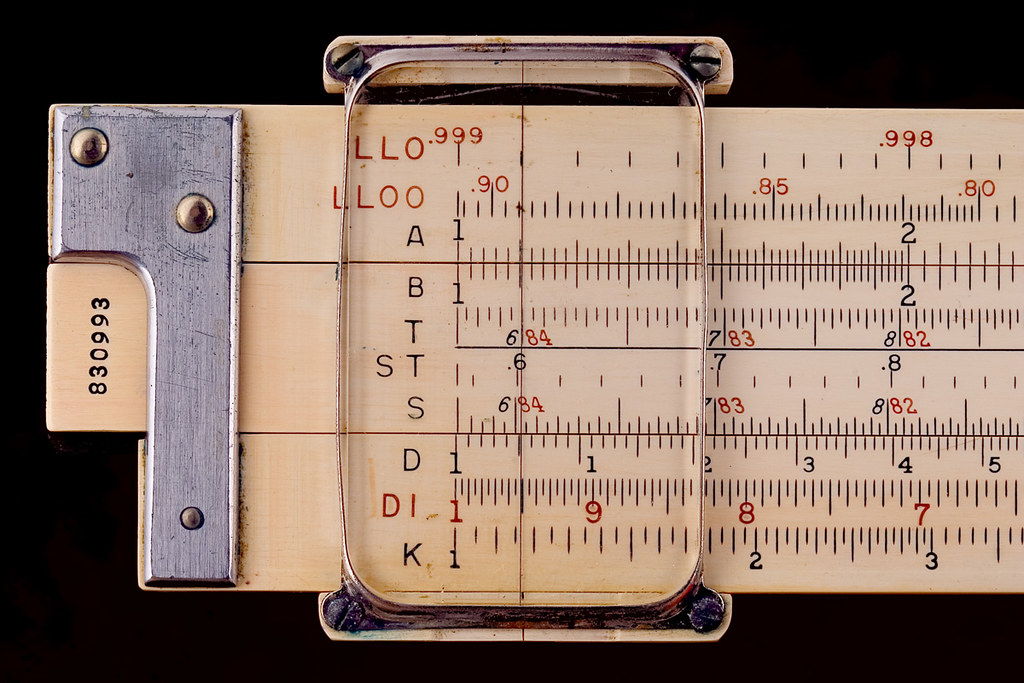
Figure 1 — The instrument that defines this volume: a Keuffel & Esser 4081-3 “Log Log Duplex Decitrig.” Scales cover both faces, a glass-and-metal cursor reads through the whole rule, and log-log scales extend it to arbitrary powers and roots. Image: “Keuffel & Esser slide rule, model 4081-3” by s58y is licensed under CC BY 2.0. To view a copy of this license, visit https://creativecommons.org/licenses/by/2.0/.
3.1 About This Volume
The first two volumes of this history told how the slide rule was invented — Napier’s logarithms, Gunter’s line, Oughtred’s sliding scales (Vol 1), and the long apprenticeship through carpenter’s, gauging, and engine rules to Amédée Mannheim’s 1851 standard layout (Vol 2). This volume tells how it became universal. Between roughly 1850 and 1970 the slide rule shed its identity as a specialist’s gauge and became the single instrument every engineer, chemist, and physicist carried — the object so bound up with technical work that for a century “slipstick” was shorthand for engineering itself. Two inventions drove that transformation: the duplex rule, which doubled how many scales a rule could carry, and the log-log scale, which freed it from mere multiplication into the world of arbitrary powers and roots. Around those inventions grew a handful of great manufacturing houses — in Hoboken and Chicago, in the Black Forest and Hamburg, in Tokyo and Manchester — whose rivalry over precision and materials produced the finest calculating instruments ever made by hand. This volume profiles them.
3.1.1 Depth-Index: The Five-Volume History
Table 1 — Depth-Index: The Five-Volume History
| Vol | Title | Primary Content |
|---|---|---|
| 1 | Logarithms and the First Scales | Napier’s logarithms, Gunter’s line, Oughtred’s rectilinear and circular rules, the Oughtred–Delamain dispute |
| 2 | Specialized Rules and the Mannheim Standard | Coggeshall’s carpenter’s rule, the Soho engine rule, Everard’s gauging rule, Amédée Mannheim’s 1851 standardization and the cursor, boxwood to celluloid |
| 3 | The Golden Age and the Makers (this volume) | The duplex rule, log-log scales, and the great firms — Keuffel & Esser, Faber-Castell, Nestler, Aristo, Pickett, Hemmi/Post, Thornton |
| 4 | Round and Cylindrical: The Pursuit of Precision | Why a curved scale buys accuracy — Fowler, Gilson, Thacher, Fuller, Otis King |
| 5 | Decline and Legacy | The HP-35, Apollo’s Pickett, the collectors, and the Oughtred Society |
Note — Cross-references appear as “see Vol N.” Each volume is self-contained; this one assumes only the Mannheim standard layout introduced in Vol 2.
3.2 From Tradesman’s Tool to Engineer’s Instrument
The slide rule of 1850 was, in most working hands, still a specialist’s device. A timber merchant had his Coggeshall rule, a brewer his gauging rule, a millwright his engine rule — each with scales tuned to one trade (Vol 2). What changed over the following century was both the market and the machine. The market changed because the second industrial revolution created an entirely new and enormous profession: the salaried engineer, trained in mathematics, employed by railways, telegraph companies, chemical works, electrical utilities, and machine shops, and confronted daily with calculations too varied for any single-trade rule. The machine changed to meet them.
Mannheim’s 1851 rule — four scales (two on the body, two on the slide) and a movable cursor — had given the profession a general-purpose layout (Vol 2). But a flat, single-faced rule of standard 25 cm length has room for only so many scales before it becomes unreadable. As engineering mathematics grew to demand trigonometry, squares and cubes, reciprocals, and eventually exponentials and logarithms of logarithms, the one-sided Mannheim rule simply ran out of surface. The golden age began when makers found two ways to win back room: build on both sides of the rule, and add scales that did fundamentally new mathematics.
3.3 The Duplex Rule: Building on Both Sides (1891)
The decisive mechanical innovation was the duplex construction, and it has a precise origin. William Cox, a British-born mathematician working as a consultant to the American firm Keuffel & Esser, designed a slide rule with scales engraved on both faces, held together by an open frame that braced the slide top and bottom, with a cursor whose hairline ran on both sides at once so that a reading on the front aligned exactly with the back. Cox’s design was patented in 1891 (U.S. Patent No. 460,930), and Keuffel & Esser introduced it commercially as the “Duplex” — the name, and very nearly the entire concept, that would dominate the premium market for the next eighty years (Oughtred Society; International Slide Rule Museum).
Why did this matter so much? A single-faced rule wastes its entire back as a mere holder. The duplex turns that back into working surface, roughly doubling the number of scales a rule of given length can carry — without crowding any one of them, because they are spread across two faces instead of jammed onto one. Just as importantly, the through-reading cursor let an engineer chain a calculation from front to back without re-aligning anything: set a value on a front scale, flip the rule, and the hairline already marks the corresponding point on the back. The cost was mechanical: a duplex must hold its slide in an open frame to precise tolerances on both edges, so that the front and back hairlines stay in register and the slide neither binds nor wobbles. Making that frame cheaply and accurately was exactly the manufacturing problem the great firms spent the next half-century perfecting.
The contrast with the older form gave the era its two vocabulary words. A simplex rule carries scales on one face only (with the cursor wrapping a closed body); a duplex carries them on both, within an open frame. By 1920 the duplex was the mark of a serious engineer’s rule, and the simplex had retreated to student and pocket models.
3.4 Log-Log Scales: Beyond Multiplication
The second great addition did not just add room — it added mathematics the rule had never before been able to do. The basic C and D scales multiply and divide because distance along them represents log x; the A and B scales (squares) represent 2 log x; the trigonometric scales handle sines and tangents. But none of these can evaluate an arbitrary power such as 2.7^1.8, or a root such as the 2.3rd root of 50, or the exponential eˣ. That requires a log-log scale, on which distance represents not log x but log(log x) — the logarithm of a logarithm.
The idea is old: the English polymath Peter Mark Roget (later famous for his Thesaurus) described a log-log scale to the Royal Society in 1815. But it remained a curiosity for nearly a century, because a log-log scale is only useful on a rule that also has the room and precision to carry it alongside everything else — which is to say, on a duplex. From the early 1900s the premium makers began adding sets of LL scales (typically marked LL1, LL2, LL3, and their reciprocal counterparts LL0/LL00) that together cover a wide range of exponents. With them, an engineer could read xʸ directly: set the cursor over the base on an LL scale, move the slide to the exponent on C, and read the answer on the LL scale beneath the hairline. Powers, roots, eˣ, and natural logarithms — the staples of heat transfer, chemistry, and electrical decay calculations — were now a single setting away.
By the 1920s and 1930s the log-log duplex was the flagship of every catalog: the most expensive, most capable rule a maker offered, and the one a graduating engineer aspired to own. Keuffel & Esser’s 4081 line (Figure 1) wore the full description on its spine — Log Log Duplex Decitrig — advertising in four words the duplex frame, the log-log scales, and the decimal-trigonometric scales that, taken together, made it a universal instrument.
3.5 The Great Makers
The golden age was not the work of one inventor but of a small number of manufacturing firms whose competition — over the fineness of their graduations, the smoothness of their slides, and the durability of their materials — drove the instrument to its peak. Each had a distinct character.
3.5.1 Keuffel & Esser (United States)
K&E was the dominant American firm. It was founded in 1867 in New York City by two German immigrants, Wilhelm (William) J. D. Keuffel and Hermann Esser, initially as an importer of drawing instruments and supplies. For its first decades it sold European-made rules, but after acquiring Cox’s duplex patent it became a manufacturer in its own right, building rules at a large factory in Hoboken, New Jersey. K&E’s catalogs set the American standard, and its model 4081 “Log Log Duplex Decitrig” (Figure 1) became the archetypal engineer’s slide rule of the mid-twentieth century — sold by the hundreds of thousands to students and professionals alike. What set K&E apart was not radical innovation after the duplex but relentless quality and ubiquity: for two generations of American engineers, “a K&E” simply meant a slide rule (International Slide Rule Museum; Hopp, 1999).
3.5.2 Faber-Castell (Germany)
The house of A. W. Faber traces its origins to a Bavarian pencil workshop founded in 1761 near Nuremberg — making it, by ancestry, the oldest firm in this volume by far. It entered slide-rule manufacture around 1892 and, after a dynastic marriage, became A. W. Faber-Castell in the early 1900s. Faber-Castell’s distinction was the sheer scale and variety of its output: it produced rules in enormous quantities and in dozens of models, from simple student rules to elaborate engineering instruments, many built on a celluloid-faced pearwood core that gave a notably crisp, white scale surface. Two of its scale systems became famous — the comprehensive “Castell” engineering rules and the “Darmstadt” system, a layout of scales developed in cooperation with the Institute for Practical Mathematics at the Technical University of Darmstadt and aimed squarely at the practicing engineer (Figure 2). The Darmstadt arrangement, with its distinctive set of LL scales on the back, was widely copied across the industry (Hopp, 1999).
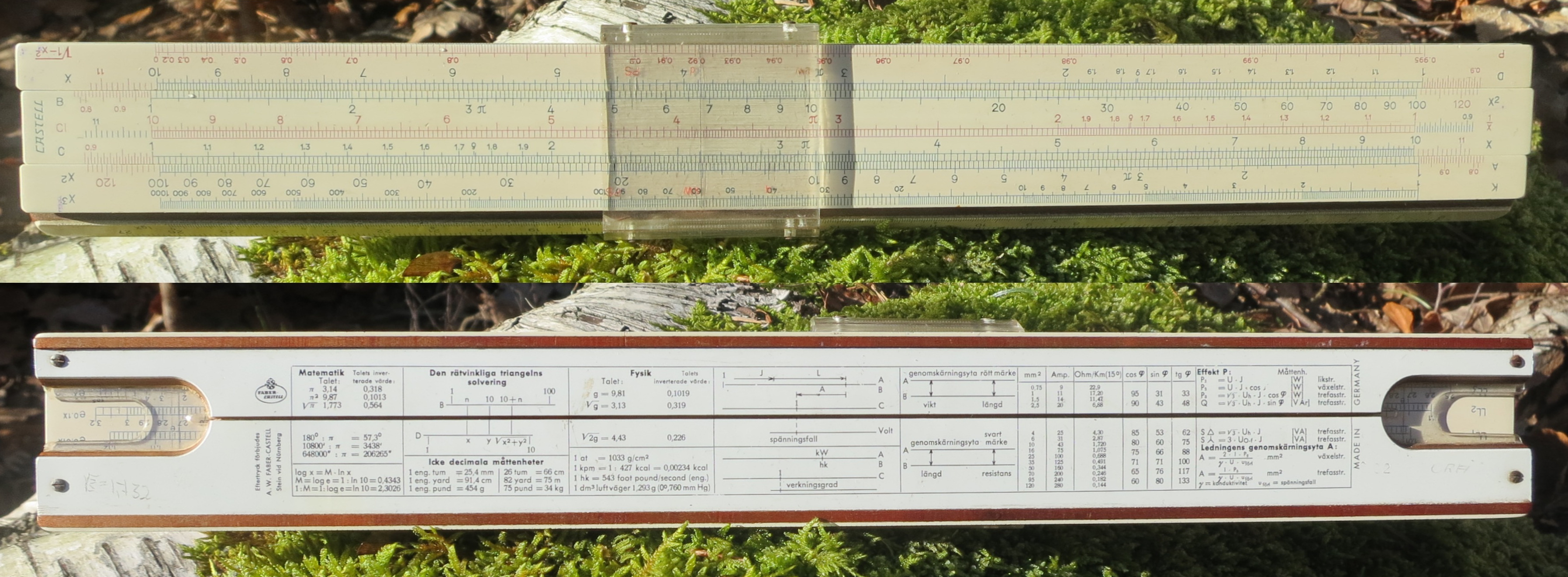
Figure 2 — An A. W. Faber-Castell 1/54 “Darmstadt” rule, a layout developed with the Technical University of Darmstadt for working engineers. Faber-Castell’s celluloid-on-pearwood scales were prized for their crisp white surface. Image: “1967 model A W Faber Castell 1 54 Darmstadt slide rule made in Germany” by R. Henrik Nilsson is licensed under CC BY 4.0. To view a copy of this license, visit https://creativecommons.org/licenses/by/4.0/.
3.5.3 Albert Nestler (Germany)
Albert Nestler AG was founded in 1878 in Lahr, in Baden near the Black Forest, and built a reputation for the highest mechanical quality — many collectors consider Nestler rules the best-finished of all. The firm’s flagship was the Rietz layout, a scale arrangement designed by the engineer Max Rietz around 1902 that added a cube scale and a folded scale to the Mannheim base; the Rietz became a de facto continental standard adopted by nearly every German maker. Nestler’s own model 23R (Figure 3) was among the most respected Rietz rules ever produced, and Nestler instruments enjoyed an almost legendary status — the company long advertised that Albert Einstein favored a Nestler rule for his own calculations. What set Nestler apart was finish and feel: the smoothness of the slide, the sharpness of the engraving, the restraint of the layout (International Slide Rule Museum; Hopp, 1999).

Figure 3 — An Albert Nestler rule from Lahr, Germany. Nestler built its reputation on mechanical finish — the smoothness of the slide and the crispness of the engine-divided scales — and its Rietz-system rules, such as the 23R, were among the most respected on the Continent. Image: “1947 or earlier Albert Nestler slide rule no 11 made in Lahr Germany” by R. Henrik Nilsson is licensed under CC BY 4.0. To view a copy of this license, visit https://creativecommons.org/licenses/by/4.0/.
3.5.4 Aristo / Dennert & Pape (Germany)
The Hamburg firm Dennert & Pape, founded in 1872, sold its rules under the brand name Aristo — a name so successful that the company eventually took it as its own. Dennert & Pape’s lasting contribution was to materials: in the 1930s it pioneered the all-plastic slide rule, replacing the traditional celluloid-on-wood construction with a solid synthetic material it called Astralon (a rigid PVC). A solid-plastic rule was dimensionally more stable than wood, immune to the celluloid layer’s tendency to peel or shrink, and could be molded and printed in volume. Astralon set the pattern that most postwar European rules would follow, and Aristo’s clean, durable instruments became a fixture of mid-century classrooms and drawing offices.
3.5.5 Pickett & Eckel (United States)
Pickett & Eckel was a relative latecomer, founded in the United States in 1943 (in Chicago, later relocating to California). Its signature was all-aluminum construction: instead of wood or plastic, Pickett rules were made of two aluminum members with the scales printed on the metal, which made them light, rigid, and impervious to humidity. Pickett is equally remembered for color — its later rules used a distinctive “eye-saver” yellow scale finish, claimed to reduce eyestrain under bright light. The firm’s reputation for ruggedness would earn its rules a place on the Apollo missions, where a Pickett N600-ES flew to the Moon (see Vol 5 for that story and the instrument’s twilight).
3.5.6 Hemmi and Post (Japan / United States)
In Japan, Jiro Hemmi founded his company in 1895 and made a material innovation of his own: the bamboo-bodied slide rule. Bamboo is exceptionally well suited to the purpose — its longitudinal grain gives outstanding dimensional stability against changes in temperature and humidity (the enemy of any wooden rule), and its natural surface lets the slide move smoothly with little tendency to bind or stick. Hemmi rules, with celluloid scales laminated to a bamboo core, were regarded as among the most mechanically reliable in the world. Through a long partnership, Hemmi manufactured rules sold in the United States under the Frederick Post name; the Post “Versalog,” a Hemmi-built bamboo log-log duplex, was one of the most admired engineering rules of the postwar era (International Slide Rule Museum; Hopp, 1999).
3.5.7 Thornton / A. G. Thornton (Britain)
Britain’s principal maker was A. G. Thornton Ltd. of Manchester, whose rules carried the well-known “PIC” trademark. Thornton supplied the British engineering and education markets through much of the twentieth century, and its rules — including the differential and standard engineering models used widely in British technical colleges — represented the home-grown alternative to the German and American giants. Britain never developed a slide-rule industry on the German scale, but Thornton ensured the country had a respected maker of its own.
3.6 Materials and Manufacturing
The character of each maker was, in the end, a story about materials and how scales were cut. The progression ran in clear stages. The earliest rules were solid boxwood — close-grained, stable, and the standard for centuries (Vol 2) — but wood reads poorly and yellows with handling. The nineteenth-century improvement was to laminate a thin layer of white celluloid on a wooden core (usually mahogany or pearwood), giving a bright, high-contrast surface for the scales while the wood provided structure; this “celluloid-on-wood” became the dominant premium construction of the golden age and is what most K&E, Faber-Castell, and Nestler rules are made of. The twentieth century then diverged into three competing answers to wood’s instability: solid plastic (Aristo’s Astralon and its imitators), aluminum (Pickett), and bamboo (Hemmi/Post) — each chosen for dimensional stability and resistance to humidity.
Equally important was how the graduations were put on. The finest scales were engine-divided: a precision machine called a dividing engine scribed each graduation mechanically into the celluloid, after which the lines were filled with pigment. Engine-dividing is what made a premium rule premium — the accuracy and evenness of the marks, on which every reading depends, came from the quality of that machine and its setup. As volumes grew, makers shifted to printing the scales photographically or lithographically onto the surface, which was faster and cheaper and, by mid-century, accurate enough that printed scales appeared even on good rules. The marks of a truly premium instrument, then and to collectors now, are consistent: crisp, accurately spaced engine-divided graduations; a slide that moves smoothly yet holds its setting; a cursor whose hairline is fine and exactly aligned front-to-back; and a body that stays flat and true across decades of changing weather. Achieving all four at once, in quantity, was the manufacturing art that the great firms spent the golden age perfecting.
3.7 Why It Mattered
In a single century the slide rule completed a remarkable journey. The duplex frame and the log-log scale turned Mannheim’s tidy four-scale rule into an instrument that could multiply, divide, square, root, take arbitrary powers, evaluate exponentials and natural logs, and run trigonometry — all in a sliver of celluloid or aluminum that fit a coat pocket and cost a week’s wages at most. The competition among Keuffel & Esser, Faber-Castell, Nestler, Aristo, Pickett, Hemmi, and Thornton pushed precision and durability to heights that hand-made calculating instruments would never exceed, because the era that came next would not be hand-made at all. For the curved and cylindrical rules that chased still greater accuracy down a different path, see Vol 4; for how the whole edifice fell in a few years to the electronic calculator — and what survives of it — see Vol 5.
Sources
- Hopp, P. M. (1999). Slide Rules: Their History, Models and Makers. Astragal Press.
- The Oughtred Society — Slide Rule History and maker references (https://www.oughtred.org/).
- International Slide Rule Museum (https://www.sliderulemuseum.com/) — maker histories, model archives, and the Cox/K&E duplex record.
- Cajori, F. (1909). A History of the Logarithmic Slide Rule and Allied Instruments.
- Cox, W. (1891). U.S. Patent No. 460,930, “Duplex” slide rule (assigned to Keuffel & Esser).
- Science Museum Group Collection — slide rules and dividing engines (https://collection.sciencemuseumgroup.org.uk/).
Founding dates, model designations, and attributions above are drawn from these sources; where a popular claim is traditional rather than firmly documented (for example, Einstein’s preference for a Nestler rule), the text flags it as reputation rather than established fact.
Comments (0)