History · Volume 1
The Story of the Slide Rule — Volume 1 — Logarithms and the First Scales
How a number trick of 1614 became a sliding instrument by 1622
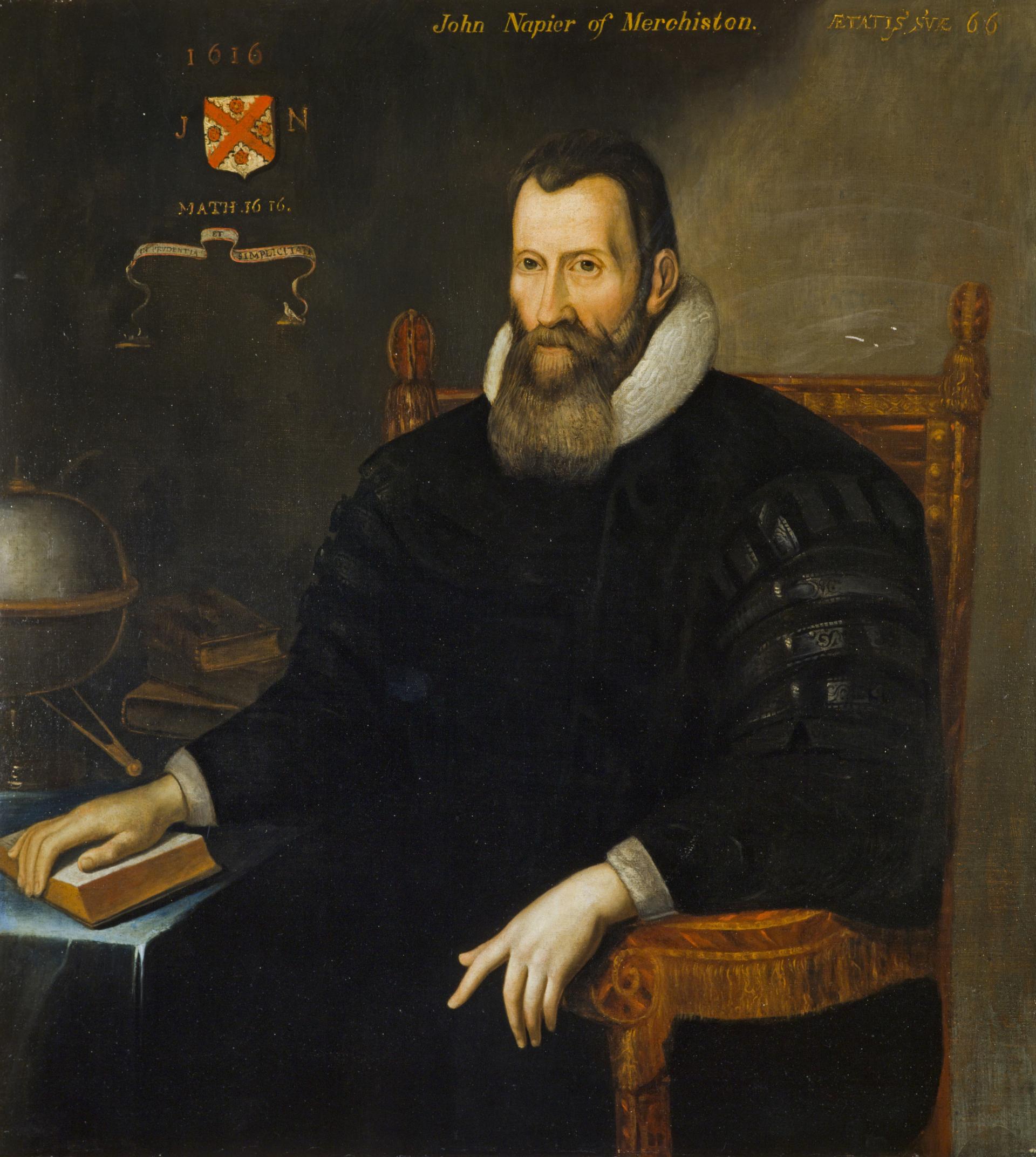
Figure 1 — John Napier of Merchiston (1550–1617), the Scottish laird whose 1614 invention of logarithms made the slide rule possible. Image: File:John Napier of Merchiston, 1616.jpg by Unknown author. License: Public domain. Via Wikimedia Commons (https://commons.wikimedia.org/wiki/File:John_Napier_of_Merchiston,_1616.jpg).

1.1 About This Volume
This volume opens a five-part history of the slide rule. It answers the first question any newcomer asks: where did this thing come from, and why does sliding two rulers past one another multiply numbers? The answer is a chain of three ideas separated by only a few years and a few hundred miles — Napier’s logarithms (1614), Gunter’s logarithmic line (c. 1620), and Oughtred’s sliding scales (c. 1622) — followed by one of the more bitter priority disputes in the history of mathematics. The volume keeps the mathematics at the level of ideas; the mechanics of reading a slide rule are the subject of the companion unit, How to Read & Operate a Slide Rule.
1.1.1 Depth-Index: The Five-Volume History
Table 1 — Depth-Index: The Five-Volume History
| Vol | Title | Primary Content |
|---|---|---|
| 1 | Logarithms and the First Scales (this volume) | Napier’s logarithms, Gunter’s line, Oughtred’s rectilinear and circular rules, the Oughtred–Delamain dispute |
| 2 | Specialized Rules and the Mannheim Standard | Coggeshall’s carpenter’s rule, the Soho engine rule, Everard’s gauging rule, Amédée Mannheim’s 1851 standardization and the cursor, boxwood to celluloid |
| 3 | The Golden Age and the Makers | The duplex rule, log-log scales, and the great firms — Keuffel & Esser, Faber-Castell, Nestler, Aristo, Pickett, Hemmi/Post, Thornton |
| 4 | Round and Cylindrical: The Pursuit of Precision | Why a curved scale buys accuracy — Fowler, Gilson, Thacher, Fuller, Otis King |
| 5 | Decline and Legacy | The HP-35, Apollo’s Pickett, the collectors, and the Oughtred Society |
Note — Cross-references appear as “see Vol N §M.” Each volume is self-contained; this one assumes no prior reading.
1.2 The Problem Before the Solution
Before 1614, multiplication was drudgery. An astronomer reducing a night’s observations, a navigator working a longitude, or a banker compounding interest faced page after page of long multiplication and division by hand — slow, and a fertile source of error. The need was acute precisely in the era of Kepler and the great sea voyages, when the quantity of arithmetic exploded while the method stayed medieval.
The breakthrough was not a machine but an idea: a way to replace multiplication with addition. That idea was the logarithm, and every slide rule ever built is a physical embodiment of it.
1.3 Napier and the Invention of Logarithms (1614)
John Napier, eighth Laird of Merchiston near Edinburgh, was a landowner, theologian, and mathematician who spent some twenty years developing his system before publishing it. In 1614 he printed Mirifici Logarithmorum Canonis Descriptio — “A Description of the Wonderful Canon of Logarithms” — a slim book of tables with an explanation of their use (Napier, 1614).
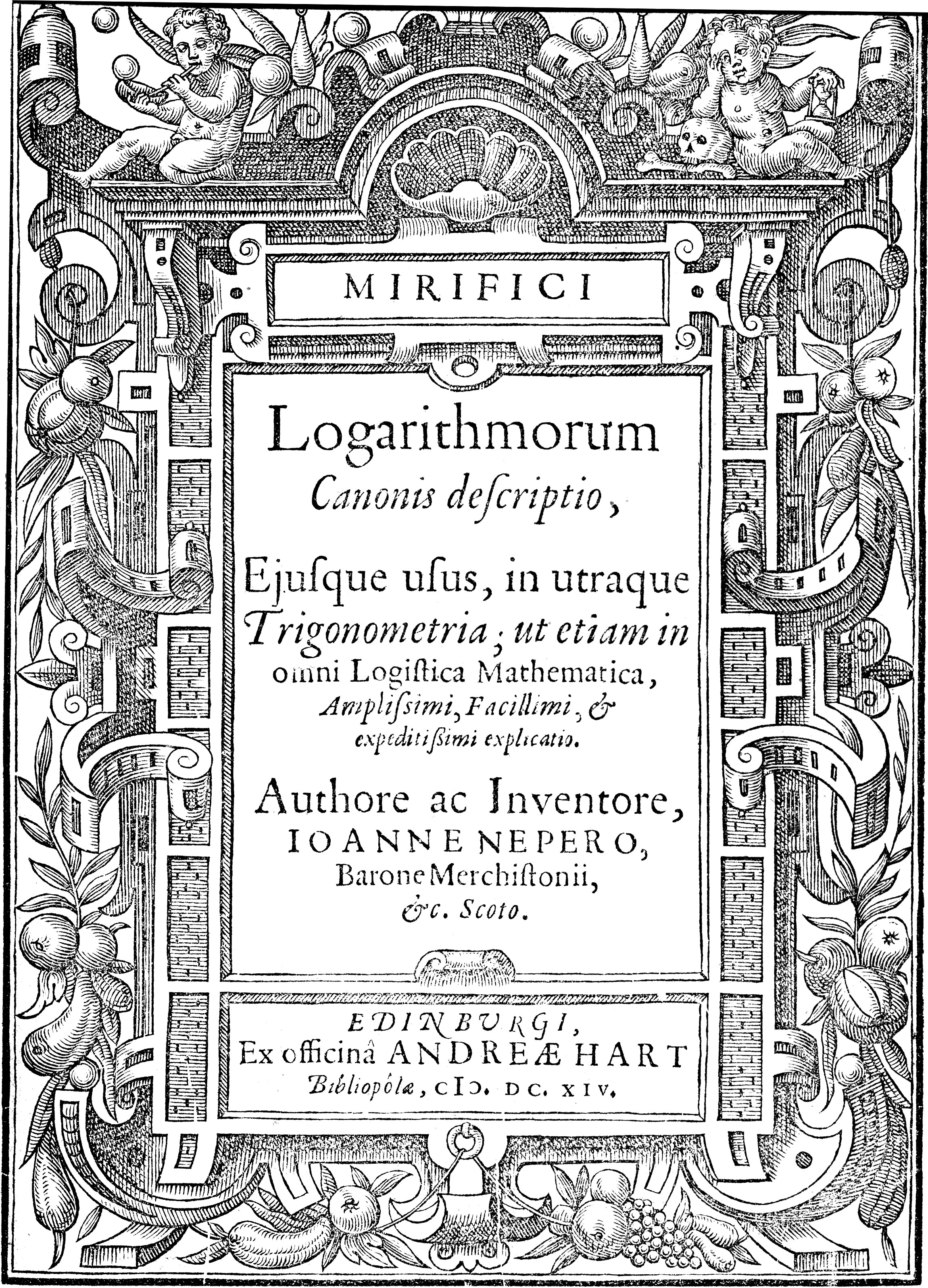
Figure 2 — The 1614 work that started everything: the title page of Napier’s Mirifici Logarithmorum Canonis Descriptio. Image: File:Mirifici Logarithmorum canonis Descriptio.jpg by John Napier. License: Public domain. Via Wikimedia Commons (https://commons.wikimedia.org/wiki/File:Mirifici_Logarithmorum_canonis_Descriptio.jpg).

Napier’s insight rests on a single property. If every number is written as a power of some base, then multiplying two numbers is the same as adding their exponents:
10ᵃ × 10ᵇ = 10⁽ᵃ⁺ᵇ⁾
The logarithm of a number is simply that exponent. To multiply 1000 by 100, one notes that they are 10³ and 10², adds the exponents to get 10⁵, and reads back 100 000. The logarithm turns a hard operation (multiplication) into an easy one (addition), and turns division into subtraction. Napier supplied the tables that let one look up any number’s exponent and look the answer back again.
The reception was immediate. Henry Briggs, professor of geometry at Gresham College in London, travelled to Edinburgh to meet Napier and, with his blessing, recast the system to base 10 — the common logarithms that would dominate practical computation for the next 350 years. Napier died in 1617; Briggs published extensive base-10 tables in 1617 and 1624. The abstract tool was now in the world. What remained was to make it mechanical.
1.4 Gunter’s Line: Logarithms Made into a Length (c. 1620)
The first step from table to instrument was taken by Edmund Gunter, an English clergyman and professor of astronomy at Gresham College. Around 1620 Gunter had the elegant idea of laying logarithms out as physical distances along a ruler. On what became known as Gunter’s line (or Gunter’s scale), the position of each number is marked not at a uniform spacing but at a distance proportional to its logarithm. The number 2 sits about 0.301 of the way along; 3 sits about 0.477 along; and so the familiar crowded-then-sparse spacing of every slide-rule scale was born (Cajori, 1909).
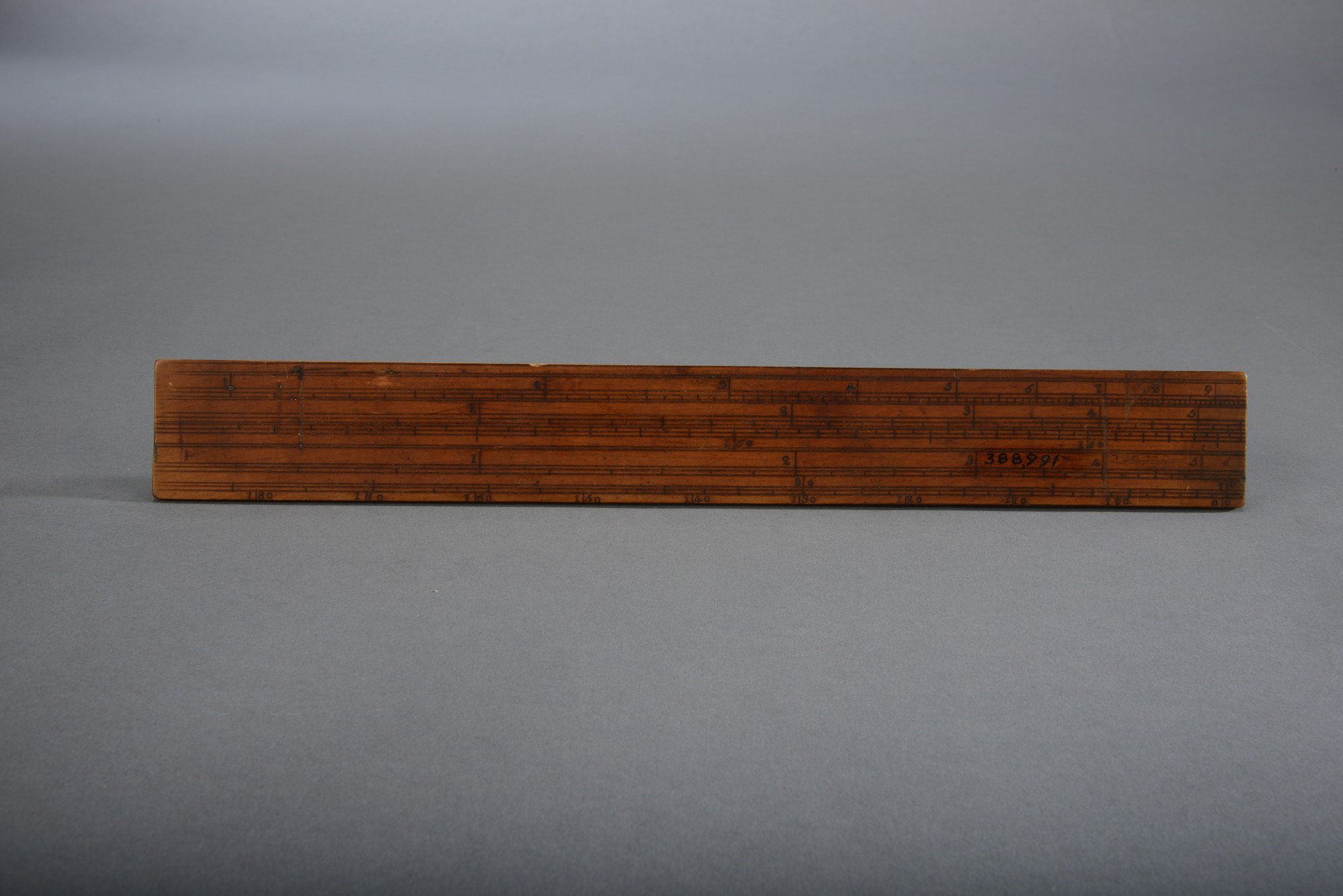
Figure 3 — A Gunter’s scale: logarithms rendered as distances along a ruler. With this and a pair of dividers, multiplication became a matter of stepping off lengths. Image: “Gunter’s Scale” (Smithsonian, National Museum of American History) is marked with CC0 1.0 (https://creativecommons.org/publicdomain/zero/1.0/).
Because distances on the line are logarithms, adding two distances multiplies the underlying numbers — exactly Napier’s principle, now in wood and brass. Gunter’s method was to use a pair of dividers: set the dividers to span from 1 to the first factor, then step that span off from the second factor, and read the product where the points land. It worked, and navigators adopted the Gunter scale enthusiastically (it remained a standard tool at sea well into the nineteenth century). But it was fiddly: every calculation meant picking up dividers, walking them along a scale, and trying not to lose the setting.
The conceptual leap that remained was small to state and enormous in consequence: replace the dividers with a second, identical scale that slides.
1.5 Oughtred and the First Slide Rule (c. 1622)
That leap was made by William Oughtred (1574–1660), an English clergyman and one of the most influential mathematics teachers of his age — the man who gave us the ”×” symbol for multiplication and the abbreviations “sin” and “cos.” Oughtred took Gunter’s line and, around 1622, did away with the dividers: he placed two logarithmic scales side by side so that one could slide against the other. To multiply, one simply lines up the “1” of the sliding scale against the first factor on the fixed scale and reads the product opposite the second factor. The dividers — and the fumbling — were gone (Oughtred Society; Britannica).
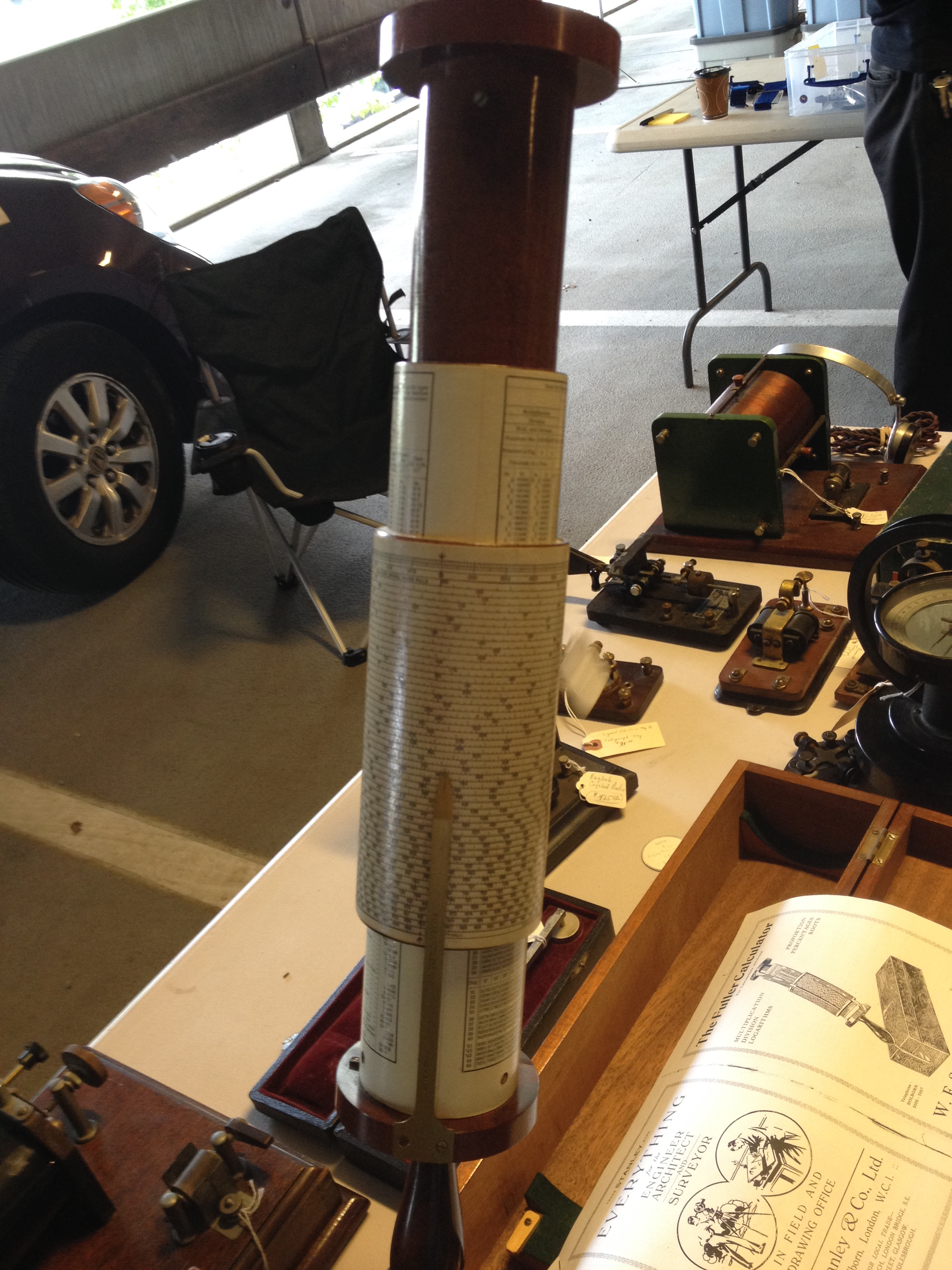
Figure 4 — Oughtred also arranged the logarithmic scales as rotating concentric circles — his “circles of proportion.” A circular rule never runs off the end of its scale, because the scale closes on itself. (Image shows a later vintage circular rule standing in for the seventeenth-century original.) Image: File:Circular slide rule full at MIT flea.agr.jpg by ArnoldReinhold. License: CC BY-SA 4.0 (https://creativecommons.org/licenses/by-sa/4.0). Via Wikimedia Commons (https://commons.wikimedia.org/wiki/File:Circular_slide_rule_full_at_MIT_flea.agr.jpg).

Oughtred built his idea in two forms. The first was the rectilinear slide rule — two straight logarithmic scales sliding past one another, the direct ancestor of every linear rule in this collection. The second was the circular slide rule, in which the scales are bent into concentric rings that rotate about a common centre — his “circles of proportion.” The circular form solved a nuisance of the straight one: a straight scale can run off its own end mid-calculation, forcing a reset, whereas a circle has no end (this advantage is explored fully in Vol 4).
Characteristically for a man who taught for love rather than publication, Oughtred did not rush either design into print. He showed them to his many private pupils and let the ideas circulate by word of mouth — a generosity that would shortly cost him dearly.
1.6 The Oughtred–Delamain Dispute
In 1630 a former pupil of Oughtred’s, Richard Delamain — a teacher of mathematics and tutor to King Charles I — published a short pamphlet, Grammelogia, or the Mathematical Ring, describing a circular slide rule and its use. He claimed the invention as his own. Oughtred, who had designed his circles of proportion years earlier and considered Delamain a student who had learned the idea from him, was incensed. When Oughtred’s own description, The Circles of Proportion and the Horizontal Instrument, appeared in 1632 (translated into English by his pupil William Forster), it carried a pointed defence of his priority, and an acrimonious public quarrel followed that embittered both men for the rest of their lives (MacTutor; Cajori, 1909).
The modern scholarly view is more charitable to both than either was to the other: historians generally hold that Oughtred and Delamain very likely arrived at the circular instrument independently, and that Oughtred’s claim to the rectilinear sliding rule — the one that truly mattered for the next three centuries — is secure. Oughtred had also demonstrated his instruments privately well before 1630; Edmund Wingate, among others, attested to the early date. The dispute is remembered today less for its substance than as a cautionary tale about the cost of teaching freely and publishing late.
Whatever the apportionment of credit, the essential machine now existed. By 1632 every ingredient of the slide rule was on the table: logarithms (Napier), logarithms-as-length (Gunter), and two such lengths sliding past one another (Oughtred). Everything that follows in this history is refinement — of scales, of materials, of precision, and of manufacture.
1.7 Why It Mattered
It is worth pausing on the magnitude of what had been achieved in under two decades. A calculation that once meant a column of long multiplication could now be done by aligning two marks and reading a third — in seconds, by anyone trained in a single afternoon. The slide rule traded a small, fixed loss of precision (typically three significant figures) for an enormous gain in speed, and for three hundred years engineers judged that an excellent bargain. The instrument that designed bridges, ships, radios, and ultimately the rockets of the Apollo program (see Vol 5) began here, with a laird’s number trick and a clergyman’s decision to let a ruler slide.
Sources
- Napier, J. (1614). Mirifici Logarithmorum Canonis Descriptio. Edinburgh.
- Cajori, F. (1909). A History of the Logarithmic Slide Rule and Allied Instruments; and On the History of Gunter’s Scale and the Slide Rule During the Seventeenth Century (1920).
- The Oughtred Society — Slide Rule History (https://www.oughtred.org/history.shtml).
- William Oughtred, MacTutor History of Mathematics Archive, University of St Andrews (https://mathshistory.st-andrews.ac.uk/Biographies/Oughtred/).
- William Oughtred, Encyclopædia Britannica (https://www.britannica.com/biography/William-Oughtred).
Specific dates and attributions above are drawn from these sources; where scholarship is divided (notably the Oughtred–Delamain priority question) the text says so rather than choosing a side.
Comments (0)