History · Volume 2
The Story of the Slide Rule — Volume 2 — Specialized Rules and the Mannheim Standard
How the slide rule served the trades for two centuries before an artillery officer made it universal
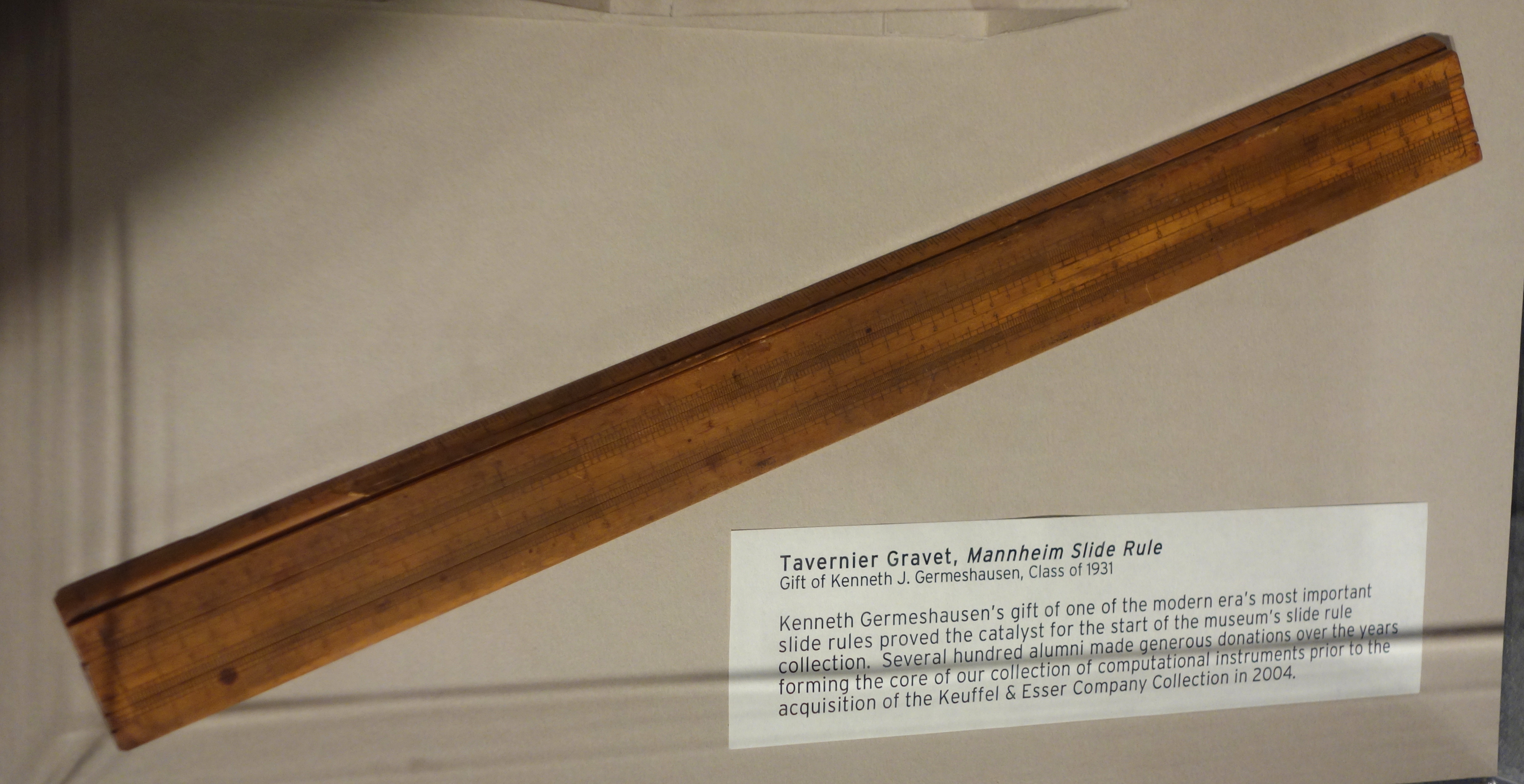
Figure 1 — A Mannheim-pattern rule made by Tavernier-Gravet of Paris. The four-scale layout (A, B, C, D) and the movable cursor riding across the face are Amédée Mannheim’s 1851 contributions; together they defined what most people picture when they hear the words “slide rule.” Image: File:Mannheim Slide Rule, Tavernier Gravet - MIT Slide Rule Collection - DSC03688.JPG by Daderot. License: CC0 (http://creativecommons.org/publicdomain/zero/1.0/deed.en). Via Wikimedia Commons (https://commons.wikimedia.org/wiki/File%3AMannheim%20Slide%20Rule%2C%20Tavernier%20Gravet%20-%20MIT%20Slide%20Rule%20Collection%20-%20DSC03688.JPG).

2.1 About This Volume
By the time William Oughtred died in 1660, every essential idea of the slide rule existed (see Vol 1). Yet for the next century and a half the instrument did not become the engineer’s badge of office it is remembered as. Instead it went to work in the trades — measuring stacks of timber, gauging casks of beer for the tax collector, and reckoning the dimensions of steam engines. This volume tells that long middle passage: the era of the specialized rule, when the instrument was shaped by carpenters, excisemen, and ironmasters rather than mathematicians. It then turns to the moment in 1851 when a young French artillery officer, Amédée Mannheim, cut through the clutter of competing designs and gave the world the four-scale layout and the sliding cursor that would define the instrument for its golden age (see Vol 3). The volume closes with the quieter revolution in materials — from solid boxwood to the bright celluloid facing that made fine, legible engraving possible.
2.1.1 Depth-Index: The Five-Volume History
Table 1 — Depth-Index: The Five-Volume History
| Vol | Title | Primary Content |
|---|---|---|
| 1 | Logarithms and the First Scales | Napier’s logarithms, Gunter’s line, Oughtred’s rectilinear and circular rules, the Oughtred–Delamain dispute |
| 2 | Specialized Rules and the Mannheim Standard (this volume) | Coggeshall’s carpenter’s rule, the Soho engine rule, Everard’s gauging rule, Amédée Mannheim’s 1851 standardization and the cursor, boxwood to celluloid |
| 3 | The Golden Age and the Makers | The duplex rule, log-log scales, and the great firms — Keuffel & Esser, Faber-Castell, Nestler, Aristo, Pickett, Hemmi/Post, Thornton |
| 4 | Round and Cylindrical: The Pursuit of Precision | Why a curved scale buys accuracy — Fowler, Gilson, Thacher, Fuller, Otis King |
| 5 | Decline and Legacy | The HP-35, Apollo’s Pickett, the collectors, and the Oughtred Society |
Note — Cross-references appear as “see Vol N §M.” Each volume is self-contained; this one assumes no prior reading.
2.2 A Tool for the Trades, Not Yet the Engineers
It is tempting to imagine that once Oughtred slid two logarithmic scales past one another, the modern slide rule followed at once. It did not. Through the late seventeenth and the whole of the eighteenth century, the slide rule was a niche instrument, and the niches were practical. The reason is partly economic and partly cultural: most calculation that mattered to a working man was not abstract multiplication but the measurement of quantities — board feet of oak, gallons in a barrel, the bore and stroke of an engine. A general-purpose rule with bare A, B, C, and D scales meant little to a carpenter who wanted to know, directly, how much a log was worth.
So the early slide rule was almost always a special-purpose rule, engraved with scales and fixed reference marks (“gauge points”) tuned to one trade. The instrument earned its keep not by elegance but by collapsing a particular professional calculation into a single setting of the slide. Three trades did the most to keep the slide rule alive in this period — building, brewing-and-excise, and engineering — and each left its mark on the instrument’s design.
2.3 Coggeshall’s Carpenter’s Rule (c. 1677)
The first slide rule to find genuinely wide practical use came from Henry Coggeshall (1623–1690), who in 1677 described a rule for measuring the dimensions, surface area, and volume of timber. He laid it out first in a London paper, Timber-Measure by a Line of More Ease, Dispatch and Exactness, and refined it into the better-known A Treatise of Measuring by a Two-Foot Rule, which Slides to a Foot (1682) (Wikipedia, “Coggeshall slide rule”; Oughtred Society).

Figure 2 — A Coggeshall carpenter’s rule in a period engraving. Two hinged boxwood legs, each a foot long, fold to a pocketable size; one leg carries a slide running in a groove. The “girt line” and timber-measure scales let a carpenter price a log in a single setting. Image: File:Coggeshall slide rule.jpg by Cyclopaedia, or Universal Dictionary of Arts and Sciences en:Cyclopaedia. License: Public domain. Via Wikimedia Commons (https://commons.wikimedia.org/wiki/File%3ACoggeshall%20slide%20rule.jpg).

The genius of the Coggeshall rule was as much in its form as its scales. It consisted of two boxwood rulers, each a foot (about 30 cm) long, hinged so they folded together into a pocketable two-foot rule; one of the legs carried a slide that ran in a groove along its middle, exactly like a modern linear slide rule. Folded, it was an ordinary carpenter’s two-foot rule for everyday marking-out. Opened and slid, it became a calculator carrying a special “girt line” and timber scales that turned the awkward arithmetic of volume directly into a reading.
Coggeshall’s design gave the slide rule its first sustained practical career outside the study, and it was a long one: the carpenter’s rule in essentially his form remained a building-trades staple for roughly two centuries, still being manufactured into the late nineteenth century. For most of that time, “slide rule” to an ordinary tradesman meant the Coggeshall rule.
2.4 Everard’s Gauging Rule and the Pull of Taxation (1683)
If carpentry kept the slide rule employed, it was taxation that drove some of its most ingenious refinements. Excise duty on beer, wine, and spirits was a major source of Crown revenue, and collecting it fairly meant measuring the liquid content of casks of every shape and degree of fullness — a problem of solid geometry performed in a damp cellar by an official with a wet stick. This was the art of gauging.
In 1683 Thomas Everard, an English excise officer, devised a slide rule purpose-built for it, describing it the following year in Stereometry, or the Art of Gauging Made Easy, by the Help of a Sliding-Rule (1684). Everard’s rule was a single square-section stock about a foot long, carrying slides in opposite faces and engraved with special gauge points — including marks for the gallon and for the standard dimensions of casks — so that an officer could compute the capacity of a full cask, or the remaining volume of a part-empty one (a related operation called ullaging), directly from the instrument (Science Museum Group; Everard, 1684).
The Everard rule was, by some accounts, the most widely used slide rule of its era, and its influence ran deep: gauging rules in recognizably Everard form were still being made and sold by firms such as Dring & Fage into the twentieth century. The lesson of the gauging rule is a recurring one in the history of instruments — that a reliable stream of money (here, excise revenue) is a powerful engine of design. The taxman needed an answer he could defend, and the slide rule learned to give it.
2.5 The Soho Rule: Engineering Joins In (c. 1779)
The third trade to shape the instrument was the most consequential for what came later. As the steam engine moved from curiosity to industry, its designers faced a flood of repetitive calculation — bores, strokes, cylinder volumes, the proportions of beams and valves. James Watt found this arithmetic irksome, and around 1779 Matthew Boulton, his partner at the Soho works in Birmingham, bought a slide rule for the firm. Watt, after using it, commissioned a rule with a set of scales suited to engine work. The result became known as the Soho rule, after the Soho manufactory, and it carried the slide rule decisively into engineering (IEEE Pulse; Britannica).
The Soho rule typically carried four scales — two on the fixed body and two on the central slide — with the upper scales running over two decades (1 to 100) for multiplication and division, and a single-decade scale for squares and roots, together with gauge points tuned to engineers’ constants. Crucially, the Soho works did not keep the design to itself. The pattern spread, and the Paris workshop of Gravet (later Tavernier-Gravet) — the same house that would soon manufacture Mannheim’s rule — made many rules to the Soho design for engineers across the Channel. In the Soho rule one can already see the slide rule changing identity: no longer only a tradesman’s measuring aid, it was becoming the calculating instrument of the industrial engineer.
2.6 Amédée Mannheim and the Modern Standard (1851)
By the middle of the nineteenth century the slide rule was useful but chaotic. Two centuries of special-purpose designs had left a thicket of incompatible scale arrangements: a carpenter’s rule, a gauger’s rule, and an engineer’s rule shared a principle but not a layout, and a calculation learned on one did not transfer to another. What the instrument lacked was a standard.
It received one from Amédée Mannheim (1831–1906), a French artillery officer and, later, a distinguished professor of geometry at the École Polytechnique. In 1851, as a young officer, Mannheim defined a spare, general-purpose set of four scales: two double-length scales, A and B, for squares and square roots, and two single-length scales, C and D, for multiplication and division — A and B on the body and slide above, C and D below (Mannheim biography, MacTutor; Smithsonian). This is the layout an entire century of schoolchildren and engineers would learn, and it is the layout on the rule in Figure 1.
Mannheim’s second contribution was, if anything, more important to the feel of using the instrument: he fixed the cursor (also called the runner or indicator) as a standard fitting — a sliding frame carrying a fine glass window scribed with a hairline that crosses every scale at once. The cursor solved a real difficulty. To read a result off a scale that was not physically adjacent to the one you had set — say, to carry a value from the D scale up to the A scale for squaring — you previously had to estimate across a gap by eye. The hairline bridges that gap exactly, letting the eye transfer a reading from any scale to any other with confidence. Mannheim did not invent the idea from nothing; a sliding indicator had been described decades earlier (John Robertson had proposed a “runner” as far back as 1775), but the notion had been forgotten. Mannheim made it permanent (Zeldes, “How the Slide Rule got its Cursor”).
To turn his design into a product, Mannheim went to the Parisian instrument house of Gravet-Lenoir — Tavernier-Gravet — which manufactured the rule in quantity. The combination proved irresistible: a clean, general layout that any technical worker could learn, plus a cursor that made it quick and reliable to use. Over the next fifty years the Mannheim pattern spread from France across Europe and to the United States, becoming the world standard and the baseline from which the great firms of the golden age would elaborate their log-log and duplex designs (see Vol 3). When the public imagination fixed on a single image of “the slide rule,” it fixed on Mannheim’s.
2.7 From Boxwood to Celluloid
The other quiet revolution of this era was in material. The classic early rules — Coggeshall’s, Everard’s, the first Mannheim rules — were made of boxwood, a dense, fine-grained, pale hardwood prized by instrument makers for its stability and the crispness with which it took an engraved line. Boxwood was excellent, but it had limits: the wood could darken and stain with handling, its grain set a floor on how fine and sharp the engraving could be, and it responded to changes in humidity.
The improvement was to face the boxwood with a thin layer of celluloid — an early semi-synthetic plastic — laminated to the wood and then engraved. The white celluloid surface gave a bright, uniform background against which black scale lines stood out with far higher contrast and legibility, and it took a finer, sharper, more precisely placed graduation than wood alone could hold. A boxwood core kept the rule light, stable, and pleasant in the hand while the celluloid face carried the scales. Over time makers moved further still, toward rules that were all celluloid (and later other plastics), eliminating the wood entirely.
This was not mere cosmetics. The accuracy a user can extract from a slide rule is limited by how finely the scales are divided and how clearly the divisions can be read; the celluloid facing improved both at once, and so improved the precision of the instrument itself. The bright-white, sharply ruled slide rule of the twentieth century — the object most people remember — is a direct result of this shift in materials, and it set the stage for the elaborate, densely engraved rules of the golden age that follows (see Vol 3).
2.8 Why It Mattered
The century and a half between Oughtred and Mannheim is easy to skip past, but it did indispensable work. It proved that the slide rule was not a mathematician’s toy but a working tool, robust enough for the cellar, the timber yard, and the engine shop. It accumulated, through carpenters and excisemen and engineers, a deep practical understanding of how scales and gauge points should be arranged. And it set up, by its very disorder, the need that Mannheim met: a single standard layout, made quick and exact by the cursor’s hairline, ready to be manufactured in the millions. With the Mannheim rule in boxwood and celluloid, the instrument was at last in its mature form. The golden age — the duplex rule, the log-log scales, and the great makers who built empires on them — begins in Vol 3.
Sources
- Everard, T. (1684). Stereometry, or the Art of Gauging Made Easy, by the Help of a Sliding-Rule. London.
- Cajori, F. (1909). A History of the Logarithmic Slide Rule and Allied Instruments.
- “Coggeshall slide rule,” Wikipedia (https://en.wikipedia.org/wiki/Coggeshall_slide_rule).
- “Everard gauger’s slide rule,” Science Museum Group Collection (https://collection.sciencemuseumgroup.org.uk/objects/co60705/everard-gaugers-slide-rule-slide-rule).
- Amédée Mannheim (1831–1906), MacTutor History of Mathematics Archive, University of St Andrews (https://mathshistory.st-andrews.ac.uk/Biographies/Mannheim/).
- “Linear Slide Rules,” Smithsonian Institution (https://www.si.edu/spotlight/slide-rules/linear-slide-rules).
- N. Zeldes, “How the Slide Rule got its Cursor” and “Slide rules for a new century” (https://nzeldes.com/article/cursors/).
- “The Slide Rule,” IEEE Pulse (https://www.embs.org/pulse/articles/the-slide-rule/); and Slide rule, Encyclopædia Britannica (https://www.britannica.com/science/slide-rule).
- The Oughtred Society — Slide Rule History (https://www.oughtred.org/history.shtml).
Specific dates and attributions above are drawn from these sources. Where a date is conventional rather than precise (notably the c. 1677 and c. 1779 origins of the Coggeshall and Soho rules), the text marks it with “c.”
Comments (0)