Pickett N3 & N600 · Volume 3
Pickett N3 & N600 — Volume 3 — Using It, and Caring for It
Worked problems on the N3's split root scales, double tangents and dual log-logs and on the pocket N600 — then how to clean, adjust and keep an aluminium rule
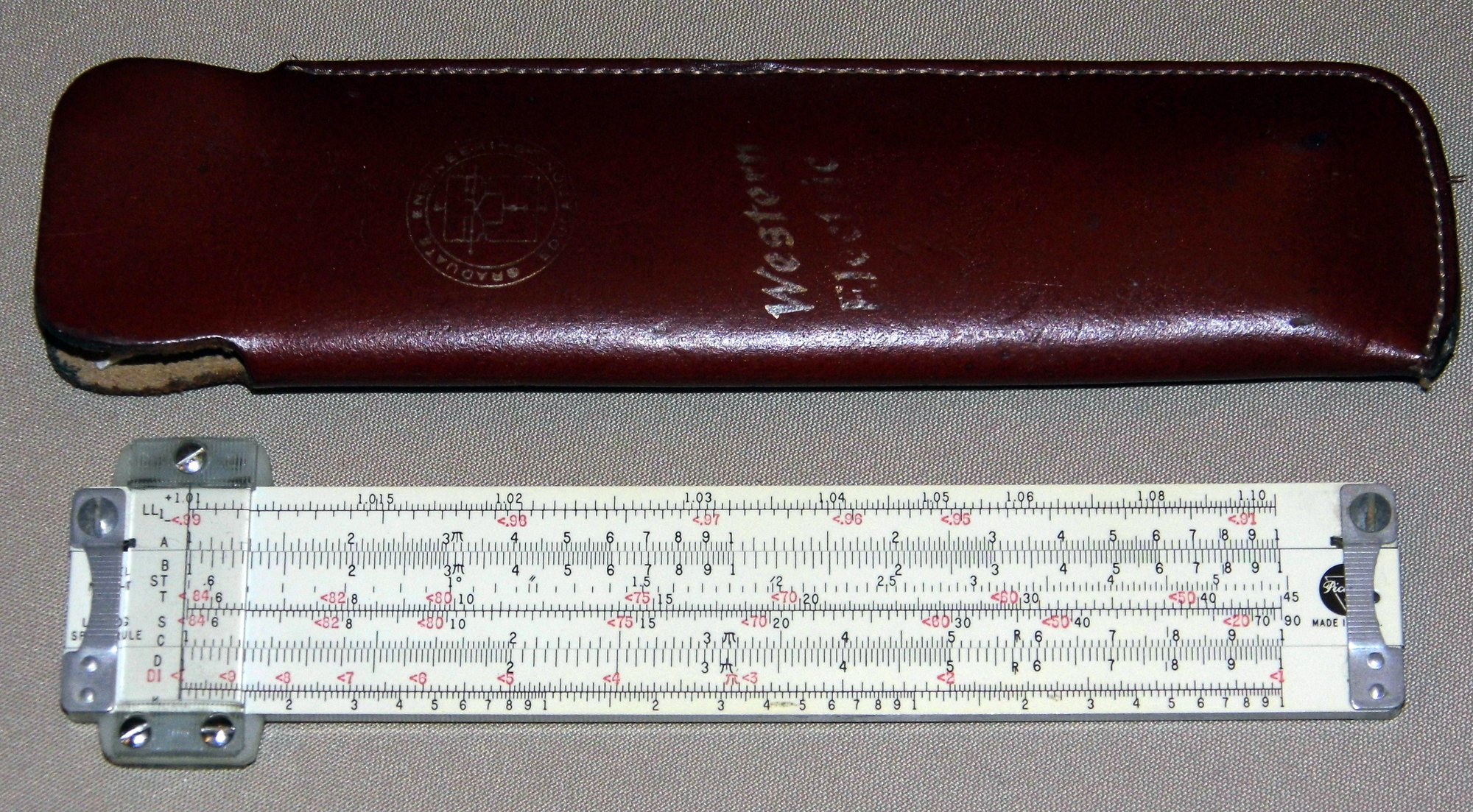
Figure 1 — The six-inch member of the family, an N600-T of 1962, with its company-stamped sleeve. Everything in this volume’s N600 section can be worked on a rule like this one. Image: “Vintage 6-Inch Pickett Slide Rule, Model N600-T with Western Electric Logo on the Leather Case, ‘Graduate Engineering Education Program’, Copyright 1962” by Joe Haupt, CC BY-SA 2.0, via Wikimedia Commons, https://commons.wikimedia.org/wiki/File:Vintage_6-Inch_Pickett_Slide_Rule,_Model_N600-T_with_Western_Electric_Logo_on_the_Leather_Case,_%22Graduate_Engineering_Education_Program%22,_Copyright_1962_(8572305700).jpg.

3.1 About This Volume
This is the working volume. It assumes the scale map of Vol 2 and the general method of the Using Slide Rules unit, and works problems that are particular to these two rules: roots on the N3’s split scales, tangents above 45° on its second T scale, powers and natural logarithms on the dual log-log scales, and the same jobs done on the smaller N600 with its shorter scale list. Every answer below was checked by calculation; the figures given are what the rule can be read to, not more. The second half is care: what an aluminium rule with printed scales, a plastic cursor and a leather case needs, and what will ruin it.
3.1.1 Depth-Index: The Three-Volume Unit
Table 1 — Depth-Index: The Three-Volume Unit
| Vol | Title | Primary Content |
|---|---|---|
| 1 | The Family and Its Variants | Pickett & Eckel, Model 3 and Model 600 to the N series, -ES and -T, Apollo, dating, identifying mine |
| 2 | Anatomy and the Full Scale Set | Aluminium construction, the cursor, every N3 and N600 scale, dual-base log-log, split root scales, cases |
| 3 | Using It, and Caring for It (this volume) | Worked examples on both rules, then cleaning, adjustment, parts and storage |
3.2 Before Starting: Check the Rule
A Pickett that has been knocked or taken apart can be out of adjustment, and it is worth thirty seconds before trusting it:
- Close the slide so the C and D indexes coincide. Every scale on the slide should line up with its partner on the body — B with A, C with D, CF with DF — at both ends.
- Put the front hairline on the left index of D. Turn the rule over: the back hairline should sit on the left index of D there too.
- Check one known answer: 2 × 3 on C and D should read 6 exactly.
If any of these fails, see Adjusting below before working the problems.
3.3 Worked Examples on the N3
3.3.1 Multiplication, division and reciprocals
3.7 × 2.4. Set the left index of C over 3.7 on D. Move the hairline to 2.4 on C. Read 8.88 on D. (Estimate: 4 × 2.4 ≈ 10, so the answer is a single-digit number near 9.) Check: 3.7 × 2.4 = 8.88.
8.88 ÷ 2.4. Set 2.4 on C over 8.88 on D; read under the C index on D: 3.7.
1 ÷ 2.4. Put the hairline on 2.4 on C and read the red CI scale under the same hairline: 0.4167, read on a 10-inch rule as 0.417.
3.3.2 Square roots on the split √ scales
The N3 sets the number on D and reads the root on a √ line above it (Vol 2). The only decision is which line.
√20. Twenty has two digits — even — so the root is on the lower √ line, labelled “EVEN.” Hairline to 2 on D; read 4.472 on the even √ line. Check: √20 = 4.4721.
√2. One digit — odd — so the upper line. Hairline to 2 on D; read 1.414. Check: √2 = 1.4142. The two problems use the same setting on D; only the line chosen differs, which is exactly the decimal decision the A scale makes users fumble on other rules.
√0.05. For a decimal, count the zeros straight after the point: one zero, odd, so the upper line. Hairline to 5 on D; read 2.236 on the odd line and place the point: 0.2236. (√0.05 = 0.22361.)
3.3.3 Cube roots on the split ∛ scales
∛5, ∛50, ∛500. Put the hairline on 5 on D once and read all three lines below it: 1.710 on the line labelled “DIGITS 1-4-7-10” (5 has one digit), 3.684 on “2-5-8-11” (50 has two), 7.937 on “3-6-9-12” (500 has three). Check: 5^(1/3) = 1.7100, 50^(1/3) = 3.6840, 500^(1/3) = 7.9370.
3.3.4 Trigonometry, including tangents above 45°
On the N3 the S, T and ST scales are on the slide, so their values are read on C under the hairline, wherever the slide happens to be.
tan 30°. Hairline to 30 on T1; read 0.577 on C. Check: tan 30° = 0.57735.
tan 60°. Hairline to 60 on T2; read 1.732 on C. Check: tan 60° = 1.73205. On a single-T rule this needs the reciprocal step shown for the N600 below.
sin 2°. Two degrees is below 5.7°, so use ST. Hairline to 2 on ST; read 3.49 on C, and since ST covers 0.01 to 0.1, the answer is 0.0349. Check: sin 2° = 0.03490; 2° in radians = 0.03491 — the same to three figures, which is why one scale serves for sine, tangent and radians.
3.3.5 Natural logarithms and powers of e
ln 5. With the slide closed, put the hairline on 5 on D (or C) and read the Ln scale: 1.609. Check: ln 5 = 1.6094.
e^0.25 and e^−0.25. Turn to the back. Hairline to 2.5 on D. Because LL2 covers exponents 0.1 to 1, the black LL2 scale reads 1.284 and the red LL2 scale 0.779. Check: e^0.25 = 1.2840, e^−0.25 = 0.7788.
ln 50. Hairline to 50 on black LL3; read 3.91 on D. LL3 covers exponents 1 to 10, so the D reading is the logarithm itself. Check: ln 50 = 3.9120.
3.3.6 Powers on the log-log scales
2¹⁰. Hairline to 2 on LL2. LL3 is LL2 with the exponent multiplied by ten, so the answer is read on the next scale up at the same hairline: 1,024 on LL3 (read to about 1,020–1,030 at that end of the scale). Check: 2¹⁰ = 1,024. Any number raised to the 10th power is one scale-jump on these rules; raising to the 100th is two.
1.06¹² (twelve years at 6 per cent). Hairline to 1.06 on LL1. Bring the left index of C under the hairline. Move the hairline to 1.2 on C — not 12, because the scale-jump will supply the factor of ten. Read 2.012 on LL2, one scale above LL1. Check: 1.06¹² = 2.0122. Had the answer been wanted for 1.2 years, it would be read at the same hairline on LL1: 1.0724.
3.4 Worked Examples on the N600
The N600 has the same kinds of scale with fewer lines (Vol 2), so the methods are the same; three things change.
Powers near 1 — 1.03³. Hairline to 1.03 on LL1 (front). Left C index to the hairline; hairline to 3 on C. Read 1.0927 on LL1. Check: 1.03³ = 1.092727. The answer stays on LL1 because 3 × ln 1.03 = 0.0887 is still inside LL1’s 0.01–0.1 exponent band.
e³ and ln 1.5. On the back, hairline to 3 on D: read 20.1 on black LL3 (e³ = 20.0855). Hairline to 1.5 on black LL2: read 0.405 on D (ln 1.5 = 0.4055), the point fixed by LL2’s 0.1–1 band.
tan 75° with a single T scale. The N600’s T scale stops at 45°. Use tan 75° = 1/tan 15°: hairline to 15 on T, then read the red CI scale under the same hairline: 3.73. Check: tan 75° = 3.7321 and 1/tan 15° = 1/0.26795 = 3.7321.
Square and cube roots are read the conventional way, setting the number on A or K and reading the root on D (Using Slide Rules Vol 3): √20 from 20 on the right half of A gives 4.47 on D; ∛500 from 500 on the right third of K gives 7.94.
3.5 Caring for an Aluminium Pickett
3.5.1 Know what is fragile
Three things on these rules are easily ruined, and everything below follows from them.
- The scales are printed on paint, not cut into the metal (Vol 2). Anything that abrades the surface — scouring powder, metal polish, toothpaste, a “magic eraser” melamine sponge, steel wool, even hard rubbing with a paper towel — takes the graduations off with the dirt. The ink and the Eye-Saver paint are also vulnerable to strong solvents.
- The cursor is plastic. The nylon bars are tough, but the clear lenses scratch easily, and solvents such as acetone, lacquer thinner and many household sprays can cloud or craze them. The hairline is a fine scribed line on the inside face of each lens; polishing a lens can thin or remove it.
- The steel parts rust and the aluminium oxidizes. The screws, the cursor spring and the slide tension spring are steel. Aluminium left damp grows a dull white bloom of oxide, especially along edges and under a case’s lining.
3.5.2 Routine cleaning
- Dust first: a soft brush or a puff of air along the slide grooves and inside the cursor.
- Remove the slide by pushing it out of the stock. Leave the cursor on unless it needs cleaning.
- Wipe the faces with a soft cotton cloth barely damp with water and a drop of mild dishwashing liquid, working along the scales, not across them. Use a cotton swab for the grooves and corners. Wipe again with a cloth damp with plain water, then dry at once with a soft dry cloth.
- For sticky residue (tape, old label glue), a little isopropyl alcohol on a swab is the usual next step — but try it first on the unprinted end of the slide or stock and look for colour on the swab. Do not use it on the cursor lenses.
- Never immerse the rule. Water trapped between the stators and braces reaches the steel screws and the spring and stays there.
3.5.3 The cursor
To clean the lenses properly, either take the lenses out where they are (undo the small lens screws, noting which lens and which way round goes on which face) or take one end brace off and slide the whole cursor off that end; put the brace back with the slide in place so the stators stay in register. Wash the lenses in lukewarm soapy water, rinse, and pat dry with a soft cloth — do not rub, and do not use alcohol or glass cleaner on them. Light scratches can be left; a scratched lens still reads, and polishing compounds risk the hairline. If a lens is cracked or badly crazed, replacements exist: the International Slide Rule Museum supplies laser-cut acrylic replica lenses for Pickett cursors in numbered sizes — flat lenses for the 4-hole metal-bar cursors, grooved flat lenses for the early 3-hole nylon-bar cursors, and flat replacements for the convex lenses — blank or with the hairline added (ISRM restoration page, 2026). It also lists the replacement screws: 3-48 UNC for the end braces and M2 for the nylon cursor bars.
3.5.4 Adjusting
Slide too tight or too loose. First clean the grooves. If the slide still binds, the stators may be pinched; if it is sloppy, they may be spread or the tension spring may be missing or flattened. Loosen the four brace screws slightly, set the gap so the slide moves smoothly with light friction, and tighten the screws again with the rule lying flat. Do not oil the slide: oil collects grit and spreads onto the scales. If a little lubrication is wanted, the traditional answer is a trace of paraffin wax rubbed on the slide’s edges and buffed off.
Scales out of line. With the brace screws slightly loose, close the slide, align the A and B (or C and D) indexes at both ends by eye under a lamp, and tighten.
Hairlines out of line. Loosen the lens screws on one face, slide the lens until its hairline lies over the same index that the other face’s hairline covers (check D’s left and right indexes on both sides), and retighten. Small screwdriver, gentle torque: the nylon bars strip easily.
3.5.5 Leather cases
- Brush off dust and wipe the outside with a barely damp cloth.
- If the leather is dry or cracking, a small amount of a neutral leather conditioner rubbed in and buffed off will help — applied with the rule out of the case, and the case left open to dry for a day before the rule goes back in.
- Do not store the rule in a case that is damp, mouldy or smells of mildew; the moisture and acids go straight to the aluminium. A case past saving can be kept separately as an artefact and the rule stored in a dry pouch.
- Owners’ names, schools and service numbers written inside the flap are history — worth photographing before any cleaning.
3.5.6 Storage and what not to do
- Store flat or hanging, dry, at room temperature, out of direct sun (the Eye-Saver yellow and the red inks can fade, and heat — a car’s dashboard, a radiator — can warp the plastic cursor).
- Do not put anything adhesive on the scales; tape lifts the print with it.
- Do not use abrasive cleaners, metal polish, solvents, or a dishwasher or ultrasonic bath.
- Do not force a stuck slide with a tool; loosen the braces instead.
- Do not “restore” faded or rubbed scales with paint or ink. A worn original is worth more, and more honest, than a touched-up one.
Sources
- Maurice L. Hartung, How to Use Dual Base Log Log Slide Rules, Pickett Form M-15 (c.1960; ISRM M115) — the √ and ∛ scales, double T scales, log-log methods including the scale-jump for powers of 10. In this site’s Reference Library.
- Maurice L. Hartung, How to Use Log Log Slide Rules, Pickett Form M-14 (1953; ISRM M223) — reference for the 600 and N3; the standard methods for LL powers and logarithms. In this site’s Reference Library.
- Using Slide Rules unit of this site, Vols 1–4 — the general method for C/D, A/B/K, trig and log-log scales.
- International Slide Rule Museum, “Restoring and Repairing Slide Rules” — replica Pickett lenses (L-PI sizes), 3-48 UNC brace screws and M2 cursor screws; notes on Pickett’s printed scales (https://www.sliderulemuseum.com/Restoration.shtml; https://www.sliderulemuseum.com/Pickett.shtml).
- Hamann, Slide Rules catalogue pages for the N3-ES and N600-ES — scale ranges.
- All worked examples were checked by calculation: 3.7 × 2.4 = 8.88; 1/2.4 = 0.41667; √20 = 4.47214; √2 = 1.41421; √0.05 = 0.22361; 5^(1/3) = 1.70998, 50^(1/3) = 3.68403, 500^(1/3) = 7.93701; tan 30° = 0.57735; tan 60° = 1.73205; sin 2° = 0.034899, 2° = 0.034907 rad; ln 5 = 1.60944; e^0.25 = 1.28403, e^−0.25 = 0.77880; ln 50 = 3.91202; 2¹⁰ = 1,024; 1.06¹² = 2.01220, 1.06^1.2 = 1.07240; 1.03³ = 1.092727; e³ = 20.0855; ln 1.5 = 0.40547; tan 75° = 3.73205.
Comments (0)