Pickett N3 & N600 · Volume 2
Pickett N3 & N600 — Volume 2 — Anatomy and the Full Scale Set
An aluminium rule taken apart: braces, slide, spring and cursor, then every scale on both faces of the N3 and the N600
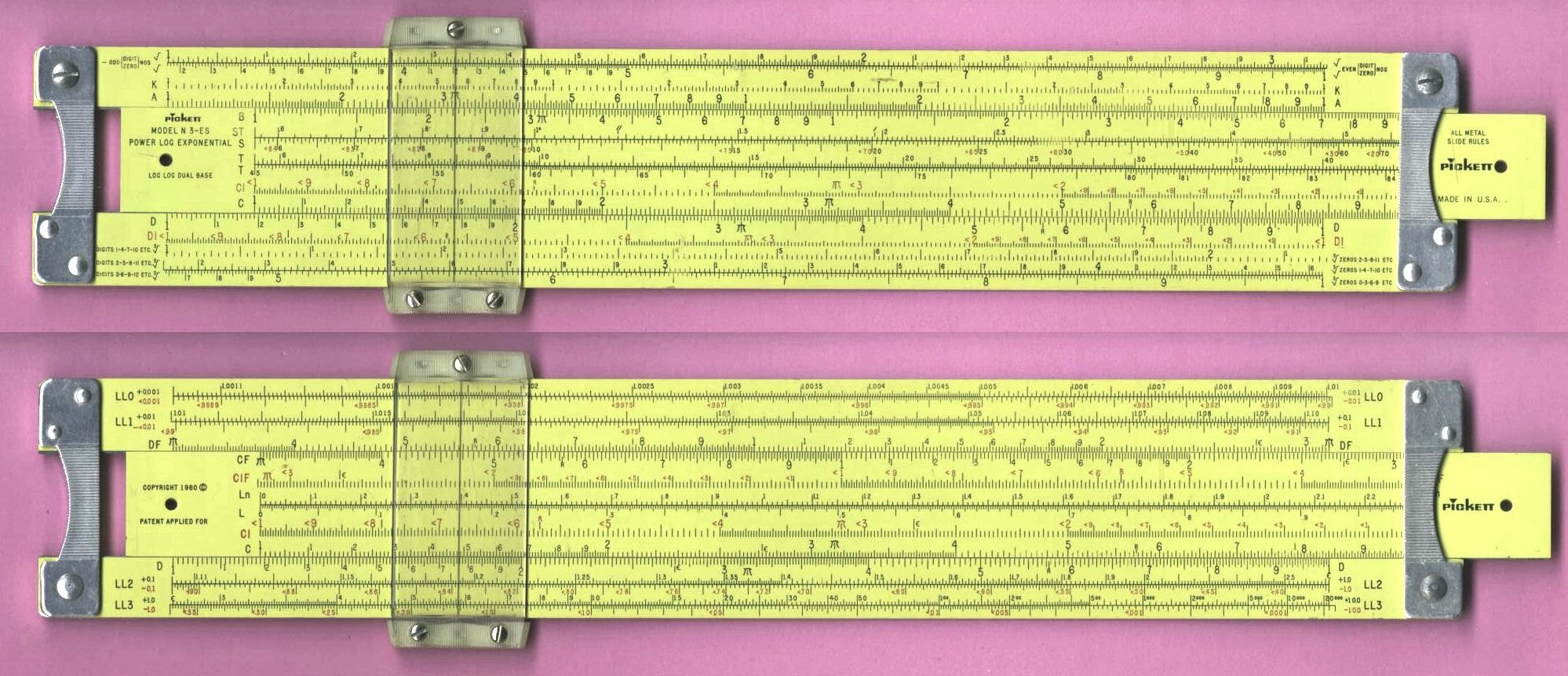
Figure 1 — Both faces of an N3-ES: the front (top) with its two √ scales above and three ∛ scales below, and the back (bottom) with the LL0–LL3 log-log scales. Image: Pickett N3-ES Power Log Exponential, donated by John L. Crawley III, International Slide Rule Museum, https://www.sliderulemuseum.com/Pickett/Pickett_N3-ES_PowerLogExponential_DonatedByJohnLCrawley.jpg.

2.1 About This Volume
Vol 1 placed the N3 and N600 in Pickett’s history. This volume is the anatomy: how an all-metal rule is put together, what the cursor is made of, and what every scale on both rules computes, with the ranges a user needs to know where an answer will appear. The two rules share their construction and their style of scales; the N3 simply carries more of them on a longer stock. How to use them — with worked examples — is Vol 3.
2.1.1 Depth-Index: The Three-Volume Unit
Table 1 — Depth-Index: The Three-Volume Unit
| Vol | Title | Primary Content |
|---|---|---|
| 1 | The Family and Its Variants | Pickett & Eckel, Model 3 and Model 600 to the N series, -ES and -T, Apollo, dating, identifying mine |
| 2 | Anatomy and the Full Scale Set (this volume) | Aluminium construction, the cursor, every N3 and N600 scale, dual-base log-log, split root scales, cases |
| 3 | Using It, and Caring for It | Worked examples on both rules, then cleaning, adjustment, parts and storage |
Note — The general meaning of the standard scales (C, D, CI, A, B, K, S, T, L, LL) is explained step by step in the Using Slide Rules unit, Vols 1–4. This volume concentrates on what is particular to Pickett’s versions.
2.2 How an Aluminium Rule Is Built
A Pickett is a duplex rule: scales on both faces, a single slide that is read from either side, and a cursor that wraps around the whole stock so that its two hairlines line up front and back.
The stock. The fixed body is two separate aluminium bars, the upper and lower stators, held a fixed distance apart by an end brace (Pickett called them posts) screwed across each end. On the later rules each brace is a stamped aluminium plate with a ridged, curved finger grip on its outer edge — the “grooved stamped posts contoured to finger tip” of Vol 1’s dating table. The braces are the only thing holding the two bars in register: loosen their screws and the stators can be shifted to set the gap and line up the scales (Vol 3).
The slide. The slide is a single aluminium strip with scales printed on both faces. On these later rules the slide has grooves along its edges that ride on the inner edges of the stators (“grooved slide” in the dating chart), and a thin flat tension spring sits in the groove to give the slide a little friction so it stays where it is set. A rule whose slide drifts loosely has usually lost or flattened that spring.
The scales. Pickett printed its scales photographically onto a painted finish rather than cutting them into the material (ISRM). On an -ES rule the ground is the Eye-Saver yellow; on a -T it is white. Black scales read left to right; the red scales are the inverted ones — values that increase from right to left — and on the N3 they also carry a small ”<” before each number as a second reminder. The print is sharp and even, and it is also the weakest part of the rule: it lies on the surface and can be rubbed away (Vol 3).
The cursor. The cursor of this period is two clear nylon bars (one along the top edge, one along the bottom) clamping a pair of clear plastic lenses, one on each face, with small screws. Each lens carries a hairline scribed into its underside; a small spring in one bar keeps the cursor snug against the stock. Earlier rules have flat grooved lenses; from about 1962 the lenses are convex, a gentle cylinder that magnifies slightly. Both hairlines must sit exactly over the same position on the two faces — the whole point of a duplex rule — and that alignment is adjustable (Vol 3).
2.3 The N3’s Front Face
The N3-ES front carries sixteen lines of scale. Reading down the rule (Figure 1, upper image):
Table 2 — The N3-ES front carries sixteen lines of scale. Reading down the rule (Figure 1, upper image)
| Scale | Where | What it gives | Range read against D |
|---|---|---|---|
| √ (odd) | upper stator | Square roots of numbers with an odd number of digits (or odd number of leading zeros after the point) | 1 to 3.162 |
| √ (even) | upper stator | Square roots of numbers with an even number of digits | 3.162 to 10 |
| K | upper stator | x³ | three cycles, 1 to 1000 |
| A | upper stator | x² | two cycles, 1 to 100 |
| B | slide | x² (A’s partner on the slide) | two cycles |
| ST | slide | Small angles: sine ≈ tangent ≈ radians | 0.573° to 5.73° |
| S | slide | Sines (black) and cosines (red) | 5.74° to 90° |
| T1 | slide | Tangents of 5.71° to 45° (and cotangents in red) | 0.1 to 1 |
| T2 | slide | Tangents of 45° to 84.29° | 1 to 10 |
| CI | slide | 1/x on the slide (red) | 10 to 1 |
| C | slide | x | 1 to 10 |
| D | lower stator | x | 1 to 10 |
| DI | lower stator | 1/x on the body (red) | 10 to 1 |
| ∛ (1, 4, 7, 10 … digits) | lower stator | Cube roots of numbers with 1, 4, 7 … digits | 1 to 2.154 |
| ∛ (2, 5, 8, 11 … digits) | lower stator | Cube roots of numbers with 2, 5, 8 … digits | 2.154 to 4.642 |
| ∛ (3, 6, 9, 12 … digits) | lower stator | Cube roots of numbers with 3, 6, 9 … digits | 4.642 to 10 |
The range figures follow from the scale definitions: √10 = 3.162, ∛10 = 2.154 and ∛100 = 4.642, so the square-root scale is one D-length split in two and the cube-root scale one D-length split in three.
Three features stand out against an ordinary log-log duplex such as the K&E 4081.
The split root scales. On most rules a square root is read by going down from the two-cycle A scale to D, and a cube root by going down from the three-cycle K scale. Each of those lands on a full-length D scale, so the root is read at full precision — but the number being rooted must be set on A or K, where it is crowded into half or a third of the length. Pickett turned this around. On the N3 the number is set on D, at full length, and its root is read on a √ or ∛ scale that is itself two or three times longer than D. Both the setting and the reading are at full scale or better. The price is that the user must pick the right line, and the labels at the ends say how. For square roots the left end reads “ODD DIGIT / ZERO NOS” and the right end “EVEN DIGIT / ZERO NOS”: a number with an odd count of digits before the point — or, for a decimal, an odd count of zeros straight after the point — takes the upper line, an even count the lower. For cube roots the left ends give the digit rule (“DIGITS 1-4-7-10 ETC.”, “2-5-8-11”, “3-6-9-12”) and the right ends the zero rule for decimals (“ZEROS 2-5-8-11 ETC.”, “1-4-7-10”, “0-3-6-9”). So 0.05 (one zero) takes the upper √ line and gives 0.2236, while 0.5 (no zeros) takes the lower and gives 0.7071; 0.005 (two zeros) takes the first ∛ line and gives 0.1710.
Two tangent scales. T1 covers 5.71° to 45° (tangents 0.1 to 1) and T2 covers 45° to 84.29° (tangents 1 to 10), both read against C and D. On a rule with a single T scale, tangents above 45° must be found as reciprocals of the cotangent; on the N3 they are read directly.
ST for small angles. Below about 5.7° the sine, the tangent and the angle in radians agree to three figures, so one scale serves all three. ST runs from 0.573° (0.01 radian) to 5.73° (0.1 radian).
2.4 The N3’s Back Face
Table 3 — The N3's Back Face
| Scale | Where | What it gives | Range |
|---|---|---|---|
| LL0 (black / red) | upper stator | e^(0.001x) and e^(−0.001x) | 1.001–1.010; red 0.999–0.990 |
| LL1 (black / red) | upper stator | e^(0.01x) and e^(−0.01x) | 1.010–1.105; red 0.990–0.905 |
| DF | upper stator | πx (D folded at π) | π to 10π |
| CF | slide | πx on the slide | π to 10π |
| CIF | slide | 1/(πx) (red) | — |
| Ln | slide | Natural logarithm of the number on C/D, as a linear scale | 0 to 2.303 |
| L | slide | Common logarithm (mantissa) of the number on C/D | 0 to 1 |
| CI | slide | 1/x (red) | 10 to 1 |
| C | slide | x | 1 to 10 |
| D | lower stator | x | 1 to 10 |
| LL2 (black / red) | lower stator | e^(0.1x) and e^(−0.1x) | 1.105–2.718; red 0.905–0.368 |
| LL3 (black / red) | lower stator | e^x and e^(−x) | 2.718–22,026; red 0.368–0.0000454 |
Each LL line is printed twice — black for the positive exponent, red for the negative — which is what Pickett means by dual base (and the box by “Synchrolog”). Because e^(−y) = 1/e^(y), the red value at any tick is the reciprocal of the black one at the same tick: 2 and 0.5 share a tick on LL2, for example. The four pairs are cut at exponents 0.001, 0.01, 0.1, 1 and 10, so each LL scale is “one decade” of exponent above the one before; moving from LL2 to LL3 at the same position multiplies the exponent by ten. That is the key to using them (Vol 3).
Ln is less common and worth noticing: it is a plain linear scale from 0 to 2.303 aligned with D, so the natural logarithm of any number from 1 to 10 set on D is read directly, with no log-log scale involved.
2.5 The N600’s Scale Set
The N600 is a pocket rule with 5-inch scales on a stock about 6½ inches long, built exactly like the N3 but with a shorter list (Hamann; ISRM):
Table 4 — The N600 is a pocket rule with 5-inch scales on a stock about 6½ inches long, built exactly like the N3 but with a shorter list (Hamann; ISRM)
| Face | Scales, top to bottom |
|---|---|
| Front | LL1 (black / red), A, [B, ST, T, S, C], D, DI, K |
| Back | LL2 (black / red), DF, [CF, Ln, L, CI, C], D, LL3 (black / red) |
(Square brackets enclose the slide.) The ranges are those of the same-named N3 scales, with three differences that matter in use:
- There is no LL0, so the N600 cannot handle exponents below 0.01 (numbers between 0.990 and 1.010) directly.
- There is a single T scale (5.71°–45°, with red cotangents), so tangents above 45° are found as reciprocals: tan θ = 1/tan(90° − θ).
- Roots are read the conventional way, from A and K down to D, because the split √ and ∛ scales are absent.
The front LL1 pair and the back LL2 and LL3 pairs together run continuously from 1.01 to 22,026 (and from 0.99 down to 0.0000454 in red), which is the whole of the range most engineering needs. For a rule that fits a shirt pocket, it is a remarkably complete instrument — which is why it was the one that flew on Apollo (Vol 1; History Vol 5).
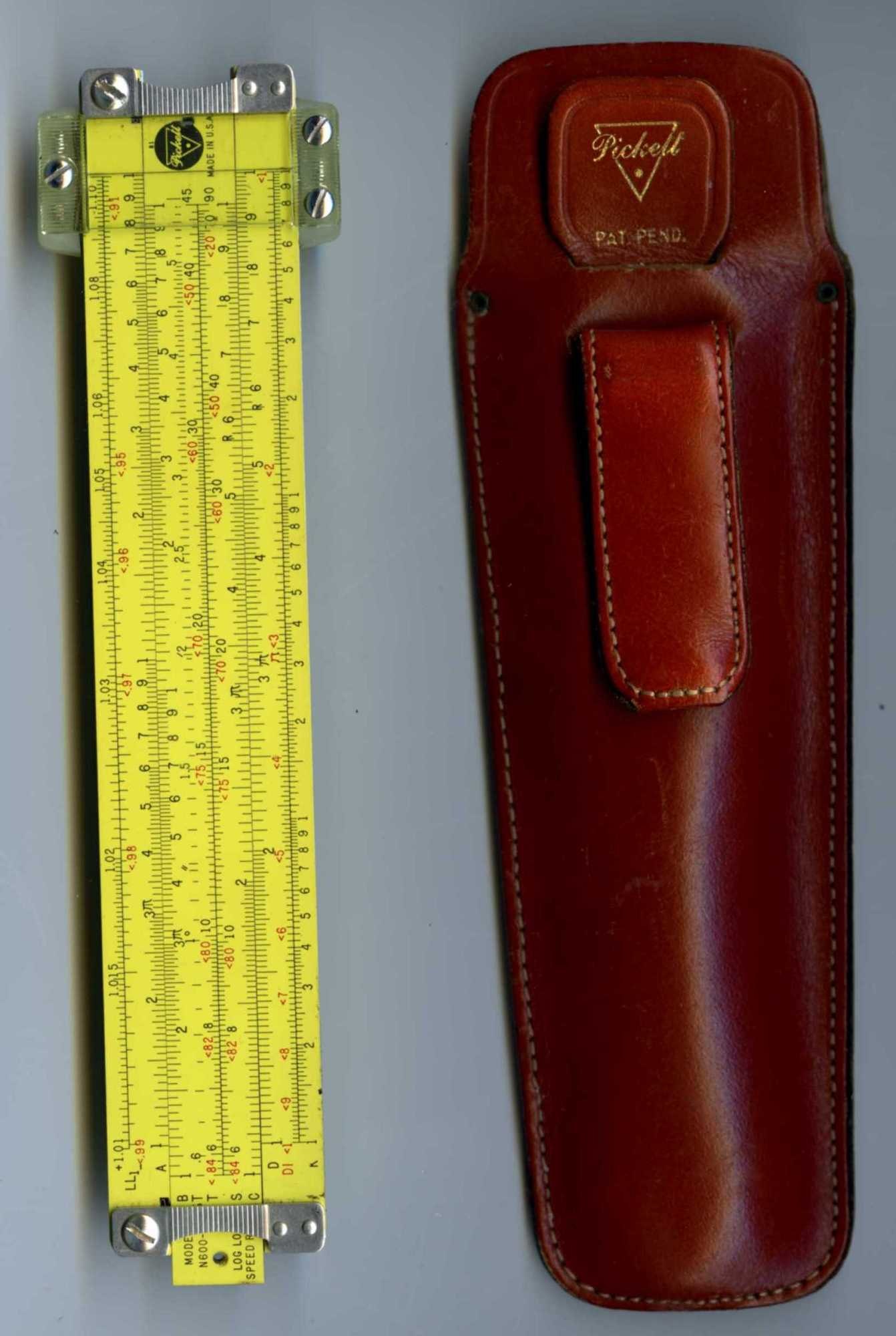
Figure 2 — The N600-ES’s front face: LL1 across the top, A and B, the slide with ST, T, S and C, then D, DI and K. The model name and “LOG LOG SPEED RULE” are on the slide end at the bottom. Image: “Pickett N600-ES Log Log Duplex Slide Rule,” Smithsonian National Museum of American History, CC0 1.0, https://ids.si.edu/ids/deliveryService?id=NMAH-AHB2009q09157.
2.6 Scale Lengths and Precision
The N3’s C and D scales are 10 inches (25 cm) long, the N600’s 5 inches (12.5 cm). On a 10-inch rule three significant figures can be read anywhere on C and D and a fourth estimated at the left end (Using Slide Rules Vol 1); a 5-inch rule reads to about two and a half to three. On the N3 the split root scales are effectively 20 and 30 inches long, so roots are read a little more precisely than products. The log-log scales are the exception in the other direction: they give the answer itself, not just its digits, so their precision is a percentage of the number read, and it falls off at the right-hand end of LL3 where the ticks cover hundreds or thousands.
2.7 The Cases
Pickett supplied leather cases from its own works — John Pickett formed Pacific Leather Works in 1953–54 for the purpose (ISRM). Two styles go with this family:
- The N3’s sleeve is a long, close-fitting leather envelope with a tucked flap, gold-stamped “Pickett” on the flap (Vol 1, Figure 1). Many are lined, and the inside of the flap is where owners wrote names, schools and service numbers.
- The N600’s holster is a short sleeve with a belt loop on the back and the triangle logo and “PAT. PEND.” stamped on the flap (Figure 2). Variants stamped with company or programme seals are common (Vol 1, Figure 4).
Both are vegetable-tanned leather over a stiff liner. Their condition matters to the rule: a case that has been stored damp holds moisture against the aluminium, and old leather can shed dye and dust into the cursor. Care is in Vol 3.
Sources
- Hamann, Slide Rules catalogue pages “Pickett N3-ES (10” / 25 cm scales)” and “Pickett Pocket N600-ES (5” / 12.5 cm scales)” — scale-by-scale formulas and ranges (https://public.bht-berlin.de/hamann/sliderules/pick-n3.html; https://public.bht-berlin.de/hamann/sliderules/pick-n6p.html).
- International Slide Rule Museum, Pickett gallery — scale lists for the N3-ES, N3-T, N3P-ES/-T, N600-ES and N600-T; notes on photo-printed scales; the Pacific Leather Works entry in the company timeline (https://www.sliderulemuseum.com/Pickett.shtml).
- Maurice L. Hartung, How to Use Dual Base Log Log Slide Rules, Pickett Form M-15 (c.1960; ISRM M115) — the √ and ∛ scales, double T scales, and the dual-base log-log scales. In this site’s Reference Library.
- Maurice L. Hartung, How to Use Log Log Slide Rules, Pickett Form M-14 (1953; ISRM M223) — reference for the 600 and N3. In this site’s Reference Library.
- Mike Konshak after Rodger Shepherd, “Chronology of Pickett Slide Rule Development” (ISRM) — cursor bars, lenses, braces and slide springs. In this site’s Reference Library.
- Range figures (√10 = 3.162, ∛10 = 2.154, ∛100 = 4.642, e^0.001 = 1.001, e^0.01 = 1.01005, e^0.1 = 1.10517, e = 2.71828, e^10 = 22,026, ln 10 = 2.303, 0.01 rad = 0.573°) were checked by calculation.
Comments (0)