Pickett N3 & N600 · Volume 1
Pickett N3 & N600 — Volume 1 — The Family and Its Variants
Pickett's ten-inch Power Log Exponential and its six-inch Apollo sibling: where they came from, how the variants differ, and how to date one
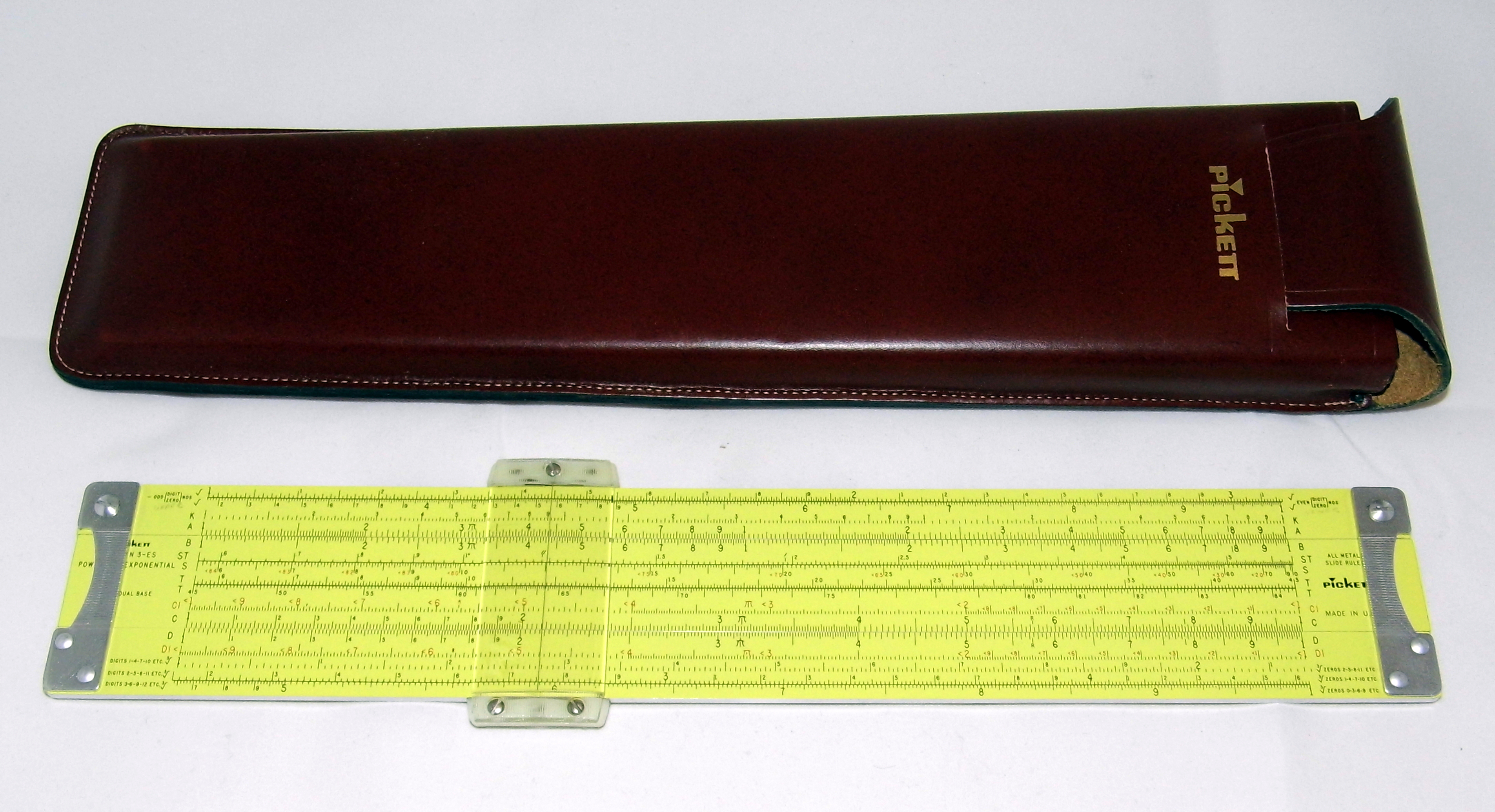
Figure 1 — A Pickett N3-ES “Power Log Exponential,” copyright 1960, with its leather sleeve: all-aluminium stock, Eye-Saver yellow scales, a clear cursor on nylon bars, and the gold-stamped Pickett logo on the case flap. Image: “Vintage Pickett Slide Rule With Leather Case, Model N3-ES Power Log Exponential, Aluminum Stock, Made In USA, Copyright 1960” by Joe Haupt, CC BY-SA 2.0, via Wikimedia Commons, https://commons.wikimedia.org/w/index.php?curid=69504003.
1.1 About This Volume
This unit covers one Pickett family: the ten-inch N3 (“Power Log Exponential”) and the six-inch N600 (“Log Log Speed Rule”), each made in a yellow -ES (Eye-Saver) and a white -T version. The two are not one rule in two sizes — their scale sets differ, and Vol 2 sets them side by side — but they were sold together, share the same construction, the same cursor and case styles and the same manuals, and an owner who knows one can pick up the other. This volume places them in Pickett’s history, sorts out the variants, and gives the evidence that dates an example. Vol 2 takes the scales apart; Vol 3 is a working guide with worked examples and a care section written for aluminium, printed scales, plastic cursors and leather cases.
1.1.1 Depth-Index: The Three-Volume Unit
Table 1 — Depth-Index: The Three-Volume Unit
| Vol | Title | Primary Content |
|---|---|---|
| 1 | The Family and Its Variants (this volume) | Pickett & Eckel, Model 3 and Model 600 to the N series, -ES and -T, Apollo, dating by logo, braces and lens, identifying mine |
| 2 | Anatomy and the Full Scale Set | Aluminium construction, the cursor, every N3 and N600 scale, dual-base log-log, split root scales, cases |
| 3 | Using It, and Caring for It | Worked examples on both rules (each checked by calculation), then cleaning, adjustment, parts and storage |
Note — “History Vol N” refers to the History unit of this site; Pickett & Eckel’s place among the great makers is told in History Vol 3, and Apollo in History Vol 5. This unit does not repeat them.
1.2 Pickett & Eckel in Brief
Pickett was a late arrival among the great makers and the only one to build its reputation on metal (History Vol 3). The company timeline kept by the International Slide Rule Museum (ISRM) runs, in outline:
Table 2 — Pickett was a late arrival among the great makers and the only one to build its reputation on metal (History Vol 3). The company timeline kept by the International Slide Rule Museum (ISRM) runs, in outline
| Year | Event |
|---|---|
| 1943 | Roswell C. Pickett, a Chicago printer, founds the firm; Arthur F. Eckel joins and it becomes Pickett & Eckel |
| 1944 | First Pickett & Eckel rules, printed on card stock |
| 1946 | First magnesium rules (the “Deci-Point”) |
| Early 1950s | Aluminium rules made under contract by Cal-Pan Co. in Alhambra, California; Cal-Pan bought out in 1953–54 |
| 1953–54 | John Pickett forms Pacific Leather Works to make the cases |
| 1964 | Move to Santa Barbara; the family sells to the Times Mirror Co.; the firm becomes Pickett Industries |
| 1974 | Move to Nogales, Arizona, with manufacturing across the border in Nogales, Sonora |
| 1975 | Combined with Chartpack as Chartpack/Pickett |
Two facts about the method matter for everything that follows. First, Pickett printed its scales photographically onto a painted aluminium surface rather than engraving them into celluloid the way K&E and Faber-Castell did (ISRM). That made the rules cheap to make in many models and gave them their crisp black-and-red artwork — and it is the single most important thing to know when cleaning one (Vol 3). Second, the metal rule is effectively immune to the humidity that warps wooden rules and swells celluloid-on-wood ones; what it gives up is the silky feel of a bamboo or mahogany slide.
1.3 From Model 3 and Model 600 to the N Series
Both rules in this family are second-generation names. Pickett’s later catalogue numbers carry an N prefix, and both N models replaced an earlier rule with the same number:
- The Model 600 was a six-inch pocket log-log rule from the magnesium era: the ISRM shows one dated 1949 with a magnesium stock and Pickett’s triangle logo, and Pickett’s 1953 manual refers to “the 1949 Model 600 Standard Synchro-Scale pocket slide rule.” Its scale set (LL1, A, B, ST, T, S, C, D, DI, K on one face; LL2, DF, CF, CIF, CI, L, C, D, LL3 on the other) is close to that of the later N600.
- The N600-ES follows from about 1958–59. ISRM examples run from 1959 through the 1964–75 “modern logo” years, and a retail price list from about 1970 shows it at $10.95. Pickett’s own name on the rule is Log Log Speed Rule, and the box calls the scales “Synchrolog.”
- The earlier Model 3 (3-T, 1953) was a Dual-Base Log Log Reciprocal rule with N-scales (N1–N4 and their reciprocals) on the back — a quite different instrument.
- The N3 that replaced it carries the copyright date 1959 or 1960 on its back and a new name, Power Log Exponential, with a new scale layout: two square-root scales and three cube-root scales framing the face, two tangent scales, and four dual log-log scales on the back. With every log-log scale doubled into a black and a red set, Hamann counts 32 scales, which made it one of the most heavily loaded rules ever sold (Vol 2). The same c.1970 price list shows the N3-ES at $26.95.
The N in the model numbers marks the new series; it is not a size code. The ten-inch rule is the N3 and the six-inch one the N600 regardless of colour.
1.4 The Variants: -ES, -T, P
The suffix after the model number is about colour, not scales.
-ES — Eye-Saver yellow. Pickett introduced its yellow finish in the mid-1950s; the ISRM notes that after the magnesium Model 800 “Pickett came up with the ‘Eye-saver Yellow’ and offered both -T and -ES models,” and has an 800-ES of 1954. Pickett marketed the colour hard. Its leaflet How Eye-Saver Slide Rules Save Your Eyes (Form 225-A) argues that yellow sits at the “point of optimum seeing of detail” on the eye’s sensitivity curve, that it “absorbs the short Actinic Rays that obscure scales on white rules,” gives “no glare,” and focuses the scales “directly ON the retina” (Figure 2). These are an advertiser’s claims, not measured results, but many owners remember the yellow as easier on the eyes under fluorescent light, and the colour became Pickett’s signature.
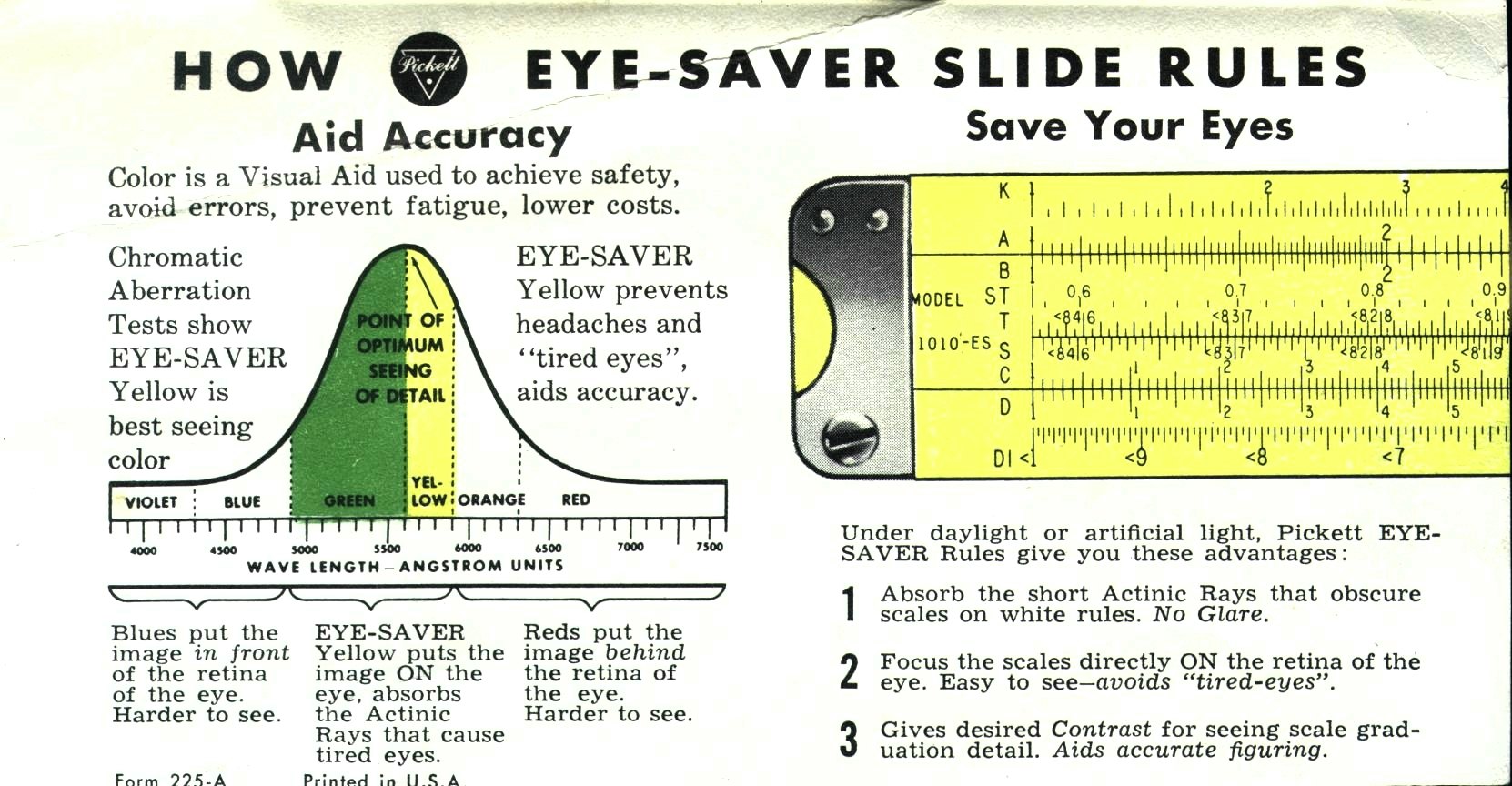
Figure 2 — Pickett’s case for yellow: the Eye-Saver leaflet, Form 225-A. The bell curve is Pickett’s drawing of the eye’s sensitivity, with the yellow band placed at its peak. Image: Pickett & Eckel, “How Eye-Saver Slide Rules Save Your Eyes,” Form 225-A; ISRM M307, Bill Wehrend Collection, https://www.sliderulemuseum.com/Manuals/ISRM_M307_Pickett_HowEyeSaverSlideRulesSaveYourEyes_BillWehrendCollection.jpg.

-T — white. The same rules were sold with white scales; Hamann reads the T as “Traditional.” Apart from the colour of the ground, an N3-T and an N3-ES of the same year have the same scales and artwork (Figure 3).
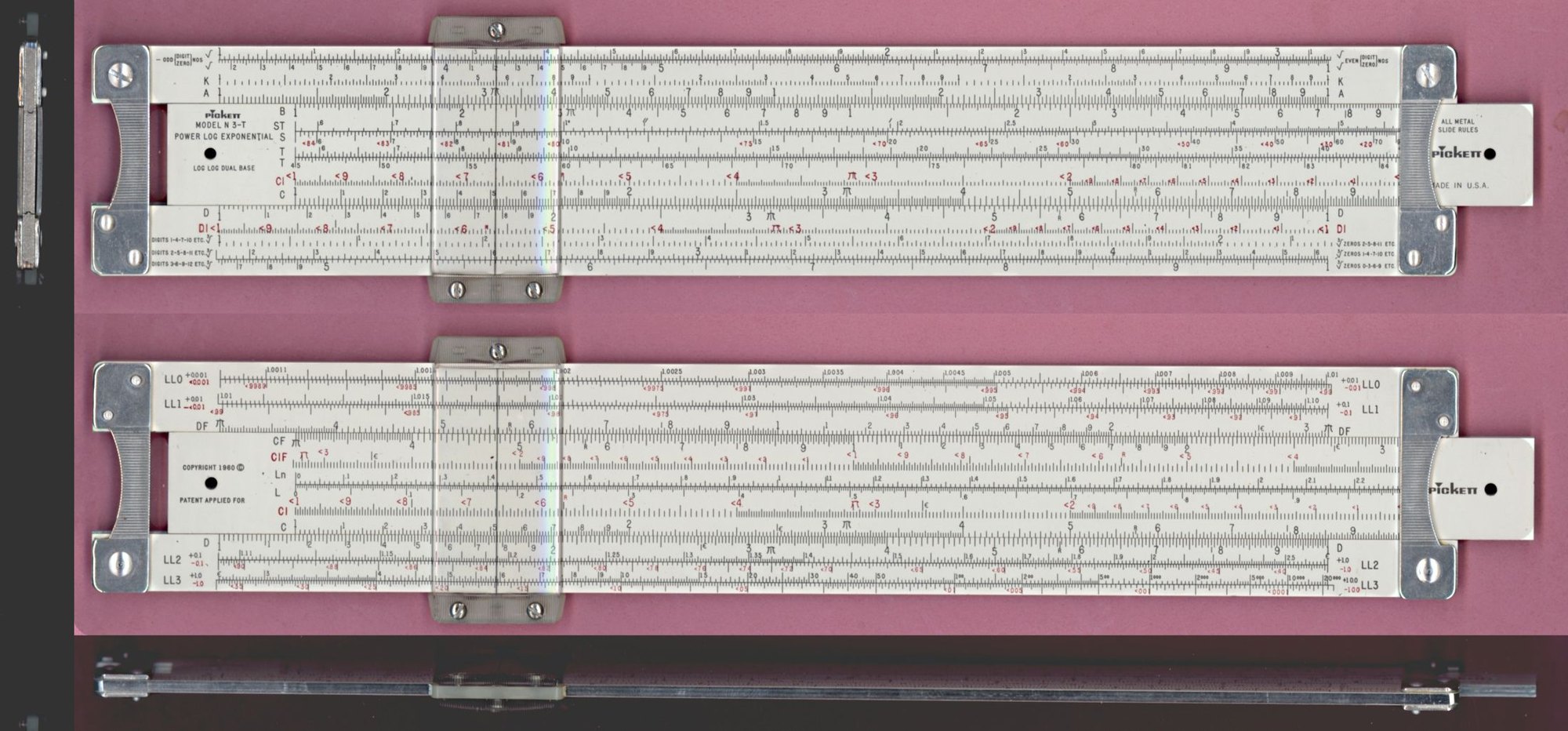
Figure 3 — The white version: an N3-T, front (top) and back (bottom), with an edge view below. Compare the scale labels with the yellow rule in Figure 1 — they are identical. This one has the 1964–75 “modern” logo and curved braces. Image: Pickett N3-T Dual Base Log Log, Leroy Hausler Collection, International Slide Rule Museum, https://www.sliderulemuseum.com/Pickett/Pickett_N3-T_DualBaseLogLogRecipScale_CurvedBraces_ModernLogo_GiftOfLeroyHauslerCollection.jpg.

P — the N3P. The ISRM also holds new-old-stock N3P-ES and N3P-T rules in “Synchrolog” boxes, with the same scale set as the N3; the c.1970 price list shows the N3P-ES at $13.95, about half the N3-ES’s $26.95. What the P stands for, and what the lower price bought less of, is not settled in the sources used for this unit.
Six-inch variants. The N600 also came in both colours (Figure 4), with red or all-black inverse scales depending on the year, and in versions with a magnifying cursor. Pickett also sold six-inch N600s in company-branded cases — the example below was issued through Western Electric’s Graduate Engineering Education Program — and in “twin packs” with a ten-inch rule.
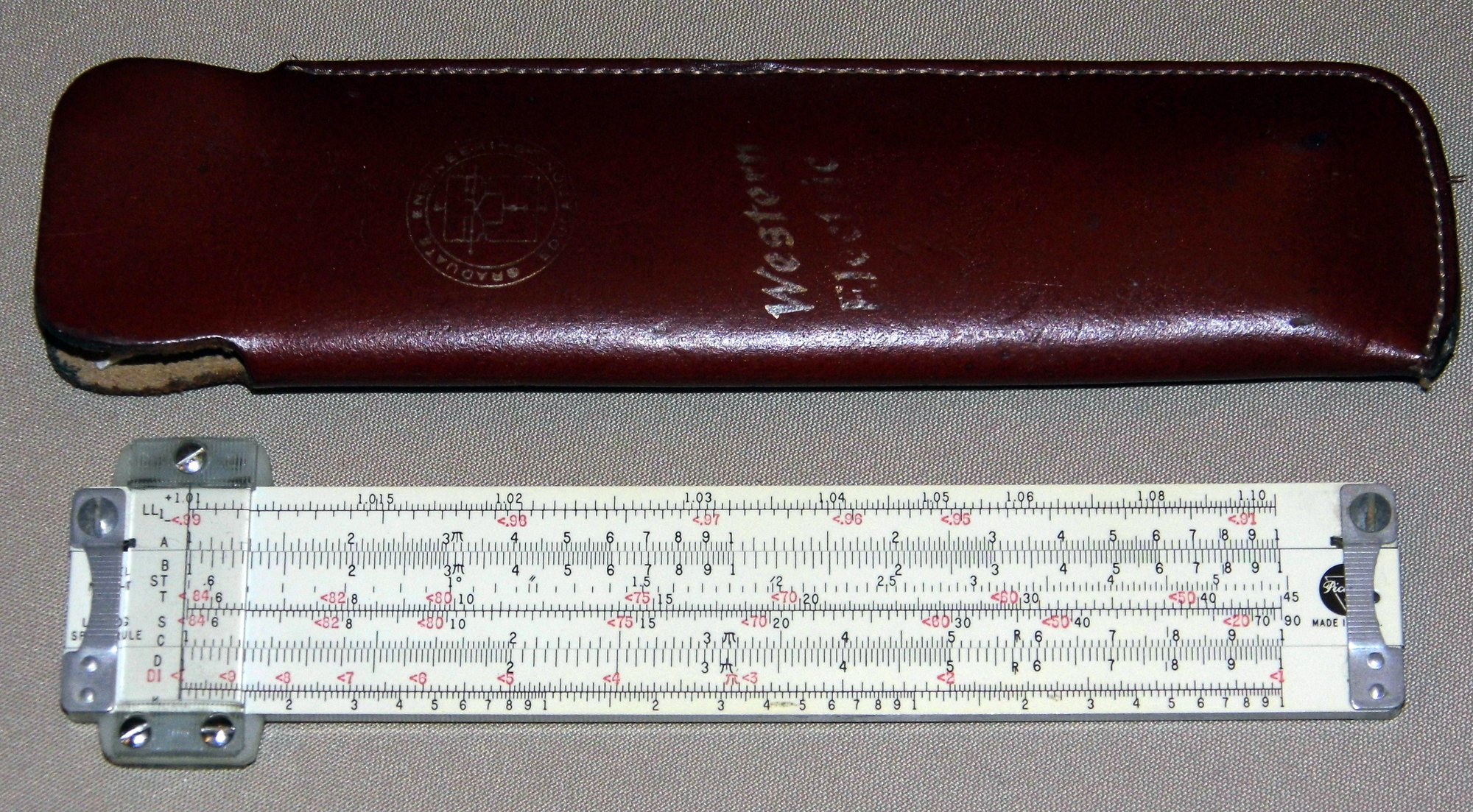
Figure 4 — An N600-T, copyright 1962, in a sleeve stamped for Western Electric’s Graduate Engineering Education Program. Image: “Vintage 6-Inch Pickett Slide Rule, Model N600-T with Western Electric Logo on the Leather Case, ‘Graduate Engineering Education Program’, Copyright 1962” by Joe Haupt, CC BY-SA 2.0, via Wikimedia Commons, https://commons.wikimedia.org/wiki/File:Vintage_6-Inch_Pickett_Slide_Rule,_Model_N600-T_with_Western_Electric_Logo_on_the_Leather_Case,_%22Graduate_Engineering_Education_Program%22,_Copyright_1962_(8572305700).jpg.

1.5 The Apollo Rule
The N600-ES is the rule that went to the Moon. The story is told in History Vol 5 and not repeated here, but two details belong in a unit about the model. Hamann’s catalogue records that the N600-ES “accompanied astronauts on five Apollo moon flights.” And the ISRM’s reference scan of the N600-ES that Buzz Aldrin carried on Apollo 11 — sold at Heritage Auction Galleries on 21 September 2007 for $77,675 — shows the standard production scale set, identical to the N600-ES in Figure 5. The astronauts carried a catalogue rule, not a special one.
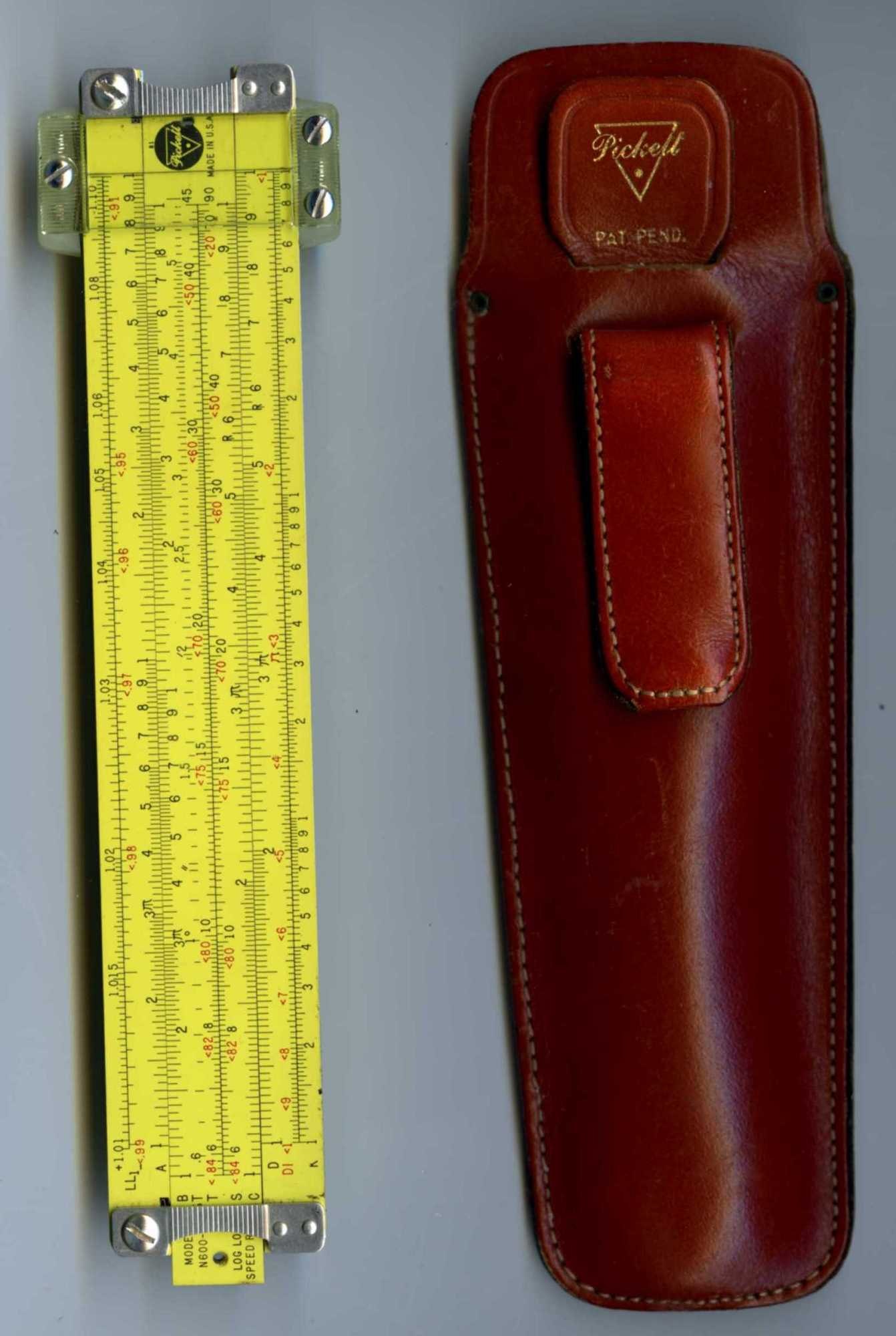
Figure 5 — The Apollo model: an N600-ES with its leather holster. The round black logo on the rule dates it to about 1958–62 (Figure 6). Image: “Pickett N600-ES Log Log Duplex Slide Rule,” Smithsonian National Museum of American History, CC0 1.0, https://ids.si.edu/ids/deliveryService?id=NMAH-AHB2009q09157.
1.6 Dating an Example
Pickett did not stamp serial numbers on these aluminium rules, and the copyright date on the back (1959, 1960, 1962…) is the date of the artwork, not of manufacture — the same copyright line stayed on rules made for years afterwards. Dating therefore relies on hardware and logo changes. The chronology compiled by Mike Konshak from Rodger Shepherd’s research (Journal of the Oughtred Society, 1992) is the standard tool (Figure 6).
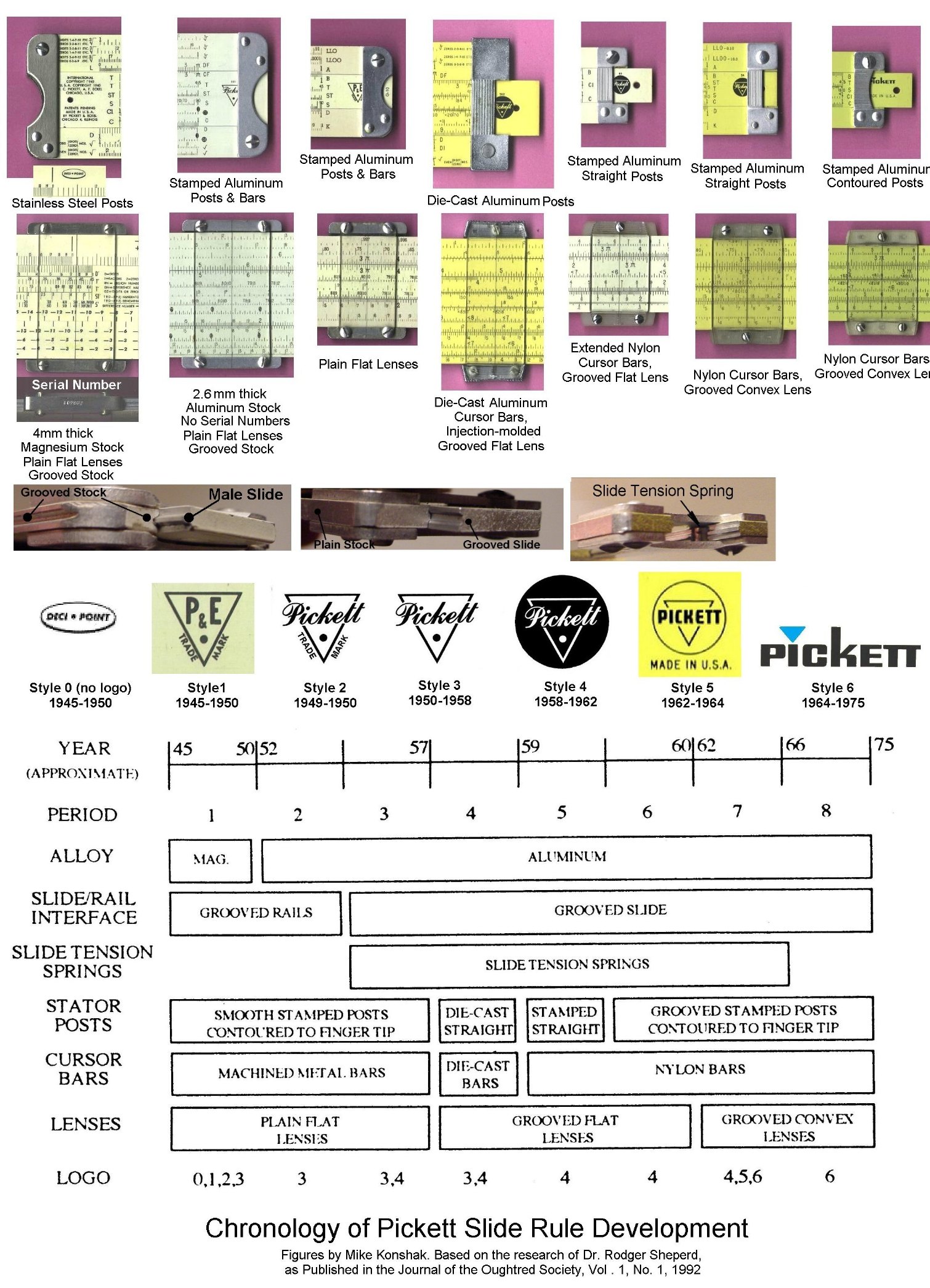
Figure 6 — The Pickett dating chart: end-brace and cursor styles across the top, logo styles and their dates below, then the change-over years for alloy, springs, braces, cursor bars and lenses. Image: “Chronology of Pickett Slide Rule Development,” figures by Mike Konshak after the research of Dr. Rodger Shepherd, Journal of the Oughtred Society 1:1 (1992); International Slide Rule Museum, https://www.sliderulemuseum.com/Manuals/Pickett_Chronology.pdf.
For the N3 and N600, which belong to the chart’s later periods, the useful clues are:
Table 3 — For the N3 and N600, which belong to the chart's later periods, the useful clues are
| Feature | What to look for | Approximate dates |
|---|---|---|
| Logo | Style 3: script “Pickett” in a triangle | 1950–58 |
| Style 4: script “Pickett” in a round black disc | 1958–62 | |
| Style 5: “PICKETT” in a round yellow disc with “MADE IN U.S.A.” | 1962–64 | |
| Style 6: block-letter “PICKETT” (the “modern” logo) | 1964–75 | |
| Cursor bars | Nylon bars (the clear-ended blocks seen in Figures 1, 3 and 5) | from c.1959 |
| Lens | Grooved flat lens | c.1957–62 |
| Grooved convex (curved) lens | c.1962–75 | |
| End braces (stator posts) | Stamped straight posts, then grooved stamped posts contoured to the fingertip | stamped straight c.1959–60; contoured from c.1960 |
| Slide tension spring | A flat spring in the slide groove | c.1952 to about 1970 |
| Address on the back | Chicago, Alhambra, or Santa Barbara (from 1964) | see timeline above |
Read together, these narrow most rules to a few years. An N3-ES with a round black logo and a flat lens, for example, is about 1960–62; one with the block logo and a convex lens is 1964 or later. The ISRM’s dated examples confirm the pattern: its N3-ES rules run from a 1960 example with a flat lens and round black logo, through a c.1962 example with a convex lens, to a “modern logo” example used at the Virginia Military Institute until 1973–74.
1.7 Mine
I own a rule from this family. Which one it is — N3 or N600, yellow or white, and of what year — is still to be identified, and there are no photographs of it in this project yet.
What would identify it, in order of how quickly each settles the question:
- Length. A rule about 12½ inches long overall with 10-inch scales is an N3; one about 6½ inches long with 5-inch scales is an N600.
- The name on the left end of the slide or stock. The N3 reads “MODEL N 3-ES” (or “N 3-T”) and “POWER LOG EXPONENTIAL,” with “LOG LOG DUAL BASE”; the N600 reads “MODEL N600-ES” (or “-T”) and “LOG LOG SPEED RULE.” A “P” after the 3 (N3P) is worth noting.
- Colour. Yellow is -ES; white is -T.
- Scale labels. An N3 has two √ scales across the top and three ∛ scales across the bottom of the front; an N600’s front starts with LL1 and ends with K (Vol 2).
- The logo, the cursor lens and the end braces, read against the table above, for the date.
- The copyright year and the city in the small print on the back.
- The case. A long flap sleeve with a gold Pickett stamp is the usual N3 case; the N600 came in a short holster with a belt loop. Owners’ names, school names and company seals (Figure 4) are common inside the flap.
Sources
- International Slide Rule Museum (ISRM), Pickett gallery and “Pickett & Eckel Historical Timeline” — models 600, N600-ES/-T, 3-T, N3-ES/-T, N3P-ES/-T, with scale lists and dated examples; c.1970 retail price list; Aldrin’s Apollo 11 N600-ES scan (https://www.sliderulemuseum.com/Pickett.shtml).
- Mike Konshak, after Rodger Shepherd, “Chronology of Pickett Slide Rule Development,” Journal of the Oughtred Society 1:1 (1992); ISRM chart (https://www.sliderulemuseum.com/Manuals/Pickett_Chronology.pdf). In this site’s Reference Library.
- Pickett & Eckel, How Eye-Saver Slide Rules Save Your Eyes, Form 225-A (ISRM M307).
- Hamann, Slide Rules catalogue pages “Pickett N3-ES” and “Pickett Pocket N600-ES” (https://public.bht-berlin.de/hamann/sliderules/pick-n3.html; https://public.bht-berlin.de/hamann/sliderules/pick-n6p.html).
- Maurice L. Hartung, How to Use Dual Base Log Log Slide Rules (Pickett, 1953; ISRM M103) — reference to the 1949 Model 600. In this site’s Reference Library.
- Smithsonian National Museum of American History, Pickett N600-ES record (NMAH 694174).
Comments (0)