Pickett Demonstration Giants · Volume 1
The Pickett Demonstration Rule — Volume 1 — The Giants of the Classroom
Four-foot and seven-foot teaching rules, why Pickett gave them away, and how to tell one from another
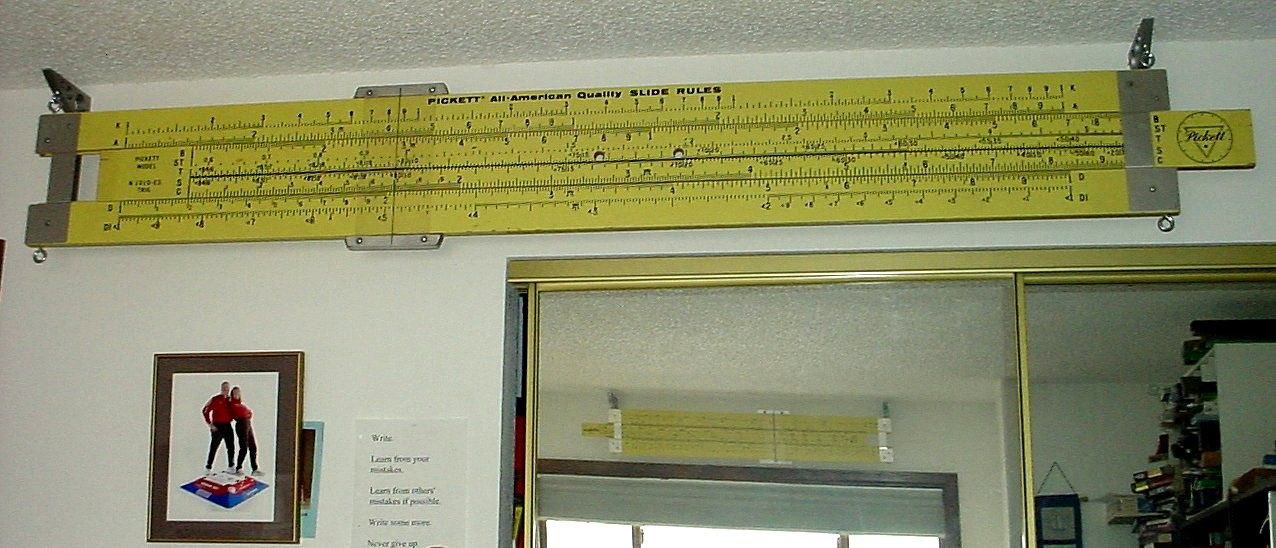
Figure 1 — A seven-foot Pickett N1010-ES demonstration rule, hung on brackets high on a wall, exactly as it would once have hung above a classroom blackboard. Image: International Slide Rule Museum, “Demonstration Slide Rules,” https://sliderulemuseum.com/DemoSR.shtml.
1.1 About This Volume
For about thirty years, from the late 1940s into the 1970s, a great many American high-school mathematics and physics rooms had a slide rule four or seven feet long hanging above the blackboard. It was nearly always yellow, nearly always made by Pickett, and it had nearly always cost the school nothing. The teacher set problems on it with a pointer; thirty students set the same problem on the ten-inch rules on their desks and read the answer back.
I own one of these giants. Its length and model are not yet recorded. This volume sets out the family — what Pickett made, why, and how the variants differ — and the marks that identify any particular example. Vol 2 takes the instrument apart: the plywood stock, the aluminium end plates, the cursor, the hanging hardware, and the scales. Vol 3 is about using one to teach, and about looking after a seven-foot wooden object whose scales are printed on paint. Pickett as a company, and its pocket and desk rules, are covered in The Story of the Slide Rule Vol 3 and the separate Pickett N3/N600 unit; they are not repeated here.
1.1.1 Depth-Index: The Pickett Demonstration Rule Unit
Table 1 — Depth-Index: The Pickett Demonstration Rule Unit
| Vol | Title | Primary Content |
|---|---|---|
| 1 | The Giants of the Classroom (this volume) | Why demonstration rules existed, Pickett’s free-rule offer, the 4-ft and 7-ft models, other makers, dating, identifying mine |
| 2 | Anatomy and the Scales | Plywood stock and slide, aluminium end plates, slider inserts, cursor, hanging eyes and brackets, the scale sets of the N1010, N902, N4, N3 and N500 demonstrators |
| 3 | Teaching with It, and Caring for It | Pickett’s own teaching method, worked classroom examples all checked, then cleaning, the slide, the cursor, hanging, storage and transport |
Note — Cross-references to other units appear as “Using a Slide Rule Vol 2.” Within this unit they appear as “see Vol N.”
1.2 Why a Slide Rule Seven Feet Long
A slide rule is a hard thing to teach from the front of a room. Its whole skill lies in small movements and fine readings — set the index over 2, push the hairline to 3, read the mark beneath it — and none of that can be seen by thirty students from their desks. A drawing on the blackboard is static, and an ordinary rule held up by the teacher is invisible beyond the front row.
The makers’ answer was the demonstration rule (also called a teaching, classroom or wall rule, and among collectors a “Moby”): a working copy of a standard student rule, scaled up four to eight times, with scales printed large enough to read across a room and a slide and cursor that really move. The International Slide Rule Museum describes them as enlarged versions of popular models that manufacturers made and supplied to schools to teach slide-rule use — and which doubled as advertising for the brand, since every student in the room looked at the maker’s name for a year (ISRM, “Demonstration Slide Rules”).
Keuffel & Esser, Dietzgen (whose seven-foot 1760-series rule copied its Mannheim type 1768), the French Graphoplex and the German DIWA all made them. But in the United States one maker dominated, and did so by giving them away.
1.3 Pickett’s Offer
Pickett & Eckel was founded in Chicago in 1943 by Roswell C. Pickett and Arthur F. Eckel. It moved most of its manufacturing to Alhambra, California, after the war, kept its Chicago offices into the 1960s, moved to Santa Barbara in 1964 as Pickett Industries, and in the mid-1970s moved to Nogales, Mexico, and stopped making slide rules (Smithsonian NMAH; The Story of the Slide Rule Vol 3). It was a late entrant to a market long held by K&E and Dietzgen, and it won its place with all-aluminium rules, a bright “Eye-Saver” yellow finish — and schools.
Pickett’s offer was simple: any school that ordered a class set of standard rules — twenty-four or more, by most accounts — received a demonstration rule free. The Cooper Hewitt museum, which holds a seven-foot N1010-ES used in an Ohio high-school physics class, records the threshold as at least twenty-four; other accounts give twenty-five (Cooper Hewitt; ISRM). The University of Waterloo Computer Museum notes simply that Pickett gave one to every school that ordered a set of normal-size rules, which is why seven-foot Picketts are “relatively common” (Waterloo). Collectors credit the programme with building Pickett’s user base: a generation of engineers learned on Pickett because their classroom had a Pickett on the wall (sliderule.ca).
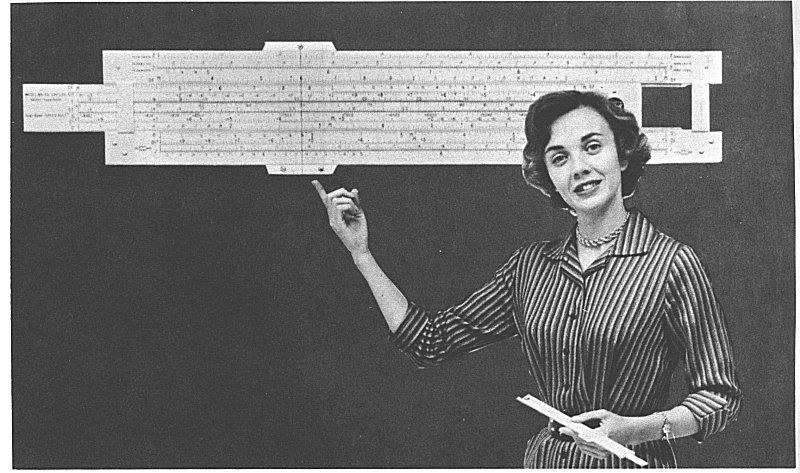
Figure 2 — The scene Pickett was selling: a teacher at a wall-mounted demonstrator, a student rule in hand. From Maurice L. Hartung’s Teaching Guide for Slide Rule Instruction (Pickett Manual 601, © 1960). Image: Pickett, Inc., via the International Slide Rule Museum, https://sliderulemuseum.com/DemoSR.shtml.
1.4 The Pickett Family
1.4.1 What the catalogue offered
Pickett’s catalogue — printed at the back of the scanned copy of the 1960 Teaching Guide in the Library — describes the “Wall Rules” plainly:
“Constructed especially for classroom teaching of slide rule technique, these rules may be used by either instructor or student for problem solving demonstrations. Each rule is finished in Pickett’s exclusive Eye-Saver Yellow color for added legibility and visibility. Light enough to be easily handled and used at a podium, the rule can also be suspended from the wall, ceiling or blackboard without impairing ease of use. Rules are made of specially-treated plywood and have adjustable metal end plates, hard-faced plastic cursor with a clearly defined hairline for legibility, and plastic inserts to assure easy slider action. The Demonstrators duplicate both sides in 7 and 4 foot lengths of Pickett Slide Rules in the following models: N3, N4, N500, N902, N1010.” (Hartung, 1960, catalogue pages)
with a table of catalogue numbers:
Table 2 — with a table of catalogue numbers
| Student model | 4-foot demonstrator | 7-foot demonstrator |
|---|---|---|
| N3 (Power Log Exponential) | 3WR-4 | 3WR-7 |
| N4 (Vector Log Log) | 4WR-4 | 4WR-7 |
| N500 (Hi-Log duplex) | 500WR-4 | 500WR-7 |
| N902 (Simplex Trig) | 902WR-4 | 902WR-7 |
| N1010 (Trig duplex) | 1010WR-4 | 1010WR-7 |
(The catalogue misprints the first entry as “3WR14”.) The same page offers the newer alternative that eventually replaced the wall rule: the PR12 and PR13 projection rules, transparent rules for an overhead projector.
1.4.2 What actually survives
The International Slide Rule Museum’s gallery of Pickett trainers shows the range in practice (ISRM, “Demonstration Slide Rules”):
- Model 2 Decipoint Trainer, 7 ft, c. 1945 — an early Pickett & Eckel demonstrator in white, before Eye-Saver yellow;
- N1010-ES Trig, 7 ft — by far the commonest Pickett giant;
- N4-ES Vector Log Log, 7 ft;
- N803-ES Speed Rule, 7 ft;
- N902-ES Simplex Trig, 4 ft;
- 500-ES, 4 ft;
- Math-Master, 4 ft — an all-metal teaching rule equivalent to the 1010, made by Pickett.
A data sheet for a four-foot N1010-ES demonstrator of about 1958, used in a Michigan high school, gives its size as 48 × 9½ × ½ inches, with a scale length of 40 inches — exactly four times a ten-inch rule (Followingtherules, MJS-p-0202). Cooper Hewitt lists its seven-foot N1010-ES, about 1960, as plywood and plexiglass, about 2.13 m (7 ft) long.
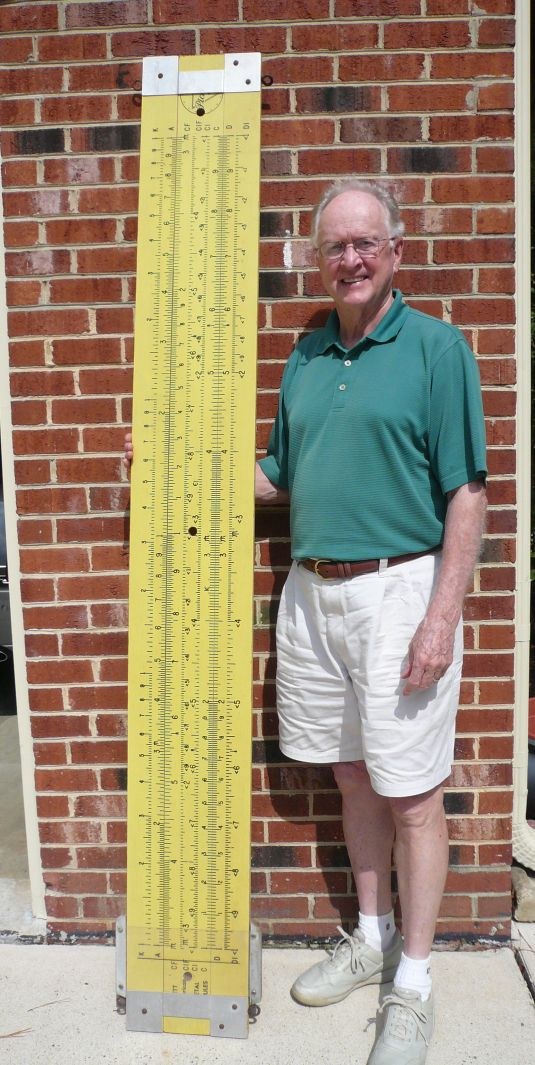
Figure 3 — The seven-foot size, with a person for scale: an N1010-ES demonstrator donated to the International Slide Rule Museum by Thomas Corby, who reported an identical rule in use at Indiana Institute of Technology. Image: International Slide Rule Museum, https://sliderulemuseum.com/DemoSR.shtml.
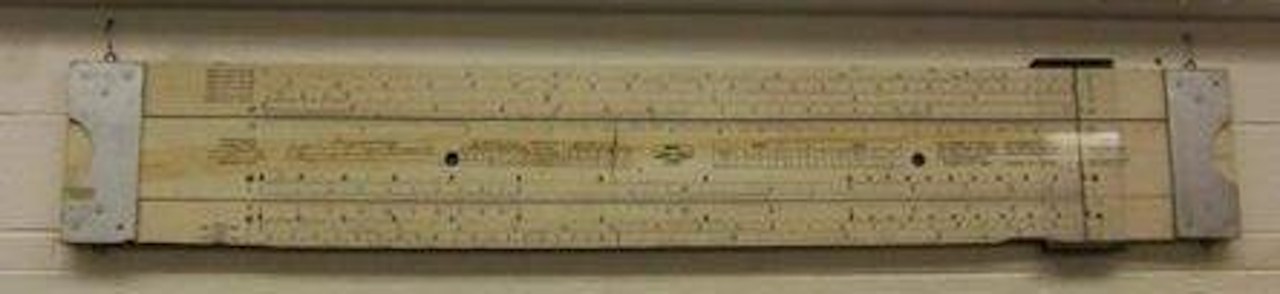
Figure 4 — The early white Pickett & Eckel Model 2 Decipoint Trainer, about 1945, seven feet long — before the yellow finish. Image: International Slide Rule Museum (photographs courtesy of Craig Kielhofer), https://sliderulemuseum.com/DemoSR.shtml.
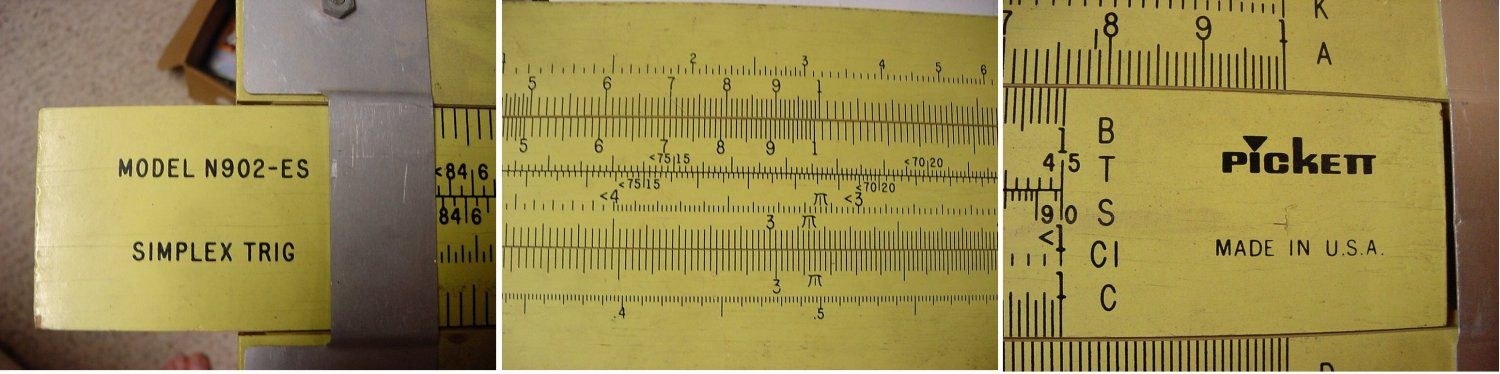
Figure 5 — A four-foot N902-ES Simplex Trig demonstrator: the model name on the left end of the slide, the scales K, A, B, T, S, CI, C, D, L, and the Pickett logo at the right. Image: International Slide Rule Museum, https://sliderulemuseum.com/DemoSR.shtml.
1.5 Dating a Pickett Demonstrator
No demonstrator carries a date, but several features narrow it down:
Table 3 — No demonstrator carries a date, but several features narrow it down
| Feature | What it suggests |
|---|---|
| White finish, “Pickett & Eckel,” “Decipoint” | Early, about 1945–1950s |
| Eye-Saver yellow finish, model suffix -ES | 1950s onward; the yellow rules were Pickett’s standard by the late 1950s |
| ”Chicago 3, Ill.” in the address | Before 1963 — the “3” is a pre-ZIP postal zone, and Pickett kept its Chicago address into the 1960s |
| ”Alhambra, California” | Pickett & Eckel’s California period, before 1964 |
| ”Pickett, Inc.” / “Santa Barbara” | After the 1964 move |
| Model N3, N4, N500, N902, N1010 | Matches the 1960s catalogue list; N803 and the Model 2 are outside it |
The student rules each demonstrator copies carry copyright dates — the N3-ES 1960, the N500-ES 1962 (Smithsonian; Followingtherules) — and a demonstrator cannot be older than the design it duplicates. Any copyright line printed on the giant itself is the best single date.
1.6 Where They Went
Electronic calculators emptied the classrooms within a few years of 1972. Teaching rules seven feet long were the first thing to go: most were thrown out, some were taken home by teachers, a few ended up on restaurant walls as décor. Survivors now hang in museums — Pickett demonstrators are in the Computer History Museum (the N1010-ES donated through the ISRM by Tom Grosh), Cooper Hewitt and the University of Waterloo — and in collectors’ houses.

Figure 6 — Second life: a large Pickett N1010-ES Trig Duplex demonstrator as décor in a Max & Erma’s restaurant, Maumee, Ohio. Image: “A Moby Slide Rule Sighting At Max And Erma’s Restaurant In Maumee Ohio, A Large Pickett N1010-ES Trig Duplex Slide Rule (23504107242)” by Joe Haupt from USA, CC BY-SA 2.0, via Wikimedia Commons, https://commons.wikimedia.org/w/index.php?curid=69504020.
1.7 Identifying Mine
I own a Pickett demonstration rule. Its length and model are not yet recorded. These will pin it down, in order of usefulness:
- Overall length — about 4 ft (48 in) or about 7 ft (84 in) — and the scale length from the left index (1) to the right index (10) of the D scale. A four-foot rule’s scales run 40 inches.
- The model name printed on the left end of the slide, e.g. “PICKETT MODEL N1010-ES TRIG,” “MODEL N902-ES SIMPLEX TRIG,” “MODEL N4-ES Vector-Type LOG LOG.”
- Both faces. The N1010, N4, N3 and N500 demonstrators are duplex, with scales on the back too; the N902 is simplex.
- The scale letters down each end — they confirm the model even if the name is worn.
- The colour — white (early) or Eye-Saver yellow.
- The address and logo text, wherever it appears: “Chicago 3, Ill.,” “Alhambra,” “Santa Barbara,” “Pickett & Eckel,” “Pickett, Inc.”
- Any copyright line, catalogue number (…WR-4 or …WR-7) or label on the back or end plates, and any school inventory tag — the last can say where it hung.
- The hardware — end plates, screw eyes or hooks for hanging, the cursor and its frame — and whether anything is a later replacement.
Sources
- Hartung, Maurice L. Teaching Guide for Slide Rule Instruction, Pickett Manual 601 (Pickett, Inc., © 1960), including the catalogue pages (“Wall Rules,” “Projection Rules”) in the scanned printing. ISRM manual M175 (filed in the Library). https://sliderulemuseum.com/Manuals/M175_Pickett_TeachingGuide_601.pdf. In this site’s Reference Library.
- International Slide Rule Museum, “Demonstration Slide Rules” — Pickett trainer gallery, materials, the free-rule offer. https://sliderulemuseum.com/DemoSR.shtml
- Cooper Hewitt, Smithsonian Design Museum, Pickett N1010-ES Trig Duplex Demonstration Slide Rule, ca. 1960, plywood and plexiglass (collection record, object 35460691).
- University of Waterloo Computer Museum, Pickett teaching-size slide rule, 2016.10.1. https://computermuseum.uwaterloo.ca/index.php/Detail/objects/1717
- Followingtherules.info, Data Sheet MJS-p-0202, Pickett N1010-ES Trig Demonstration, c. 1958. https://followingtherules.info/data-sheet-mjs-p-0202.html
- Smithsonian National Museum of American History, Pickett slide-rule records (company chronology; N3-ES; N500-ES). https://si.edu/object/pickett-n500-es-log-log-duplex-slide-rule:nmah_694532
- sliderule.ca, “Pickett Slide Rules.” https://sliderule.ca/pickett.htm
- Mike Konshak (figures), after Dr. Rodger Shepherd, Journal of the Oughtred Society 1:1 (1992), Chronology of Pickett Slide Rule Development, 2006. In this site’s Reference Library.
Comments (0)