Otis King · Volume 3
Otis King's Patent Calculator — Volume 3 — Using It, and Caring for It
Three movements, four figures, and how to keep a sixty-year-old cylinder working
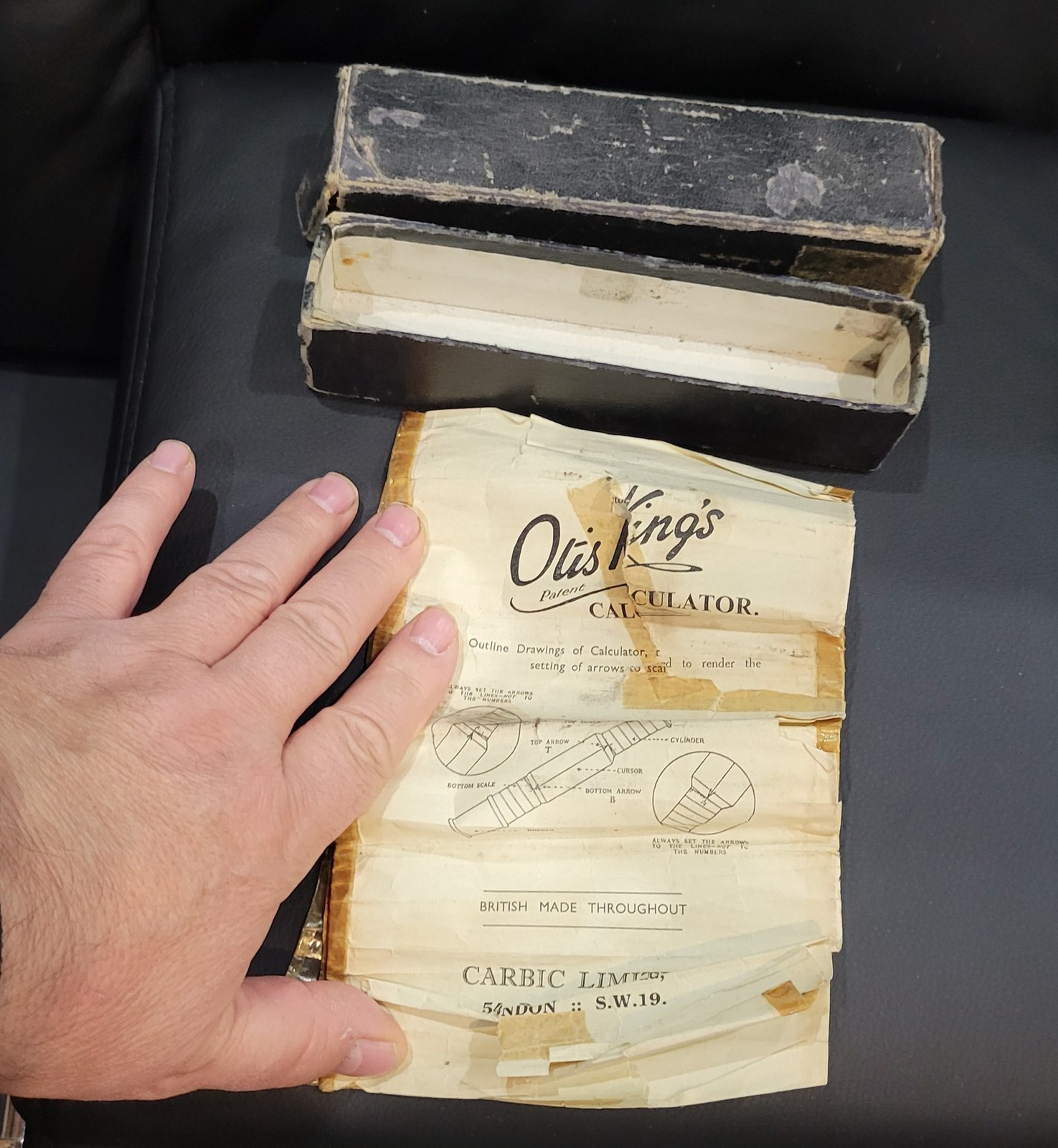
Figure 1 — The box and instruction sheet that came with my T3271. The sheet is the Dundonald Road edition: an outline drawing of holder, cursor and cylinder with the top arrow T and bottom arrow B, the order “always set the arrows to the lines — not to the numbers,” and “British made throughout · Carbic Limited · London S.W.19.” Its folds have been patched with old adhesive tape, now yellow and lifting — a care problem in its own right (below). Photo: my own.
3.1 About This Volume
Vols 1 and 2 identified the instrument and its parts. This volume is practical: how to set and read an Otis King, worked through on real problems with every result checked by direct calculation, and then how to clean, lubricate, store and not damage one. The operating method follows the Carbic instruction leaflet of the same edition as the sheet in my box (Carbic, Instructions, c. 1962); the care advice is specific to its materials — plated brass, black enamel, varnished paper, card and an old printed sheet.
3.1.1 Depth-Index: The Otis King Unit
Table 1 — Depth-Index: The Otis King Unit
| Vol | Title | Primary Content |
|---|---|---|
| 1 | The Model | Inventor, Carbic Ltd, Models K and L, construction types, serial dating, my T3271 |
| 2 | Anatomy and the Scales | Holder, cylinder, cursor; T and B arrows; middle unity; graduation; accuracy; materials |
| 3 | Using It, and Caring for It (this volume) | The three movements; multiplication, division, chains, proportion, percentages, constants; the decimal point; cleaning and storage |
3.2 The Three Movements
The leaflet insists that one sequence “should always be adhered to.” Paraphrased:
- Movement 1. Take the holder in the left hand and open the instrument gently to its full extent. Move the cursor to set the bottom arrow (B) to the first number on the holder scale.
- Movement 2. Move the cylinder so that a number on its scale is set to the top arrow (T) — the number to the arrow, not the arrow to the number. Do not touch the cursor while moving the cylinder.
- Movement 3. Move the cursor to set either arrow as required; the companion arrow then points to the answer.
The abbreviations are the leaflet’s own: B is the bottom arrow, T the top arrow, and Unity means the middle unity (“ONE”) on a Model K, or whichever end unity is available on a Model L.
Why it works: the arrows are a fixed distance apart (Vol 2). With B on a number a and the cylinder’s unity under T, moving the cursor until T reaches b on the cylinder carries B along the holder scale by the logarithmic length of b. B then stands at log a + log b, the product. Setting a divisor to T and running T back to unity subtracts its logarithm instead.
3.2.1 The two core rules
Table 2 — The two core rules
| To multiply a × b | To divide a ÷ m |
|---|---|
| 1. Set B to a | 1. Set B to a |
| 2. Set Unity to T | 2. Set m to T |
| 3. Move T to b | 3. Move T to Unity |
| 4. Read the answer at B | 4. Read the answer at B |
Every other procedure — chains, proportions, percentages — is a combination of these two.
3.3 Worked Examples
All results below were checked by direct calculation; the instrument gives four significant figures, and the final digit should be treated as good to about ±1.
3.3.1 Multiplication: 115 × 23
Set B to 115 on the holder. Set the middle unity (“ONE”) of the cylinder to T. Move the cursor until T reaches 23 on the cylinder. Read 2645 at B.
Check: 115 × 23 = 2,645 exactly. Note that 23 is set as “230” — the scale carries digits only, and on a Model K, thanks to the middle unity, there is always cylinder scale on whichever side of ONE the second factor lies.
3.3.2 Division: 833 ÷ 17
Set B to 833. Set 17 on the cylinder to T. Move T to Unity. Read 49 at B.
Check: 833 ÷ 17 = 49 exactly.
3.3.3 A chain: (6 × 4 × 9) ÷ (7 × 5 × 2)
Alternate the two movements, never touching the cursor while the cylinder moves:
- Set B to 6. Set 7 to T. Move T to 4. (B now shows 6 × 4 ÷ 7 = 3.429.)
- Set 5 to T. Move T to 9. (B now shows 3.429 × 9 ÷ 5 = 6.171.)
- Set 2 to T. Move T to Unity. Read 3.086 at B.
Check: 216 ÷ 70 = 3.08571…, which rounds to 3.086. Every pair of moves does one division and one multiplication, so a long chain needs no intermediate readings at all.
3.3.4 Proportion: 12 is to 7 as 16 is to x
Set B to 12. Set 7 to T. Now move the cursor until B reaches 16, and read x at T: 9.333.
Check: x = 16 × 7 ÷ 12 = 9.3333. With the cylinder fixed, every pair of numbers under B and T stands in the same ratio, 12:7. Moving the cursor reads off as many equivalents as are needed, which is why the leaflet calls this the instrument’s natural mode for commercial work.
3.3.5 Percentages “of, off and on”: 5 per cent of 162
Set B to 162. Set Unity to T. The instrument is now set for any percentage problem on 162:
- Move T to 5 → B reads 8.1 (5% of 162). Check: 162 × 0.05 = 8.1.
- Move T to 95 → B reads 153.9 (5% off 162). Check: 162 × 0.95 = 153.9.
- Move T to 105 → B reads 170.1 (5% on 162). Check: 162 × 1.05 = 170.1.
- Without resetting, move T to 45 → 72.9, or to 126 → 204.1. Check: 162 × 0.45 = 72.9; 162 × 1.26 = 204.12.
3.3.6 A constant factor: thirty-seconds to decimals
Set B to 32. Set Unity to T. Now 32 and 1 are locked together, and moving the cursor converts any number of thirty-seconds: move B to 3 and read 0.09375 at T; to 7, 0.21875; to 15, 0.46875; to 29, 0.9062.
Check: 3/32 = 0.09375, 7/32 = 0.21875, 15/32 = 0.46875, 29/32 = 0.90625. The leaflet prints the exact values; what the scale itself delivers is four figures — about 0.0938, 0.2188, 0.4688 and 0.9062 — with the last digit estimated between graduations.
3.3.7 A unit conversion: a marathon in kilometres
Set B to 262 (26.2 miles). Set Unity to T. Move T to 1609 (1.609 km per mile). Read 4216 at B, which the decimal rules below place as 42.16 km.
Check: 26.2 × 1.609 = 42.156. (With the exact factor 1.609344 the answer is 42.165, still 42.16 or 42.17 to four figures.)
3.4 Placing the Decimal Point
As on any slide rule, the Otis King gives digits and the operator supplies magnitude (Using a Slide Rule Vol 1). Estimation is usually enough, but the leaflet also gives formal rules. Count the places of a number as the number of figures before its decimal point (so 674 has +3, 7.82 has +1), or, for a decimal fraction, minus the number of zeros after the point (0.45 has 0, 0.0421 has −1). Then:
- Multiplication, with factors of m and n places: if the answer reads above the original setting of B, it has m + n − 1 places; if below, m + n. Example: 3 × 3 reads 9, above 3, so 1 + 1 − 1 = 1 place: 9. 3 × 4 reads 12, below 3, so 1 + 1 = 2 places: 12. 115 × 23 reads 2645, above 115, so 3 + 2 − 1 = 4 places: 2,645.
- Division: if the quotient reads above the original setting, it has m − n places; if below, m − n + 1. Example: 3 ÷ 4 reads 75, above 3, so 1 − 1 = 0 places: 0.75. 833 ÷ 17 reads 49, below 833, so 3 − 2 + 1 = 2 places: 49.
“Above” and “below” here mean the answer’s digit-string compared with the starting one: 2645 sits higher on the holder scale than 115, and 49 sits lower than 833. In the marathon example, 26.2 has 2 places and 1.609 has 1; the answer 4216 reads above 262, so 2 + 1 − 1 = 2 places: 42.16.
3.5 The Model L Differences
Everything above applies to both models, with “Unity” meaning the middle ONE on a Model K. On a Model L there is no middle unity, so the cylinder will sometimes be “closed in or opened out too far” for the cursor to reach the next factor. The leaflet’s cure, which changes nothing in the calculation:
- To close the cylinder in: move T to the bottom unity, then set the top unity to T.
- To open the cylinder out: move T to the top unity, then set the bottom unity to T.
For logarithms, set B to the bottom unity of the holder scale and set “.000” of the lower (linear) cylinder scale to T. Then moving B to any number reads its mantissa at T, and moving T to a mantissa reads the number at B. Powers and roots follow: multiply or divide the logarithm by the index and take the antilogarithm. Mine is a Model K (Vol 1), so these settings do not apply to it.
3.6 Cleaning and Care
An Otis King is mechanically simple and robust, but it combines five materials that want different handling: plated brass, black enamel, printed paper under a clear finish, a card box, and a printed paper sheet. Most damage seen on surviving instruments comes from cleaning with the wrong product, not from use. The procedures below are written for a sound instrument in ordinary used condition. For anything flaking, split or rare, the right course is to do less, or to consult a conservator.
3.6.1 Before starting: what not to use
- No solvents on any painted or printed surface. Acetone, nail-varnish remover, lacquer thinner, methylated spirit, isopropyl alcohol, “goo removers” and WD-40 can soften or lift the clear finish on the scales, dissolve printing ink, and strip or dull the black enamel.
- No abrasives — no metal polish, toothpaste, cream cleansers, magic-eraser melamine sponges, Scotch-Brite or steel wool — anywhere near the scales or the cursor tube. They remove printing and enamel along with the dirt. The cream-cleanser methods widely recommended for plastic straight rules are not safe on paper scales.
- No soaking and no running water. Water wicks under the paper scale strips, lifts the glue and leaves tide-marks.
- No disassembly by force. The cursor, cylinder and holder are a close sliding fit. If something will not move, stop.
3.6.2 The scales
Dust the scales with a soft, clean brush (a camera lens brush or soft artist’s brush), turning the tubes so the bristles follow the helix. Light finger-grime on the clear finish can be lifted with a cloth that is barely damp with water and a trace of mild, neutral soap, worked on one small area at a time and dried immediately with a soft dry cloth. Test first on the least visible turn, near the end of the scale, and stop at once if any ink or finish comes off on the cloth. The yellow-to-cream ageing of the paper, which on mine is deeper on the cylinder than on the holder strip, is in the paper itself and cannot be cleaned out; attempts to bleach or brighten it destroy the scale. Where the scale strip is lifting at its edge or seam, do not glue it with modern adhesives. A conservator can relay it with a reversible paste.
3.6.3 The black enamelled cursor tube
The enamel on these tubes chips at the ends and wears through where fingers grip, as the middle instrument in Vol 1, Figure 3 shows. Wipe it with the same barely damp, mild-soap cloth and dry it. A very thin coat of a microcrystalline conservation wax, buffed off, will give a uniform sheen and some protection; keep it off the scales. Do not repaint or touch in the tube. Original finish, even worn, is worth more to a collector and to the instrument’s history than fresh paint, and solvent-based paints can creep under the arrows’ fill. The pale flecks on the cursor in my photographs (Vol 1, Figure 1) may be dust or tiny chips; a look under a loupe will tell which before any cleaning.
The cursor’s arrows are engraved and filled. If the fill has fallen out, an arrow can still be read by its engraved line; refilling is a restorer’s job.
3.6.4 Plated parts: handle, knob and tube ends
Chrome is hard and forgiving. Clean it with a soft cloth, damp with mild soap and water, then dry it. A small amount of non-abrasive chrome cleaner may be used on the handle and knob only, applied to the cloth, not the instrument, with the scales and enamel kept well clear. Nickel plating, the duller finish of some instruments, is softer and wears through to brass more easily: use the soap-and-water method only. Do not try to re-plate worn edges. The serial number on the handle bottom of mine (Vol 1, Figure 4) is a shallow stamping that heavy polishing will soften over time.
3.6.5 The sliding fit and lubrication
The cylinder should slide and turn smoothly inside the holder and the cursor tube without shake. If it is stiff, first clean: draw the cylinder out fully and wipe the exposed inner bearing surfaces with a dry cloth to remove old, gummy grease and grit. If it is still stiff, a very small amount of light, non-staining lubricant — a trace of light instrument oil or a pure silicone-free grease, applied with a fingertip to the bare metal bearing surfaces only and then mostly wiped off — is enough. Never let oil reach the paper scales, where it soaks in and leaves a permanent translucent stain. A loose cursor that wobbles will cost accuracy (Vol 2). On a Type B instrument the cursor screws can be snugged gently; a Type C cursor held by a dimple should be left alone.
3.6.6 Storage
Store the instrument closed, in its box, lying flat, somewhere dry, at a stable room temperature and away from sunlight, which yellows paper and fades ink. Avoid damp cellars, hot attics and the inside of a car. Do not wrap it in PVC or in newspaper, both of which give off compounds that attack finishes and paper. Acid-free tissue is fine.
3.6.7 The box
The box is card covered in black paper, and on mine the covering is worn through at the edges and scuffed on the lid, with the corners splitting (Figure 1). Handle it by the bottom tray, not the lid. Do not tape it: pressure-sensitive tape yellows, its adhesive migrates into the card, and it becomes harder to remove each year. Loose corners can be stabilised by a conservator with wheat-starch paste or a reversible adhesive and Japanese tissue. Otherwise the best care is to keep the box dry and uncrushed. It adds real value to a boxed Otis King.
3.6.8 The instruction sheet
The sheet is the most fragile thing in the set and the one most worth protecting. It is the c. 1962 Dundonald Road edition (Vol 1), a copy of which is preserved in this site’s Reference Library. On mine, earlier owners mended the splitting folds with adhesive tape, now yellow and lifting, and the edges are torn. Old tape cannot be reversed by peeling. Pulling it off skins the paper and takes the print with it, and the adhesive residue keeps staining the paper. The correct course is:
- Leave the tape in place unless a paper conservator removes it. They use controlled heat or solvents and can then reinforce the folds with Japanese tissue and wheat-starch paste.
- Store the sheet flat or loosely folded along its existing folds, in an acid-free folder or a polyester (Mylar/Melinex) sleeve, and separately from the metal instrument, which can mark it.
- Scan or photograph it at high resolution so that it never needs to be unfolded to be read.
- Never laminate it.
Sources
- Carbic Ltd, Otis King’s Patent Calculator (instruction leaflet, 54 Dundonald Road, London S.W.19; c. 1962). Scan by Jaap Scherphuis (https://www.jaapsch.net/mechcalc/pdf/otisking.pdf). All operating rules, examples and decimal-point rules. In this site’s Reference Library.
- Lyon, R. F., Otis King’s Patent Calculator and OK types (https://www.svpal.org/~dickel/OK/OtisKing.html). Cursor screw and dimple fixings, plating variants.
- The Oughtred Society and the International Slide Rule Museum (https://www.oughtred.org/; https://www.sliderulemuseum.com/) — general collector guidance on cleaning slide rules: no solvents on printed scales, gentle mild-soap cleaning, minimal lubrication.
- Canadian Conservation Institute, CCI Notes on paper care and on pressure-sensitive tape (https://www.canada.ca/en/conservation-institute.html). Why old tape is not peeled, polyester enclosures, acid-free storage, no lamination.
Every worked result was re-computed: 115 × 23 = 2,645; 833 ÷ 17 = 49; (6 × 4 × 9) ÷ (7 × 5 × 2) = 3.0857; 16 × 7 ÷ 12 = 9.3333; 162 × 0.05 = 8.1, × 0.95 = 153.9, × 1.05 = 170.1, × 0.45 = 72.9, × 1.26 = 204.12; 3/32 = 0.09375, 7/32 = 0.21875, 15/32 = 0.46875, 29/32 = 0.90625; 26.2 × 1.609 = 42.156 and 26.2 × 1.609344 = 42.165. The decimal-place examples (3 × 3, 3 × 4, 3 ÷ 4, 5 ÷ 4 and the above) follow the leaflet’s rules and were checked against the true answers.
Comments (0)