Otis King · Volume 1
Otis King's Patent Calculator — Volume 1 — The Model
A pocket cylinder from London, its makers, its models, and how to date one
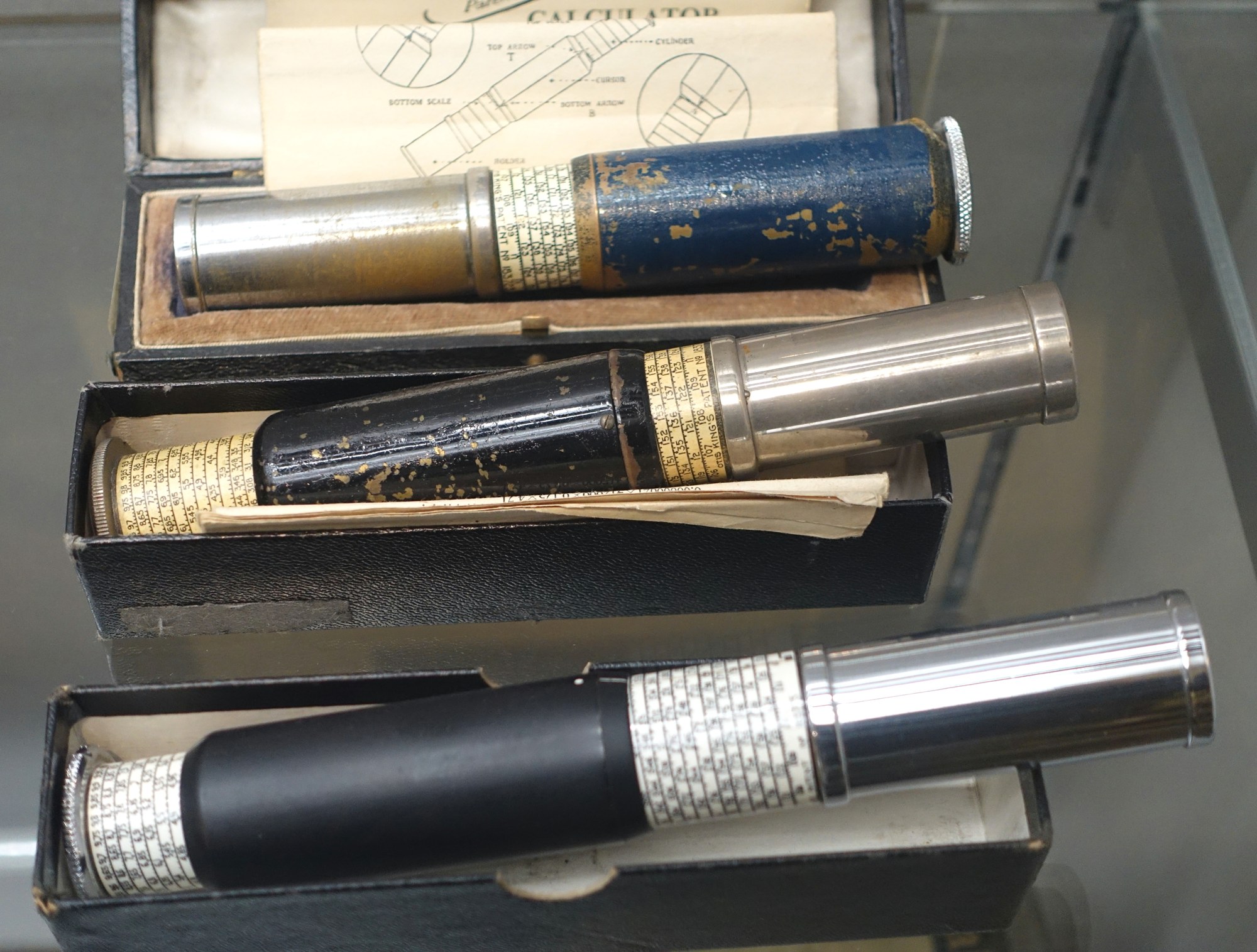
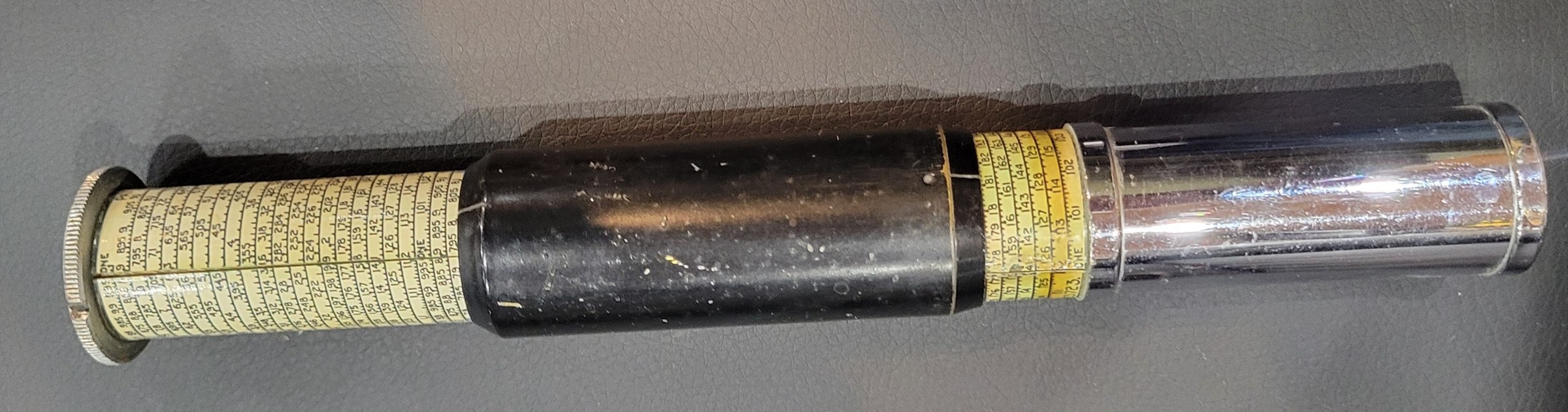
Figure 1 — My Otis King, serial T3271, pulled open to working length. From left: the knurled knob on the end of the cylinder, the cylinder’s long helical scale, the black cursor tube, the first turns of the holder scale (beginning at “ONE”), and the chrome-plated handle whose end carries the serial number. Photo: my own.
1.1 About This Volume
The Otis King is the slide rule that made precision portable. Closed, it is a metal tube about six inches long and an inch across; pulled open, it exposes a logarithmic scale 66 inches long, wound as a helix around a cylinder, that reads to about four significant figures. For roughly fifty years, from the early 1920s to the early 1970s, it was sold from London by a firm better known for acetylene lamps and welding gas, and it outlived almost every straight pocket rule of its era.
This volume is about the instrument as a model: who designed it, who made it, the variants that were sold, and how any particular example can be identified and dated from its scales, its fittings and its serial number. It ends with the identification of my own, serial T3271. The physical anatomy and every scale are the subject of Vol 2; operation and care are Vol 3. The general principle of cylindrical rules, and how the Otis King compares with the Fuller and the Thacher, is already covered in Using a Slide Rule Vol 5 and The Story of the Slide Rule Vol 4, and is not repeated here.
1.1.1 Depth-Index: The Otis King Unit
Table 1 — Depth-Index: The Otis King Unit
| Vol | Title | Primary Content |
|---|---|---|
| 1 | The Model (this volume) | Otis Carter Formby King, Carbic Ltd, the patents, Models K and L and the rarer variants, construction types A–E, serial-number dating, identifying my T3271 |
| 2 | Anatomy and the Scales | Holder, cylinder and cursor; the top and bottom arrows; the “ONE” middle unity; the K and L scale sets; graduations and real-world accuracy; materials |
| 3 | Using It, and Caring for It | The three-movement method; multiplication, division, proportion, percentages and constants, all checked; the decimal point; cleaning, plating, enamel, scales, the box and the instruction sheet |
Note — Cross-references to other units appear as “Using a Slide Rule Vol 5” or “History Vol 4.” Within this unit they appear as “see Vol N.”
1.2 The Inventor and the Maker
1.2.1 Otis Carter Formby King
The calculator carries its inventor’s name: Otis Carter Formby King (1876–1944), an English electrical engineer. His early patent applications give his address as Bray’s Lane, Coventry (1921), and then “Ashdene,” Emscote Road, Stoke, Coventry; by the time the 1923 patent was granted he had moved to 51 Holborn Viaduct, London EC1 (Hopp, 1996). The design itself is covered by British Patent 183,723 (applied 1921, granted 1922), with improvements in 207,762 and 207,856 (1922–23), and by US Patent 1,645,009 and several Continental equivalents (Wikipedia, Otis King; Scherphuis).
King’s idea was not the helical scale as such — George Fuller had wound a logarithmic scale round a cylinder in 1878 (see the Fuller unit) — but how to make one small enough for a pocket while keeping it easy to set. The answer was a pair of concentric scale tubes that both slide and turn, read through a single cursor tube carrying two arrows. The patents also describe more ambitious variants: a version with three spiral scales and a three-window cursor, cursors with edge scales for percentage allowances, and a desk instrument with interchangeable cylinders. None of these appears to have sold in quantity (Hopp, 1996).
1.2.2 Carbic Limited
The calculator was manufactured and sold by Carbic Ltd, which sounds like an odd home for a precision instrument until its history is known. Carbic was floated in 1910 by C. C. Wakefield & Co. — the lubricants firm that became Castrol — to take over its “Carbic cake” business: compressed calcium carbide for acetylene lighting. By 1914 Carbic described itself as “Acetylene Lighting and Welding Specialists,” and it was still selling oxy-acetylene welding plant decades later (Grace’s Guide, Carbic). Both Carbic and King used 51 Holborn Viaduct, which is presumably how the engineer and the gas company came together. The calculator was a sideline that ran for half a century.
Carbic’s addresses are useful for dating, because they were printed on scales and instruction sheets (Lyon, OK table):
Table 2 — Carbic's addresses are useful for dating, because they were printed on scales and instruction sheets (Lyon, OK table)
| Code | Address | Period |
|---|---|---|
| 0 | 44 & 66 Bray’s Lane, Coventry | 1921 |
| — | “Ashdene,” Emscote Road, Stoke, Coventry | 1922 |
| 1 | 51 Holborn Viaduct, London EC1 | early 1920s onward |
| 3 | 171 Seymour Place, London W1 | mid-century (on leaflets with c. 1949–51 rules) |
| 4 | 54 Dundonald Road, London S.W.19 | the later, “Type C” era, to the end of production |
Production is usually given as about 1922 to about 1972. Jaap Scherphuis’s survey of contemporary advertising finds Otis King advertisements running from 1922 into the early 1970s, and the instrument was sold in the United States under its own name, by distributors, and briefly as a relabelled “GENIAC” pocket calculator by Oliver Garfield of New York before Garfield made his own unlicensed copy around 1959 (Lyon; Wikipedia, Otis King).
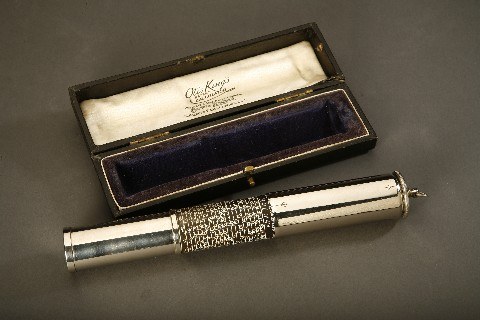
Figure 2 — An early Otis King in its fitted, silk-lined case. The ring on the cap and the plated (not enamelled) cursor tube are features of the earliest construction type; later instruments, like mine, have a black enamelled cursor tube and a plain knob. Image: File:Otis King’s.JPG by Negar 5980. License: CC BY-SA 3.0 (https://creativecommons.org/licenses/by-sa/3.0). Via Wikimedia Commons (https://commons.wikimedia.org/wiki/File:Otis_King%27s.JPG).

1.3 What It Was For
The Otis King was sold first as a business instrument, not an engineering one. The earliest instruction leaflets lead with commercial arithmetic — proportion, percentages “of, off and on,” dividing a sum in given proportions, interest, and sterling calculations in which pounds, shillings and pence are reduced to decimals — and only afterwards with the logarithms and roots of the scientific model (Carbic, Instructions, c. 1962). That pitch made sense. A clerk, cost accountant, buyer or quantity surveyor needed four reliable figures on money and quantities, which a 10-inch Mannheim rule could not give, and did not want to carry a book of tables or pay for a mechanical adding machine.
Engineers, chemists, navigators and students adopted it for the same reason: four figures in a jacket pocket. Its main limitation — it does only multiplication and division, plus logarithms on one model — mattered little to anyone whose work was mostly ratios. Until electronic calculators arrived, nothing else gave that precision in that size, and that explains its fifty-year run.
1.4 The Models
Collectors know about a dozen Otis King models by letter. In practice, two account for nearly every example found (Lyon; Scherphuis):
Table 3 — Collectors know about a dozen Otis King models by letter. In practice, two account for nearly every example found (Lyon; Scherphuis)
| Model | Holder (bottom) scale | Cylinder (top) scale | Does |
|---|---|---|---|
| K | one logarithmic decade, 1 to 10, 66 in long | two decades in series, meeting at a “ONE” — the middle unity | Multiplication, division, proportion, percentages |
| L | the same 66-in decade | one logarithmic decade plus a uniform scale from 0 to 1 in 2,000 divisions | All of the above, plus common logarithms, hence any power or root |
The difference is one scale, and it decides how the instrument is used. The Model K has the double-length cylinder scale so that, whichever way a multiplication runs, there is always unity available to set to — the cylinder never needs to be re-indexed. The Model L gives up half that cylinder length to a linear mantissa scale; for ordinary multiplication it has only a top and a bottom unity, so the operator must occasionally “close in” or “open out” the cylinder by one decade mid-calculation (Vol 3 shows the move). In return, the Model L finds logarithms to about four places and raises numbers to arbitrary powers.
Lyon records the printed scale numbers: 414 (holder) and 423 (cylinder) for the Model K; 429 and 430 for the Model L, with 416 and 417 on older L units. Rarer variants include the Model N, an early instrument with British-units and cash scales (2,240 lb to the ton), a monetary calculator with its own scale numbers, and the patent variants mentioned above.
1.4.1 Construction types
Independently of the model, Peter Hopp and Dick Lyon sort Otis Kings into construction types by their fittings (Hopp, 1996; Lyon, OK types):
- Type D (about 1921, rare) — squared-off lower cursor edge, a triangular top cap; the earliest form.
- Type A (about 1921–23) — a single light plated or brass cursor tube with arrow-shaped index marks; often a key-ring loop on the cap; Holborn Viaduct address on the scales; no “MADE IN ENGLAND.”
- Type B (to about the late 1950s) — a two-part cursor held by screws; caps of many shapes, usually notched to help find the ONE; “MADE IN ENGLAND” on the knob.
- Type B/C (transitional) — a type C cursor, but marked like a B.
- Type C (to the end, about 1972; the most common) — the cursor is held by a dimple (a small white dot beside the lower arrow) instead of screws, and “MADE IN ENGLAND” is stamped on the bottom of the handle, around the serial number.
- Type E — an Otis King built into the top of a walking cane.
Plating is usually chrome; some are dull nickel, and the earliest can be bare brass. The cursor tube is normally black enamel; earlier ones are plated or brass.
Figure 3 — Three generations side by side. The top instrument’s leaflet shows the same outline drawing, “top arrow T” and “bottom arrow B,” that heads the sheet in my box. The middle cursor tube shows the chipping that old black enamel is prone to (Vol 3). Image: “Otis King cylindrical slide rules, view 2 - Ridai Museum of Modern Science, Tokyo - DSC07492” by Daderot. License: CC0 (http://creativecommons.org/publicdomain/zero/1.0/deed.en). Via Wikimedia Commons (https://commons.wikimedia.org/wiki/File:Otis_King_cylindrical_slide_rules,_view_2_-_Ridai_Museum_of_Modern_Science,_Tokyo_-_DSC07492.JPG).

1.5 Dating by Serial Number
Otis King serials are a letter followed by three or four digits (a very few early ones are digits only). The letters I, L, O and Q were not used for serial series, which leaves about 23 possible series of up to 10,000 each. Hopp noticed that every known example in series C to K — and possibly M and P — is numbered below 1,000, which suggests those series were short and total production nearer 100,000–130,000 than the theoretical 230,000 (Hopp, 1996).
How the letters map to years is still a matter of argument. Colin Barnes proposed in the Journal of the Oughtred Society that the letter changed each year and cycled through the alphabet more than once; Lyon has published an alternative timeline and notes that several firmly dated examples (1935, 1949) do not fit Barnes’s scheme neatly (Lyon, OK table). What is reasonably firm is the anchoring of the later series by dated documents:
- An L-series and an N-series Model L have each been dated to 1949–1951 by leaflets bearing the Seymour Place address.
- The Smithsonian dates its Model L serial T/0503 to “about 1960–1962” from its serial number, citing Lyon’s 1998 JOS article on dating the Otis King.
- Jaap Scherphuis’s Model K serial T8866 is dated to about 1962.
- Lyon’s table lists T-series Type C examples (T0775 to T8156, both K and L) under a “1960/62” heading.
- A Smithsonian Y-series example is dated about 1965–69, consistent with the letters continuing to run forward through the 1960s.
So a T serial points to the early 1960s, roughly 1960–1962, and the fittings, address and leaflet edition should agree. This is a strong inference from a consistent body of dated examples, not a published factory ledger, and should be stated as “about.”
1.6 My Otis King: Serial T3271
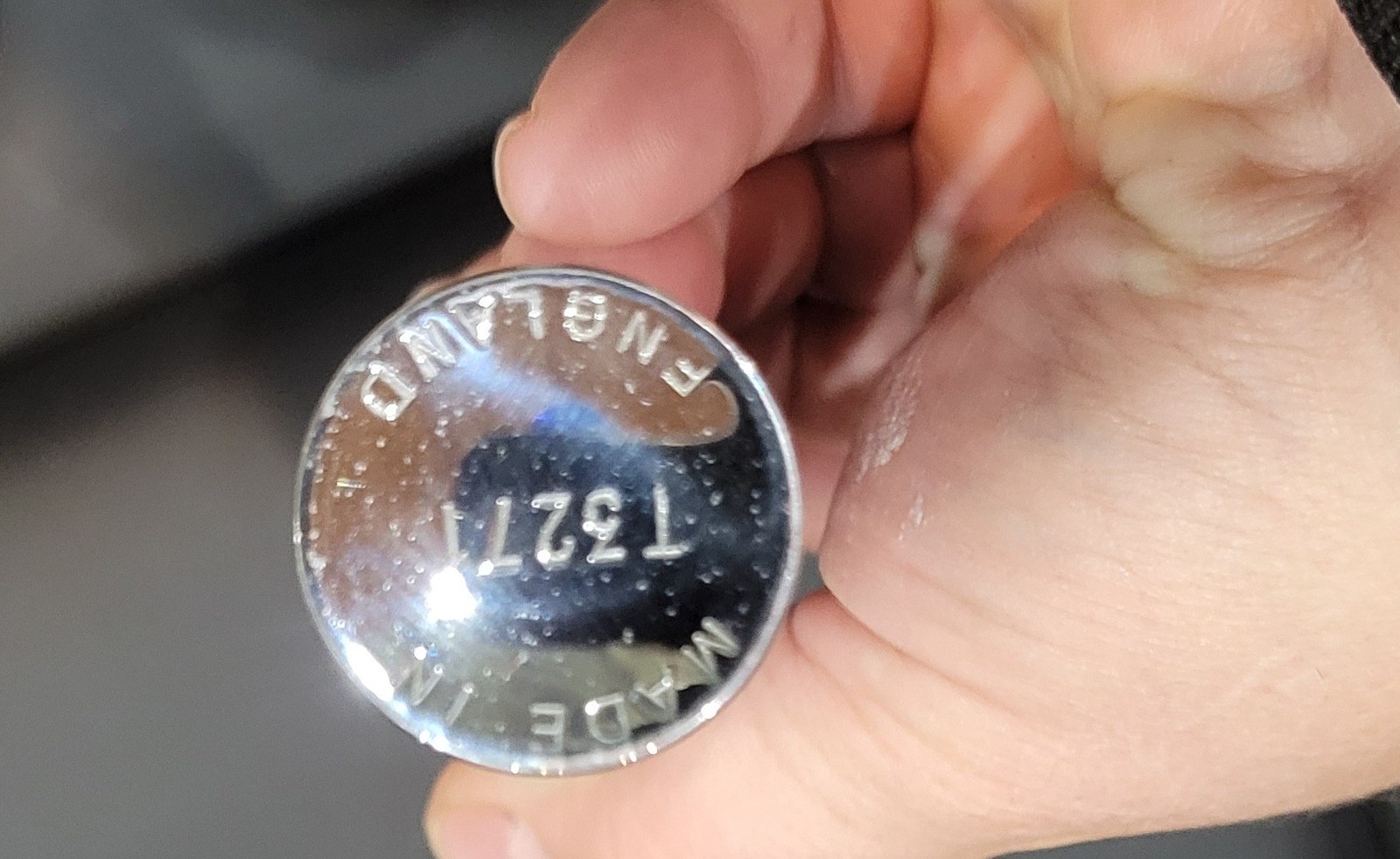
Figure 4 — The bottom of the handle on mine: “MADE IN ENGLAND” stamped round the rim, the serial T3271 across the middle. Marking the handle bottom this way, rather than the knob, is the signature of a Type C instrument. Photo: my own.
I own an Otis King’s Patent Calculator, serial T3271, with its original black card box and its Carbic Ltd instruction sheet. The evidence in my photographs lines up as follows.
Construction type: C. “MADE IN ENGLAND” is stamped around the serial on the bottom of the chrome handle, not on the knob, and the knob at the other end is plain apart from its knurling and a small notch in the rim (Vol 2, Figure 4). The cursor is a black enamelled tube with no screws, and a small pale dimple is visible near its bottom-arrow end (Vol 2, Figure 3). All three features are Type C, the late and most common form.
Model: K, with high confidence. The model is decided by the cylinder scale, and the long run of scale exposed between the knob and the cursor in Figure 1 settles it. Reading along the helix from the cursor end toward the knob, the numbering goes …7.9, 8, 8.95, 9 — “ONE” — 1.01, 1.13, 1.26 … 4, 4.5, 5.05 … 8.95, 9 — “ONE” at the knob end. The scale passes through a unity marked “ONE” in the middle of its length and carries on into a second decade. That is the middle unity that the instruction sheet defines for the Model K: “The Cylinder carries two scales in series … The point at which these two scales meet half-way up the Cylinder is denoted by the word ‘ONE’” (Carbic, Instructions). On a Model L the same stretch of cylinder would end at a single unity and give way to an evenly divided scale reading 0 to 1, and there is no evenly divided scale anywhere in the photograph. The short run of holder scale at the handle end begins, as on every Otis King, at “ONE,” followed by 1.01, 1.02 and onward — the bottom of the single holder decade. A partly hidden printed number ending “…23.” at the foot of that run is consistent with Lyon’s Model K scale number 423, but the first digit is out of view and I have not relied on it. A published photograph of a labelled Model K (Vol 2, Figure 3) shows exactly the same layout.
The one thing that would raise this from “high confidence” to certain is to pull the cylinder out to its full length and confirm that the cylinder scale is logarithmic all the way along, with no uniform 0-to-1 section, and to read the small scale numbers printed at the ends of the two scales.
Date: about 1960–1962. A T serial, Type C fittings, and an instruction sheet from Carbic Ltd at 54 Dundonald Road, London S.W.19 — the last address, and the same edition the Internet Archive copy is dated to about 1962 — all point to the early 1960s.
Sources
- Carbic Ltd, Otis King’s Patent Calculator (8-page instruction leaflet, 54 Dundonald Road, London S.W.19; c. 1962). Scan by Jaap Scherphuis (https://www.jaapsch.net/mechcalc/pdf/otisking.pdf; also Internet Archive, https://archive.org/details/otisking). Quoted for the Model K and L scale descriptions. In this site’s Reference Library.
- Hopp, P. M. (1996). “Otis-King — Conclusions?” Journal of the Oughtred Society 5(2): 62–65 (https://osgalleries.org/journal/pdf_files/5.2/V5.2P62.pdf). Serial series, production estimate, Types D and E, King’s patents and addresses. In this site’s Reference Library.
- Lyon, R. F. (Dick Lyon), Otis King’s Patent Calculator, OK types, OK table and OK scales pages (https://www.svpal.org/~dickel/OK/OtisKing.html). Model scale numbers, construction types, Carbic addresses, serial table and the Barnes dating discussion.
- Scherphuis, J., Otis King’s Pocket Calculator, Jaap’s Mechanical Calculators Page (https://www.jaapsch.net/mechcalc/otisking.htm). Model K/L scale arrangement, T8866 dated about 1962, patents and advertising.
- Smithsonian National Museum of American History, Otis King’s Pocket Calculator Model L Cylindrical Slide Rule, serial T/0503, dated about 1960–1962 (https://americanhistory.si.edu/collections/object/nmah_1214638).
- Grace’s Guide, Carbic (https://www.gracesguide.co.uk/Carbic). Carbic’s origin in C. C. Wakefield & Co., acetylene business, Holborn Viaduct.
- Otis King, Wikipedia (https://en.wikipedia.org/wiki/Otis_King). Inventor’s dates, production span, patents, GENIAC.
Serial-to-year dating for the Otis King is a collectors’ reconstruction, not a factory record; the “about 1960–1962” for my T3271 rests on several independently dated T-series examples and on the address and leaflet edition, and is given as an approximation.
Comments (0)