K&E 4081-3 Log Log Duplex Decitrig · Volume 3
K&E 4081-3 Log Log Duplex Decitrig — Volume 3 — Using It, and Caring for It
Eleven worked problems across both faces, every answer checked, then how to clean, adjust and store a celluloid-on-mahogany K&E
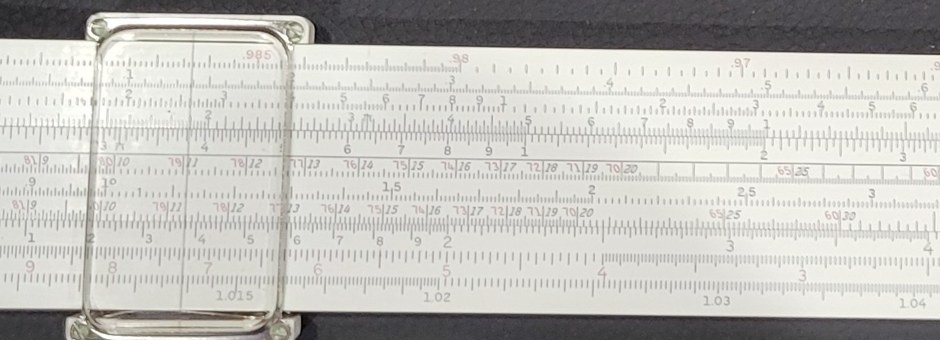
Figure 1 — The middle of my 4081-3’s trig face. On the slide, T has paired black and red figures (“79|11”, “78|12”), the SRT scale is numbered in fractions of a degree (“1°”, “1.5”), and S has its red cosine figures. LL1 (1.015, 1.02, 1.03) runs along the bottom. Photo: my own.
3.1 About This Volume
Vol 2 described every scale on the 4081-3. This volume puts them to work on eleven problems, chosen so that every scale group gets used and so that several problems need both faces — the point of a log-log duplex. Each problem gives the setting, what to read, how to place the decimal point, and the exact value for comparison. A 10-inch rule reads three significant figures, sometimes four at the left end of a scale, so the answers here are given to the precision the rule can deliver, with the exact figure in brackets. The general methods come from How to Read & Operate a Slide Rule (Vols 2–4). The way the problems are set up follows the Kells–Kern–Bland manual (Vol 1).
The second half of the volume covers care: cleaning, adjusting the slide, the cursor, the case and storage. It is specific to what a 1960s K&E is made of: celluloid on mahogany, pigment-filled engraved graduations, aluminium brackets and a glass or plastic window.
3.1.1 Depth-Index: The Three-Volume Unit
Table 1 — Depth-Index: The Three-Volume Unit
| Vol | Title | Primary Content |
|---|---|---|
| 1 | The Engineer’s Rule | Origin, the family, the five scale sets, the manual, dating by serial number, my 640904 |
| 2 | Anatomy and Every Scale | Construction, the cursor, every scale with formula and range, the log-log system, the decimal legends |
| 3 | Using It, and Caring for It (this volume) | Worked problems on both faces; cleaning, adjustment, cursor, case and storage |
3.2 Before Starting: Two Habits for This Rule
Close the rule before reading across faces. Values on scales fixed to the stock (D, DI, A, K, L and all six LL scales) can be carried from one face to the other with the hairline at any slide position, because the stocks do not move. Slide scales (C, CI, CF, CIF, B, S, T, SRT) read against stock scales on the other face only through the hairline, and their readings mean what the problem needs only if the slide is where the problem put it. When a problem says “flip the rule”, turn it over end to end without touching the cursor.
Let the legends place the decimal point. On the log-log scales the decimal point is fixed by the scale itself. On D it is set by the legend at the end of whichever LL scale is in use (Vol 2, “The range legends”).
3.3 Worked Problems on the Front (Log-Log) Face
3.3.1 Circumference with no setting: π × 3.2
A pipe has an outside diameter of 3.2 in. What is its circumference?
- Move the hairline to 3.2 on D.
- Read DF under the hairline: 10.05.
DF is D multiplied by π, so no slide movement is needed. Decimal: π × 3 ≈ 9.4, so the answer is about ten. Answer: 10.05 in (exact 10.0531).
3.3.2 Multiplication with the folded scales: 6.2 × 3.1 × 7.4
- Set 3.1 on CI over 6.2 on D. Multiplying by setting a CI value over D needs no index. The left index of C now stands over 1.922 on D, which is 6.2 × 3.1 = 19.22.
- The next step would be to move the hairline to 7.4 on C, but with the slide in this position, 7.4 on C is beyond the right end of the stock. This is where the folded scales are used.
- Instead, move the hairline to 7.4 on CF and read DF: 1422.
Decimal: 6 × 3 × 7 ≈ 126, so the answer is 142.2 (exact 142.228). The folded scales let the third factor go in without resetting the slide.
3.3.3 Compound growth: 1.06¹⁰
What does $1 grow to at 6% a year for ten years?
- On the trig face, move the hairline to 1.06 on LL1.
- Flip the rule. Read LL2 under the same hairline: 1.791.
Moving from LL1 to LL2 on the same hairline raises the number to the tenth power (Vol 2). No arithmetic is needed. Answer: $1.79 (exact 1.7908). This problem needs both faces: LL1 is on the reverse face and LL2 on the front, and the hairline joins them.
3.3.4 Exponentials and natural logarithms: e^2.5 and ln 50
- Move the hairline to 2.5 on D. Read LL3: 12.18 (exact 12.1825). The LL3 legend, “1.0 to 10.0”, says that 2.5 on D means 2.5, not 0.25 or 25.
- In the other direction, move the hairline to 50 on LL3 and read D: digits 391. The legend gives a range of 1–10, so ln 50 = 3.91 (exact 3.9120).
3.3.5 An arbitrary power: 3.2^1.4
- Set the left index of C under the hairline at 3.2 on LL3.
- Move the hairline to 1.4 on C.
- Read LL3: 5.10 (exact 5.0958).
This works because LL3 is laid out by log(ln x). Multiplying ln 3.2 by 1.4 on C and D gives ln of the answer, and LL3 converts it back to a number. Check: 3.2¹ = 3.2 and 3.2² = 10.24, so a power of 1.4 should give something between them, and 5.10 is.
3.3.6 A power below one: 0.98^25
What fraction of a population is left after 25 generations if each loses 2%?
- On the trig face, move the hairline to 0.98 on LL01.
- Flip the rule. Set the left index of C under the hairline.
- Move the hairline to 2.5 on C and read LL02: 0.604 (exact 0.6035).
On C, the factor 2.5 takes 0.98 to 0.98^2.5 on LL01. Reading one scale further along, on LL02, raises that to the tenth power, giving 0.98^25. The reciprocal LL scales behave exactly like the positive ones.
3.3.7 Decay: e^−0.35
A capacitor discharges through a resistor for 0.35 time constants. What fraction of the voltage remains?
- Move the hairline to 3.5 on D.
- Read LL02: 0.705 (exact 0.70469).
The LL02 legend, “−0.1 to −1.0”, says that 3.5 on D stands for −0.35 against this scale. The same setting read on LL03 gives e^−3.5 = 0.0302, and on LL01 it gives e^−0.035 = 0.966. One hairline gives three different decays.
3.3.8 Solving for an exponent: 2^x = 10
How many doublings make a factor of ten?
- Move the hairline to 2 on LL2. Bring the right index of C under the hairline.
- Move the hairline to 10 on LL3.
- Read C: digits 332.
The setting divides ln 10 by ln 2 on C and D. Decimal: 2³ = 8 and 2⁴ = 16, so x lies between 3 and 4. x = 3.32 (exact 3.3219).
3.4 Worked Problems on the Reverse (Trig) Face
3.4.1 A side of a right triangle: 12 sin 35°
A ladder 12 ft long leans at 35° to the ground. How high does it reach?
- Set the left index of the slide over 12 on D. The left end of S, at 5.74°, is on this index and stands for sin = 0.1.
- Move the hairline to 35 on S (black figures).
- Read D: 6.88.
With the slide set like this, the S scale multiplies 12 by the sine of whatever angle is under the hairline, so the same setting gives every other angle as well: 20° → 4.10, 50° → 9.19. Answer: 6.88 ft (exact 6.8829). Cosines come from the red figures: 12 cos 55° is the same 6.88, because the red 55 is at the same graduation as the black 35.
3.4.2 Small angles and radians: 2° on SRT
- With the slide closed, move the hairline to 2 on SRT.
- Read D: digits 349. The SRT legend, “0.01 to 0.1”, makes it 0.0349.
That one reading is sin 2° (0.03490), tan 2° (0.03492) and 2° in radians (0.03491), all equal to three figures. That is why K&E renamed ST as SRT in 1955 (Vol 1). The difference first shows in the fourth significant figure, beyond what a 10-inch rule can read.
3.4.3 Cube root, logarithm and reciprocal with one hairline
- Move the hairline to 50 on K, in the middle of K’s three cycles, because 50 has two digits before the decimal point. Read D: 3.68 (exact cube root of 50 = 3.6840).
- Leave the hairline where it is and read L: 0.566, the mantissa of log 3.684 (exact 0.5663).
- Read DI: 0.271 (exact 1/3.684 = 0.2714).
All three come from one hairline position, because K, L, D and DI are all on the stock on the same face. A second example, log 4.2: hairline to 4.2 on D, read L = 0.623 (exact 0.6232).
3.5 Cleaning, Adjustment and Care
The 4081-3 is made of materials that react differently to cleaning: celluloid (cellulose nitrate with camphor) over mahogany, graduations filled with black and red pigment, aluminium end brackets and cursor bars with steel screws, a glass or plastic cursor window, and an orange leather or synthetic case. Every step below is chosen so that what cleans one material does not damage another. The guiding rule, shared by conservators and the collector societies, is to use the least aggressive method that works, and to try every method first on an end or edge that is out of sight.
3.5.1 What not to use
- Acetone, lacquer thinner, MEK, nail-polish remover. These are solvents for cellulose nitrate. They dissolve celluloid in seconds, and with it the pigment in the graduations.
- Alcohols (isopropyl, methylated spirit) on the face. Celluloid is partly soluble in them. They can dull or whiten the surface and lift red pigment. Keep them off the celluloid entirely.
- Abrasive cleaners and polishes (scouring powders, metal polish, toothpaste, rubbing compound). The graduation pigment sits in shallow cuts. Abrasives remove the surface around it, and then the pigment itself, starting with the fine marks.
- Melamine foam (“magic eraser”). Some collectors use it lightly on K&E faces, but it is a fine abrasive. If it is used at all, it should be very light, on a test patch, and never over the red figures.
- Soaking or running water. Water swells the mahogany, which can lift the celluloid at the ends and warp the slide.
- Oils (sewing-machine oil, WD-40, olive oil) in the slide groove. Oil soaks into the end grain of the mahogany, collects grit, and can work under the edge of the celluloid.
- Silicone sprays. They leave a film that spreads, attracts dust and is very hard to remove.
- Heat (hair dryers, sunny windowsills, hot cars). Celluloid yellows in light and heat, and shrinks with age. Heat speeds both.
3.5.2 Cleaning the faces
- Take the cursor off first (see below). Dirt collects under it, and taking it off keeps cleaning liquid out of the window and away from its edge strips.
- Dust with a soft brush or a dry microfibre cloth.
- Wash with a few drops of mild dish soap in warm water, on a cloth or cotton swab that is damp, not wet. Work along the length of the scales, one short section at a time. A wooden toothpick wrapped in cloth reaches the grime along the edges of the slide and stock.
- Rinse with a second cloth dampened with plain water, then dry immediately with a dry cloth.
- Leave the stubborn marks. Ink, pencil and dark staining in the celluloid often will not come out without removing celluloid or pigment, and a clean-but-marked face is worth more than a polished one with faded figures.
Yellowing in the celluloid itself is ageing of the material, not dirt, and cannot be washed out. The cream tone of my 4071-3 beside the brighter white of my 4081-3 may be partly this, though the light was different in the two photographs.
3.5.3 The slide: cleaning the groove and setting the fit
A 4081-3 slide should move smoothly under light thumb pressure and stay where it is put. It should not drift when the rule is tilted, and it should not take effort to move.
- Cleaning the groove. Take the slide out completely. Wipe the tongue-and-groove faces of the slide and both stocks with a dry cloth, then a barely damp one, and let them dry. Old hardened grease and grit cause most stiff slides.
- Lubrication. The most cautious remedy is to rub a trace of paraffin wax (a plain candle) along the wooden tongues of the slide and buff it off. That is all most rules need. Use nothing wet.
- Adjusting the fit. The two stocks are joined only by the end brackets, so the fit is adjustable. Loosen the three screws of one end bracket by about half a turn, then those of the other. With the slide in place, press the stocks together gently, or ease them apart, until the slide moves freely without play, and tighten the screws a little at a time, alternating, while checking that the slide still moves along its whole length. Check the scales after tightening: the C and D indexes should line up when the slide is closed. Old screws can be brittle and the threads in the wood worn, so firm, light pressure on a screwdriver that fits the head properly is enough. Never force a screw that will not turn.
3.5.4 The cursor
Removing and refitting. The cursor comes apart by unscrewing the four corner screws. Before that, note which bar was at the top on which face. Lay the parts out in order, along with any spacers. The two windows go back with the scribed hairline on the side facing the rule.
Cleaning the window. Find out first whether it is glass or plastic (Vol 2):
- Glass tolerates a little isopropyl alcohol or glass cleaner on a cloth. Keep the cleaner off the plastic edge strips, and wipe the hairline side very gently: the line is scribed and filled, and the fill can be wiped out.
- Plastic (K&E’s “unbreakable” window) gets mild soap and water only. Alcohol, ammonia-based glass cleaners and solvents can craze transparent plastics with a network of fine cracks.
Aligning the hairlines. After reassembly, or whenever readings across faces seem wrong: close the rule with the C and D indexes aligned, and set the front hairline exactly on the left index of D. Turn the rule over. The back hairline should sit on the left index of D on that face too. If it does not, loosen the screws of the window on that face slightly, move the window until its hairline is on the index, and tighten. Then check again at the right index.
A damaged window — cracked, crazed or scratched over the hairline — is replaced, not repaired. The procedure is in the K&E 4071-3 Polyphase Duplex Decitrig unit (Vol 3), written for the cracked glass on my 4071-3. It applies to this rule unchanged, except that a 1960s rule may originally have had a plastic window.
3.5.5 The case
My 4081-3 lives in an orange case with the K&E logo embossed on the flap. K&E sold the 4081-3 in the 1960s with sewn leather cases (68 1210, 68 1215) and a synthetic-leather case (68 1220). The Smithsonian describes its orange 1950s–60s K&E cases as leather. Which material mine is matters for care:
- Leather: wipe with a barely damp cloth. Use a leather conditioner sparingly, and only on the outside, so that it does not soak through to the rule.
- Vinyl / synthetic: wipe with mild soap and water. Do not use leather conditioners or solvent cleaners on vinyl — they extract plasticiser and leave it hard and cracked.
The snap fasteners and their plated studs can corrode. A drop of light machine oil on a cloth, wiped on and then off, keeps them working. Keep the oil away from the leather.
3.5.6 Storage
- Lay the rule flat in its case, away from radiators, sunny windows and attics. Heat and light are what age celluloid.
- Let it breathe. Ageing cellulose nitrate gives off small amounts of acidic vapour. In a sealed plastic bag or airtight box the vapour builds up and can corrode the aluminium brackets, the cursor screws and the case studs, and speed the decay of the celluloid itself. A fitted case in an open drawer is better than a zip-lock bag.
- Store it closed, with the slide centred and the cursor in the middle, so that no part sticks out to be knocked.
- Do not store it with rubber bands round it. Old rubber leaves marks and sticks to celluloid.
3.5.7 When to stop
If the celluloid is lifting at an end, cracking, or giving off a sharp, acidic smell, the problem is in the material, not dirt, and cleaning will make it worse. Lifted celluloid can sometimes be reattached, but only with an adhesive chosen not to attack celluloid, a job best left to someone experienced in restoring slide rules. The International Slide Rule Museum and the Oughtred Society are the places to find one.
Sources
- Lyman M. Kells, Willis F. Kern and James R. Bland, Log Log Duplex Decitrig Slide Rule No. 4081: A Manual (K&E, 1955 printing) — procedures for the LL, trig, K and L scales on this layout. In this site’s Reference Library.
- How to Read & Operate a Slide Rule, Vols 2–4, this project — the general methods referred to above.
- K&E, The SRT Scale supplement (1955) — the radian rule and legend. In this site’s Reference Library.
- International Slide Rule Museum (https://www.sliderulemuseum.com/) and the Oughtred Society (https://www.oughtred.org/) — K&E parts, cursor generations, and collectors’ guidance on cleaning celluloid-faced rules.
- Clark McCoy, 4081-3 family pages — the 68 1210 / 68 1215 / 68 1220 case variants (http://www.mccoys-kecatalogs.com/KEModels/ke4081-3family.htm).
- National Museum of American History — orange K&E leather cases on the 4071-3 (1993.0482.01) and 4081-5 records.
- General conservation guidance on cellulose nitrate (sensitivity to solvents, heat and light; release of acidic vapour; the need for ventilated storage) from museum plastics-conservation literature.
- Every worked answer was checked by calculation: π × 3.2 = 10.0531; 6.2 × 3.1 × 7.4 = 142.228 (after the CI setting the C left index stands at 1.922 on D; 7.4 on C would fall at 1.153 scale-lengths, off the stock; on CF it falls at 0.656, where DF reads 14.2228); 1.06¹⁰ = 1.79085; e^2.5 = 12.1825; ln 50 = 3.91202; 3.2^1.4 = 5.09577; 0.98^25 = 0.60346; e^−0.35 = 0.70469, e^−3.5 = 0.03020, e^−0.035 = 0.96561; ln 10 / ln 2 = 3.32193; 2^3.322 = 10.0005; 12 sin 35° = 6.88292, 12 sin 20° = 4.10424, 12 sin 50° = 9.19253; sin 2° = 0.034899, tan 2° = 0.034921, 2° = 0.034907 rad; ∛50 = 3.68403, log 3.68403 = 0.56634, 1/3.68403 = 0.27144; log 4.2 = 0.62325.
Comments (0)