K&E 4081-3 Log Log Duplex Decitrig · Volume 1
K&E 4081-3 Log Log Duplex Decitrig — Volume 1 — The Engineer's Rule
Where the 4081 came from, how its scale set changed between 1937 and 1972, and how to date one from its serial number
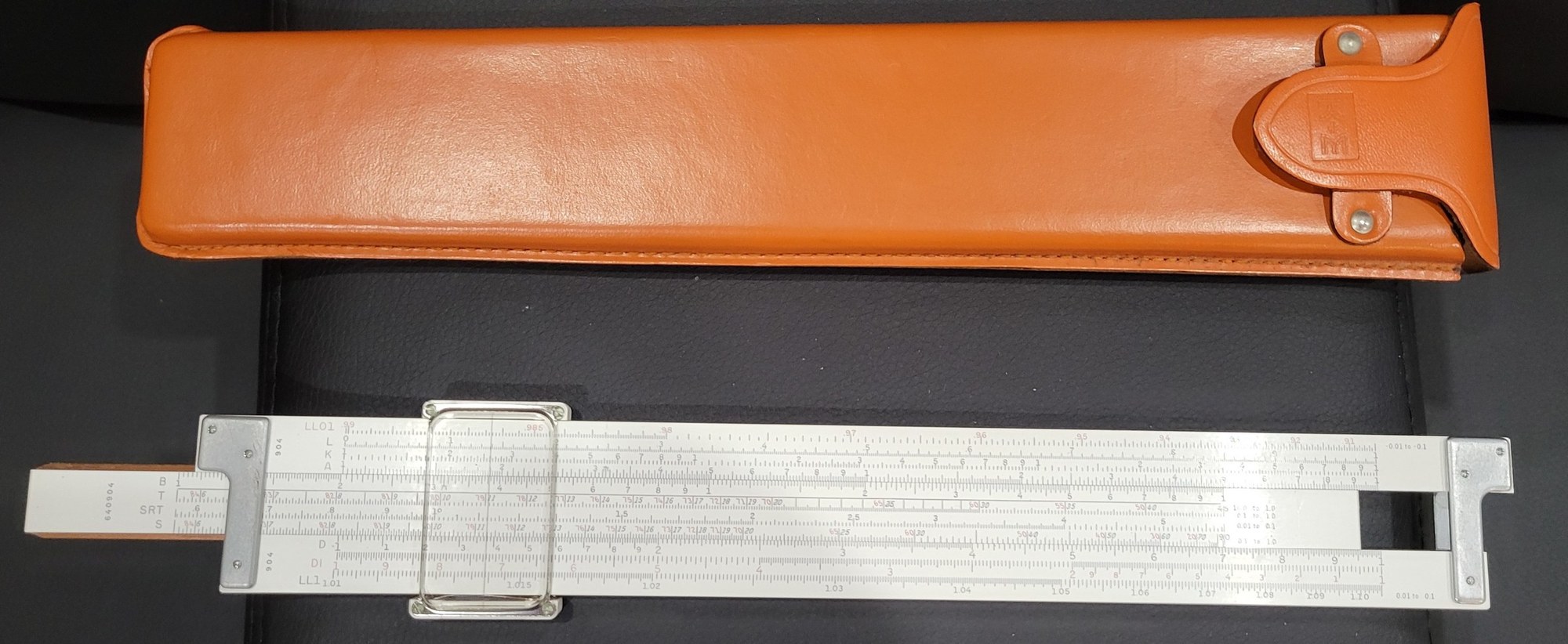
Figure 1 — My Keuffel & Esser 4081-3, serial 640904, with its orange K&E case. This is the face K&E called the reverse: LL01, L, K and A on the upper stock; B, T, SRT and S on the slide; D, DI and LL1 on the lower stock. The slide is drawn out so the serial number on its end shows. Photo: my own.
1.1 About This Unit
If one slide rule stands for American engineering in the middle of the twentieth century, it is the Keuffel & Esser 4081-3 Log Log Duplex Decitrig. Generations of engineering students bought one as freshmen and used it until the pocket calculator arrived in the early 1970s. It had all the scales a working engineer needed: multiplication and division, folded and inverted scales for chained work, squares and cubes, sines and tangents in decimal degrees, common logarithms, and a full set of log-log scales for powers, roots and exponentials. It came in a fitted case with a hardbound manual of more than a hundred pages, written by three mathematics professors from the U.S. Naval Academy.
I own one: serial 640904, in an orange K&E case. This unit covers that rule. This volume is the model’s history and how to date an example. Vol 2 goes through the construction and every scale, and Vol 3 works problems on it and covers cleaning and care. The general story of K&E, the duplex frame and the log-log idea is told in the History unit (Vol 3, “The Golden Age and the Makers”). The general method for each scale family is in How to Read & Operate a Slide Rule (Vols 2–4). This unit cross-references those volumes rather than repeating them, and concentrates on what is particular to the 4081-3.
1.1.1 Depth-Index: The Three-Volume Unit
Table 1 — Depth-Index: The Three-Volume Unit
| Vol | Title | Primary Content |
|---|---|---|
| 1 | The Engineer’s Rule (this volume) | Origin at the Naval Academy, the 4080/4081 family, the five scale sets, model numbers, the Kells–Kern–Bland manual, dating by serial number, my 640904 |
| 2 | Anatomy and Every Scale | Mahogany and celluloid construction, the cursor, every scale on both faces with its formula and range, the log-log system and its decimal legends |
| 3 | Using It, and Caring for It | Worked problems with every number checked, then cleaning, slide adjustment, cursor care, the case, and what not to do |
Note — “Vol N” means a volume of this unit. Other units are named in full, such as “History, Vol 3”.
1.2 Keuffel & Esser in Brief
Keuffel & Esser was founded in New York in 1867 by two German immigrants, Wilhelm J. D. Keuffel and Hermann Esser, as a dealer in drawing materials. It started making slide rules in 1891, after acquiring William Cox’s patent for the duplex rule. Its rules were made in a plant in Hoboken, New Jersey, across the Hudson from Manhattan. The History unit (Vol 3) tells that story. For this unit the important fact is scale: by the 1950s K&E was making more than 100,000 slide rules a year, and the 4081-3 was its best-known model.

Figure 2 — The Keuffel & Esser plant in Hoboken, rebuilt in 1906 after a fire. K&E’s slide rules, including my 4081-3, were made here until the company shut down its slide-rule dividing machines in 1975. The building was converted to housing that year and was listed on the National Register of Historic Places in 1985. Image: File:Keuffel and Esser Manufacturing Complex.jpg by Theornamentalist. License: CC BY-SA 3.0 (https://creativecommons.org/licenses/by-sa/3.0). Via Wikimedia Commons, https://commons.wikimedia.org/wiki/File:Keuffel_and_Esser_Manufacturing_Complex.jpg.

1.3 Origins: A Rule for the Naval Academy
The 4081 began as a teaching instrument. In the mid-1930s three mathematics professors at the U.S. Naval Academy in Annapolis — Lyman M. Kells, Willis F. Kern and James R. Bland — worked with K&E on a scale arrangement for midshipmen. Their aim was to let a student do a multi-step calculation, including powers and trigonometric functions, without writing down intermediate results. K&E’s catalogue records show the first sale of the new rule, the 4080-3, to the Naval Academy in the fall of 1936. It entered the general catalogue in 1937.
There were two versions from the start, and the difference was in the trigonometric scales:
- 4080 Log Log Duplex Trig — the S and T scales were divided in degrees and minutes, as on a protractor.
- 4081 Log Log Duplex Decitrig — the S and T scales were divided in decimal fractions of a degree. 34.5° was simply 34.5, not 34°30′.
“Decitrig” was K&E’s registered trademark for decimal-degree trig scales, and the ® appears on the rules and manuals. Decimal degrees suited engineering arithmetic, because an angle could be fed straight into other calculations, and the 4081 became the more popular of the two.
The design was protected by a group of patents that K&E printed on the rules for decades. The Smithsonian’s examples list five: 2,168,056 (Carl M. Bernegau, 1939); 2,170,144 (Kells, Kern and Bland, 1939); 2,285,722 (Kells, Kern and Bland, 1942); 2,422,649 (James R. Bland, 1947); and 2,500,460 (Herschel Hunt, 1950). In the Smithsonian’s summary, these patents covered how the scales were arranged so that multi-step problems could be solved without writing down intermediate settings, and where a legend was placed to make placing the decimal point easier. Those legends — small range notes such as “0.01 to 0.1” at the right end of each log-log and trig scale — can be seen on my rule (Vol 2).
1.4 The Family and Its Model Numbers
The suffix after the dash gives the length, a convention K&E used across its catalogue:
Table 2 — The suffix after the dash gives the length, a convention K&E used across its catalogue
| Model | Scale length | Notes |
|---|---|---|
| 4081-3 | 10 in (25 cm) | The standard desk and student rule — this unit |
| 4081-5 | 20 in (50 cm) | The same scale set at double length, for extra significant figures |
| 4181-1 | 5 in (12.5 cm) | Pocket version, first described in 1953 |
| N9081-3 / N9081-1 | 10 in / 5 in | All-plastic versions, c. 1949–1953 |
Three changes in model numbering help date an example:
- 1948–1954: K&E added an “N” prefix (N4081-3, N4081-5) and dropped it again in 1954.
- 1962: K&E converted its whole catalogue to “68 xxxx” numbers. In the 1962 lists the 4081-3 appears as 68 1210, 68 1215 and 68 1220, depending on which case it came in. Rules carrying the old “4081-3” marking were still being made after the change.
- 1972: The 4081 family’s last catalogue appearance. K&E shut down its slide-rule machines in 1975.
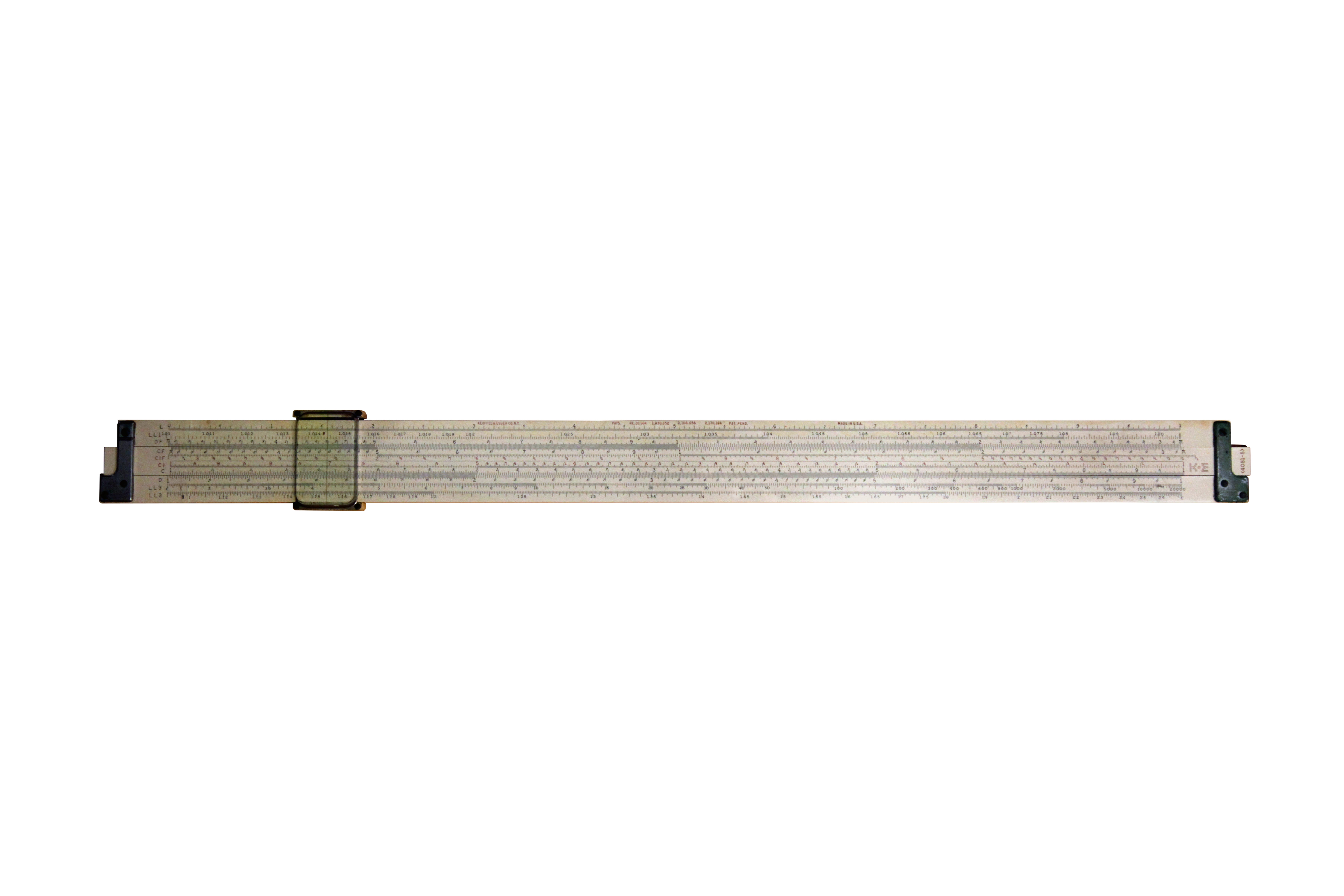
Figure 3 — For comparison, the twenty-inch 4081-5. It carries the same scale set as my 4081-3 at twice the length: the same 1955–1962 layout, about twice as long, and about one more significant figure at the left end of each scale. Image: “Keuffel and Esser Model 4081-5 Log Log Duplex Decitrig-IMG 5817-white” by Rama, licensed under CC BY-SA 3.0 fr (https://creativecommons.org/licenses/by-sa/3.0/fr/deed.en), https://commons.wikimedia.org/w/index.php?curid=89064474.
1.5 Five Scale Sets in Thirty-Five Years
The name stayed the same from 1937 to 1972, but the scales did not. Clark McCoy’s survey of K&E catalogues finds at least five scale sets on the 4081-3. Comparing a rule against this table is the quickest way to place it within a decade:
Table 3 — The name stayed the same from 1937 to 1972, but the scales did not. Clark McCoy's survey of K&E catalogues finds at least five scale sets on the 4081-3. Comparing a rule against this table is the quickest way to place it within a decade
| Catalogue | Front face (stock = slide = stock) | Reverse face (stock = slide = stock) |
|---|---|---|
| 1937 | L LL1 DF = CF CIF CI C = D LL3 LL2 | LL00 LL0 A = B T ST S = D DI K |
| 1939 | L LL1 DF = CF CIF CI C = D LL3 LL2 | LL0 LL00 A = B T ST S = D DI K |
| 1948 | LL02 LL03 DF = CF CIF CI C = D LL3 LL2 | LL01 K A = B T ST S = D L LL1 |
| 1954 | LL02 LL03 DF = CF CIF CI C = D LL3 LL2 | LL01 L K A = B T ST S = D DI LL1 |
| 1955b–1972 | LL02 LL03 DF = CF CIF CI C = D LL3 LL2 | LL01 L K A = B T SRT S = D DI LL1 |
Source: McCoy, “Collection of Pages from K&E Catalogs for the 4081-3 Family.”
The main changes were these:
- 1948: The two old reciprocal log-log scales (LL0, LL00) were replaced by three — LL01, LL02 and LL03. These matched the three positive scales LL1, LL2 and LL3, so the rule now covered e−x as fully as ex. The L scale moved to the reverse face. To make room, the DI scale was dropped.
- 1953–1954: K&E put the DI scale back. It issued a 1953 addendum to the manual explaining it.
- Late 1955: The small-angle ST scale was renamed SRT (“sine–radian–tangent”). K&E issued a supplement telling owners to read SRT wherever the manual said ST. The supplement describes SRT as a C scale graduated in degrees from about 0.573° to 5.73°, so that setting the hairline to an angle in degrees also sets it to the same angle in radians on C.
My 4081-3 has the final layout. Its trig face reads LL01 L K A / B T SRT S / D DI LL1, and its log-log face reads LL02 LL03 DF / CF CIF CI C / D LL3 LL2 — the 1955b scale set exactly. That fixes the earliest possible date for it at late 1955, before looking at the serial number.

Figure 4 — An earlier 4081-3, for comparison. It has the 1937–1947 front face (L, LL1 and DF on the upper stock), which has no LL02 or LL03 scales. “KEUFFEL & ESSER CO. N.Y.” is engraved across the top. Its warm yellow tone is aged celluloid. Image: File:Vintage Keuffel & Esser Duplex Type 10 Inch Slide Rule, Model 4081-3, Made In USA (25690854784).jpg by Joe Haupt from USA. License: CC BY 2.0 (https://creativecommons.org/licenses/by/2.0). Via Wikimedia Commons, https://commons.wikimedia.org/wiki/File:Vintage_Keuffel_%26_Esser_Duplex_Type_10_Inch_Slide_Rule,_Model_4081-3,_Made_In_USA_(25690854784).jpg.

Construction also changed. Up to about 1947 the celluloid covered the whole face. From about 1947 the model number and logo were engraved on the top edge. Around 1952–1953 K&E began leaving some wood showing on the top and bottom edges and inlaying a strip of laminate there, with the model number engraved on the inlay. Rules from 1952 on also repeat the last three digits of the serial number on both stock pieces, next to the full number on the slide. My rule shows all of these features: “640904” on the slide and “904” on the upper and lower stocks (Figure 1; detail in Vol 2).
1.6 The Manual: Kells, Kern and Bland
Each 4081 was sold with a manual by the three Naval Academy professors, Log Log Duplex Decitrig Slide Rule No. 4081: A Manual. It was revised several times: the copy in this site’s Reference Library is a 1955 printing marked “Copyright 1943, 1945, 1947, 1955”. It runs to 132 pages in six chapters: multiplication and division; proportion and combined operations; squares, square roots, cubes and cube roots; trigonometry, including solving triangles; the log-log scales; and a chapter on the logarithmic theory behind the instrument. It opens with the claim that the treatment is “superficial” only in appearance: a beginner learns two general principles, sets the rule by diagram and example, and only afterwards learns why it works.
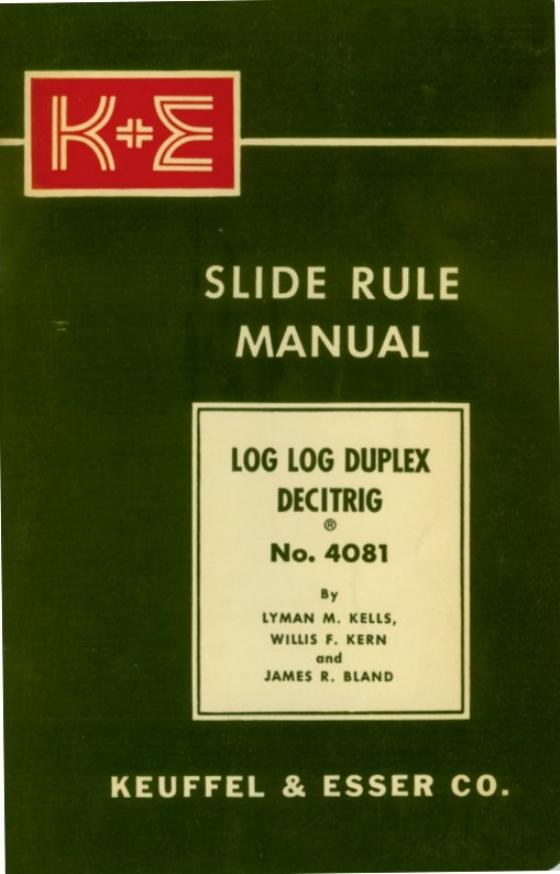
Figure 5 — The cover of the 1955 Kells–Kern–Bland manual for the No. 4081. A copy of this printing is in this site’s Reference Library. Image: scan from Clark McCoy’s K&E manuals archive, http://www.mccoys-kecatalogs.com/KEManuals/manuals.htm.
The manual was not a pamphlet. It was a short textbook in the Annapolis style, with numbered articles, worked examples and exercises with answers. For many students it was their first organised treatment of logarithms, as well as their guide to the rule. Vol 3 follows its methods.
1.7 Who Used It
K&E’s price list for 1959 shows the 4081-3 at $22.50, and the 20-inch 4081-5 with a leather case at $50.50. That was a considerable sum for a student, and buying one was part of starting an engineering course. The rule’s users were civil, mechanical and electrical engineers, chemists and physicists, surveyors and draftsmen. The log-log scales made it especially useful wherever exponentials appear: compound interest, radioactive decay, the cooling of a body, the discharge of a capacitor, and gas expansion.
One example in the Smithsonian collection shows how much some engineers relied on it. Moritz Otto Shollmier graduated in mechanical engineering from the University of Arkansas in 1956 and lost his sight to diabetes in 1961. He went on designing heating and air-conditioning systems with a 4081-3 adapted for braille: raised metal dots at key graduations, an oversized cursor, and a taut wire in place of the hairline. The Smithsonian dates that rule, serial 397208, to about 1958.
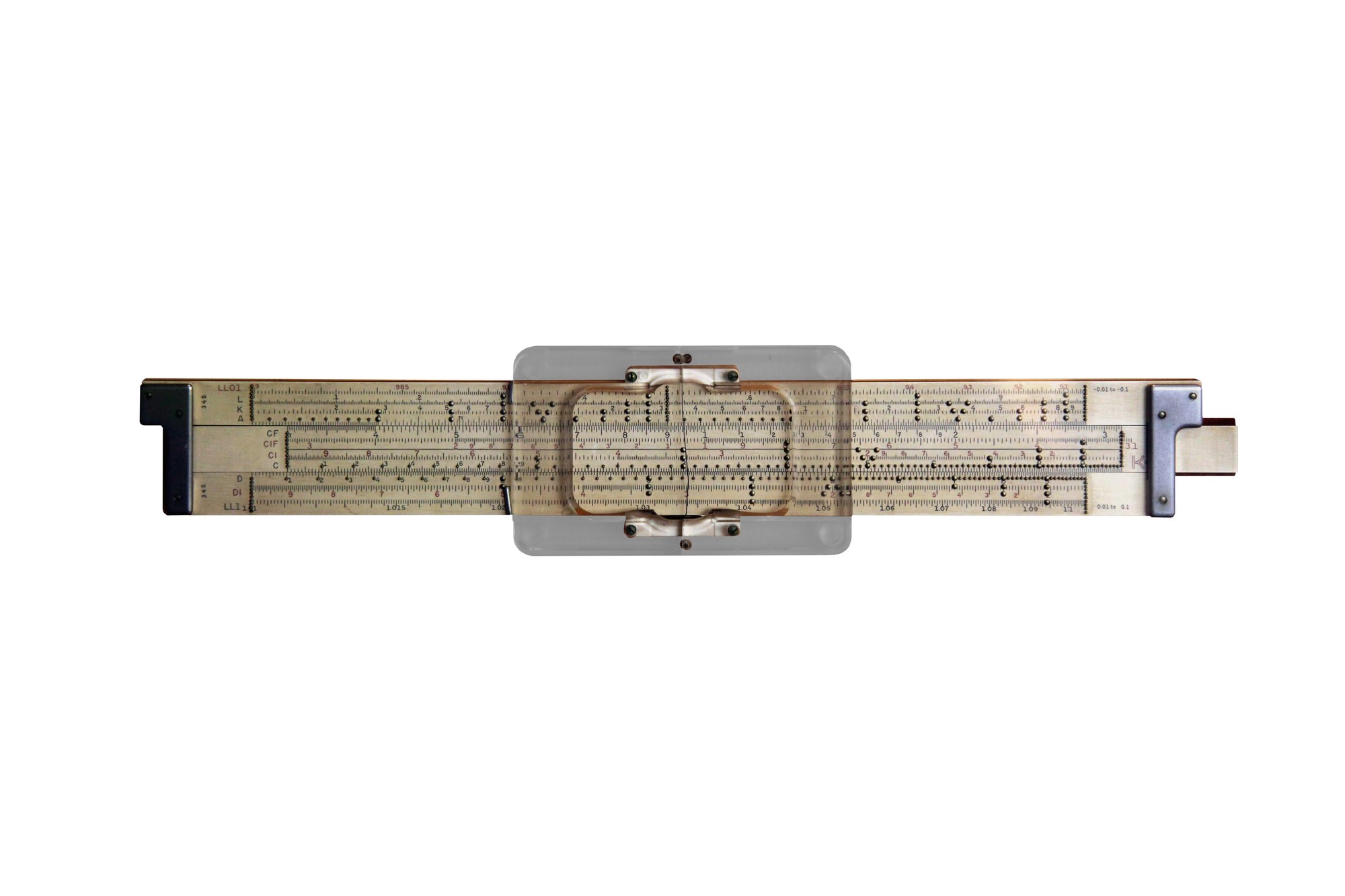
Figure 6 — A braille-adapted 4081-3, with raised dots along the scales and an oversized cursor carrying a wire instead of a scribed hairline. This is not Shollmier’s rule but another braille-adapted 4081-3. Image: File:Braille Model 4081-3 slide rule-IMG 5835-white.jpg by Rama. License: CC BY-SA 3.0 fr (https://creativecommons.org/licenses/by-sa/3.0/fr/deed.en). Via Wikimedia Commons, https://commons.wikimedia.org/wiki/File:Braille_Model_4081-3_slide_rule-IMG_5835-white.jpg.

1.8 Dating a K&E by Its Serial Number
K&E stamped serial numbers on its wooden rules from the early 1920s until the end of production. The system has one complication: the numbers ran from 0 to 999,999 and then started again. That happened three times, so every six-digit serial number has up to four possible dates, one in each cycle. To date a rule you have to decide which cycle it belongs to from its other features — scale set, patents, construction — and then read the year off that cycle’s table.
Clark McCoy’s dating tables, which build on Ed Chamberlain’s earlier charts, give these cycles. McCoy states the dates as approximate, “within +/- one year”:
Table 4 — Clark McCoy's dating tables, which build on Ed Chamberlain's earlier charts, give these cycles. McCoy states the dates as approximate, "within +/- one year"
| Series | Years | Serials | Approx. rate |
|---|---|---|---|
| #1 | 1922–1943 | 0 → 999,999 | 37,000/yr in the 1920s, rising to 60,000 |
| #2 | 1944–1955 | 0 → 999,999 | 77,000/yr |
| #3 | 1956–1966 | 0 → 990,500 | 88,500, rising to 100,000/yr |
| #4 | 1967–1975 | 0 → 540,000 | 60,000/yr |
McCoy’s own pages give slightly different rollover years in different places (1943–44, 1954 and 1962 on one page; 1945, 1955 and 1968 on another). Mike Syphers’ benchmark study of dated rules gives a similar picture. Serial dating is therefore good to about a year within a cycle, and only as reliable as the reasoning used to pick the cycle.
1.8.1 My 4081-3, serial 640904
The number 640904 falls in each table as follows:
Table 5 — The number 640904 falls in each table as follows
| Cycle | Year for 640,904 | Consistent with my rule? |
|---|---|---|
| #1 | 1938 (638,000–698,000) | No. The 1938 4081-3 had the L LL1 DF face and an ST scale, and the 1950 Hunt patent did not exist yet. |
| #2 | 1952 (616,000–693,000) | No. In 1952 the rule was the N4081-3, with the 1948 layout: ST rather than SRT, and no DI. |
| #3 | 1962 (542,500–642,500) | Yes. The SRT layout was introduced in late 1955; the last-three-digits marking and inlaid edges date from 1952 on. |
| #4 | — (the cycle stopped at about 540,000) | No. |
Only the third cycle fits, so my 4081-3 was made in about 1962, near the end of that year’s run of numbers (642,500 marks the change to 1963). Syphers’ benchmarks give the same result independently: a 4081-3 at serial 432,306 in this cycle is dated 1960, and a 68-1200 at 810,037 is dated 1964. Interpolating between them puts 640,904 at about 1962.
How confident I am: the cycle is close to certain, because the SRT scale set rules out cycles #1 and #2, and cycle #4 never reached this number. The year is good to about ±1, as the tables claim: realistically 1961–1963, with 1962 the best estimate. Two things could tighten it. If the inlaid top edge reads “4081-3” rather than “68 1210”, “68 1215” or “68 1220”, the rule was still carrying the old number after the 1962 changeover. And the orange K&E case suggests a later rule rather than an earlier one: the Smithsonian’s orange-cased examples, a 4071-3 inscribed “July ‘62” and a 4081-5 of about 1958, both come from this period.
1.8.2 A rule fourteen numbers away
I also own a K&E 4071-3 Polyphase Duplex Decitrig whose slide appears to read 640890 — only fourteen numbers from this rule. The natural guess is that the two came from the same batch. They almost certainly did not. The 4071-3 still has the old ST scale, which K&E replaced with SRT on that model in 1955–56, and that places it in cycle #2, in about 1952. The two rules are probably about ten years apart, and the near-identical serials are a coincidence of the rollover. The K&E 4071-3 Polyphase Duplex Decitrig unit (Vol 1) sets out the evidence.
1.9 Identifying a 4081-3 Like Mine
To identify a 4081-3 and place it in time:
- Read the model number on the right-hand end of the slide or on the top-edge inlay: “4081-3” (with “N” for 1948–54) or a 68-xxxx number from 1962 on.
- Read the scale names at the left end of each face and compare them with the table above.
- Read the serial on the slide end. From 1952 on, check that its last three digits are repeated on both stock pieces.
- Read the patent line on the top edge. A rule marked 2,500,460 was made in 1950 or later.
- Look at the cursor. K&E’s metal-barred “New Improved” cursor with a glass window and a logo dates from about 1938–1955. Later cursors have blank bars, and from about 1956 they have a plastic window that K&E sold as unbreakable (Vol 2).
The History unit (Vol 5) describes how the HP-35 ended the slide rule’s working life. The 4081-3 lasted almost to the end: it appeared in K&E’s catalogue until 1972, and K&E stopped its dividing machines three years later.
Sources
- Clark McCoy, “Collection of Pages from K&E Catalogs for the 4081-3 Family of Slide Rules: 4080-3 & 4081-3 Family Groups” — scale sets by catalogue year, N-prefix and 68-xxxx numbering, edge construction, case model numbers (http://www.mccoys-kecatalogs.com/KEModels/ke4081-3family.htm).
- Clark McCoy, “Dating K&E Slide Rules” and the serial-number tables by series — cycle tables, the serial/last-three-digits convention, inlaid edges (https://mccoys-kecatalogs.com/keserialnumbers/Dating-2.htm; https://www.mccoys-kecatalogs.com/Dating.htm).
- Mike Syphers, “K&E Timeline Study Update,” Following the Rules — dated benchmark serials including 4081-3 #432306 (1960) and 68-1200 #810037 (1964) (https://followingtherules.substack.com/p/a-k-and-e-timeline-study-update).
- National Museum of American History, Smithsonian Institution: K&E 4081-3, cat. MA.318482 (serial 320858, c. 1957; patent list; 1959 price $22.50); 4081-3 braille rule (serial 397208, c. 1958; Shollmier history); 4081-5 (serial 450243, orange case; 1959 price $50.50). Read via the Internet Archive copies of the americanhistory.si.edu records.
- K&E, The SRT Scale: Supplement to the Manuals on the 4081, 4083, 4071 Slide Rules (1955) and The DI Scale (1953), reproduced at http://www.mccoys-kecatalogs.com/KEManuals/manuals.htm. In this site’s Reference Library.
- Lyman M. Kells, Willis F. Kern and James R. Bland, Log Log Duplex Decitrig Slide Rule No. 4081: A Manual (Keuffel & Esser, 1955 printing) — in this site’s Reference Library.
- C. Hamann, Berlin slide-rule collection pages for 4081-3 “Version A” (1941) and “Version B” (1955) scale formulas (https://public.bht-berlin.de/hamann/sliderules/ke81.html, ke81b.html).
- “Keuffel and Esser,” Wikipedia — founding, 1891 start of slide-rule manufacture, Hoboken plant, 1975 end of engraving (https://en.wikipedia.org/wiki/Keuffel_and_Esser).
- The identification of my rule rests on my own photographs (scale names, serial 640904 and “904” on both stocks, the K&E © logo on the slide end). The dating arithmetic above was checked against each cycle table.
Comments (0)