K&E 4081-3 Log Log Duplex Decitrig · Volume 2
K&E 4081-3 Log Log Duplex Decitrig — Volume 2 — Anatomy and Every Scale
Mahogany, celluloid and aluminium; twenty-one scales on two faces; and the small range legends that place the decimal point
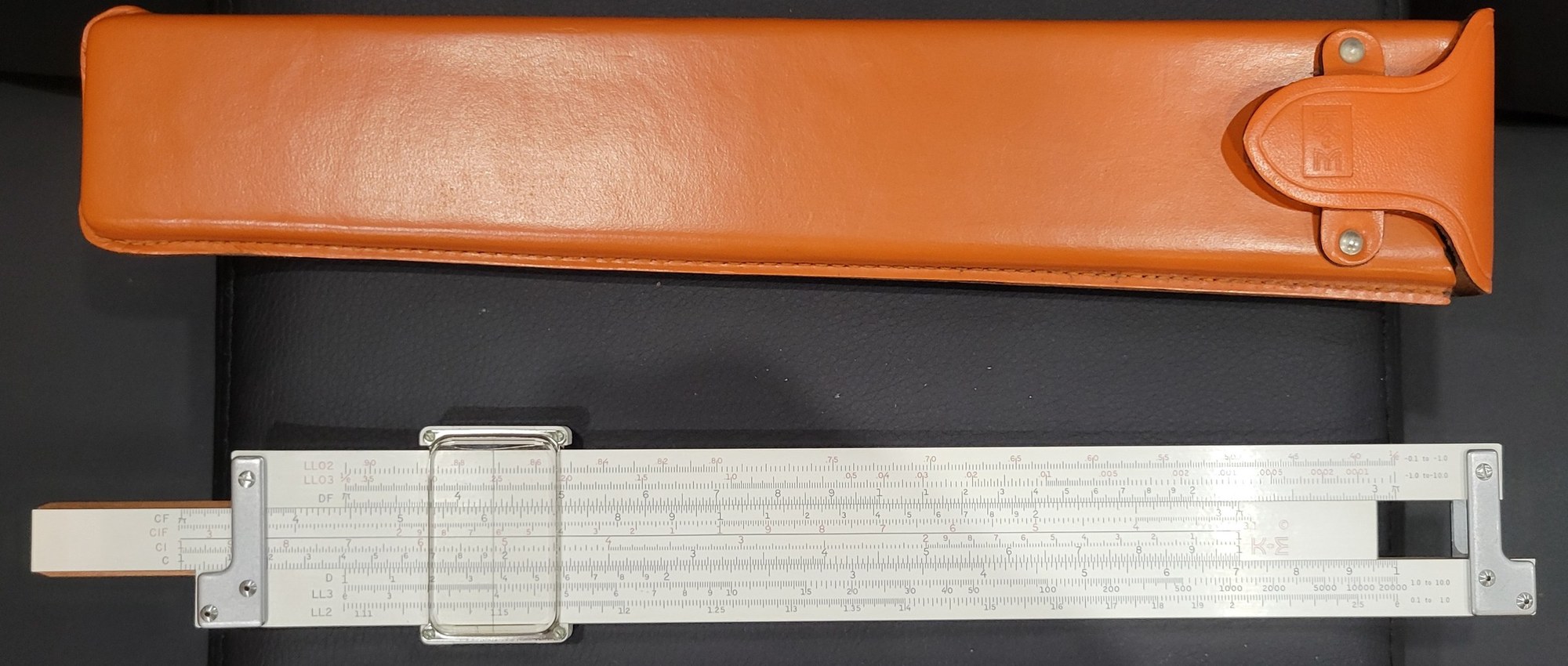
Figure 1 — My 4081-3, serial 640904, log-log face up. K&E’s manual calls this the front face. It carries the C and D scales with their folded and inverted companions, and four of the six log-log scales. The red K&E logo with © is on the right end of the slide. Photo: my own.
2.1 About This Volume
Vol 1 placed my 4081-3 in the 1955–1962 scale set and dated it to about 1962. This volume goes through the instrument piece by piece: what it is made of, how the frame and cursor go together, and then every scale on both faces — what each one computes, its range, and the small details K&E added to keep track of the decimal point. The general technique for each family of scales is in How to Read & Operate a Slide Rule: C, D, CI and the folded scales in Vol 2; A, B, K and the log-log scales in Vol 3; S, T, ST and L in Vol 4. This volume covers how the 4081-3 lays those scales out, which is what Vol 3 of this unit needs for its worked problems.
2.1.1 Depth-Index: The Three-Volume Unit
Table 1 — Depth-Index: The Three-Volume Unit
| Vol | Title | Primary Content |
|---|---|---|
| 1 | The Engineer’s Rule | Origin, the family, the five scale sets, the manual, dating by serial number, my 640904 |
| 2 | Anatomy and Every Scale (this volume) | Construction, the cursor, every scale with formula and range, the log-log system, the decimal legends |
| 3 | Using It, and Caring for It | Worked problems, cleaning, adjustment, cursor and case care |
2.2 Construction
2.2.1 Mahogany under celluloid
The 4081-3 is a wooden rule. Its three long members — the upper stock, the lower stock and the slide between them — are mahogany, chosen because it is stable and holds glue well. A thin sheet of white celluloid (cellulose nitrate plasticised with camphor) is laminated onto each working surface, and the graduations are cut into the celluloid by K&E’s dividing engines. Each cut is then filled with black or red pigment. This is the “engine-divided” construction described in the History unit (Vol 3, “Materials and Manufacturing”). The graduations are recessed lines, not printing on the surface, so they survive decades of thumbs, but they can still be damaged by solvents and abrasives (Vol 3).
Where the slide is pulled out (Figure 3, and Figure 1 of Vol 1), the reddish-brown mahogany shows between the celluloid faces. On rules from about 1952 on, the top and bottom edges show some wood with a strip of laminate inlaid into it, and the model number and patent line are engraved on that strip.
2.2.2 The frame: end brackets and adjustment
The two stocks are held together by aluminium end brackets, one at each end, each fixed by three screws. The brackets are L-shaped: the foot of each L reaches across one stock, which leaves an open window at the end of the rule through which the slide can be seen and pushed. Because the two stocks are joined only at their ends, the gap between them — and so how tightly the slide fits — can be adjusted by loosening the bracket screws, moving the stocks, and tightening the screws again. Vol 3 gives the procedure. On my rule the bracket screws have recessed socket heads. On my older 4071-3 the bracket fasteners are domed, with one slotted screw. McCoy dates K&E’s change from rivets to hex screws to 1958, which fits a 1962 date for this rule.
2.2.3 The cursor
The cursor (K&E called it the indicator) is a window between two metal bars joined by four corner screws. Clear edge strips run down the long sides, and the bars grip the top and bottom edges of the rule so that the cursor slides without wobbling. One hairline is scribed on each side, and the two must line up exactly: a value set on one face is read on the other through the same hairline. The International Slide Rule Museum’s parts list gives the sequence of K&E cursors:
Table 2 — The cursor (K&E called it the indicator) is a window between two metal bars joined by four corner screws. Clear edge strips run down the long sides, and the bars grip the top and bottom edges of the rule so that the cursor slides without wobbling. One hairline is scribed on each side, and the two must line up exactly: a value set on one face is read on the other through the same hairline. The International Slide Rule Museum's parts list gives the sequence of K&E cursors
| Period | Cursor | Window |
|---|---|---|
| 1915–1935 | Frameless all-glass, logo and patent imprints | Drilled glass |
| 1938–1955 | ”New Improved” metal-barred cursor with K&E logo | Glass (part 7L) |
| 1956 on | Same pattern, blank bars | ”Unbreakable” plastic (part 7W) |
| c. 1960 on | Narrow cursor | Plastic |
On that sequence, a 1962 rule like mine should have the blank-barred cursor with a plastic window. The Smithsonian, however, describes a 4081-3 of about 1957 and a 4081-5 of about 1958 as having glass windows with plastic edges. The changeover was evidently gradual, or cursors were swapped between rules, so the window itself has to be checked. A plastic window is lighter, gives a dull rather than ringing tap, and its edges show no green tint. That matters in Vol 3, because glass and plastic need different cleaning.
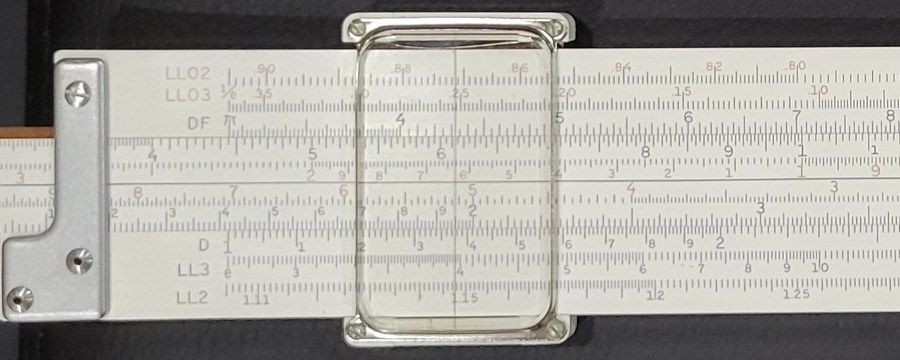
Figure 2 — The cursor on my 4081-3: metal top and bottom bars, four corner screws, and a clear window with a single hairline that crosses all ten scales on this face. The hairline on the other face must line up with it exactly. Photo: my own.
2.2.4 Serial numbers and markings
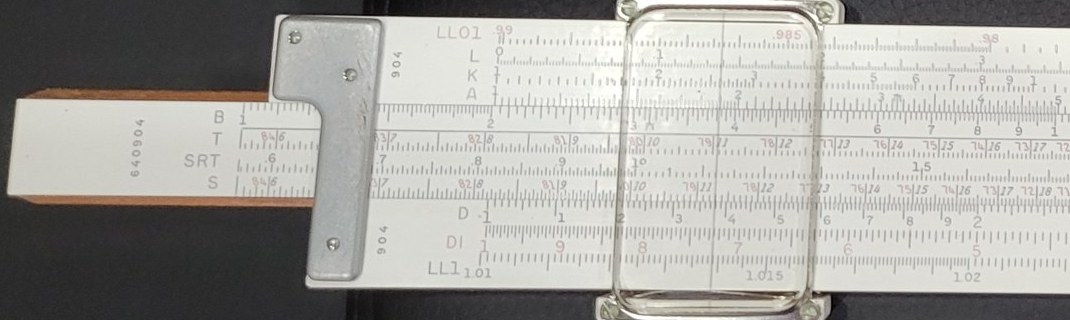
Figure 3 — The serial marking on my rule: 640904 on the end of the slide and 904 on the upper and lower stocks. Repeating the last three digits on the stocks was K&E practice from 1952 on, so that a slide could be matched to its own frame. The scale names are on the left, and the mahogany core shows along the edges of the drawn-out slide. Photo: my own.
Markings on my rule, as far as the photographs show:
- Slide end (left, trig face): serial 640904.
- Both stocks (left, trig face): 904.
- Slide end (right, log-log face): the red K&E logo with ©.
- Case flap: the K&E logo, embossed.
- Top-edge inlay: not visible in my photographs. On other examples of this period it reads “PATS. PEND. MADE IN U.S.A. 4081-3 LOG LOG DUPLEX DECITRIG ® COPYRIGHT 1947 BY KEUFFEL & ESSER CO.” followed by the five patent numbers listed in Vol 1.
2.3 The Two Faces at a Glance
Both faces share a single cursor, and both have a D scale on the lower stock. That shared D scale is what ties the two faces together.
Table 3 — The Two Faces at a Glance
| Face (K&E’s name) | Upper stock | Slide | Lower stock |
|---|---|---|---|
| Front (log-log face, Figure 1) | LL02 · LL03 · DF | CF · CIF · CI · C | D · LL3 · LL2 |
| Reverse (trig face, Vol 1 Figure 1) | LL01 · L · K · A | B · T · SRT · S | D · DI · LL1 |
All six log-log scales are on the stocks, not the slide, and are keyed to D. That is the Kells–Kern–Bland arrangement: a value on any log-log scale can be carried by the hairline to D on either face and from there to the slide scales, so a power or exponential can be combined with ordinary multiplication without writing anything down.
2.4 Every Scale
In the formulas below, x is the reading on the D (or C) scale, running from 1 to 10. A red scale or red figures read right to left.
2.4.1 The basic and folded scales
Table 4 — The basic and folded scales
| Scale | Where | Computes | Range / notes |
|---|---|---|---|
| C | Slide, front | x | 1–10; the working scale on the slide |
| D | Stock, both faces | x | 1–10; one on each face, aligned so either can be read |
| CI | Slide, front | 1/x | 10 → 1, red, right to left; for reciprocals and for multiplying in one setting |
| CF | Slide, front | πx | π → 10π, “folded at π” |
| DF | Stock, front | πx | Matches CF on the stock; reading DF above D multiplies by π |
| CIF | Slide, front | 1/(πx) | Inverted folded scale, red |
| DI | Stock, reverse | 1/x | Reciprocal of D, red |
K&E folded CF and DF at π, so these scales start and end at π (≈ 3.1416) and have 1 near the middle. This has two uses. Any number on D has π times itself directly above it on DF. And when a result would run off the end of C and D, it can be read on CF and DF instead without moving the slide. How to Read & Operate, Vol 2, explains the method. In Figure 1, the π marks at the left ends of DF and CF can be seen, and another π near the right end of each.
2.4.2 Squares, cubes and logarithms
Table 5 — Squares, cubes and logarithms
| Scale | Where | Computes | Range / notes |
|---|---|---|---|
| A | Stock, reverse | x² | Two cycles, 1–10 and 10–100 |
| B | Slide, reverse | x² | The same as A, on the slide |
| K | Stock, reverse | x³ | Three cycles, 1–10, 10–100 and 100–1000 |
| L | Stock, reverse | log₁₀ x | 0 to 1, evenly divided; gives the mantissa of the D reading |
Square roots are read in the opposite direction, from A or B down to D. The half of A to use depends on whether the number has an odd or even number of digits. Cube roots on K work the same way across its three cycles. How to Read & Operate, Vol 3, explains both. The L scale is on the reverse face next to K, so on this rule a common logarithm is read on the trig face, not on the log-log face.
2.4.3 The trigonometric scales (decimal degrees)
Table 6 — The trigonometric scales (decimal degrees)
| Scale | Where | Computes | Range |
|---|---|---|---|
| S | Slide, reverse | sin θ (black) · cos θ (red) | 5.74° to 90° → 0.1 to 1.0 |
| T | Slide, reverse | tan θ (black) · cot θ (red) | 5.71° to 45° → 0.1 to 1.0 |
| SRT | Slide, reverse | sin θ ≈ tan θ ≈ θ in radians | 0.573° to 5.73° → 0.01 to 0.1 |
The angles are in decimal degrees: the S scale is subdivided 30, 30.5, 31… rather than 30°, 30°30′, 31°…. That is the “Decitrig” of the name. Each trig scale carries two sets of numbers. The black numbers run left to right and give sine or tangent. The red numbers run right to left for the complementary angle: cosine on S, and cotangent or the tangent of angles above 45° on T. The figures are paired along the scale — “84|6”, “83|7”, “82|8” on S, and “45” at the right end of T — so one graduation serves an angle and its complement.
The trig scales are on the slide. With the slide closed (indexes aligned), a function value is read on D on the same face. With the slide set to some other position, the scale becomes a multiplier: setting 90° on S over a length on D gives the length times the sine of any angle under the hairline. Vol 3 uses this to solve a triangle in one setting.
SRT is for angles below about 5.7°. For angles that small, sin θ, tan θ and θ in radians agree to slide-rule accuracy. K&E’s 1955 supplement turns this into a rule: when the hairline is set to an angle in degrees on SRT, it is also set to that angle in radians on C, provided the C reading is prefixed “0.0”, as the end legend says. The supplement’s own example is 3.56° = 0.0621 radian.
2.4.4 The log-log scales
These six scales make the 4081 a “Log Log”. Each gives e raised to a multiple of the D reading. They come in two sets of three:
Table 7 — These six scales make the 4081 a "Log Log". Each gives e raised to a multiple of the D reading. They come in two sets of three
| Scale | Face | Computes | Range of values | End legend |
|---|---|---|---|---|
| LL1 | Reverse (bottom) | e0.01x | 1.010 → 1.105 | 0.01 to 0.1 |
| LL2 | Front (bottom) | e0.1x | 1.105 → e (2.718) | 0.1 to 1.0 |
| LL3 | Front (bottom) | ex | e → 22,026 | 1.0 to 10.0 |
| LL01 | Reverse (top) | e−0.01x | 0.990 → 0.905 | −0.01 to −0.1 |
| LL02 | Front (top) | e−0.1x | 0.905 → 1/e (0.368) | −0.1 to −1.0 |
| LL03 | Front (top) | e−x | 1/e → 0.0000454 | −1.0 to −10.0 |
Taken together, the six scales cover numbers from about 0.00005 up to about 22,000 continuously. Each scale is the decade-by-decade continuation of the one before. LL1 continues into LL2 and LL2 into LL3, so reading the same hairline position one scale further along raises the number to the tenth power: under the hairline, LL2 = (LL1)10 and LL3 = (LL2)10. The same holds for LL01 → LL02 → LL03. A value and its reciprocal sit in matching positions: the LL1 reading and the LL01 reading under one hairline multiply to 1. How to Read & Operate, Vol 3, explains the method in general. Vol 3 of this unit applies it.
Because these scales give numbers directly rather than mantissas, their decimal point is fixed: 2.5 on LL3 means 2.5, not 25 or 0.25. The decimal point that still has to be supplied is the one on D, and the end legends supply it.
2.4.5 The range legends
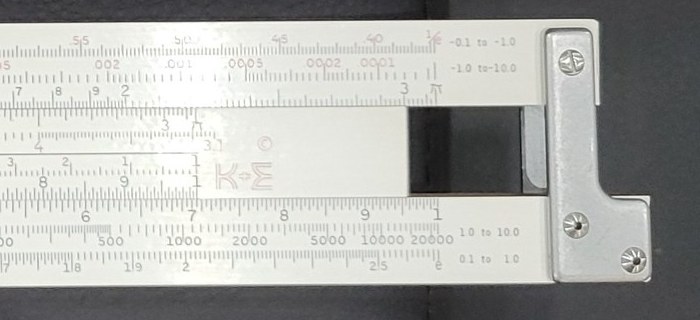
Figure 4 — The right-hand end of my rule’s log-log face, showing the range legends that belong to the patented layout. Each legend gives the range of the exponent that the D scale represents when that log-log scale is used. For example, D read against LL3 runs from 1.0 to 10.0, so 2.5 on D is the exponent 2.5 and LL3 shows e2.5. Photo: my own.
The legends are small, but they solve a real problem. When the hairline joins D and a log-log scale, the D reading is the exponent k in ek, and its decimal point depends on which log-log scale is in use. Against LL1 the digits “35” on D mean 0.035; against LL2, 0.35; against LL3, 3.5. The negative scales work the same way with a minus sign. The legend at the end of each scale states the range, so the operator never has to work it out. The trig scales on the slide have legends of the same kind on my rule: “10.0 to 1.0” and “0.1 to 1.0” for the two sets of numbers on T, “0.01 to 0.1” for SRT, and “0.1 to 1.0” for S. They can be seen at the right end of the slide in Vol 1 Figure 1.
2.5 Gauge Marks
The 4081-3 carries few gauge marks. π is marked on A and B and at both ends of the folded scales. The e marks at the ends of LL2 and LL3 can be seen in Figure 4, along with 1/e at the ends of LL02 and LL03. There are no special marks for c, ρ or the like; the rule is a general engineering instrument rather than a specialist one. How to Read & Operate, Vol 4, covers gauge marks generally.
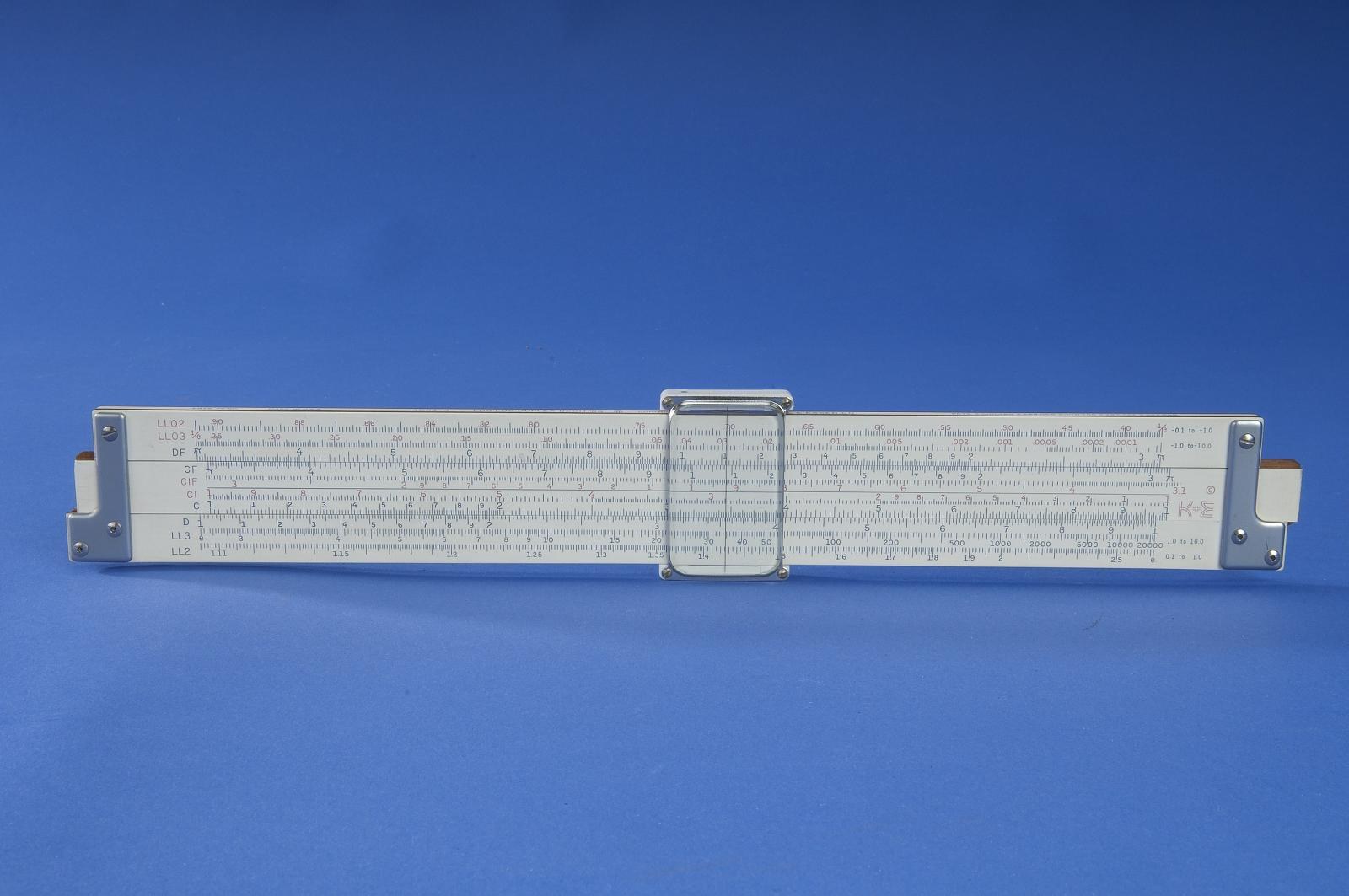
Figure 5 — An example of the same 1955–1962 layout in the Smithsonian: serial 320858, about 1957, given to the museum by K&E itself in 1961. The museum records its indicator as glass with plastic edges held by metal screws. Image: National Museum of American History, Smithsonian Institution, cat. MA.318482, gift of Keuffel & Esser Company, image NMAH-DOR2010-0344, https://americanhistory.si.edu/collections/object/nmah_1214610.
2.6 What My Photographs Show and Do Not Show
My two photographs confirm the full scale set on both faces, the serial and repeated digits, the logo, the bracket screws, the cursor pattern and the range legends. They do not show the top-edge inlay, so the model number and patent line are not yet confirmed from the rule itself. They also do not show whether the cursor window is glass or plastic, or the length of the scales. A 10-inch scale with a rule about 12.5 inches long confirms a 4081-3 rather than the 20-inch 4081-5. These are the open checks noted in Vol 1.
Sources
- Lyman M. Kells, Willis F. Kern and James R. Bland, Log Log Duplex Decitrig Slide Rule No. 4081: A Manual (K&E, 1955 printing) — scale definitions, the front and reverse face illustrations, the treatment of the LL scales. In this site’s Reference Library.
- K&E, The SRT Scale supplement (1955), page 2 — the 0.573°–5.73° range and the radian rule, with the example 3.56° = 0.0621 rad (http://www.mccoys-kecatalogs.com/KEManuals/SRTscale/SRTscale.htm). In this site’s Reference Library.
- C. Hamann, K&E 4081-3 “Version B” (1955) — scale-by-scale formulas: LL02 = exp(−0.1X), LL03 = exp(−X), LL3 = exp(X), LL2 = exp(0.1X), LL01 = exp(−0.01X), LL1 = exp(0.01X), SRT = arc(0.01X) (https://public.bht-berlin.de/hamann/sliderules/ke81b.html).
- Clark McCoy, 4081-3 family pages and dating notes — inlaid edges from 1952–53, serial-digit repetition, fastener changes (http://www.mccoys-kecatalogs.com/KEModels/ke4081-3family.htm; https://mccoys-kecatalogs.com/keserialnumbers/Dating-2.htm).
- International Slide Rule Museum, “Parts for Keuffel and Esser Slide Rules” — K&E cursor generations and window part numbers 7L (glass) and 7W (unbreakable) (https://sliderulemuseum.com/PartsKE.shtml).
- National Museum of American History, K&E 4081-3, cat. MA.318482, and 4081-5 records — markings, indicator construction (Internet Archive copies of americanhistory.si.edu records).
- Scale ranges checked by calculation: e0.01 = 1.01005, e0.1 = 1.10517, e10 = 22,026.5, e−0.01 = 0.99005, e−0.1 = 0.90484, e−1 = 0.36788, e−10 = 0.0000454; arcsin 0.1 = 5.74°, arctan 0.1 = 5.71°, 0.01 rad = 0.573°, 0.1 rad = 5.73°.
Comments (0)