K&E 4071-3 Duplex Decitrig · Volume 3
K&E 4071-3 Polyphase Duplex Decitrig — Volume 3 — Using It, and Caring for It
Nine worked problems without log-log scales, every answer checked; then cleaning a 1950s K&E and replacing a cracked glass cursor window
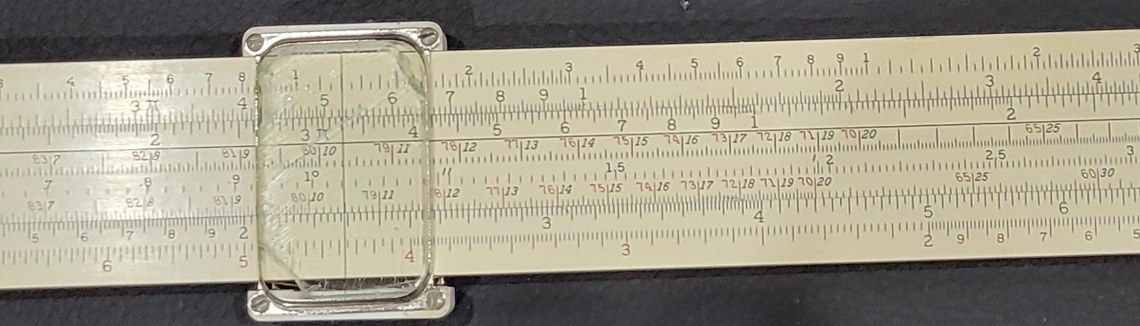
Figure 1 — The reverse face of my 4071-3 under the cursor. On the slide, T and S carry paired black and red figures (“78|12”, “77|13”), and ST is numbered in fractions of a degree (“1°”, “1.5”). A and B have the π mark. Fine lines run along the lower edge of the window on this face as well. Photo: my own.
3.1 About This Volume
This volume works nine problems on the 4071-3, chosen to use every scale group. Several show how this rule covers the ground of the missing log-log scales by using its L scale. Each problem gives the setting, the reading, how to place the decimal point, and the exact value. A 10-inch rule reads three significant figures, so the answers are given to that precision, with the exact figure in brackets. The general methods are in How to Read & Operate a Slide Rule (Vols 2–4), and the problems follow the approach of the Kells–Kern–Bland manual (Vol 1).
The second half covers care, and in particular replacing the cracked glass in my rule’s cursor. The cleaning advice for celluloid on mahogany is the same as for my 4081-3, and is summarised here with a pointer to the fuller version in that unit.
3.1.1 Depth-Index: The Three-Volume Unit
Table 1 — Depth-Index: The Three-Volume Unit
| Vol | Title | Primary Content |
|---|---|---|
| 1 | The Log Log’s Plainer Sibling | The family, the name, scale-set changes, patents, the manual, dating my 640890 |
| 2 | Anatomy and Every Scale | Construction, the glass cursor, every scale with formula and range, the end legends |
| 3 | Using It, and Caring for It (this volume) | Worked problems; cleaning, adjustment, and replacing the cursor glass |
3.2 Worked Problems on the Front Face
3.2.1 Three factors in one setting: 1.8 × 2.1 × 1.5
- Set 2.1 on CI over 1.8 on D. With CI, the first multiplication needs no index. The right index of C now stands over 3.78 on D, which is 1.8 × 2.1.
- Moving the hairline to 1.5 on C would not work: with the slide in this position, 1.5 on C is beyond the left end of the stock.
- Instead, move the hairline to 1.5 on CF and read DF: 567.
Decimal: 2 × 2 × 1.5 ≈ 6, so the answer is 5.67 (exact 5.67). The folded scales take the third factor without resetting the slide — the main reason the rule has them. How to Read & Operate, Vol 2, explains the method in general.
3.2.2 A logarithm and an antilogarithm: 7.5^2.3
The 4071-3 has no log-log scales, so a power that is not a square or a cube is done in three steps with the L scale, the way it was done with printed log tables:
- Take the logarithm. Move the hairline to 7.5 on D and read L: 0.875 (exact log 7.5 = 0.87506).
- Multiply by the power on C and D. 0.875 × 2.3 = 2.01 (exact 2.0125). The digits come from C and D; the decimal point is placed by estimation. The whole number part, 2, is the characteristic: it gives the power of ten.
- Take the antilogarithm. Move the hairline to the decimal part, .013 on L, and read D: 1.03. With the characteristic of 2, the answer is 1.03 × 10² = 103 (exact 7.5^2.3 = 102.95).
Three readings, each with its own small error, make this method less accurate than the one-setting log-log method on my 4081-3. That is the price of a simpler rule. How to Read & Operate, Vol 4, explains the L scale, and the 4081 unit’s Vol 3 does a power on the log-log scales for comparison.
3.3 Worked Problems on the Reverse Face
3.3.1 Area of a circle: π × 1.75²
- Move the hairline to 1.75 on D. The square shows on A: 3.06 (exact 3.0625).
- Set the left index of B under the hairline.
- Move the hairline to the π mark on B and read A: 9.62.
Decimal: 3 × 3 ≈ 9. Area = 9.62 square units (exact 9.6211).
3.3.2 Square root: √2000
2000 has an even number of digits (four), so it is set on the right half of A. A number with an odd number of digits goes on the left half. How to Read & Operate, Vol 3, explains the rule.
- Move the hairline to 2 (meaning 20) on the right half of A.
- Read D: 4.47.
Decimal: 40² = 1600 and 50² = 2500, so the root is in the forties. √2000 = 44.7 (exact 44.721).
3.3.3 Cube root: ∛270
K has three cycles. 270 has three digits before the decimal point, so it goes in the third cycle (100–1000).
- Move the hairline to 270 on K (the “2.7” of the right-hand cycle).
- Read D: 6.46.
Check: 6³ = 216 and 7³ = 343. ∛270 = 6.46 (exact 6.4633).
3.3.4 Solving a triangle: the law of sines
In a triangle, side b = 8 is opposite angle B = 65°, and angle A = 40°. Find side a.
The law of sines, a / sin A = b / sin B, is a proportion, so the S scale on the slide can be set against D:
- Set 65 on S over 8 on D.
- Move the hairline to 40 on S.
- Read D: 5.67.
This one setting gives every other side of the triangle as well. The third angle is C = 180° − 65° − 40° = 75°, and with the hairline on 75 on S, D reads 8.53 for side c (exact 8.5262). a = 5.67 (exact 5.6739). The manual’s Arts. 33–35 cover this method, including the ambiguous case.
3.3.5 A tangent above 45°: tan 70°
T runs only from 5.71° to 45°. Angles above 45° use the red figures, which read right to left, and the answer is read on the reciprocal scale.
- With the slide closed, move the hairline to red 70 on T. It is at the same graduation as black 20.
- Read DI: 2.75.
The legend “10.0 to 1.0” (Vol 2, Figure 6) says the answer lies between 1 and 10. tan 70° = 2.75 (exact 2.7475). This works because tan 70° = 1/tan 20°.
3.3.6 A cosine from the red figures: cos 62°
- With the slide closed, move the hairline to red 62 on S. It is at the same graduation as black 28.
- Read D: 0.469 (legend “0.1 to 1.0”).
cos 62° = 0.469 (exact 0.46947), the same as sin 28°.
3.3.7 A small angle on ST: 1.5°
- With the slide closed, move the hairline to 1.5 on ST.
- Read D: digits 262. The legend “0.01 to 0.1” places the decimal point.
sin 1.5° ≈ tan 1.5° ≈ 0.0262. The exact values are 0.026177 and 0.026186, and 1.5° is 0.026180 rad — all the same to three figures. That is why one scale serves for all three, and why K&E later renamed it SRT (Vol 2).
3.4 Cleaning and Care
3.4.1 The rule
The 4071-3 is made of the same materials as my 4081-3 — celluloid over mahogany, pigment-filled engraved graduations, aluminium brackets — and needs the same care. The full procedure, with the reasons for each step, is in the K&E 4081-3 Log Log Duplex Decitrig unit (Vol 3). In short:
- Never use acetone, lacquer thinner, MEK, nail-polish remover or alcohol on the celluloid. They dissolve or whiten it and lift the pigment from the figures.
- Never use abrasives or metal polish on the faces. The fine graduations go first.
- No soaking, no oil, no silicone, no heat.
- Clean with a few drops of mild dish soap on a cloth that is damp, not wet, working one short section at a time. Rinse with a second damp cloth and dry at once. Take the cursor off first.
- Slide fit: clean the tongues and grooves, and if the slide is still stiff, rub on a trace of paraffin wax and buff it off. If the end brackets on this rule are partly riveted (Vol 2), the slide fit can be adjusted only through the slotted screws. Do not drill out rivets to get more adjustment: it destroys original construction to fix something that cleaning usually cures.
- Storage: flat, away from heat and light, and not sealed in plastic — ageing celluloid gives off acidic vapour that corrodes metal in a closed space.
The cream colour of this rule’s face is most likely aged celluloid. It is part of the material and will not wash out. Attempts to bleach or polish it away will damage the figures.
3.4.2 The cursor: replacing a cracked glass window
The cursor glass on mine is cracked at the top-left corner and along the bottom edge of the front window (Vol 2, Figure 2), and the reverse window also shows lines along its lower edge (Figure 1). A cracked window is more than a blemish:
- Loose chips of glass scratch celluloid. A fragment caught under the window and dragged along the rule will cut lines into the face that cannot be removed.
- The hairline can shift. If a crack runs near the hairline, a piece of glass carrying part of the line can move, and readings become unreliable without anyone noticing.
- Fracture edges are sharp.
Until the glass is replaced, the cursor should not be slid along the rule. It is safer to take it off and store it separately, wrapped in tissue.
Finding a replacement. For an original-looking repair, the right part is a K&E 7L glass window for the 1938–1955 “New Improved” cursor of a 10-inch duplex rule. The International Slide Rule Museum lists used 7L windows and complete cursors in its K&E parts catalogue. A whole donor cursor of the same pattern is often the simplest solution, because its windows already carry an aligned hairline. The alternatives, in order of preference:
- An original 7L glass window, or a complete original cursor of the same pattern, from a K&E parts source or a donor rule. This keeps the rule original.
- A later 7W “unbreakable” plastic window of the same size. It fits, but it belongs to the post-1956 cursor and makes this a mixed cursor. If this is done, the change should be recorded with the rule.
- A new window cut and scribed to order. Some slide-rule restorers make replacement windows with a scribed hairline. It is the most work, and the result is a modern part.
The window should not be replaced with an unmarked piece of glass or plastic with an inked line drawn on it. A hand-drawn line is too thick, and ink on the surface wears off.
Removing the cursor. The procedure for taking the cursor apart:
- Close the rule and lay it on a soft, clean cloth on a tray, so that no glass fragments or small screws can be lost.
- Note the orientation. Mark or photograph which bar is at the top of the front face, which window goes on which face, and which way round each window sits. The hairline is scribed on the side facing the rule.
- Using a screwdriver that fits the slots exactly, loosen and remove the four corner screws. Turn them gently: steel screws in aluminium bars can be stiff after seventy years, and a slipping screwdriver will scar the bars or crack the remaining glass further. A drop of light oil on the thread, left for a few minutes and then wiped off, helps a stiff screw. Keep the oil off the celluloid and glass.
- Lift away the bars and windows, keeping everything in order. Pick up all glass fragments with tape, not fingers, and check the rule’s faces and the cloth for chips before going on.
Fitting the new window.
- Clean the new window: glass with a little glass cleaner on a cloth, plastic with soap and water only. The new window goes in the position of the old one, hairline side toward the rule.
- Reassemble the bars round both windows and start all four screws finger-tight first.
- Put the cursor back on the rule and tighten the screws a little at a time, in a criss-cross order, until the cursor runs smoothly without rocking. Overtightening cracks glass, so stop as soon as it is firm.
Aligning the hairlines. The two hairlines must coincide, or a value carried from one face to the other will be wrong.
- Close the rule, with the slide indexes exactly level with those of D.
- On the front face, set the hairline exactly over the left index of D.
- Turn the rule over without moving the cursor. The reverse hairline should lie exactly over the left index of D on that face.
- If it does not, slightly loosen the screws holding the window on that face, nudge the window until the line sits on the index, and tighten again. Check the same way at the right index. If the two ends disagree, the hairline is not square to the rule, so ease the window round until both ends agree.
3.4.3 Cleaning a glass window
Glass tolerates more than celluloid: a little isopropyl alcohol or glass cleaner on a soft cloth is safe. Take the cursor off the rule first, so that no cleaner reaches the face, and keep the cleaner off the clear plastic edge strips. Wipe the hairline side gently, along the line and not across it. The line is scribed into the glass and filled, and the fill can be wiped out of a worn line.
3.4.4 The case
My 4071-3’s case, if it had one, is not in my photographs. The Smithsonian’s 4071-3, made between 1955 and 1962, came in an orange K&E leather case very like the one with my 4081-3. Care of K&E leather and synthetic cases is in the 4081 unit (Vol 3).
Sources
- Lyman M. Kells, Willis F. Kern and James R. Bland, The Polyphase Duplex Decitrig Slide Rule No. 4071: A Manual (K&E, 1939; later 68 2055 edition) — Arts. 9, 14, 17–24, 26–28 and 33–36 on the methods used above. In this site’s Reference Library.
- How to Read & Operate a Slide Rule, Vols 2–4, this project.
- K&E 4081-3 Log Log Duplex Decitrig, Vol 3, this project — full cleaning and storage procedure for K&E celluloid-on-mahogany rules.
- International Slide Rule Museum, “Parts for Keuffel and Esser Slide Rules” — 7L glass and 7W unbreakable windows, complete “New Improved” cursors, matching parts by rule length (https://sliderulemuseum.com/PartsKE.shtml).
- National Museum of American History, K&E 4071-3, cat. 1993.0482.01 — orange leather case, “frameless glass indicator with plastic edges”.
- General conservation guidance on cellulose nitrate (sensitivity to solvents, heat and light; acidic off-gassing; ventilated storage).
- Every worked answer was checked by calculation: 1.8 × 2.1 = 3.78 and × 1.5 = 5.67 (after the CI setting, 1.5 on C would fall at −0.246 of the scale length, off the stock; on CF it falls at 0.256, where DF reads 5.670); log 7.5 = 0.875061, × 2.3 = 2.012641, 10^0.012641 = 1.0295, 7.5^2.3 = 102.953; 1.75² = 3.0625, π × 3.0625 = 9.62113; √2000 = 44.7214; ∛270 = 6.46330; 8 sin 40° / sin 65° = 5.67390 and 8 sin 75° / sin 65° = 8.52625; tan 70° = 2.74748 = 1/tan 20°; cos 62° = sin 28° = 0.469472; sin 1.5° = 0.0261769, tan 1.5° = 0.0261859, 1.5° = 0.0261799 rad.
Comments (0)