K&E 4071-3 Duplex Decitrig · Volume 2
K&E 4071-3 Polyphase Duplex Decitrig — Volume 2 — Anatomy and Every Scale
Fifteen scales on two faces of celluloid-covered mahogany, a pre-1956 glass cursor, and the old ST scale that dates the rule

Figure 1 — My 4071-3, reverse face: K and A on the upper stock; B, T, ST and S on the slide; D and DI on the lower stock. The ST label (rather than SRT) is the main evidence that the rule was made before 1956. The trig scales are in decimal degrees, with paired black and red figures. Photo: my own.
2.1 About This Volume
Vol 1 dated my 4071-3 to about 1952. This volume goes through its construction and then every scale on both faces. The 4071-3 shares its construction and most of its scales with the 4081-3. The K&E 4081-3 Log Log Duplex Decitrig unit (Vol 2) covers those in more depth, and this volume concentrates on what is different: no log-log scales, the L scale on the front face, the older ST scale, and an earlier-pattern cursor with a glass window. General methods for each scale family are in How to Read & Operate a Slide Rule (Vols 2–4).
2.1.1 Depth-Index: The Three-Volume Unit
Table 1 — Depth-Index: The Three-Volume Unit
| Vol | Title | Primary Content |
|---|---|---|
| 1 | The Log Log’s Plainer Sibling | The family, the name, scale-set changes, patents, the manual, dating my 640890 |
| 2 | Anatomy and Every Scale (this volume) | Construction, the glass cursor, every scale with formula and range, the end legends |
| 3 | Using It, and Caring for It | Worked problems; cleaning, adjustment, and replacing the cracked cursor glass |
2.2 Construction
2.2.1 Wood, celluloid and pigment
Like every K&E duplex of its time, the 4071-3 is built from three strips of mahogany — upper stock, slide and lower stock — with white celluloid laminated onto each working face. The graduations are cut by K&E’s dividing engines and filled with black and red pigment. Where the slide is drawn out (Figure 3), the reddish wood shows along its edges. The face of my rule is a warm cream rather than bright white. Celluloid yellows with age, and the Smithsonian’s 4071-3 of a few years later shows a similar tone (Figure 5), though light and camera colour balance affect how this looks in a photograph.
McCoy’s catalogue notes record that the 1955b catalogue changed the 4071-3’s top and bottom edges from solid laminate to inlaid laminate, with wood showing. On the 4081 family the change began in 1952–53. Which kind of edge my rule has can be seen only by turning it on its side. It is another check on the date (Vol 1).
The text printed in red across the top of the front face — maker, patents, “MADE IN U.S.A.” — is on the face itself. On the 4081-3 the maker and patent line are engraved on the top edge instead.
2.2.2 End brackets
Two L-shaped aluminium end brackets join the stocks, one at each end. On my rule each bracket has two domed heads, which look like the rivets K&E used before 1958, and one slotted screw (Figure 3 and Vol 1, Figure 1). McCoy dates K&E’s change from rivets to hex screws to 1958, which fits a rule made before then. If the domed heads are rivets, they cannot be loosened, which limits how much the slide fit can be adjusted (Vol 3).
2.2.3 The cursor: the 1938–1955 pattern, with glass
The cursor has two metal bars, top and bottom, joined by four slotted corner screws, with a glass window on each face and clear edge strips down the long sides. A hairline is scribed on the inner side of each window, and the two hairlines are aligned with each other through the rule.
The International Slide Rule Museum’s guide to K&E parts identifies this as the “New Improved” cursor, made from about 1938 to 1955. It used window part 7L, glass. From 1956 K&E fitted blank bars and window 7W, an “unbreakable” plastic. Three things show that the window on my rule is glass: the fracture lines run in straight and gently curved paths, the broken edges have the green tint of soda-lime glass, and small pieces have come away at the corners. Plastic would craze or bend rather than break like this.
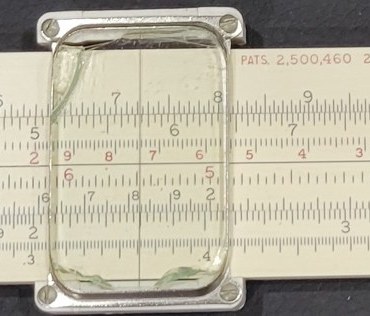
Figure 2 — The cursor on my 4071-3, front face. The glass is cracked across the top-left corner and along the bottom edge, and the green edges of the fractures show that it is glass. The hairline is still intact over all seven scales on this face. The four slotted screws at the corners are what come out to replace the window (Vol 3). Photo: my own.
In the ISRM’s guide, the 1938–1955 glass-window cursor has a K&E logo on its bars. My photographs do not show the bars closely enough to tell whether mine has one. If it does, that supports a pre-1956 date. If the bars are blank, the cursor may have been replaced at some point.
2.2.4 Markings
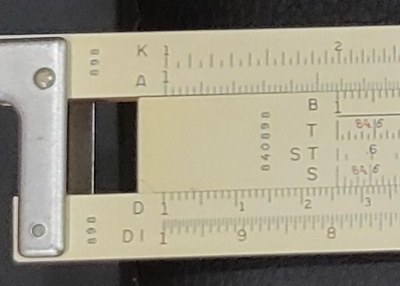
Figure 3 — The serial number on my rule. The slide end carries the full number, which reads as 640890; it is faint in this photograph and should be checked with a magnifier. Both stocks carry 890. This is K&E’s practice from 1952 on of repeating the last three digits on the frame, so that a slide could be matched to its frame. The scale names show the older ST, and the mahogany core shows in the gap. Photo: my own.
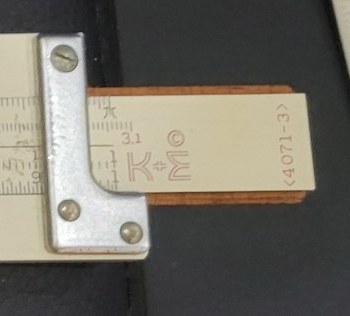
Figure 4 — The right end of the slide, front face: the K&E logo with © and the model number ‹4071-3›, with no “N” prefix and no 68-series number. The “3.1” and the star are the ends of the CF and DF scales, which run slightly past π. Photo: my own.
2.3 The Two Faces at a Glance
Table 2 — The Two Faces at a Glance
| Face | Upper stock | Slide | Lower stock |
|---|---|---|---|
| Front (Vol 1, Figure 1) | DF | CF · CIF · CI · C | D · L |
| Reverse (Figure 1) | K · A | B · T · ST · S | D · DI |
Fifteen scales in all, against twenty-one on the 4081-3. The six log-log scales are missing. The L scale is on the front face beside D, where the 4081 has it on the reverse. The rest is the 4081’s set, laid out the same way.
2.4 Every Scale
x is the reading on C or D, from 1 to 10. Red scales and red figures read right to left.
2.4.1 Front face
Table 3 — Front face
| Scale | Where | Computes | Range / notes |
|---|---|---|---|
| DF | Upper stock | πx | Folded at π: begins and ends at π, with 1 near the middle |
| CF | Slide | πx | Folded at π; the slide’s counterpart of DF |
| CIF | Slide | 1/(πx) | Inverted folded scale, red |
| CI | Slide | 1/x | Inverted C, red, 10 → 1 |
| C | Slide | x | 1–10 |
| D | Lower stock | x | 1–10 |
| L | Lower stock | log₁₀ x | 0 to 1, evenly divided, read against D |
All the multiplication and division happens on this face. C and D are the main pair; CI allows two multiplications from one slide setting; CF and DF continue a calculation that would otherwise run off the end, or multiply by π without moving the slide. How to Read & Operate, Vol 2, explains these methods, and the 4081 unit’s Vol 3 works an example. Because L is beside D, any number set on D can be converted to its common logarithm without turning the rule over. On the 4071-3 this matters more than it does on the 4081, because L is the only way this rule can do general powers (Vol 3).
2.4.2 Reverse face
Table 4 — Reverse face
| Scale | Where | Computes | Range / notes |
|---|---|---|---|
| K | Upper stock | x³ | Three cycles: 1–10, 10–100, 100–1000 |
| A | Upper stock | x² | Two cycles: 1–10, 10–100 |
| B | Slide | x² | As A, on the slide |
| T | Slide | tan θ (black) · cot θ (red) | 5.71° to 45° → 0.1 to 1.0 |
| ST | Slide | sin θ ≈ tan θ (≈ θ in radians) | 0.57° to 5.73° → 0.01 to 0.1 |
| S | Slide | sin θ (black) · cos θ (red) | 5.74° to 90° → 0.1 to 1.0 |
| D | Lower stock | x | 1–10; the same D as on the front |
| DI | Lower stock | 1/x | Red, 10 → 1 |
The trig scales are divided in decimal degrees. Each graduation carries a pair of figures, such as “84|6”, “83|7”, “82|8” on S: black for the angle read left to right, red for its complement read right to left. The red figures give cosines on S, and on T they give cotangents, or tangents of angles above 45° read on DI. A and B carry π marks (“3π” in Figure 1).
2.4.3 ST, and how it differs from SRT
The 1939 manual calls ST the Sine Tangent scale: for angles below about 5.7°, a sine and a tangent are equal to three figures, so one scale serves for both. From 1956 K&E printed SRT in its place. K&E’s 1955 supplement describes SRT as a C scale graduated in degrees from about 0.573° to 5.73°, so that setting an angle in degrees on it also sets that angle in radians on C (with “0.0” in front). The supplement’s example is 3.56° = 0.0621 rad. The supplement simply tells owners to read SRT wherever their manual says ST, and the two scales cover the same angles.
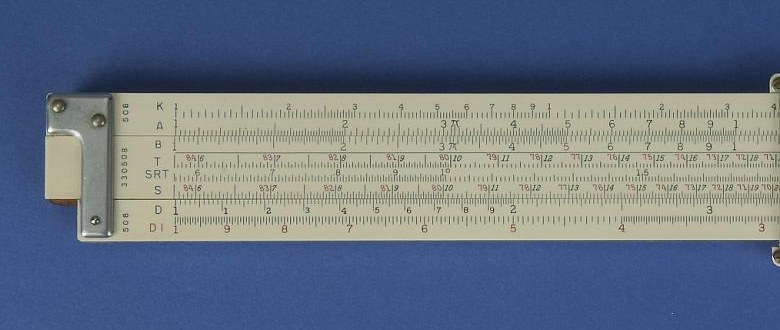
Figure 5 — The later layout, for comparison: the Smithsonian’s 4071-3, serial 330508, which the museum dates to 1955–1962. The slide reads B, T, SRT, S where mine reads B, T, ST, S. The serial marking follows the same convention as mine: the full number on the slide, the last three digits on both stocks. Image: National Museum of American History, Smithsonian Institution, cat. 1993.0482.01, gift of Alfred E. Brown, image NMAH-DOR2012-2003 (detail), https://americanhistory.si.edu/collections/object/nmah_1214629.
2.4.4 The range legends
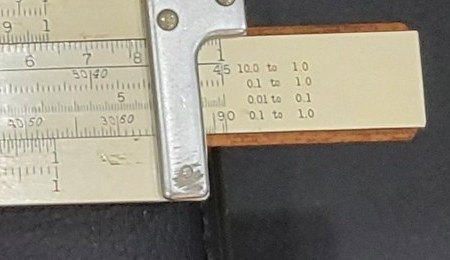
Figure 6 — The decimal-range legends at the right end of my rule’s slide: “10.0 to 1.0” (T, red figures — tangents of angles above 45°, read on DI), “0.1 to 1.0” (T, black), “0.01 to 0.1” (ST) and “0.1 to 1.0” (S). They tell the operator where the decimal point goes in a trig result. Photo: my own.
These legends belong to the group of patents printed on the face. With no log-log scales, the 4071-3 has only these four. On the 4081-3 the same idea runs through all six log-log scales as well.
2.5 What Is Different from the 4081-3
Table 5 — What Is Different from the 4081-3
| Feature | My 4071-3 (c. 1952) | My 4081-3 (c. 1962) |
|---|---|---|
| Log-log scales | None | LL1–3, LL01–03 |
| L scale | Front face, beside D | Reverse face, top stock |
| Small-angle scale | ST | SRT |
| Cursor window | Glass (7L), now cracked | Glass or plastic — to be checked |
| End-bracket fasteners | Domed heads (rivets?) and one slotted screw | Recessed-head screws |
| Maker and patents | Printed in red across the front face | On the edge inlay (not yet confirmed on mine) |
| Face colour in my photos | Cream | Bright white |
| Serial | 640890 (appears), “890” on stocks | 640904, “904” on stocks |
Sources
- Lyman M. Kells, Willis F. Kern and James R. Bland, The Polyphase Duplex Decitrig Slide Rule No. 4071: A Manual (K&E, 1939, and the later 68 2055 edition) — contents: Art. 9, “Use of the scales DF and CF”; Art. 14, “The CI and CIF (reciprocal) scales”; Art. 24, “The L scale”; Art. 26, “The S (Sine) and ST (Sine Tangent) scales”; Art. 28, “The red numbers on the S and T scales”; Art. 39, “To change radians to degrees or degrees to radians”. In this site’s Reference Library.
- K&E, The SRT Scale supplement (1955), p. 2 (http://www.mccoys-kecatalogs.com/KEManuals/SRTscale/SRTscale.htm). In this site’s Reference Library.
- Clark McCoy, “Collection of Pages from K&E Catalogs for the 4071-3 Family” — scale sets, mahogany with laminated celluloid, engine-divided, inlaid edges 1955b (https://mccoys-kecatalogs.com/KEModels/ke4071family.htm); “Dating K&E Slide Rules” — serial-digit repetition, rivets to hex screws and glass to plastic windows (https://mccoys-kecatalogs.com/keserialnumbers/Dating-2.htm).
- International Slide Rule Museum, “Parts for Keuffel and Esser Slide Rules” — “New Improved” cursor 1938–1955 with 7L glass window; 1956 on, blank bars and 7W unbreakable window (https://sliderulemuseum.com/PartsKE.shtml).
- National Museum of American History, K&E 4071-3, cat. 1993.0482.01 — description, marking positions, “frameless glass indicator with plastic edges”.
- Scale ranges checked by calculation: arctan 0.1 = 5.711°, arcsin 0.1 = 5.739°, 0.01 rad = 0.573°, 0.1 rad = 5.730°; 3.56° = 0.06213 rad.
Comments (0)