K&E 4071-3 Duplex Decitrig · Volume 1
K&E 4071-3 Polyphase Duplex Decitrig — Volume 1 — The Log Log's Plainer Sibling
K&E's general-purpose duplex of 1939–1967: what it was for, how it changed, and why my example is probably ten years older than its serial number suggests
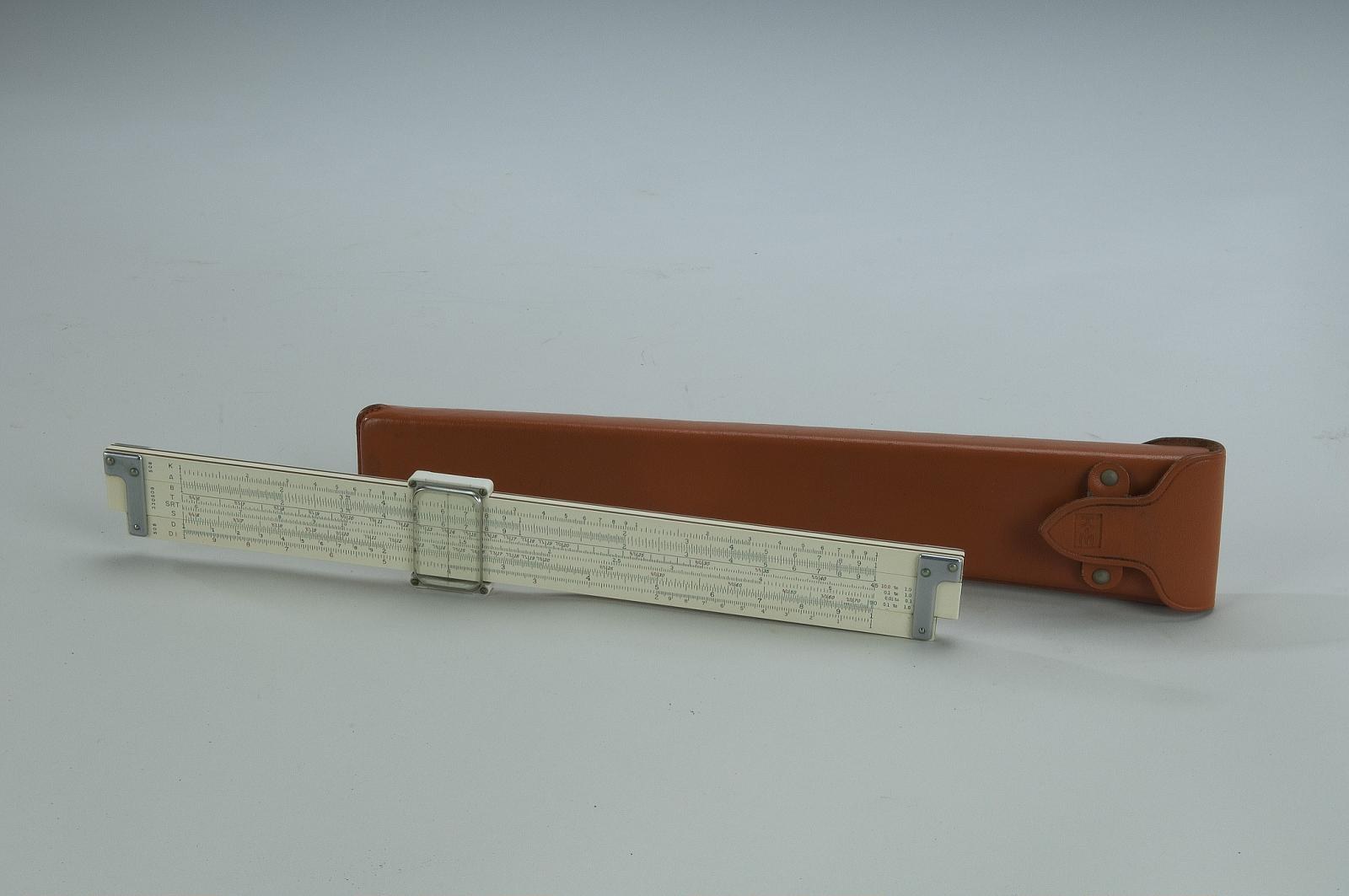

Figure 1 — My Keuffel & Esser 4071-3 Polyphase Duplex Decitrig, front face. The upper stock carries DF; the slide carries CF, CIF, CI and C; the lower stock carries D and L. “KEUFFEL & ESSER CO.”, the patent numbers and “MADE IN U.S.A.” are printed in red across the top. The cracks in the cursor glass show at its top-left and bottom edges. Photo: my own.
1.1 About This Unit
The K&E 4071-3 Polyphase Duplex Decitrig has almost every scale of the famous 4081-3 Log Log Duplex Decitrig — folded and inverted scales, squares, cubes, logarithms, sines and tangents in decimal degrees — but no log-log scales. It was the rule for people who multiplied, divided and did trigonometry all day but rarely needed to raise a number to a fractional power: surveyors, draftsmen, many civil and mechanical engineers, and students in courses that did not need exponentials. Its manual was written by the same three Naval Academy professors who wrote the 4081’s, and the two rules share most of their patents.
I own one. Its slide end carries the K&E logo and “‹4071-3›”, and its serial number appears to be 640890. The cursor glass on mine is cracked. This volume covers the model’s history and the dating of my example. Vol 2 covers its construction and every scale, and Vol 3 works problems on it and covers care, including replacing the cursor glass. I also own a 4081-3, which has its own unit (K&E 4081-3 Log Log Duplex Decitrig). Where the two rules are the same, this unit cross-references that one rather than repeating it. The general history of K&E and the duplex rule is in the History unit (Vol 3).
1.1.1 Depth-Index: The Three-Volume Unit
Table 1 — Depth-Index: The Three-Volume Unit
| Vol | Title | Primary Content |
|---|---|---|
| 1 | The Log Log’s Plainer Sibling (this volume) | The 4070/4071 family, what “Polyphase” and “Decitrig” mean, scale-set changes, patents, the manual, dating my 640890 |
| 2 | Anatomy and Every Scale | Mahogany and celluloid construction, the 1938–55 glass cursor, every scale on both faces with formula and range, the end legends |
| 3 | Using It, and Caring for It | Worked problems with every number checked; cleaning, adjustment, and replacing the cracked cursor glass |
Note — “Vol N” means a volume of this unit; other units are named in full.
1.2 The Name
The name has three parts:
- Polyphase. K&E used this name from at least 1913, for the 4088-3 Polyphase Duplex, which had an inverted CI scale on its slide. The Polyphase models in the Smithsonian’s collection — the 4088, the 4053/4054 Polyphase Mannheim and the 4071 — all carry the CI scale. The sources consulted do not explain the word itself; “many scales” is a reasonable reading of it, not a documented one.
- Duplex. Scales on both faces, with an open frame and a cursor that reads through both faces (History, Vol 3).
- Decitrig. K&E’s registered name for trigonometric scales divided in decimal degrees. The twin model, the 4070-3 Polyphase Duplex Trig, had the same layout with its S, T and ST scales divided in degrees and minutes.
1.3 The 4070/4071 Family, 1939–1967
Clark McCoy’s survey of K&E catalogues gives this outline:
Table 2 — Clark McCoy's survey of K&E catalogues gives this outline
| Date | Event |
|---|---|
| 1939 | 4070-3 (Trig) and 4071-3 (Decitrig) first listed. 10-inch only, mahogany with laminated celluloid, engine-divided. |
| 1949 | A plastic 9071-3 is mentioned among the spare cursors in that year’s catalogue. McCoy knows of one surviving example but no other documentation. |
| 1955b | The inlaid top and bottom edges replace solid laminate. The small-angle ST scale becomes SRT in the catalogue. |
| 1962 | Model numbers converted to K&E’s 68 xxxx series: the 4071-3 appears as 68 1497 and 68 1502. |
| 1967 | Last catalogue appearance. The family is absent from the 1972 catalogue. |
K&E kept the scale set almost unchanged for the whole life of the model. McCoy records just two layouts:
Table 3 — K&E kept the scale set almost unchanged for the whole life of the model. McCoy records just two layouts
| Period | Front face | Reverse face |
|---|---|---|
| 1939–1955 | DF = CF CIF CI C = D L | K A = B T ST S = D DI |
| 1956 on | DF = CF CIF CI C = D L | K A = B T SRT S = D DI |
My 4071-3 has the first layout. Its slide reads B, T, ST, S (Vol 2, Figure 1). That one letter is the most useful evidence for its date.
McCoy notes one oddity: in the catalogue that introduced the change, the 4071-3 illustration still shows ST while the text describes SRT. K&E’s 1955 supplement, The SRT Scale, was issued for three models — the 4081 Log Log Duplex Decitrig, the 4083 Log Log Duplex Vector and the 4071 Polyphase Duplex Decitrig — and told owners to read SRT wherever their manual said ST. McCoy’s note on the supplement dates the change on the rules themselves to 1956.
Figure 2 — A later 4071-3 in the Smithsonian: serial 330508, with an SRT scale, dated by the museum to 1955–1962 and in an orange leather case inscribed inside the flap “H. R. L. JULY ‘62”. Its patent line is the same as on mine. Image: National Museum of American History, Smithsonian Institution, cat. 1993.0482.01, gift of Alfred E. Brown, image NMAH-DOR2012-1506, https://americanhistory.si.edu/collections/object/nmah_1214629.
1.4 The Patents on the Face
Across the top of my rule’s front face, printed in red:
KEUFFEL & ESSER CO. · PATS. 2,500,460 2,168,056 2,170,144 PAT. PEND. · MADE IN U.S.A.
These are three of the five patents on the 4081 (that unit’s Vol 1):
Table 4 — These are three of the five patents on the 4081 (that unit's Vol 1)
| Patent | Inventor | Issued |
|---|---|---|
| 2,168,056 | Carl M. Bernegau | 1 Aug 1939 |
| 2,170,144 | Lyman M. Kells, Willis F. Kern, James R. Bland | 22 Aug 1939 |
| 2,500,460 | Herschel Hunt | 14 Mar 1950 |
The Smithsonian summarises this group of patents as covering how the scales are arranged, so that multi-step problems can be solved without writing down intermediate settings, and where the legends that help place the decimal point go.
The Hunt patent is the useful one for dating. A rule printed with 2,500,460 was made after March 1950. “PAT. PEND.” shows that K&E had at least one further application pending, which was normal on its rules of the 1950s and 1960s, so it does not narrow the date.
1.5 The Manual
The 4071 was sold with The Polyphase Duplex Decitrig Slide Rule No. 4071: A Manual, by Lyman M. Kells, Willis F. Kern and James R. Bland of the U.S. Naval Academy — the same authors as the 4081 manual. Its first edition is dated 1939. The copy in this site’s Reference Library, from Clark McCoy’s archive, includes the covers of both the 1939 orange paper edition and the 1962 green “Slide Rule Manual” edition (K&E Manual No. 68 2055), together with the text and the SRT supplement.
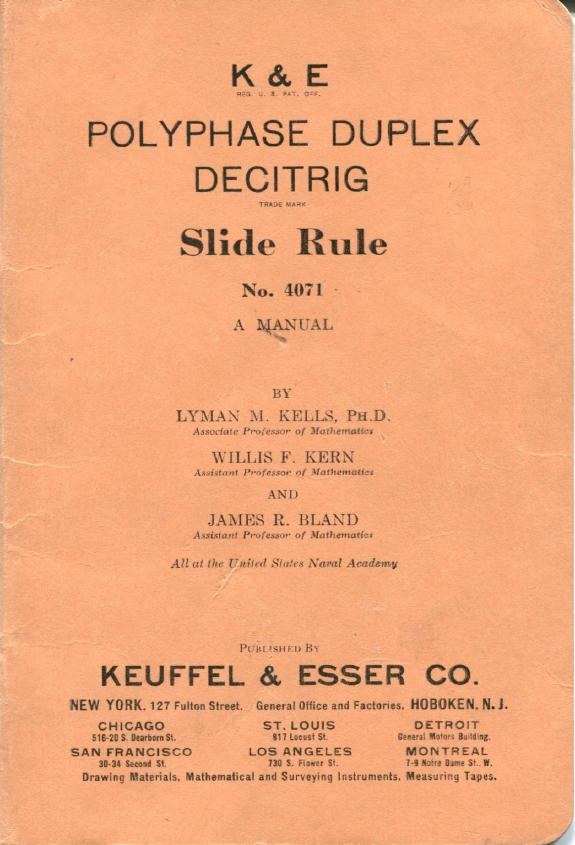
Figure 3 — The orange paper cover of the 1939 edition of the 4071 manual. Image: scan from Clark McCoy’s K&E manuals archive, http://www.mccoys-kecatalogs.com/KEManuals/manuals.htm.
The manual has five chapters:
- Multiplication and division, including the folded DF and CF scales.
- Proportion and combined operations, including the CI and CIF scales.
- Squares, square roots, cubes and cube roots, and the L scale.
- Plane trigonometry, with the S, ST and T scales, the red numbers, the law of sines for right and oblique triangles, the law of cosines, radians, and vectors.
- Logarithms and the slide rule, with a historical note and answers to the exercises.
It is the 4081 manual without the log-log chapter, written in the same Annapolis style of numbered articles and graded exercises.
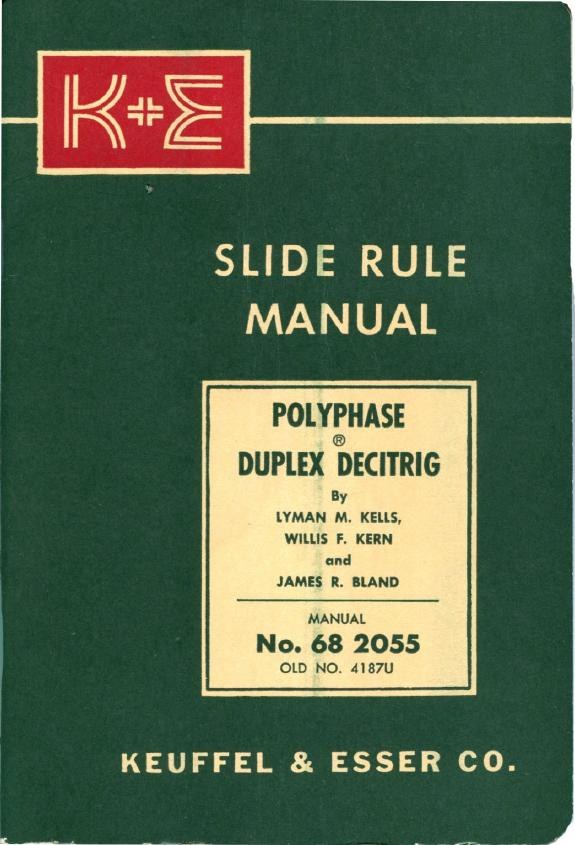
Figure 4 — The later green edition, K&E Manual No. 68 2055, issued after the 1962 renumbering. The text inside is the Kells–Kern–Bland manual, revised for the SRT scale. Image: scan from Clark McCoy’s K&E manuals archive, http://www.mccoys-kecatalogs.com/KEManuals/manuals.htm.
1.6 Dating My 4071-3
1.6.1 Reading the serial
K&E printed the serial number on the slide end. From 1952 on it also printed the last three digits on both stock pieces, so that a slide could be matched to its frame. On my rule the stocks clearly read 890. The full number on the slide is small and partly worn in my photograph, but it reads as 640890, and the 890 on the stocks agrees with that (Vol 2, Figure 2). I treat the serial as 640890, with the first digits to be confirmed under a magnifier.
1.6.2 Which cycle?
K&E’s serial numbers ran from 0 to 999,999 and then started again, three times between the 1920s and 1975. A six-digit serial therefore has up to four possible dates, and the rule’s other features have to decide between them. McCoy’s dating tables (built on Ed Chamberlain’s charts, and stated to be good to about ±1 year) put 640,890 at:
Table 5 — K&E's serial numbers ran from 0 to 999,999 and then started again, three times between the 1920s and 1975. A six-digit serial therefore has up to four possible dates, and the rule's other features have to decide between them. McCoy's dating tables (built on Ed Chamberlain's charts, and stated to be good to about ±1 year) put 640,890 at
| Cycle | Year for 640,890 | Consistent with my rule? |
|---|---|---|
| #1 (1922–1943) | 1938 | No. The Hunt patent printed on the face was not issued until 1950, and the 4071 was first listed in 1939. |
| #2 (1944–1955) | 1952 (616,000–693,000) | Yes. The ST scale was in use 1939–1955; Hunt’s 1950 patent is printed; the three-digit stock marking is used from 1952. |
| #3 (1956–1966) | 1962 (542,500–642,500) | Unlikely. By 1956 the 4071-3 had SRT, not ST, and a 1962 rule would probably be marked 68 1497 or 68 1502. |
| #4 (1967–1975) | — | No. The cycle ended at about 540,000, and the 4071 was gone by 1972. |
Mike Syphers’ benchmark study gives the same answer independently. His dated 4081-family rules in the second cycle, 195,932 in 1947 and 691,870 in 1952, put 640,890 at about 1951–1952.
My 4071-3 was most probably made in about 1952, realistically 1951–1953. The cycle is well supported: the ST scale and the Hunt patent together exclude every cycle but #2. The one way it could be wrong is if K&E went on making ST-scale 4071-3 slides after the catalogue change. McCoy’s note that the catalogue picture still showed ST shows how slowly such changes worked through. The year is good to about ±1, as the tables claim.
Two features of the hardware point the same way, though neither proves anything on its own:
- The cursor glass is real glass. The cracked edges in my photographs have the green tint of soda-lime glass. The International Slide Rule Museum’s parts guide says K&E’s metal-barred cursor had a glass window (part 7L) from 1938 to 1955, and an “unbreakable” plastic window (7W) from 1956.
- The end brackets have domed heads that look like rivets, plus one slotted screw. McCoy dates K&E’s change from rivets to hex screws to 1958. My 4081-3 of about 1962 has recessed-head screws.
1.6.3 Fourteen numbers from my 4081-3
My 4081-3 Log Log Duplex Decitrig carries serial 640904 — only fourteen numbers higher than this rule. It is tempting to think the two came off the line together. The evidence says no. The 4081-3 has the SRT scale, the 1955b layout and the later fasteners, which put it in cycle #3, at about 1962. This rule has ST and belongs in cycle #2, at about 1952. The near-identical numbers are a coincidence of K&E’s serial counter running through the same digits a second time, about a decade apart.
There is one more possibility, unlikely but worth recording. If K&E really did use up old ST slides on 4071-3 rules into the early 1960s, the two could be batch-mates after all. The ways to test it are the cursor (logo bars and glass suggest pre-1956; blank bars suggest later), the case, and any date written inside it. The Smithsonian’s own 4071-3 has its owner’s “July ‘62” inside the flap.

Figure 5 — The former Keuffel & Esser plant in Hoboken, New Jersey, where both my K&E rules were made, photographed in November 2021. K&E rebuilt the plant in 1906 after a fire and converted it to housing in 1975, the year it stopped making slide rules. Image: File:Keuffel and Esser Manufacturing Complex Hoboken November 2021.jpg by King of Hearts. License: CC BY-SA 4.0 (https://creativecommons.org/licenses/by-sa/4.0). Via Wikimedia Commons, https://commons.wikimedia.org/wiki/File:Keuffel_and_Esser_Manufacturing_Complex_Hoboken_November_2021.jpg.

1.7 Where the 4071 Sat in K&E’s Range
In the 1950s K&E’s 10-inch engineering duplex rules formed a ladder. The 4070-3 / 4071-3 Polyphase Duplex Trig / Decitrig had full trig, folded and inverted scales, K and L. Above them were the 4080-3 / 4081-3 Log Log Duplex Trig / Decitrig, which added six log-log scales. The 4083-3 Log Log Duplex Vector added hyperbolic functions. A buyer chose a rung by what the work required. The 4071-3 gave the most useful scales for everyday technical calculation without the cost and clutter of the log-logs.
What the 4071-3 cannot do directly is powers and roots other than squares and cubes, and natural exponentials. Those can still be done with its L scale: take the logarithm, multiply, and take the antilogarithm, three readings where a 4081 needs one. Vol 3 shows how.
Sources
- Clark McCoy, “Collection of Pages from K&E Catalogs for the 4071-3 Family of Slide Rules” — introduction 1939, scale sets 1939–1955 and 1956 on, ST→SRT, inlaid edges 1955b, the 9071-3, 68 1497 / 68 1502, last catalogue 1967 (https://mccoys-kecatalogs.com/KEModels/ke4071family.htm).
- Clark McCoy, “Dating K&E Slide Rules” and the serial tables by series; The SRT Scale and The DI Scale addendum pages (https://mccoys-kecatalogs.com/keserialnumbers/Dating-2.htm; http://www.mccoys-kecatalogs.com/KEManuals/SRTscale/SRTscale.htm). In this site’s Reference Library.
- Mike Syphers, “K&E Timeline Study Update,” Following the Rules — benchmark serials (https://followingtherules.substack.com/p/a-k-and-e-timeline-study-update).
- National Museum of American History, Smithsonian Institution, K&E 4071-3 Polyphase Decitrig Duplex, cat. 1993.0482.01 (serial 330508; markings; patents with inventors and dates; “JULY ‘62” case) — read via the Internet Archive copy of the americanhistory.si.edu record; also the Smithsonian’s 4088-3 records for the 1913 introduction of the Polyphase Duplex.
- International Slide Rule Museum, “Parts for Keuffel and Esser Slide Rules” — cursor generations, 7L glass and 7W unbreakable windows (https://sliderulemuseum.com/PartsKE.shtml).
- Lyman M. Kells, Willis F. Kern and James R. Bland, The Polyphase Duplex Decitrig Slide Rule No. 4071: A Manual (K&E, 1939; later edition as Manual No. 68 2055) — in this site’s Reference Library.
- “Keuffel and Esser,” Wikipedia — Hoboken plant, 1975 end of slide-rule engraving (https://en.wikipedia.org/wiki/Keuffel_and_Esser).
- The identification and reading of my rule rest on my own photographs: the scale names, “‹4071-3›” and the K&E © logo on the slide end, the patent line, “890” on both stocks and the slide serial, and the cracked cursor glass.
Comments (0)