Fuller Cylindrical Calculator · Volume 3
Fuller's Calculator — Volume 3 — Using It, and Caring for It
Bring, set, bring — and how to look after varnished paper, papier-mâché, brass and mahogany
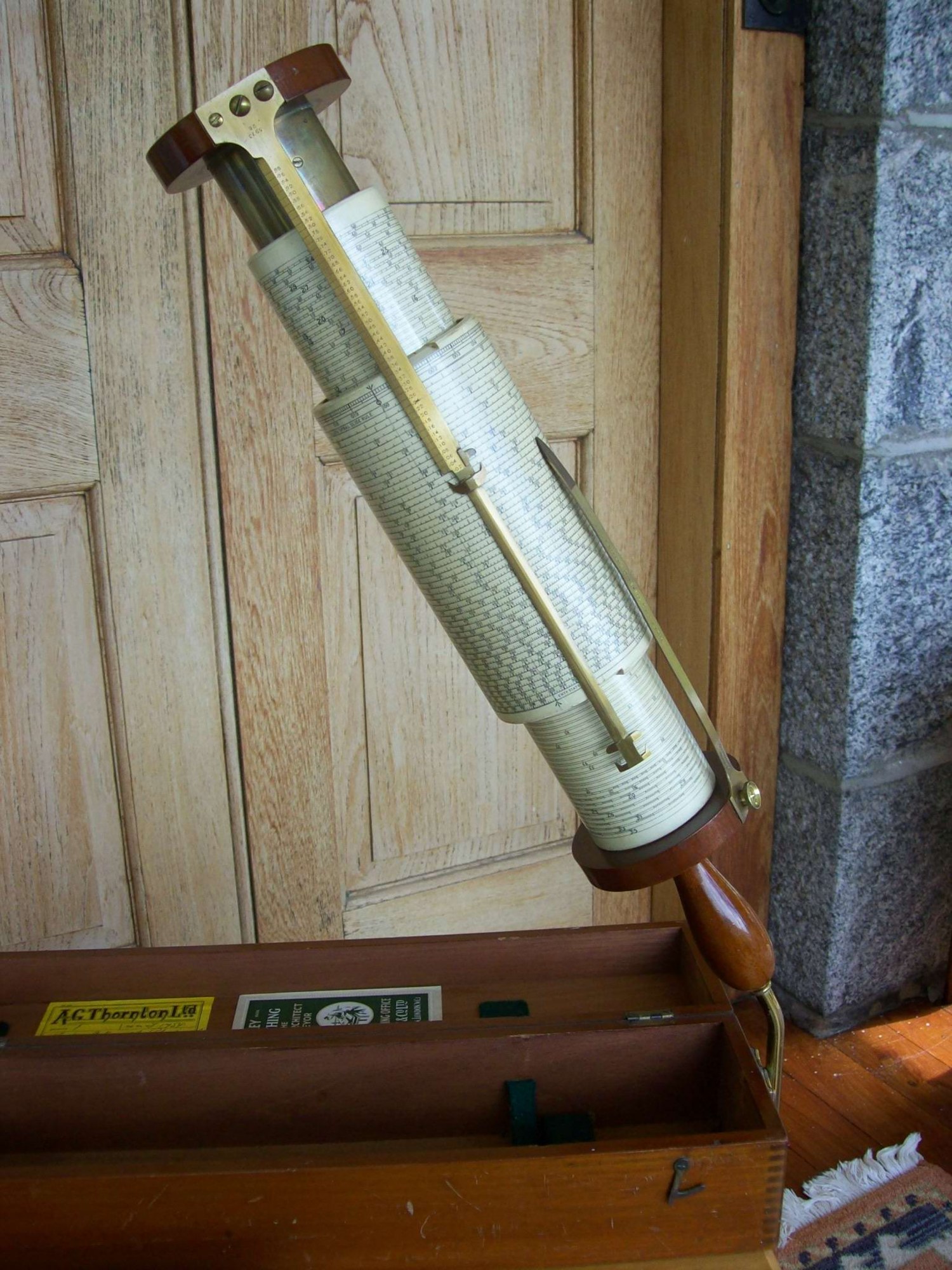
Figure 1 — A Fuller in working position: handle at the bottom, the scale cylinder slid part way up the inner cylinder, and the brass index bar, with its cap and adjusting screws at the top, lying along the scale. Image: File:Fuller’s calculator.jpg by Thincat. License: CC BY-SA 4.0 (https://creativecommons.org/licenses/by-sa/4.0). Via Wikimedia Commons (https://commons.wikimedia.org/wiki/File:Fuller%27s_calculator.jpg).

3.1 About This Volume
This volume is practical. The first half follows Stanley’s own instructions to show how the Fuller is set and read, with worked examples whose answers have all been checked by direct calculation. The second half covers care, written for the Fuller’s particular materials: a shellac-varnished paper scale on papier-mâché, a brass index bar, a mahogany (or Bakelite) handle and a mahogany box. Part names follow Stanley’s booklet — F the fixed index, A and B the movable indexes — as set out in Vol 2.
3.1.1 Depth-Index: The Fuller Unit
Table 1 — Depth-Index: The Fuller Unit
| Vol | Title | Primary Content |
|---|---|---|
| 1 | The Model | George Fuller, Stanley, Models No. 1/2/3, K&E, dating, identifying mine |
| 2 | Anatomy and the Scale | Parts and naming; the index system; graduation; linear log scale; inner-cylinder scales; materials |
| 3 | Using It, and Caring for It (this volume) | Bring and set; multiplication, division, chains, logs and powers, sines; decimal point; adjusting the bar; cleaning and storage |
3.2 Holding It
The Fuller is held by its handle, upright or slanting, with the other hand free to turn and slide the scale cylinder or the index bar; the booklet has the left thumb press the fixed index F down onto the scale when a reading is taken. For long sessions, Stanley’s box doubles as a stand: a support kept in a fitting inside the box fixes to its end and holds the calculator at a working angle, “to save the fatigue of holding the instrument in the hand” (Stanley, Instructions).
3.3 Two Movements: “Bring” and “Set”
Stanley’s whole method rests on the observation that the instrument allows only two movements (Stanley, Instructions):
- Moving the scale cylinder is the multiplying movement. The booklet calls it “bring”: bring a number on the scale to an index.
- Moving the index bar is the dividing movement. The booklet calls it “set”: set index A (or B) to a number on the scale.
Three rules follow:
- A numerator is brought to an index; a denominator has an index set to it.
- The two movements must alternate. Where a factor is missing, 1 is used — in the booklet’s words, 100 or 1 “understood.”
- The first and last movements are always multiplying. The fixed index F is used only for them: the first factor is brought to F, and the answer is read under F.
Why it works: bringing a to F puts F at log a. Setting A to 1 on the scale fixes the bar’s position relative to the scale. Bringing b to A then turns and slides the cylinder by log b relative to the bar, which is fixed in space, so the point under F is now log a + log b. Each “set … bring” pair adds one logarithm; “set to m … bring 1” subtracts log m.
3.3.1 Multiplication and division in tables
Table 2 — Multiplication and division in tables
| To find | Moves |
|---|---|
| a × b | Bring a to F · Set A to 100 · Bring b to A or B · Read at F |
| a × b × c | Bring a to F · Set A to 100 · Bring b to A or B · Set A to 100 · Bring c to A or B · Read at F |
| a ÷ m | Bring a to F · Set A or B to m · Bring 100 to A · Read at F |
| (a × b) ÷ m | Bring a to F · Set A or B to m · Bring b to A or B · Read at F |
(Stanley, Instructions, tables on p. 8.) Index A is used where possible; when it is off the scale, B — exactly one scale-length away — gives the same digits.
3.4 Worked Examples
All results were re-computed; the Fuller reads four figures reliably and five where the scale is open.
3.4.1 Multiplication: 173 × 24
Bring 173 to F. The next move must be dividing, with the understood denominator 1, so set A (or B) to 1 (100) on the scale. Bring 24 (240) to A or B. Read 4152 under F.
Check: 173 × 24 = 4,152.
To go on and multiply by 12 — feet to inches — continue the sequence: set A or B to 1, bring 12 to A or B, and read 49824 under F. Check: 4,152 × 12 = 49,824. The last digit, 4, can be checked mentally from 2 × 2 = 4, a habit the booklet recommends.
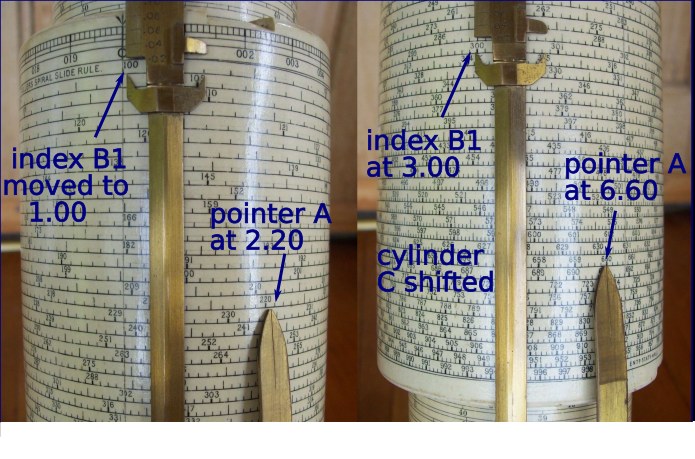
Figure 2 — 2.2 × 3 on a Fuller, in the modern labelling (pointer A = the booklet’s fixed index F; index B1 = movable index A). Left: 2.20 is under the fixed pointer, and the movable index is set to 1.00. Right: the cylinder has been turned and slid until 3.00 is under the movable index; the fixed pointer now reads 6.60. Check: 2.2 × 3 = 6.6. Image: File:Fuller’s calculator multiplication detail.png by Thincat. License: CC BY-SA 4.0 (https://creativecommons.org/licenses/by-sa/4.0). Via Wikimedia Commons (https://commons.wikimedia.org/wiki/File:Fuller%27s_calculator_multiplication_detail.png).

3.4.2 Division: 286 ÷ 24, then ÷ 11
Bring 286 to F. Set A or B to the divisor 24. Complete the sequence by bringing 1 on the scale to A or B. Read 11.917 under F. (The booklet prints 11.916, truncating rather than rounding.)
To divide again by 11, set A or B to 11 and bring 1 to the index: 1.0833 under F.
Check: 286 ÷ 24 = 11.91667; ÷ 11 = 1.08333.
3.4.3 A chain: (25 × 22 × 16) ÷ (11 × 29 × 14)
Bring 25 to F. Set A to 11. Bring 22 to A or B. Set A or B to 29. Bring 16 to A or B. Set A or B to 14. Complete the sequence by bringing 1 to A or B. Read 1.9704 under F — “correct to four places,” as the booklet says.
Check: 8,800 ÷ 4,466 = 1.97044. Six factors took seven movements and no intermediate reading. That is where the Fuller beats both tables and an ordinary slide rule.
3.4.4 A circle’s area to five figures: π × 2.5²
Bring 31416 (π) to F. Set A to 1. Bring 25 to A or B. Set A to 1. Bring 25 to A or B. Read 19635 under F; by estimation (3 × 6 ≈ 18) the answer is 19.635.
Check: 3.1416 × 6.25 = 19.635.
3.4.5 Powers with the logarithm scales: 24.2^2.3
On a Model No. 2, bring 242 to F and read the mantissa under the index L on the inner-cylinder log scale: .3838. Any Fuller can give the same mantissa from the linear scales on the bar and the cylinder rim (Vol 2). The characteristic is 1, so log 24.2 = 1.3838. Multiply by 2.3 on the main scale in the usual way: 3.1828. Set the mantissa .1828 back to L (or to the linear scales) and read the antilogarithm 15233 under F. With a characteristic of 3, the answer is 1523.3.
Check: log₁₀ 24.2 = 1.38382; × 2.3 = 3.18278; 10^3.18278 = 1,523.26. (The booklet reads the mantissa as .3837 and the product as 3.1827, with the same final answer.)
3.4.6 Solving a triangle with the sine scale (Model No. 2)
Given angles A = 75°, C = 24° and side b = 126 yards, the third angle is B = 180° − 99° = 81°, and by the sine rule a = b sin A / sin B. Move the cylinder until the index S marks 81° on the sine scale; set the movable index to 126; move the cylinder until S marks 75°; read a = 123.22 on the movable index. In the same way, with S at 24°, c = 51.888.
Check: 126 × sin 75° ÷ sin 81° = 123.224; 126 × sin 24° ÷ sin 81° = 51.888. (The booklet prints 123.23 for a, a reading one unit high in the fifth figure — a fair picture of five-figure work on a Fuller.)
3.4.7 The Fuller-Bakewell reduction (illustration)
On a Fuller-Bakewell, a tacheometer reading is reduced with the inner-cylinder scales: horizontal distance = 100 × S × cos²α, and height = 100 × S × sin α cos α (anallatic telescope, constant ignored). For a stadia intercept S = 1.25 ft at α = 8°, that is 125 × 0.98063 = 122.58 ft horizontal and 125 × 0.13782 = 17.23 ft of height. The instrument gives each answer from one setting of the angle against the index S or L. The booklet sets out the exact moves and a model field book.
Check: cos² 8° = 0.980631; sin 8° cos 8° = 0.137819.
3.5 Placing the Decimal Point
The Fuller, like every slide rule, gives digits only. The booklet fixes the decimal point using the characteristic of the logarithm: the number of figures before the decimal point minus one. So 4360 has characteristic 3, 4.36 has 0, and 0.436 has −1, with one more minus for each zero after the point. The characteristic of a product is the sum of the factors’ characteristics, of a quotient their difference, with a correction of one according to whether the digits wrapped past the end of the decade. In practice, as Stanley also says, the point “may most frequently be determined merely by inspection”: round each factor to one figure, estimate, and place the point to match — 19635 is 19.635 because π × 2.5² is about 3 × 6.
3.6 Adjusting the Index Bar
The bar must lie exactly parallel to the cylinder’s axis. Otherwise A and B are not a whole scale-length apart along the helix, and every reading taken on B is wrong. Test: set index A to the very beginning of the scale; index B should fall exactly on the last division. Adjust with the three fixings at the top of the bar: a pivot screw (P), a tightening screw (T), and a cam (C), which looks like a screw but is not. Release T, turn C until the bar moves into alignment, and tighten T (Stanley, Instructions). Use a screwdriver that fits the slots exactly, and do not overtighten T into old brass threads. This adjustment, not lubrication, is the usual cure for a Fuller that “reads wrong.”
3.7 Cleaning and Care
A Fuller in its box survives very well; a Fuller cleaned with the wrong product does not. The scale is printed paper finished with shellac varnish on a papier-mâché tube, and that combination rules out the methods suited to celluloid or plastic rules. The procedures below are for an instrument in ordinary, sound condition. For a lifting, cracked or flaking scale, stop and consult a conservator.
3.7.1 What never to use on a Fuller
- No alcohol of any kind — methylated spirit, isopropyl alcohol, surgical spirit, hand sanitiser, alcohol wipes. Shellac dissolves in alcohol. Even a quick wipe softens the varnish, smears it and can lift the printing beneath.
- No other solvents — acetone, thinners, “goo remover,” WD-40, ammonia-based glass cleaners.
- No water beyond a barely damp cloth. Water blooms shellac white, cockles the paper and can soften papier-mâché.
- No abrasives, polishes or cream cleansers on the scale. They cut through the varnish to the printing.
- No metal polish on the index bar near the scale. Polishes such as Brasso contain ammonia and abrasive, and the residue migrates onto the paper.
3.7.2 The varnished scale
Dust the scale with a soft brush, following the helix. Light surface grime and old fingerprints can usually be lifted with a soft cloth barely dampened with distilled water with a trace of mild neutral soap, worked on a small area at a time and dried at once. Test first on the last turn of the scale or on the inner-cylinder tables, which are less important, and stop if the cloth picks up colour. The amber tone of old shellac and the yellowing of the paper are part of the instrument and cannot safely be “brightened.” Scratches, worn patches and lifting edges of the paper are conservation problems. Do not revarnish over them, and do not glue them with modern adhesives.
Handle the scale cylinder as little as possible, and with clean, dry hands or nitrile gloves. Skin oils sink into worn shellac and darken it. Turn and slide it by its end rims where possible.
3.7.3 The sliding fit
The scale cylinder should slide and turn on the inner cylinder smoothly and without shake, and the central tube should move freely inside it. Papier-mâché takes up moisture, so a Fuller kept somewhere damp can swell and bind, and one moved suddenly from cold to warm can stick for a while. If it binds:
- Do not force it and do not twist the cylinder against resistance. Papier-mâché tubes split, and the scale paper tears at the seam.
- Let the instrument stand closed in its box in a dry, normally heated room for some days, and try again.
- Clean the bearing surfaces: wipe the exposed inner cylinder and the inside rim of the scale cylinder with a soft dry cloth to remove grit and old, gummed lubricant.
- Avoid oils. Oil soaks into papier-mâché and paper and leaves permanent dark stains. If a dry fit still drags, restorers sometimes use a very light film of microcrystalline wax on the bearing faces, buffed off, kept clear of any printed surface. Treat this as a last resort.
3.7.4 Brass index bar and pointers
The brass carries engraved index lines and the stamped serial number and year (Vol 1), which are the instrument’s identity. Wipe it with a soft cloth. If it is lacquered, leave the lacquer alone. If it is bare and dull, accept the patina, or clean it with the bar removed from the scale area — protected by a card mask if it cannot be removed — using the gentlest non-ammoniated cleaner and very little rubbing over the stamps. Never polish the engraved index tips, whose sharpness sets the accuracy of every reading. Keep the adjusting screws (P, T) and the cam (C) dry and free of polish.
3.7.5 The handle and end caps
Mahogany handles and caps were finished with French polish or varnish, both usually shellac-based, so the alcohol prohibition applies to them too. Clean with a barely damp cloth and dry them. A thin coat of a good paste wax or microcrystalline wax, buffed, protects them and gives a soft sheen. Bakelite handles (after about 1945) are tougher: a damp cloth, then a dry buff. Bakelite’s dull brown surface layer is original and should not be polished off with abrasives.
3.7.6 The mahogany box
The box is part of the instrument: it is the case, the stand and, often, the home of the instruction booklet and dealer’s label (Vol 1, Figure 1). Look after it as fine furniture:
- Clean with a soft cloth, slightly damp at most. No alcohol — its finish is very likely French polish. Wax sparingly with a paste furniture wax if the finish is dry.
- Hinges and catch: keep the screws snug. A drop of light oil on a cotton bud may be applied to a stiff brass hinge pin and wiped dry, with no oil on the wood.
- Labels and trade cards inside the lid are historical evidence. Do not clean, re-glue or remove them; store the box so that they stay dry.
- Keep the stand fitting and any felt pads in place. A missing stand is the commonest loss.
- If the lid has warped or the joints have opened, leave repair to a furniture restorer using hide glue, not modern PVA or epoxy.
3.7.7 Storage
Store the calculator in its box, closed and lying flat, in a room with stable, moderate humidity (roughly 40–55 per cent relative humidity) and temperature, out of direct sunlight. Sunlight yellows paper and fades ink; damp swells papier-mâché and blooms shellac; dry heat, as on a radiator shelf, shrinks wood and cracks varnish. Keep any instruction booklet in an acid-free folder in the box or alongside it. The c. 1948 Stanley booklet is preserved in this site’s Reference Library, so the original never needs to be handled to be read.
Sources
- W. F. Stanley & Co. Ltd, Instructions for the Use of the Fuller Calculator (c. 1948). Scan: University of Queensland Physics Museum (https://physicsmuseum.uq.edu.au/sites/default/files/Instructions%201948.pdf). Bring/set method and tables, every booklet example quoted above, decimal-point method, adjustment of the index bar, the box as a stand, Model No. 2 log and sine examples, the Fuller-Bakewell formulae. In this site’s Reference Library.
- Fuller calculator, Wikipedia (https://en.wikipedia.org/wiki/Fuller_calculator). Shellac-varnished paper on papier-mâché, multiplication in the pointer A/B1 convention.
- Canadian Conservation Institute, CCI Notes on the care of wooden objects, shellac finishes and paper (https://www.canada.ca/en/conservation-institute.html). Shellac’s solubility in alcohol and sensitivity to water; humidity and light; reversible repairs.
- The Oughtred Society and the International Slide Rule Museum (https://www.oughtred.org/; https://www.sliderulemuseum.com/). General collector guidance on gentle cleaning and against solvents on scales.
Every worked result was re-computed: 173 × 24 = 4,152 and × 12 = 49,824; 286 ÷ 24 = 11.9167 and ÷ 11 = 1.0833; (25 × 22 × 16) ÷ (11 × 29 × 14) = 8,800 ÷ 4,466 = 1.97044; 2.2 × 3 = 6.6; 3.1416 × 2.5² = 19.635; log₁₀ 24.2 = 1.38382, × 2.3 = 3.18278, antilog = 1,523.26; 126 sin 75° / sin 81° = 123.224 and 126 sin 24° / sin 81° = 51.888; 125 cos² 8° = 122.58 and 125 sin 8° cos 8° = 17.23.
Comments (0)