Fuller Cylindrical Calculator · Volume 1
Fuller's Calculator — Volume 1 — The Model
Professor Fuller's 41-foot slide rule, Stanley's ninety-five-year production run, and how to identify an example
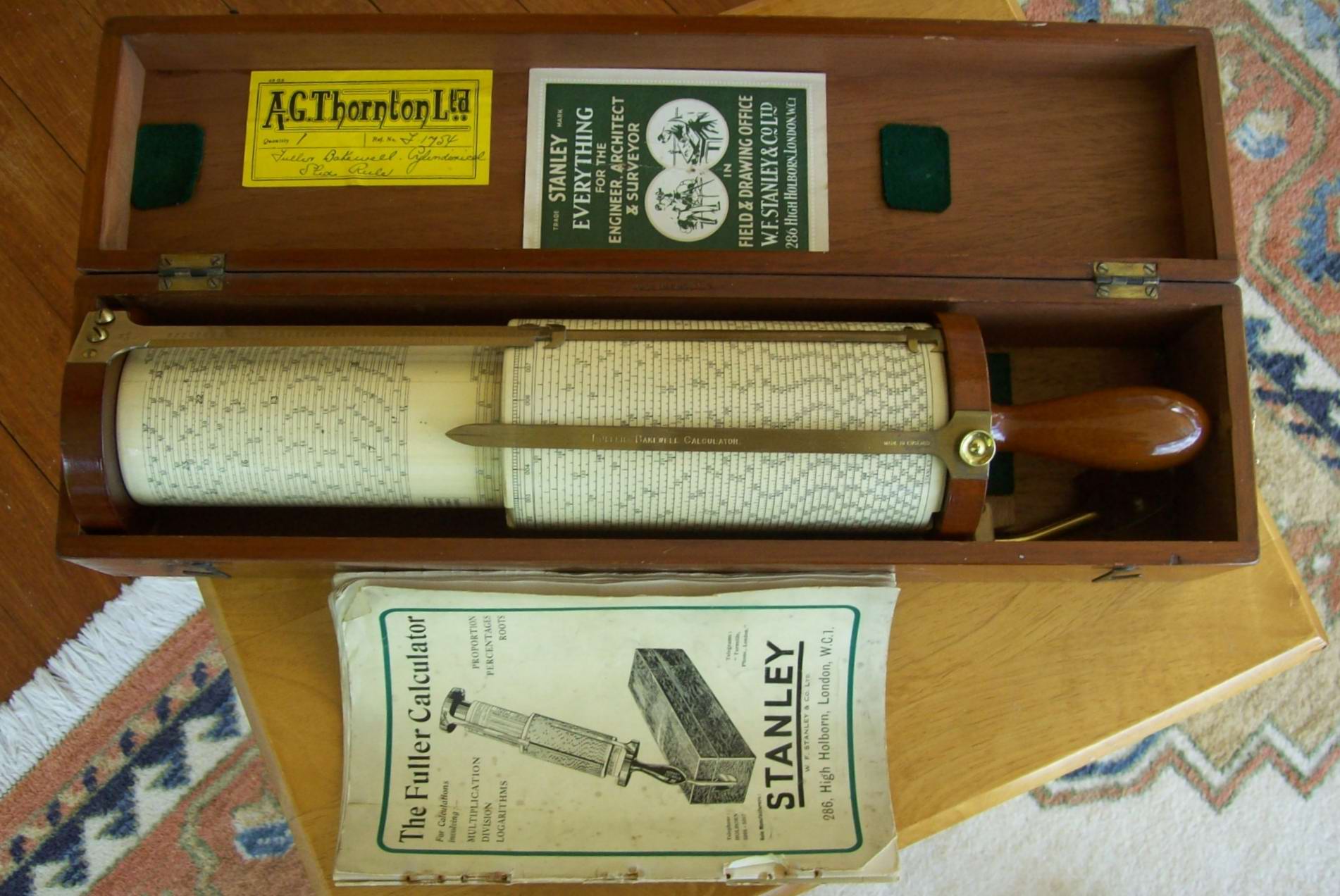
Figure 1 — A Fuller calculator in its mahogany box: the varnished paper scale cylinder, the brass index bar engraved “Fuller-Bakewell Calculator,” the turned mahogany handle, a Stanley trade card from 286 High Holborn and a dealer’s label in the lid, and the Stanley instruction booklet below. Box, booklet and labels are all evidence when identifying an example. Image: “Fuller’s calculator in case” by Thincat. License: CC BY-SA 4.0 (https://creativecommons.org/licenses/by-sa/4.0). Via Wikimedia Commons (https://commons.wikimedia.org/wiki/File:Fuller%27s_calculator_in_case.jpg).

1.1 About This Volume
The Fuller calculator is the longest slide rule most people will ever handle: a single logarithmic scale 500 inches — 41 feet 8 inches, about 12.7 metres — long, wound fifty times round a cylinder you can hold in two hands. It reads to four significant figures every time and often to five. W. F. Stanley & Co. of London made it, in essentially the same form, from 1878 until 1973, longer than almost any other calculating instrument.
This volume covers the Fuller as a model family: its inventor, its maker, the variants Stanley sold, its American distribution by Keuffel & Esser, and the markings by which any one example can be identified and dated. I own a Stanley-made Fuller, but I have not yet photographed it or read its markings, so this volume describes the family in general and ends with a checklist of what will identify mine. Vol 2 covers the anatomy and scales; Vol 3 covers operation and care. The general case for cylindrical rules — why a longer scale buys figures — is in Using a Slide Rule Vol 5 and The Story of the Slide Rule Vol 4, and is not repeated here.
1.1.1 Depth-Index: The Fuller Unit
Table 1 — Depth-Index: The Fuller Unit
| Vol | Title | Primary Content |
|---|---|---|
| 1 | The Model (this volume) | George Fuller, the 1878 patent, W. F. Stanley & Co., Models No. 1, No. 2 and No. 3 (Fuller-Bakewell) and the rarer variants, K&E’s 1742/4015, prices, dating by the pointer stamp, identifying mine |
| 2 | Anatomy and the Scale | The scale cylinder, inner cylinder and handle; the fixed and movable indexes; the 50-turn helix and its graduation; the linear log scale; the inner-cylinder scales of each model; materials and how they changed |
| 3 | Using It, and Caring for It | The “bring” and “set” sequence; multiplication, division, chains, logs and powers, all checked; the decimal point; adjusting the index bar; cleaning, the varnished paper scale, wood, brass and the mahogany box |
Note — Cross-references to other units appear as “Using a Slide Rule Vol 5.” Within this unit they appear as “see Vol N.”
1.2 George Fuller and His Patent
George Fuller (1829–1907) was an Irish civil engineer, a Member of the Institution of Civil Engineers, and Professor of Engineering at Queen’s College, Belfast — now Queen’s University. Engineering and surveying computation in the 1870s meant logarithm tables, four- or five-figure work done by look-up and addition. An ordinary slide rule was much faster but gave only three figures. Fuller set out to build an instrument with the speed of a slide rule and the precision of tables.
His solution was a single logarithmic scale wound as a helix round a cylinder, read against index pointers spaced exactly one full scale-length apart along the cylinder’s axis. He patented it in Britain in 1878 (patent no. 1044 of that year) and in the United States on 2 September 1879 (US Patent 219,246, “Improvement in Calculators”), and described it in Nature in 1879 (Wikipedia, Fuller calculator; Science Museum Group).
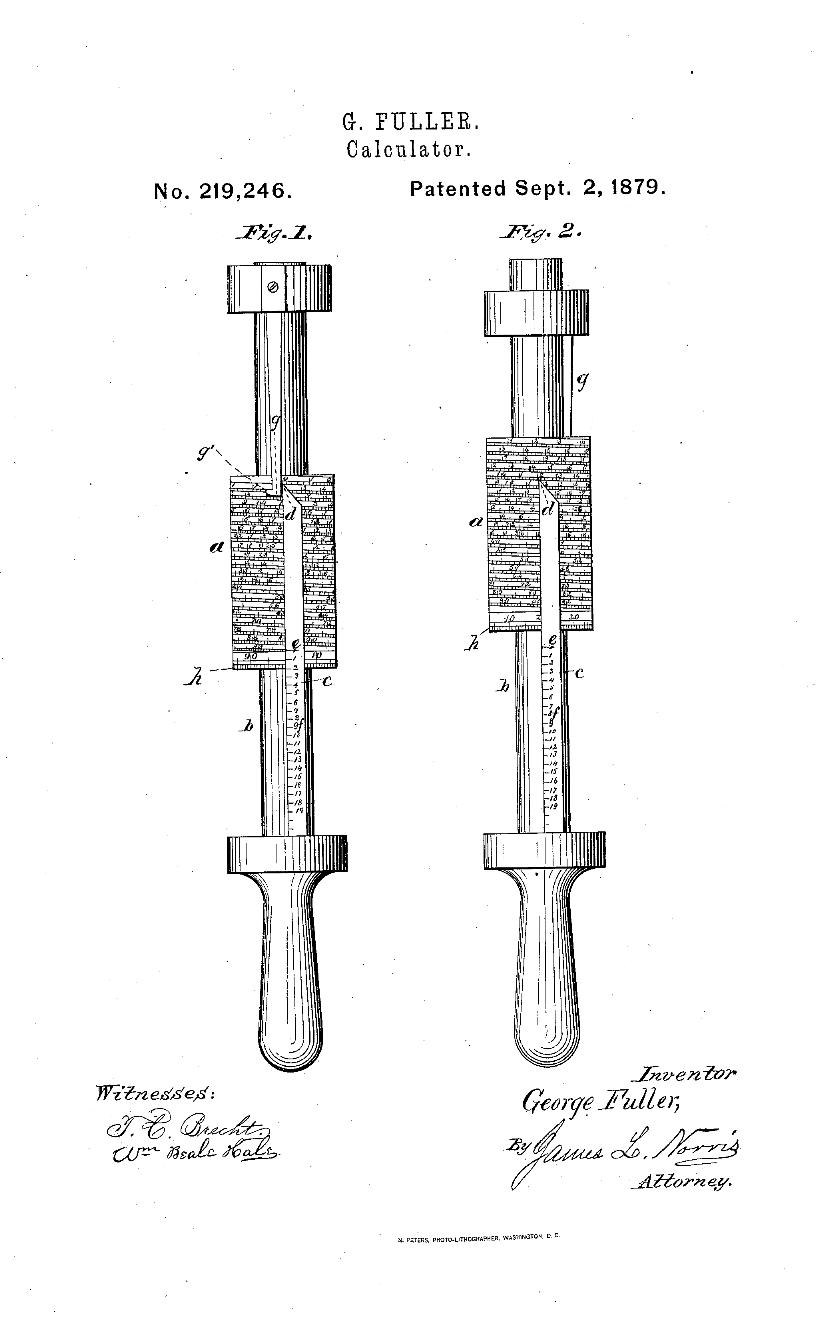
Figure 2 — Fuller’s US patent of 2 September 1879, No. 219,246. Already in place: the scale cylinder that slides and turns on an inner tube, the handle, and the long index bar lying along the cylinder. The production instrument changed remarkably little over the following ninety-five years. Image: File:George Fuller calculator US patent, 1879.jpg, by George Fuller (1829–1907). License: Public domain. Via Wikimedia Commons (https://commons.wikimedia.org/wiki/File:George_Fuller_calculator_US_patent,_1879.jpg).

The idea of putting a long scale on a cylinder was not new; Fuller’s contribution was the indexing. A helix fifty turns long is useless if the user cannot tell which turn a reading is on. Fuller placed a fixed index on the handle and a movable bar carrying indexes one scale-length apart. Whatever the setting, one of the two movable indexes always lies on the scale, so no reading falls off the end and no turn has to be counted. Vol 2 explains the geometry.
1.3 W. F. Stanley & Co.
The instrument was manufactured by W. F. Stanley & Co. Ltd of London, the leading British maker of drawing, surveying and mathematical instruments, from 1878 until production ended in 1973. Stanley made fewer than 14,000 in all. Numbered production ran at about 180 a year around 1900 and declined after the mid-1950s (Wikipedia; Smithsonian). Instruments made after 1973 stayed in Stanley’s stock and catalogue for some years; the 1976 British list still priced the Model 1 at £60 and the Model 2 at £61.25.
Stanley’s addresses help date boxes, trade cards and instruction booklets. Earlier material gives 286 High Holborn, London W.C.1 (the trade card in Figure 1). The c. 1948 instruction booklet gives the head office and works at New Eltham, London S.E.9, with showrooms at 13 Railway Approach, London S.E.1, and in Glasgow (Stanley, Instructions, c. 1948).
1.3.1 In America: Keuffel & Esser
In the United States the Fuller was sold by Keuffel & Esser of New York, under K&E’s own catalogue numbers 1742 and later 4015. K&E catalogues between 1895 and 1927 show the price rising from $28 to $42, and K&E sold only the standard Model 1. K&E also published an English-language edition of Fuller’s instructions (McCoy, K&E 4015). In 1968 a standard Fuller still cost about $50 in the US.
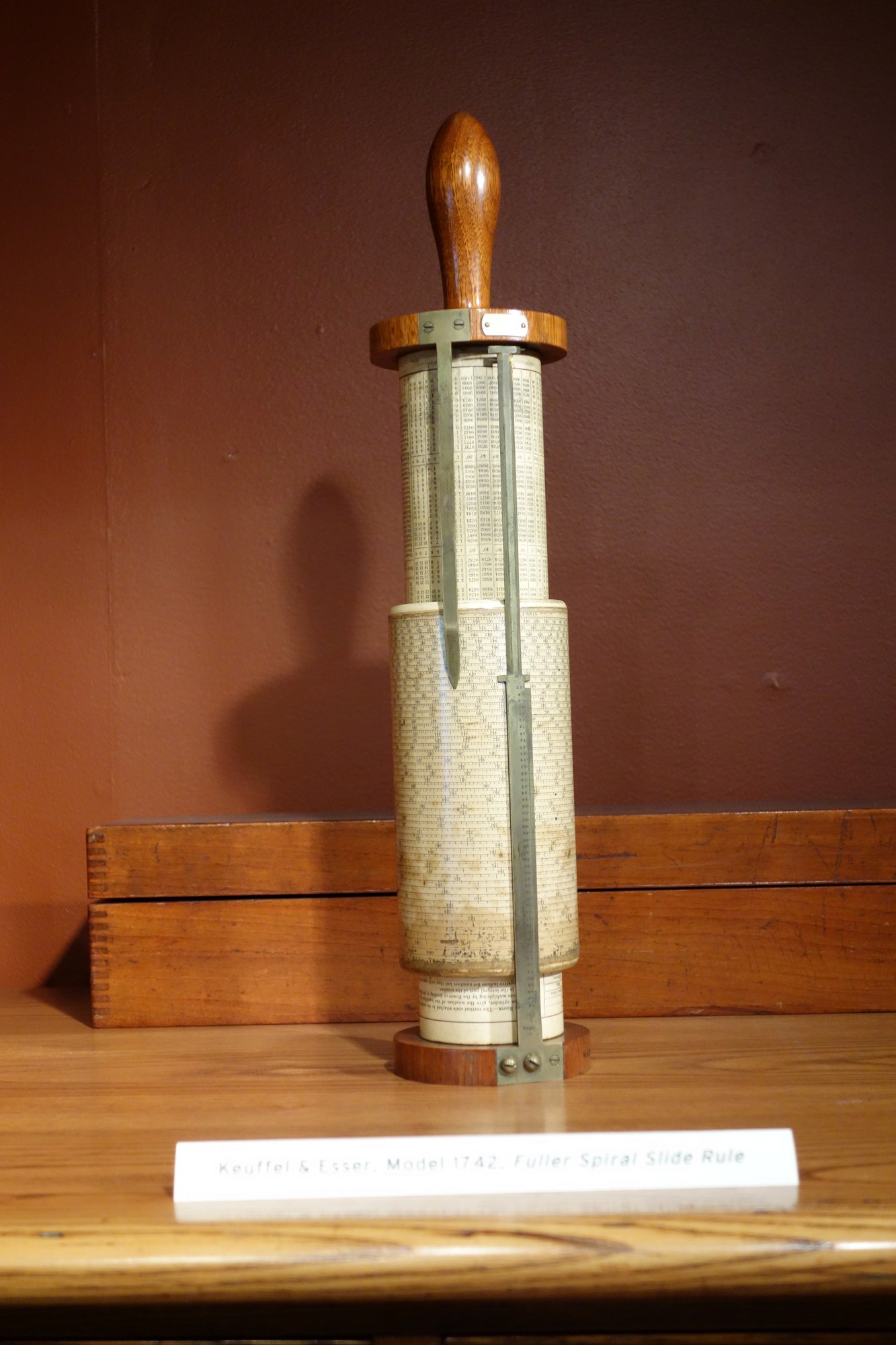
Figure 3 — A Fuller sold by Keuffel & Esser as its Model 1742, in the MIT slide-rule collection. Apart from the dealer’s catalogue number it is the Stanley instrument. Image: “Keuffel & Esser Model 1742, Fuller Spiral Slide Rule - MIT Slide Rule Collection - DSC03575” by Daderot. License: CC0 (http://creativecommons.org/publicdomain/zero/1.0/deed.en). Via Wikimedia Commons (https://commons.wikimedia.org/wiki/File:Keuffel_%26_Esser_Model_1742,_Fuller_Spiral_Slide_Rule_-_MIT_Slide_Rule_Collection_-_DSC03575.JPG).

1.4 The Models
All Fullers share the same scale cylinder, 500-inch helix and index system. The models differ in what is printed on the inner cylinder — the fixed tube on which the scale cylinder slides, exposed as the scale cylinder moves (Stanley, Instructions; Wikipedia):
Table 2 — All Fullers share the same scale cylinder, 500-inch helix and index system. The models differ in what is printed on the inner cylinder — the fixed tube on which the scale cylinder slides, exposed as the scale cylinder moves (Stanley, Instructions; Wikipedia)
| Model | Inner cylinder carries | Intended for | Price, UK 1900 |
|---|---|---|---|
| No. 1 (the standard Fuller) | A table of useful data: weights of metals, strengths of timber, conversion factors, decimals of a foot, hundredweight and pound | Multiplication, division, proportion, percentages — general engineering and commercial work | £3 |
| No. 2 | A scale of logarithms to four decimal places and a scale of sines from 5° 45′ to 88°, both spiral (the sine scale about 32 ft long) | As No. 1, plus logarithms, powers and the solution of triangles — engineers and surveyors | — |
| No. 3, the Fuller-Bakewell | Logarithmic scales of cos²α and sin α · cos α, separated by a zero mark | Tacheometric (stadia) surveying: reducing staff readings to horizontal distance and height | £4 10s |
The Fuller-Bakewell owes its scales to W. N. Bakewell, M.I.C.E. A surveyor using a tacheometer reads a stadia intercept S and a vertical angle α. The horizontal distance is then 100S cos²α (plus a small instrument constant), and the height difference is the inclined distance × sin α cos α. With the angle scales on the inner cylinder, each reduction becomes a single setting (Stanley, Instructions). The instrument in Figure 1 is a Fuller-Bakewell; its index bar is engraved with the name.
Stanley also made, in small numbers:
- A smaller Fuller with a 200-inch (5.1 m) scale, sold only briefly; very few survive.
- Barnard’s Coordinate Calculator, a related cylindrical instrument with multiple indexes on its pointers, listed from Stanley’s 1912 catalogue until 1958.
- The Whythe-Fuller, introduced in 1962 for complex-number work, converting between Cartesian and polar coordinates.
(Wikipedia, Fuller calculator.)
1.4.1 How the construction changed
The external form hardly changed in ninety-five years, but the materials did, and these are useful for dating (Wikipedia):
- The cylinders are papier-mâché, covered with printed paper and finished with shellac varnish.
- The index pointers and the central tube were brass. The tube had a mahogany cap.
- About 1935 the brass tube gave way to phenolic resin (a Bakelite-type plastic).
- About 1945 the mahogany handle and caps were replaced by Bakelite.
- The case was always a hinged mahogany box, about 46 × 12 × 11 cm, and it doubles as a stand: a support stored inside the box fixes to its end, so the calculator can be worked without holding it (Stanley, Instructions).
1.5 Dating an Example
For all but the earliest instruments, Stanley stamped the serial number and the last two digits of the year of manufacture at the top of the movable index bar (Wikipedia). Published examples show the pattern:
Table 3 — For all but the earliest instruments, Stanley stamped the serial number and the last two digits of the year of manufacture at the top of the movable index bar (Wikipedia). Published examples show the pattern
| Stamped | Reads as | Source |
|---|---|---|
| 633 | serial 633, before 1885 (unstamped year; dated by sale records) | dealer listings |
| 936 | serial 936; catalogued 1893–94 | Harvard Collection of Historical Scientific Instruments |
| 1135/98 | serial 1135, made 1898 | Institution of Civil Engineers Museum, Scotland, 2025/014 |
| 2449 1907 | serial 2449, made 1907 | university physics-museum record |
Once the year stamp is read, the date needs no further work. The materials (brass or phenolic tube, mahogany or Bakelite handle), the Stanley address on the box or booklet, and any K&E marking provide cross-checks.
1.6 My Fuller
I own a Fuller cylindrical calculator made by Stanley. I have not yet photographed it, and its exact model is not yet identified.
The following photographs and readings will identify it:
- The top of the movable index bar, close up and in raking light. The stamped serial number and two-digit year dates the instrument outright.
- Any engraving along the index bar — “Fuller Calculator,” “Fuller-Bakewell Calculator,” a Stanley name or a K&E name and number (1742 or 4015).
- The inner cylinder, with the scale cylinder pushed fully toward the handle so that as much of the inner tube as possible shows. A table of data means Model No. 1; a logarithm scale and a sine scale mean No. 2; cos² and sin·cos scales either side of a zero mark mean No. 3, the Fuller-Bakewell.
- The handle and end caps: turned mahogany (before about 1945) or moulded Bakelite (later).
- The central tube where it shows at the top: brass with a mahogany cap (before about 1935) or phenolic (later).
- The scale’s overall length, end cap to end cap. The standard instrument is about 43–44 cm long. A noticeably smaller instrument could be the rare 200-inch model.
- The box, inside and out: the Stanley address on any label or trade card (286 High Holborn or New Eltham), any dealer’s label — retailers such as A. G. Thornton of Manchester stuck their own labels in the lid, with their own stock references, which should not be confused with a model number — and whether the stand fitting is still present.
- Any instruction booklet in the box, with its cover, model number and address. The c. 1948 Stanley edition is preserved in this site’s Reference Library.
- The scale surface in good light, to record its condition before any cleaning (Vol 3).
Sources
- W. F. Stanley & Co. Ltd, Instructions for the Use of the Fuller Calculator (Models No. 1, No. 2 and Fuller-Bakewell; New Eltham, London S.E.9; c. 1948). Scan: University of Queensland Physics Museum (https://physicsmuseum.uq.edu.au/sites/default/files/Instructions%201948.pdf). Models, inner-cylinder scales, Bakewell’s tacheometry formulae, the box as a stand, Stanley addresses. In this site’s Reference Library.
- Fuller calculator, Wikipedia (https://en.wikipedia.org/wiki/Fuller_calculator). George Fuller’s dates and patents, production 1878–1973 and numbers, Model 1 construction and materials changes (c. 1935, c. 1945), year-and-serial stamp, prices, the small model, Barnard’s and Whythe-Fuller instruments.
- McCoy, M., K&E 4015 Fuller’s Calculator manual and catalogue pages (http://www.mccoys-kecatalogs.com/KEManuals/4015/4015.htm; https://www.mccoys-kecatalogs.com/KEModels/ke4015family.htm). K&E sale of the Fuller and its instructions.
- Smithsonian National Museum of American History, Fuller’s Spiral Slide Rule records (https://americanhistory.si.edu/collections/search/object/nmah_694148). Production of about 14,000.
- Institution of Civil Engineers Museum, Scotland (Heriot-Watt), item 2025/014, “The Fuller Calculator,” maker’s number 1135/98 (https://ice-museum-scotland.hw.ac.uk/item/2025-014/).
- University of Queensland Physics Museum, Fuller’s Cylindrical Slide Rule (Fuller Calculator) (https://physicsmuseum.uq.edu.au/fullers-cylindrical-slide-rule-fuller-calculator).
- Science Museum Group, George Fuller (https://collection.sciencemuseumgroup.org.uk/people/cp148283/george-fuller).
- US Patent 219,246, G. Fuller, “Improvement in Calculators,” 2 September 1879 (https://patents.google.com/patent/US219246A/en).
Dates for the material changes (c. 1935, c. 1945) and the production figures come from secondary sources and are approximate. The serial-and-year stamp is the reliable dating evidence on any individual instrument.
Comments (0)