Fowler Circular Calculators · Volume 3
Fowler's Circular Calculators — Volume 3 — Using It, and Caring for It
The datum-and-cursor method with checked examples, and how to keep a hand-built pocket instrument dry, clean and turning
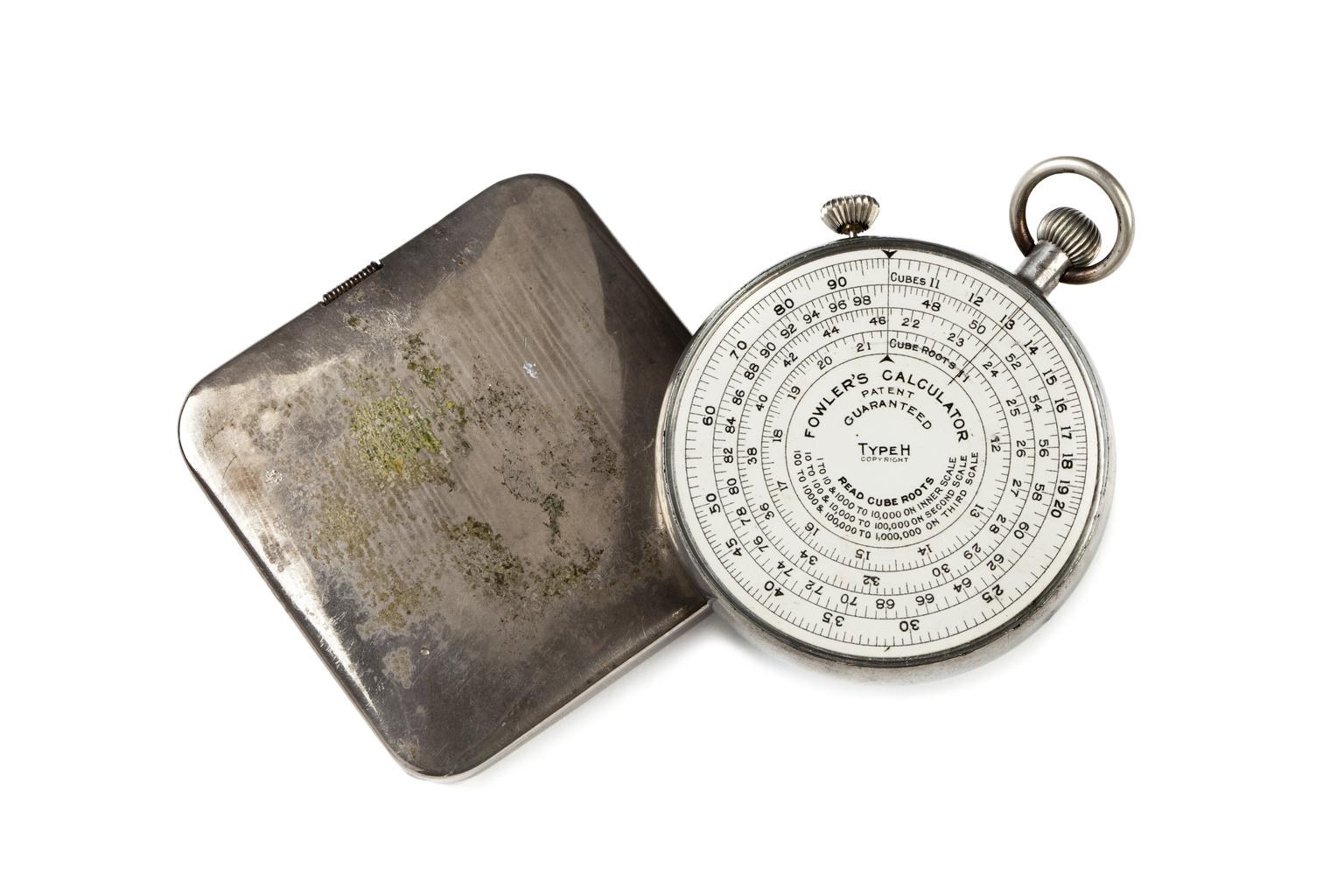
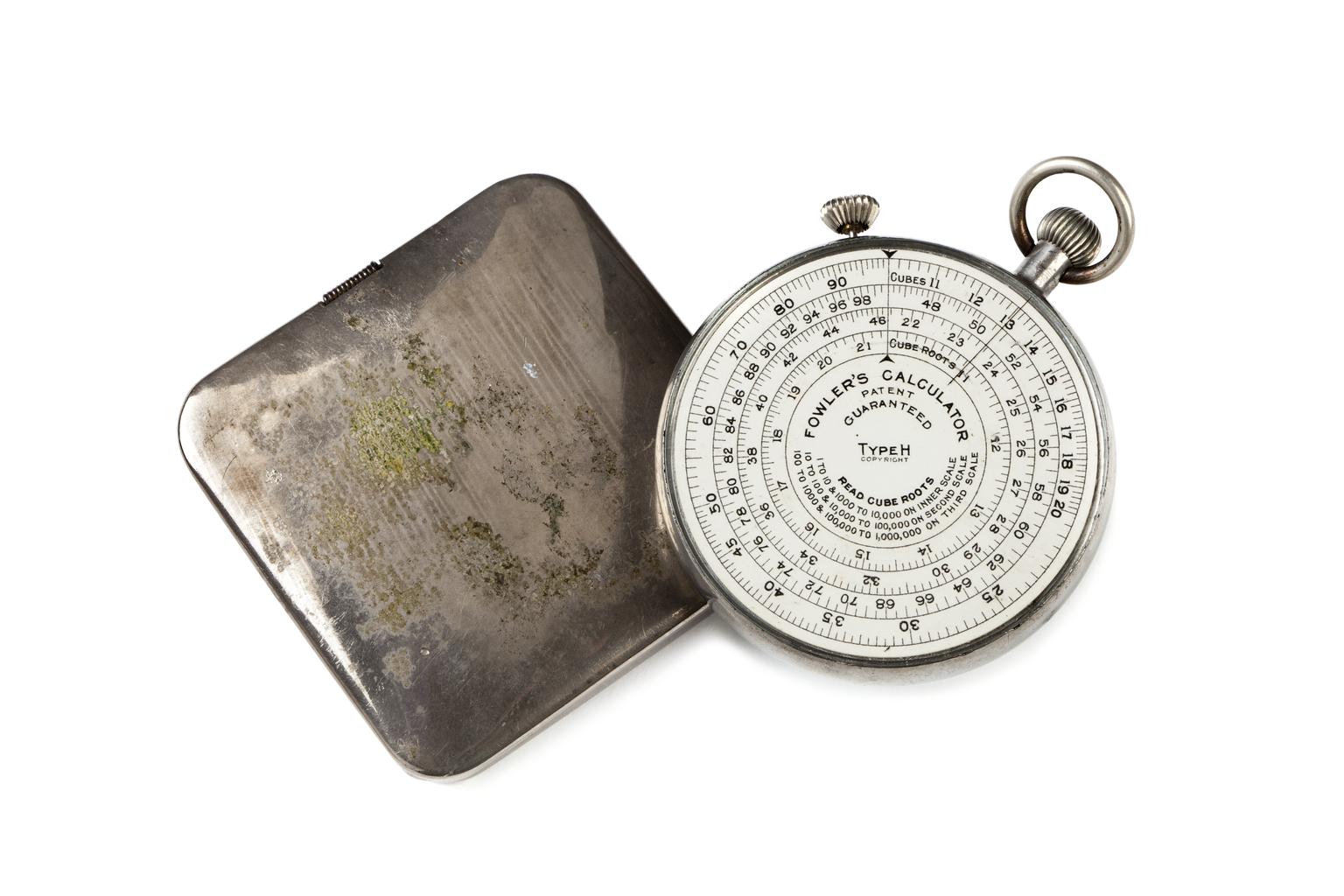
Figure 1 — A 2½-inch Fowler’s Calculator, Type H, beside its nickelled tin. A Fowler’s enemies are damp, grit and well-meant polishing; the tin and the leather case were its defence. Image: Fowler & Co., “Fowler’s Calculator,” Science Museum Group Collection, © The Board of Trustees of the Science Museum, CC BY-NC-SA 4.0, https://coimages.sciencemuseumgroup.org.uk/643/750/large_smg00249731__0002_.jpg.
3.1 About This Volume
Vol 2 named the parts: a dial turned by the top nut, a fixed Datum line, and a Cursor swung by the side nut. This volume puts them to work. The first half is Fowler’s own method, taken from the firm’s instruction leaflets, worked through for multiplication, chains, division, constant factors, roots and trigonometry, with every number checked by calculation. The second half is care: what the nickel or chrome case, the glass crystals, the knurled knobs, the printed dials, the plastic cursor and the leather case each need — and, as important, what must not be done to them.
Everything here applies to any Fowler. Where a step differs between models — the Long Scale’s two faces, the Twelve-Ten’s twelfths — it says so. The general reading of circular scales, and why a circle never runs off its end, is in Using a Slide Rule Vol 5.
3.1.1 Depth-Index: The Fowler Unit
Table 1 — Depth-Index: The Fowler Unit
| Vol | Title | Primary Content |
|---|---|---|
| 1 | The Family | W. H. and Harold Fowler, the Scientific Publishing Company, the patents, the models by size and trade, dating features, identifying mine |
| 2 | Anatomy and the Scales | Case, crystals, crown and side-winder, datum line and cursor, the dials of the Long Scale, Universal, Twelve-Ten and Magnums, scale lengths and real accuracy |
| 3 | Using It, and Caring for It (this volume) | The datum-and-cursor method; multiplication, chains, division, roots and trig, all checked; cleaning the case, glass and dials; damp, storage and repair cautions |
3.2 The Method
3.2.1 The three moves
Fowler’s leaflets reduce every calculation to the same three moves, with the top nut called X and the side nut Y (Fowler’s (Calculators) Ltd, 1956):
- Set a number under the Datum — turn the dial with X.
- Set the Cursor to a number — swing it with Y. The dial does not move.
- Turn the dial with X until a number comes under the Cursor, and read the answer under the Datum.
Why it works: a number x sits on the dial at an angle proportional to log x. Move 1 turns the dial by log a. Move 2 fixes the cursor at a known angle from the datum. Move 3 turns the dial by exactly enough that the angle between datum and cursor is preserved while a new number is brought to the cursor — which adds (or subtracts) a second logarithm. The cursor plays the part of the slide on a straight rule; the datum plays the part of the D scale’s reading point. Because the dial is a closed circle, nothing ever runs off the end.
3.2.2 Multiplication
Fowler’s rule for a × b (Fowler’s (Calculators) Ltd, 1956):
Set a under Datum by top nut X. Set Cursor at 1·0 by side nut Y. Set dial by nut X till b is under Cursor. Read a × b under Datum.
Worked example — 2.34 × 3.17 on a Long Scale.
On the short scale first. Set 2.34 under the Datum; swing the Cursor to the index 1; turn the dial until 3.17 is under the Cursor; under the Datum read about 7.42. The short scale is only 6.7 inches round, so the third figure is an estimate.
Then on the long scale. Repeat the same three moves on the six inner circles. The short-scale result says the answer is about 7.4, and the long scale’s sixth circle runs from 6.813 to 10, so the answer is read on the sixth circle: 7.418.
Decimal point. Estimate: 2 × 3 = 6, 2.5 × 3 = 7.5, so the answer is about 7. It is 7.418.
Check: 2.34 × 3.17 = 7.4178; log 2.34 + log 3.17 = 0.36922 + 0.50106 = 0.87028 = log 7.4178.
This is the right way to use any Fowler with a long scale, and Fowler said so: the short scale is “convenient for finding an approximate result to determine the precise circle of the ‘Long-scale’ on which to read the very accurate result” (1956). Each circle of a six-circle long scale holds one-sixth of the decade, so the same angular setting appears on all six circles; only an estimate of the answer says which one to read.
3.2.3 Chained multiplication
For a × b × c, there is no need to read the intermediate product (Fowler’s (Calculators) Ltd, 1956):
Set Cursor again at 1·0 by nut Y. Set dial by nut X till c is under Cursor. Read a × b × c under Datum.
Worked example — 2.34 × 3.17 × 1.25. After the first product (7.418 under the Datum), swing the Cursor back to 1·0, turn the dial until 1.25 is under the Cursor, and read 9.27 under the Datum (short scale 9.27, long-scale sixth circle 9.272). Check: 7.4178 × 1.25 = 9.2723.
3.2.4 Division, and “times then divide”
For a ÷ m (Fowler’s (Calculators) Ltd, 1956):
Set a under Datum by nut X. Set Cursor to m by nut Y. Set dial by nut X till 1·0 is under Cursor. Read a/m under Datum.
Worked example — 87.5 ÷ 3.2. Set 875 under the Datum, swing the Cursor to 32, turn the dial until 1 is under the Cursor, read 2734 under the Datum. Estimate: 90 ÷ 3 = 30, so the answer is 27.34. Check: 87.5 ÷ 3.2 = 27.34375.
For (a × b) ÷ m the leaflet saves a move: set a under the Datum, the Cursor to m, then turn the dial till b is under the Cursor and read the answer under the Datum.
Worked example — 12.5 × 4.8 ÷ 3.6. Set 125 under the Datum; Cursor to 36; turn the dial until 48 is under the Cursor; read 1667 under the Datum. Estimate: 12 × 5 ÷ 4 = 15, so 16.67. Check: 12.5 × 4.8 = 60; 60 ÷ 3.6 = 16.667.
3.2.5 A constant factor
The angle between Datum and Cursor is a number, and it stays set while the dial turns. That makes a Fowler excellent for applying one factor to a column of values — prices, conversions, scale drawings.
Worked example — inches to millimetres (× 25.4). Set 1 under the Datum and swing the Cursor to 254. Now, for each value, turn the dial to bring it under the Datum and read the result under the Cursor:
- 3.75 in → read 9525 → 95.25 mm (check: 3.75 × 25.4 = 95.25);
- 7.5 in → read 1905 → 190.5 mm (check: 7.5 × 25.4 = 190.5).
Reversing the roles — value under the Cursor, answer under the Datum — divides by the factor instead.
3.2.6 Square roots (Long Scale back dial)
Set the number on scale 1 of the back dial under the Datum and read its root on scale 4, the square-root scale that runs twice round. Fowler’s rule chooses the turn: if the number has an odd number of digits (before the decimal point), read the inner circle of the square-root scale; if even, the outer (Fowler’s (Calculators) Ltd, 1956).
- √30 — two digits, even, so the outer circle: 5.477. Check: 5.4772² = 30.000.
- √300 — three digits, odd, so the inner circle: digits 1732, so 17.32. Check: 17.32² = 299.98.
On the Magnum the two turns of the square-root scale sit side by side as an outer and inner ring, and the same digit rule applies (Purcell, 2011).
3.2.7 Trigonometry (Long Scale back dial)
The log sine and log tangent scales are read against scale 1 through the Datum. Angles from 5°45′ to 90° give sines from 0.1 to 1; the small-angle scale from 35′ to 5°45′ gives sines from 0.01 to 0.1.
- sin 30° — set 30° on scale 5 under the Datum; read 5 on scale 1, so 0.5. Check: sin 30° = 0.5.
- tan 20° — set 20° on scale 6; read 364, so 0.364. Check: tan 20° = 0.36397.
- sin 2° — set 2° on scale 7; read 349, and because this scale covers 0.01 to 0.1, 0.0349. Check: sin 2° = 0.034899.
Because the Datum runs across all the circles at once, the trig scales combine directly with multiplication: setting an angle under the Datum is setting its sine on scale 1, ready for the Cursor.
3.2.8 The Twelve-Ten’s feet and inches
The Twelve-Ten was built for one recurring job: multiplying dimensions in feet and inches without first converting them. Worked example — a floor 7 ft 9 in by 11 ft 3 in. In decimals, 7 ft 9 in = 7.75 ft and 11 ft 3 in = 11.25 ft, and 7.75 × 11.25 = 87.1875 sq ft, which is 87 sq ft and 27 sq in. The Twelve-Ten’s two “Twelfths” scales let 7′ 9″ and 11′ 3″ be set as they stand, with the result read on the decimal “Tenths” scale or back in twelfths. The detailed procedure fills much of its 99-page booklet (Blankenhorn and De Cesaris, 2002); no copy of that booklet was found online for this unit.
3.2.9 Good habits
- Approach every setting from the same direction. The friction in a Fowler’s wheels is designed to stop creep, but a little backlash remains; coming up to the mark always clockwise (or always anticlockwise) makes it repeatable.
- Sight straight down the Datum. The reading lines sit above the dial; looking at an angle shifts the reading by parallax, which on a 2½-inch dial can be a whole graduation.
- Find the circle on the short scale first on any long-scale model, then read the long scale.
- Read the outer circles in preference to the inner when a choice exists: they are longer, so their graduations are wider.
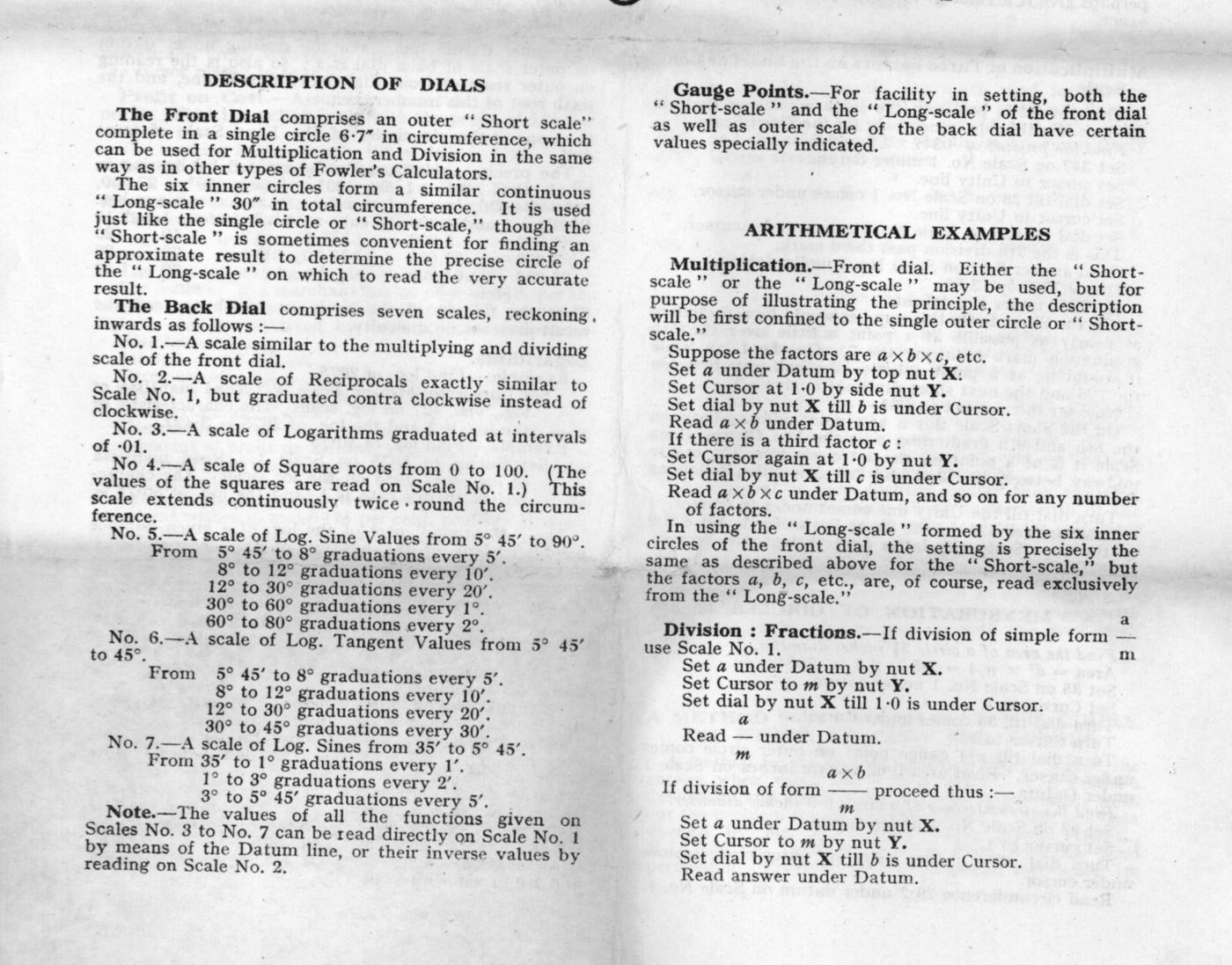
Figure 2 — Fowler’s own words: the inside pages of the 1956 leaflet for the Long Scale Vest Pocket Calculator, describing the dials and the datum-and-cursor method used throughout this volume. Image: Fowler’s (Calculators) Ltd, List 33V (1956), scan from the International Slide Rule Museum, manual M437, https://sliderulemuseum.com/PocketWatch.shtml.
3.3 Caring for a Fowler
A Fowler is a small, hand-assembled mechanism with a printed face behind glass. Almost every survivor that has been ruined was ruined in one of three ways: damp got in, grit got in, or someone polished or oiled it. The procedures below are written for an instrument in ordinary used condition. They are deliberately conservative: nearly everything on a Fowler can be made worse in a minute and cannot be put back.
3.3.1 Before anything else: look
Before cleaning, examine the instrument under a good light and a magnifier, and photograph both faces. Note:
- whether each crystal is tight in its bezel, or loose, cracked or missing;
- whether the dial shows foxing, water stains, flaking or lifting at the edge;
- whether the knobs turn smoothly and the dial and cursor actually follow them, or slip;
- whether the case has rust (on steel), plating loss, or cracks (early cast cases);
- the serial number and any marks, before any cleaning can blur them.
3.3.2 The case: nickel, chrome and steel
- Dust and fingerprints: a dry microfibre cloth. For grime, a cloth barely damp with water and a trace of mild soap, followed at once by a dry cloth. Water must never reach the crystal edge, the knob stems or the seam between case halves — that is the way in to the dial.
- Tarnish on nickel: a dry cloth first; if more is needed, a jeweller’s (rouge-impregnated) cloth used sparingly on the smooth back and rim only. Nickel plating on the pressed-steel cases is thin and wears through to the base metal at the edges and on the knurling. Do not use liquid or paste metal polish (Brasso and the like): it is abrasive, it lodges in the knurling and the case seams, and residue migrates under the bezel onto the crystal and dial.
- The late chromed cast cases need only a dry or damp-then-dry cloth; chrome does not tarnish, and polishing it achieves nothing but scratches.
- Rust spots on steel parts: do not wire-brush or sand. Wipe the spot with a cloth carrying a trace of light machine oil, leave a minute, wipe off completely. Any oil left on the outside will creep.
- The early cast (“sintered”) cases are brittle. Never prise, flex or clamp them; they crack.
- Never re-plate. Stripping and re-plating destroys the markings, the serial number and the instrument’s originality.
3.3.3 The crystals
- Clean the outside of the glass with a dry microfibre cloth; for a smear, breathe on it and wipe. If something stronger is needed, put a little isopropyl alcohol on the cloth, never on the glass, and keep it clear of the bezel edge so nothing wicks inside.
- Do not open the case to clean the inside of the crystal unless there is a real problem — dust on the dial, a loose glass, condensation. Opening a two-part case means parting the friction-fit halves evenly; anything forced, or done with a screwdriver in the seam, chews the knurled edges.
- A cracked or missing crystal should be replaced, not left: a watch-crystal maker can cut and fit a glass to the bezel. That is reversible and protects the dial; leaving the dial exposed is not.
3.3.4 The knobs and the mechanism
- Do not oil a Fowler. The firmness of the knobs is a designed friction (Vol 2) that holds the dial and cursor where they are set. Oil defeats it, and worse, it creeps along the axle onto the printed dial and stains it permanently.
- A knob that is stiff should be worked gently back and forth, a little at a time, never forced. A knob that spins without moving the dial or cursor has lost its friction or its drive; that is a workshop repair, not something to be cured by tightening.
- The axle is unscrewed with a pin spanner in its two holes. Fowler offered a spanner for the purpose; pliers or a screwdriver will mar the axle, which on many examples carries the serial number. Dismantling the works is for a competent watch or instrument repairer — or someone prepared to practise on a scrap example first.
3.3.5 The dials
The printed dial is the most fragile and least restorable part of the instrument.
- Never wet a dial, and never apply any solvent to it — not water, not alcohol, not cleaning fluid. Printed scales on paper or card dissolve, bleed or cockle; foxing spreads with moisture.
- If the case has been opened, loose dust can be lifted with a rubber bulb blower or a very soft, clean brush, without touching the printed face.
- Foxing, toning and water stains cannot be safely removed. Leave them. They are part of the instrument’s history, and every attempt to “clean” a dial makes it worse.
- Do not replace an original dial with a reproduction print unless the original is beyond use; if that is ever done, keep the original.
3.3.6 The cursor
Fowler cursors were fine metal pointers on early instruments and thin clear plastic strips or sheets on later ones. Clean a plastic cursor, if at all, with a dry soft brush. Keep alcohol, acetone and all other solvents away from it: old cellulose plastics craze, cloud or dissolve, and the black hairline is printed and wipes off.
3.3.7 Backs and cases
- Bakelite and Rexene backs: a cloth barely damp with water, dried at once. No solvents and no polish on Rexene (leathercloth); it cracks and the coating lifts.
- Leather cases: brush out grit, which otherwise scratches the crystal every time the calculator goes in. A leather case that has become dry can take a small amount of leather dressing on the outside, allowed to dry fully before the calculator goes back in. Powdery, crumbling leather (“red rot”) should not be dressed; it needs consolidating or simply leaving.
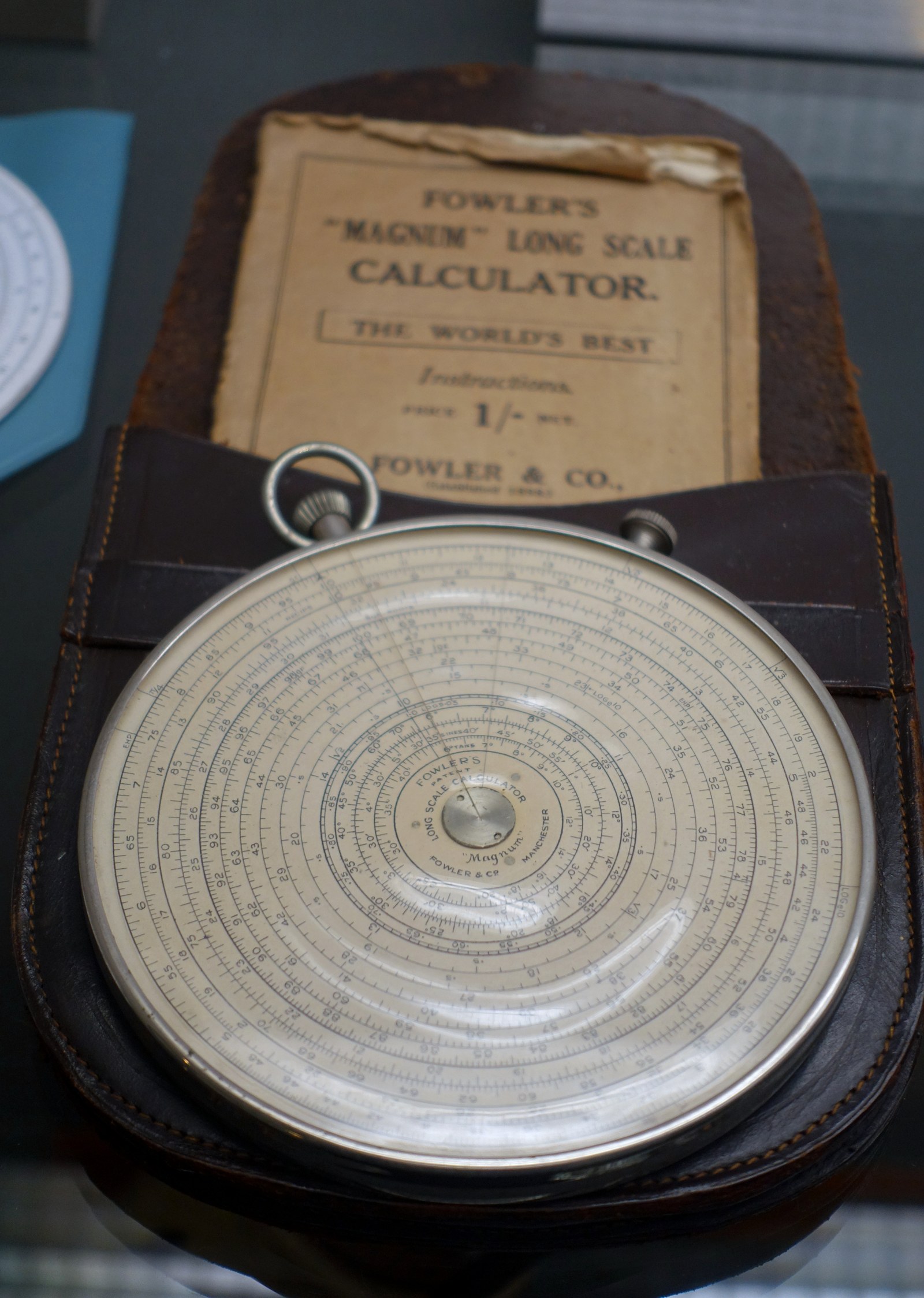
Figure 3 — A Magnum Long Scale in its fitted leather case, with its original paper sleeve. A dry, grit-free case is the best protection a Fowler has; a damp one is the worst. Image: “Fowler’s Magnum Long Scale Calculator — Ridai Museum of Modern Science, Tokyo” by Daderot, CC0, via Wikimedia Commons, https://commons.wikimedia.org/wiki/File:Fowler%27s_Magnum_Long_Scale_Calculator_-_Ridai_Museum_of_Modern_Science,_Tokyo_-_DSC07485.JPG.

- Faux-leather cases of the late period tend to split and shed; they protect only from scratches.
- Nickelled tins with velvet linings: the velvet holds dust and damp. Air the tin, brush the velvet gently, and check the hinge rather than forcing it.
- Instruction leaflets and booklets go in an acid-free folder, stored flat, alongside the instrument — not folded up inside the case, where they absorb damp and transfer acid to the leather.
3.3.8 Damp: the main enemy
Moisture is what turns a sound Fowler into a ruined one. It rusts the steel case and the internal parts, fogs the inside of the crystal, foxes the printed dial and lets mould grow in leather cases and velvet linings. The steps are simple:
- Store it dry, at ordinary room temperature and moderate humidity (roughly 40–55% relative humidity) — not in a cellar, a garage, an outside wall cupboard or an attic.
- Avoid sudden temperature changes. Bringing a cold calculator into a warm room condenses moisture inside the case; let it warm up slowly in its case before opening it out.
- A sachet of silica gel in the drawer or box where it is kept (not inside the calculator) is cheap insurance; dry or replace the gel when it changes colour.
- Do not seal it in a plastic bag with whatever damp it already holds.
- If it has been damp already — condensation inside, a musty case — let it dry slowly in a warm, dry room with the case open, out of sunlight. Do not apply heat.
3.3.9 What not to do
- Do not immerse it, rinse it, or put it in an ultrasonic cleaner.
- Do not oil the knobs, axle or works.
- Do not use metal polish, wire wool or abrasives on the case.
- Do not put any liquid on the dial or the cursor.
- Do not prise open an early cast case, or force the halves of a pressed-steel one.
- Do not attack the axle with pliers or a screwdriver.
- Do not re-plate, repaint or re-print anything original.
- Do not leave it in a damp drawer, a cold car or a sunny window.
Sources
- Fowler’s (Calculators) Ltd. Instructions for the Use of Fowler’s Vest Pocket Calculator, List 33V (Sale, 1956) — the X/Y nuts, Datum and Cursor, the multiplication, division and square-root rules, quoted above. ISRM manual M437 (filed in the Library). In this site’s Reference Library.
- Fowler, William H. Fowler’s “Universal” Calculator: Instructions (Fowler & Co., Sale, c. 1938–42). ISRM manual M392 (filed in the Library). In this site’s Reference Library.
- Hopp, Peter M. A Fowler’s Gallimaufry, 2nd ed. (UK Slide Rule Circle, 2021) — case construction, the Fowler spanner, rust and repairs, cases and tins. https://sliderulemuseum.com/Papers/Gallimaufry_ByPeterMHopp_UKSRC.pdf. In this site’s Reference Library.
- Purcell, Bryan. “The Fascinating Tale of the Fowler Magnum Pocket Slide Rule.” Journal of the Oughtred Society 20:1 (2011). https://osgalleries.org/journal/pdf_files/20.1/V20.1P19.pdf. In this site’s Reference Library.
- Blankenhorn, Richard, and Robert De Cesaris. “The Fowler Calculators — a Catalogue Raisonné.” Journal of the Oughtred Society 11:2 (2002). https://osgalleries.org/journal/pdf_files/11.2/V11.2P3.pdf. In this site’s Reference Library.
- Every worked example was checked by direct calculation: 2.34 × 3.17 = 7.4178; × 1.25 = 9.2723; 87.5 ÷ 3.2 = 27.34375; 12.5 × 4.8 ÷ 3.6 = 16.667; 3.75 × 25.4 = 95.25; 7.5 × 25.4 = 190.5; √30 = 5.4772; √300 = 17.3205; sin 30° = 0.5; tan 20° = 0.36397; sin 2° = 0.034899; 7.75 × 11.25 = 87.1875.
- Care guidance follows general conservation practice for plated metal, glass, printed paper, early plastics and leather, applied to the Fowler’s construction as described by Hopp.
Comments (0)