Fowler Circular Calculators · Volume 2
Fowler's Circular Calculators — Volume 2 — Anatomy and the Scales
Case, crystals, crowns, the datum line and the cursor, and what every circle on the dial is for
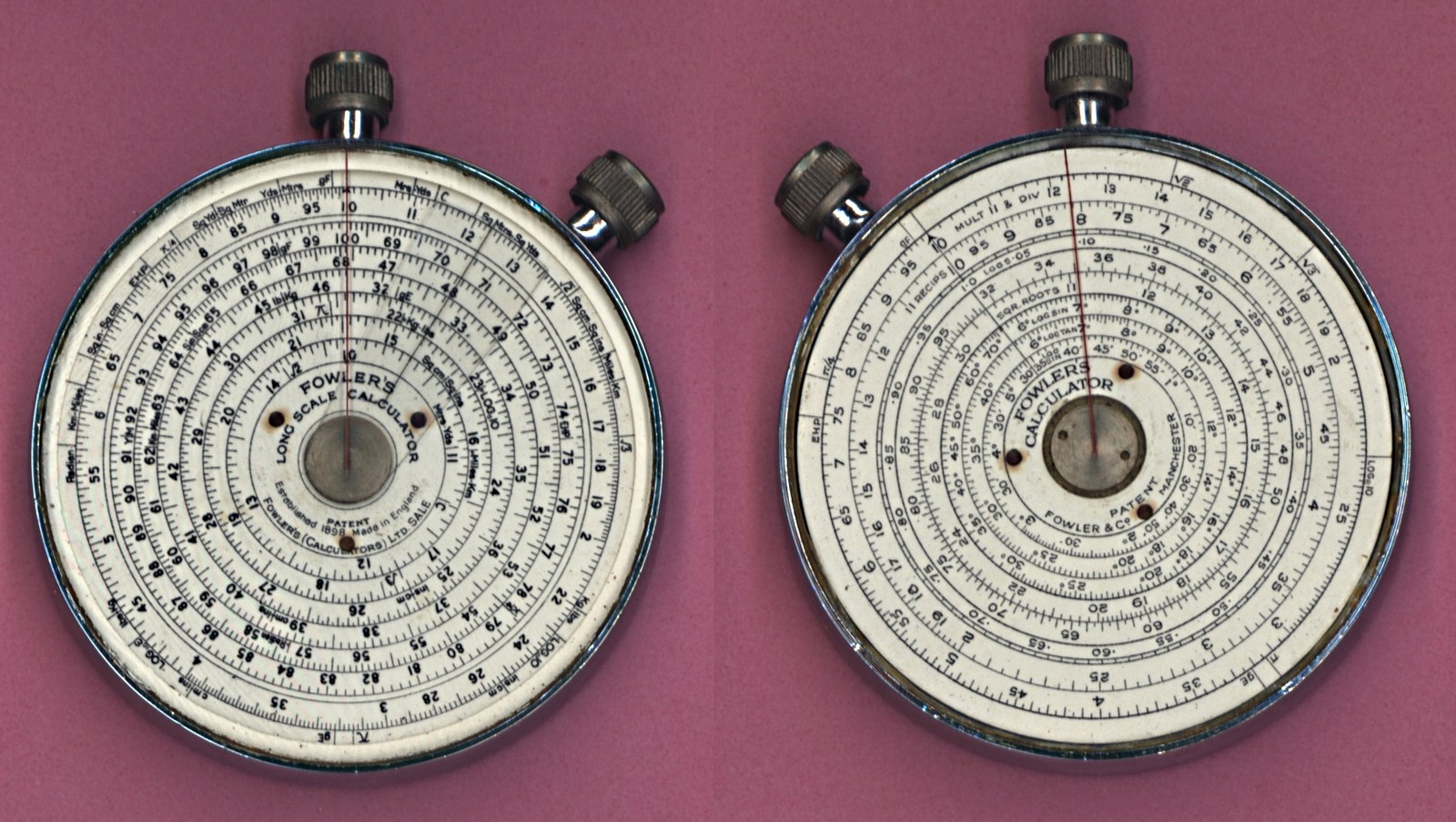
Figure 1 — Both faces of a Long Scale Vest Pocket Calculator, c. 1956, in the late smooth “chromed” case with two knobs and no loop. Front (left): the outer short scale and the six-circle long scale. Back (right): the general scales. A thin red datum line runs from the top crown to the centre of each dial; the black hairline is the cursor. Note “Fowler’s (Calculators) Ltd, Sale” on the front and the older “Fowler & Co., Manchester” on the back. Image: International Slide Rule Museum, ISRM 21.12.09.01, https://sliderulemuseum.com/PocketWatch.shtml.
2.1 About This Volume
Vol 1 laid out the Fowler family and how to tell its members apart. This volume opens the case. A Fowler differs from an ordinary circular slide rule in one fundamental way, and nearly everything about its anatomy follows from it: the scales turn, and the reading lines stay put. There is no fixed scale to set against a moving one. Instead there is a fixed reference line printed on the crystal, a second line that can be swung round independently, and a dial that is turned under both. The sections below take the parts in order — case and works, crystals, controls, the two reading lines, the dials — then go scale by scale through the commonest models and finish with what the long scales really buy in accuracy. How to operate the instrument, and how to look after it, is Vol 3.
2.1.1 Depth-Index: The Fowler Unit
Table 1 — Depth-Index: The Fowler Unit
| Vol | Title | Primary Content |
|---|---|---|
| 1 | The Family | W. H. and Harold Fowler, the Scientific Publishing Company, the patents, the models by size and trade, dating features, identifying mine |
| 2 | Anatomy and the Scales (this volume) | Case, crystals, crown and side-winder, datum line and cursor, the dials of the Long Scale, Universal, Twelve-Ten and Magnums, scale lengths and real accuracy |
| 3 | Using It, and Caring for It | The datum-and-cursor method; multiplication, chains, division, roots and trig, all checked; cleaning the case, glass and dials; damp, storage and repair cautions |
2.2 The Case and the Works
2.2.1 Three kinds of case
Fowler built the body three ways over its life (Hopp, 2021):
- The early cast case. The first Fowlers were assembled in a one-piece case of cast — collectors say “sintered” — aluminium alloy. It is distinctive, dull rather than bright, and brittle; the crystals are set so that the case is hard to open without damage. Some early examples carry hand-written serial numbers and repair notes in ink on the inside, put there by William or Harold Fowler.
- The two-part pressed-steel case. From the 1920s the works went into a pressed-steel case in two halves, usually with a knurled (serrated) edge on both halves that grips by friction. It comes apart easily, so mechanisms could be serviced and crystals replaced. Most Fowlers seen today are of this kind, nickel-plated.
- The late “chromed” cast case. From about 1948 Fowler went back to a cast case, now smooth and bright, with the crystal inset and the back held by three screws — often a Rexene-covered (leathercloth) back on the single-sided models, sometimes chromed steel.
Single-sided models had their own backs: plain steel, or for a period a moulded Bakelite back lettered with the Fowler name, the same moulding used across the Type B Textile, the Twelve-Ten and the Universal (Hopp, 2021).
2.2.2 The spider and the shafts
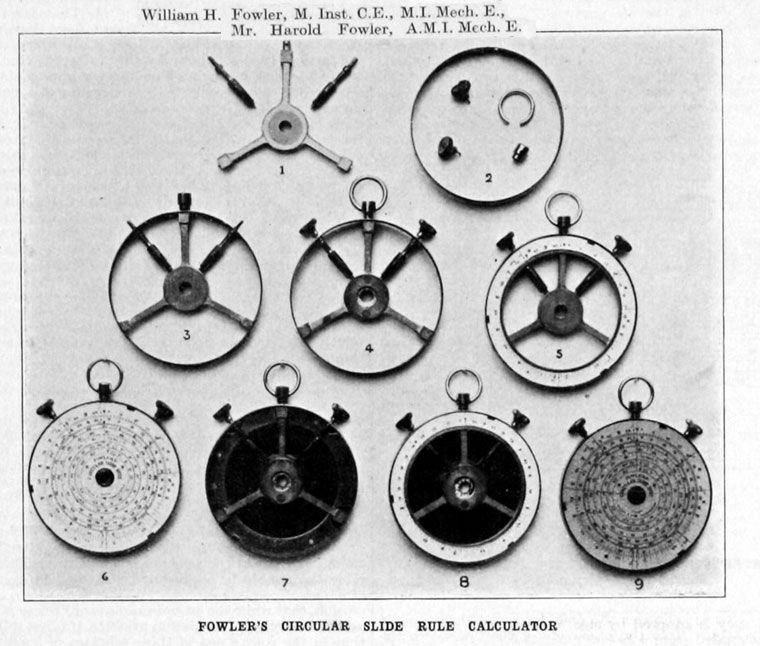
Figure 2 — “Fowler’s Circular Slide Rule Calculator,” the parts laid out for an advertisement of 1926: (1) the three-armed spider carrying the radial shafts; (2) the case ring and small fittings; (3–5) the frame built up with its stems, side-winders and central loop; (6–9) dials and finished faces. This is the construction of the 1924 patent. Image: from The Engineer vol. 142, p. 206 (20 August 1926), via the International Slide Rule Museum, https://sliderulemuseum.com/PocketWatch.shtml.
Inside, the mechanism is closer to a watch than to a slide rule. A central axle carries the dial wheels. A spider — a three-armed frame — locates the axle in the case and carries short radial shafts that run out through the rim to the knobs; each shaft drives its wheel by friction or gearing, and the 1924 patent was specifically about giving each wheel a “definite and controllable amount of frictional resistance” so that dial and cursor stay where they are set (Hopp, 2021). The earlier patents of 1914 dealt with backlash — the slight slop that lets a setting creep — and several anti-backlash arrangements are visible inside surviving examples.
Two things follow for the owner. The axle is screwed in place, with two small holes for a pin spanner; Fowler offered a special spanner for it, and the slots are easily chewed by a screwdriver or pliers. And the “feel” of the knobs — firm, smooth, no creep — is a designed friction, not dirt; it should not be “freed” with oil (Vol 3).
2.2.3 The crystals
Each dial sits behind a domed or flat glass crystal, held in the bezel like a watch glass. On the pressed-steel cases the crystal can be removed when the case halves are parted; on the early cast cases it is effectively sealed. The fixed datum line (below) lies between crystal and dial and does not move with either knob; exactly how it is carried varies between patterns, and any example being opened should be looked at closely before anything is lifted out. A loose or cracked crystal is the commonest serious fault, because it lets in the dust and damp that spoil the dials.
2.2.4 The controls
Fowler’s controls changed with the patents, and they are among the best dating features (Vol 1):
- Early: a milled knob in the centre of the back turned the front pointer, and the crown at the top turned the dial (the 1910 patent).
- From the 1924 patent: a central loop with two side-winders — one each side of the loop — on short radial stems.
- Most Long Scales of the 1930s and 1940s: a crown in the loop at twelve o’clock plus a single side key at about two o’clock.
- From about 1948: two knurled keys and no loop.
On every pattern the rule is the same, and Fowler’s own leaflets say it plainly: the top nut (they call it X) turns the dial; the side nut (Y) turns the cursor (Fowler’s (Calculators) Ltd, 1956). Purcell describes the Magnum identically: the screw over the red line rotates the scale; the screw at two o’clock rotates the black cursor (Purcell, 2011).
2.2.5 The two reading lines: datum and cursor
- The Datum is a fixed radial line running from the top crown to the centre of the dial — a fine red line on most Fowlers, a “bulls-eye” pointer on some early ones. It never moves. Every answer in Fowler’s instructions is “read under Datum.”
- The Cursor is a black hairline that can be swung round the dial by the side knob, independently of the dial. Early Fowlers used a fine metal pointer; later ones a clear plastic strip or sheet printed with a black line, sometimes with a small finger-tab.
The angle between the Datum and the Cursor is what stores a number while the dial is turned — the circular equivalent of setting the slide on a straight rule. Vol 3 shows exactly how.
On the double-sided Long Scale, the front and back dials are synchronised: they turn together under the crown, so a value set under the datum on one face stands under the datum on the other. Fowler’s 1956 leaflet points out that this, with the six-circle long scale, allows readings to be carried between the faces.
2.3 The Dials
Fowler’s dials are printed, not engraved: the scales were drawn on steel dies — a 1929 photograph shows the cutting head of the dividing machine that marked them out — and printed onto the dial faces (Hopp, 2021). The cream or white ground of most surviving dials has darkened to ivory or tan, and many show foxing and spotting, the typical ageing of printed paper or card. Whatever the exact facing on a given example, the printed face is the most vulnerable part of the instrument and is treated as such in Vol 3.
2.3.1 The Long Scale Calculator (2½ inches, double-sided)
Fowler’s 1956 leaflet for the Long Scale Vest Pocket Calculator describes the dials exactly (Fowler’s (Calculators) Ltd, 1956):
Front dial
- The “Short-scale” — the outer circle, a single decade complete in one circle 6.7 inches in circumference. It is used for multiplication and division like the C and D scales of a straight rule, and above all for finding roughly where an answer lies.
- The “Long-scale” — the six inner circles, forming one continuous scale 30 inches long. It is used exactly like the short scale but gives about one more figure. The six circles divide the decade at 10^(1/6) ≈ 1.468, 10^(2/6) ≈ 2.154, 10^(3/6) ≈ 3.162, 10^(4/6) ≈ 4.642 and 10^(5/6) ≈ 6.813; a short-scale reading tells which circle to read.
- Gauge points — marks for frequently used constants and conversions on the short scale, long scale and back outer scale.
Back dial, reckoning inwards:
- A scale like the front short scale (the multiplying scale).
- Reciprocals — the same scale graduated anticlockwise (a CI scale).
- Logarithms, graduated at intervals of 0.01 (an L scale).
- Square roots, running twice round the circle (the square is read on scale 1).
- Log sines from 5°45′ to 90° — every 5′ from 5°45′ to 8°, every 10′ to 12°, every 20′ to 30°, every 1° to 60°, every 2° to 80°.
- Log tangents from 5°45′ to 45°, graduated similarly.
- Log sines of small angles from 35′ to 5°45′.
All the functions on scales 3 to 7 are read against scale 1 through the datum line; their inverses are read on scale 2.
2.3.2 The Universal (3⅜ inches, single dial)
Nine circles on one dial: the short scale, reciprocals, logarithms, cubes and cube roots on three circles, sines (5°45′–90°), small-angle sines (35′–5°45′) and tangents (5°45′–45°) (Blankenhorn and De Cesaris, 2002). It is a complete general-purpose rule in one face, with a longer short scale than the 2½-inch models because the dial is bigger, and it was sold with a 48-page booklet by W. H. Fowler — a copy is in the Library.
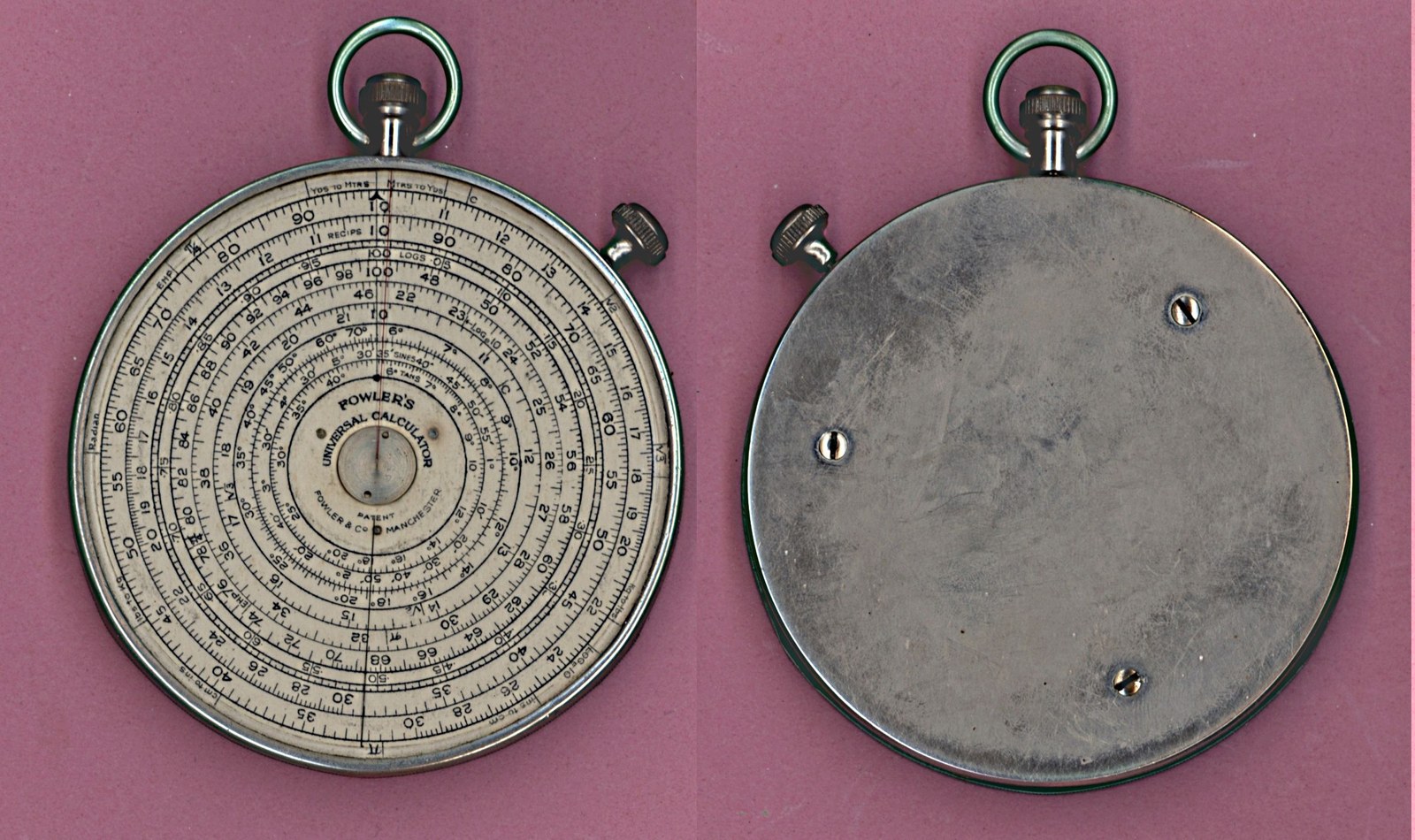
Figure 3 — A Fowler’s Universal Calculator in the late two-knob case, front and back; the back is a plain plate held by three screws. Image: International Slide Rule Museum, the calculator that belonged to Richard Levy (1932–2017), gift of Benjamin Levy, https://sliderulemuseum.com/PocketWatch.shtml.
2.3.3 The Twelve-Ten (3⅜ inches, single dial)
Seven circles: “Tenths” (the ordinary decimal scale), reciprocals, two scales graduated in “Twelfths” — one for 1–10, one for 10–100 — then sines from 6° to 90°, small-angle sines and tangents (Blankenhorn and De Cesaris, 2002). The twelfths scales are the point of the instrument: a quantity in feet and inches, or shillings and pence, can be set directly instead of first being turned into a decimal. The outer rim adds gauge marks for conversions such as yards to metres, cubic inches to cubic feet, and inches to centimetres (Figure 3 of Vol 1).
2.3.4 The Magnum Long Scale (4⅝ inches, single dial)
The Magnum puts everything on one big dial. Purcell’s measurements of the better of its two layouts, from the outside in (Purcell, 2011):
Table 2 — The Magnum puts everything on one big dial. Purcell's measurements of the better of its two layouts, from the outside in (Purcell, 2011)
| Ring | Radius (in) | Circumference (in) |
|---|---|---|
| Gauge marks (π, π/4, radian, lb–kg, km–mile, in–cm, g, …) | 2.25 | 14.4 |
| Short scale (C) | 2.125 | 13.4 |
| Reciprocals (CI) | 2.0 | 12.6 |
| Square roots, outer turn | 1.875 | 11.8 |
| Square roots, inner turn | 1.75 | 11.0 |
| Logarithms (L) | 1.6875 | 10.6 |
| Long scale, six circles | 1.625 down to 1.0 | 10.2 down to 6.3 — 49.5 in in total |
| Sines 6°–75° | 0.875 | 5.5 |
| Sines and tangents 35′–5.5° | 0.75 | 4.7 |
| Tangents 6°–45° | 0.6875 | 3.9 |
The Magnum’s short scale alone, at 13.4 inches, is longer than the C scale of a ten-inch straight rule; its long scale is roughly five times as long. The other Magnum layout has the L scale inside the long scale instead of outside it.
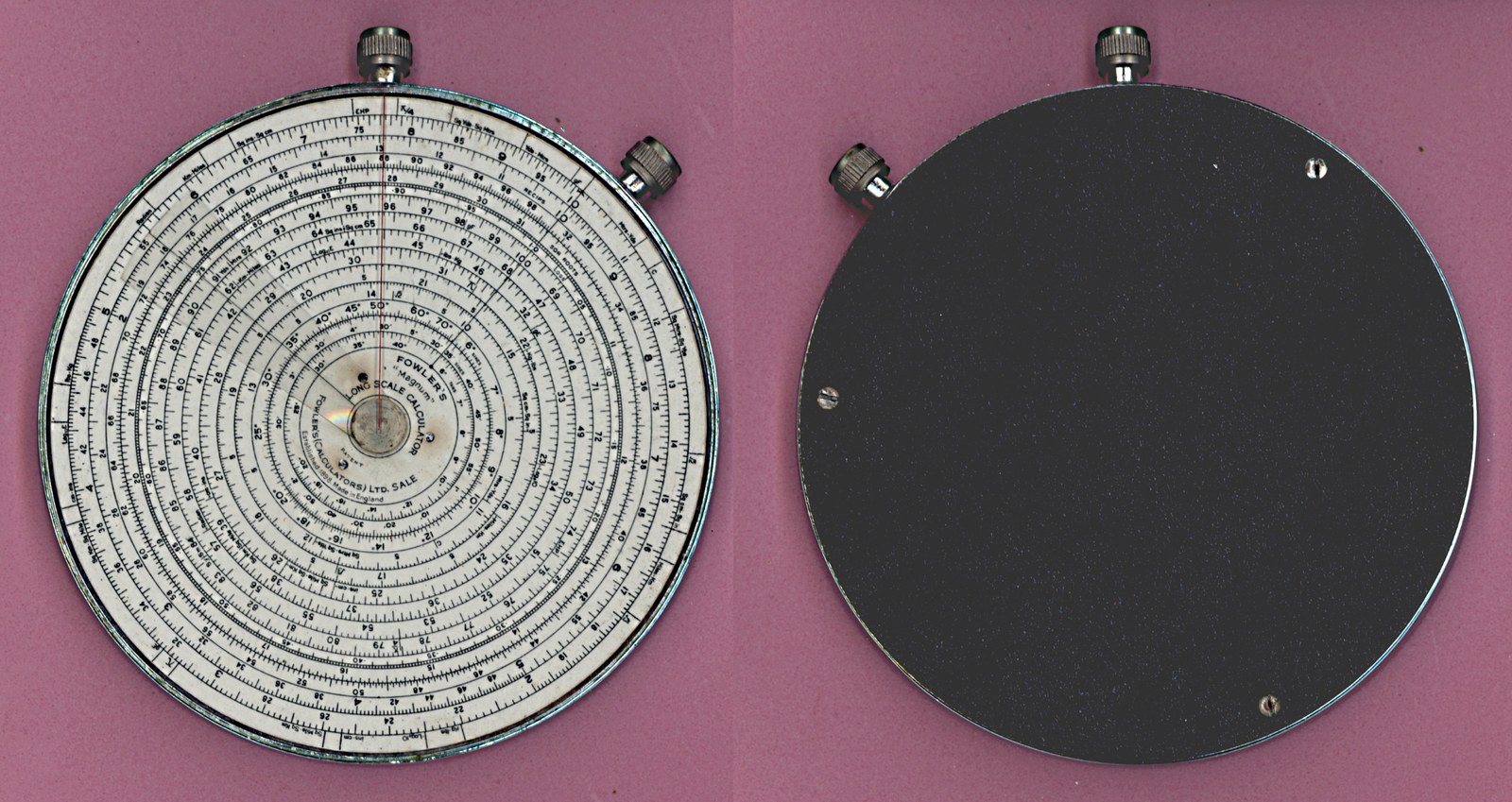
Figure 4 — A Fowler’s “Magnum” Long Scale Calculator, 4⅝ inches across, front and back. Image: International Slide Rule Museum, gift of Philip Rodley (New Zealand), https://sliderulemuseum.com/PocketWatch.shtml.
2.3.5 The Jubilee Magnum Extra Long Scale (4⅝ inches, single dial)
Thirteen circles: the short scale, reciprocals, logarithms, and a long scale wound on ten circles, the whole giving a total scale length of 76 inches (Blankenhorn and De Cesaris, 2002; Science Museum Group). On the example in Figure 5 the axle cap carries the interlaced “FC” logo that dates it to about 1948, the year of the model’s launch.
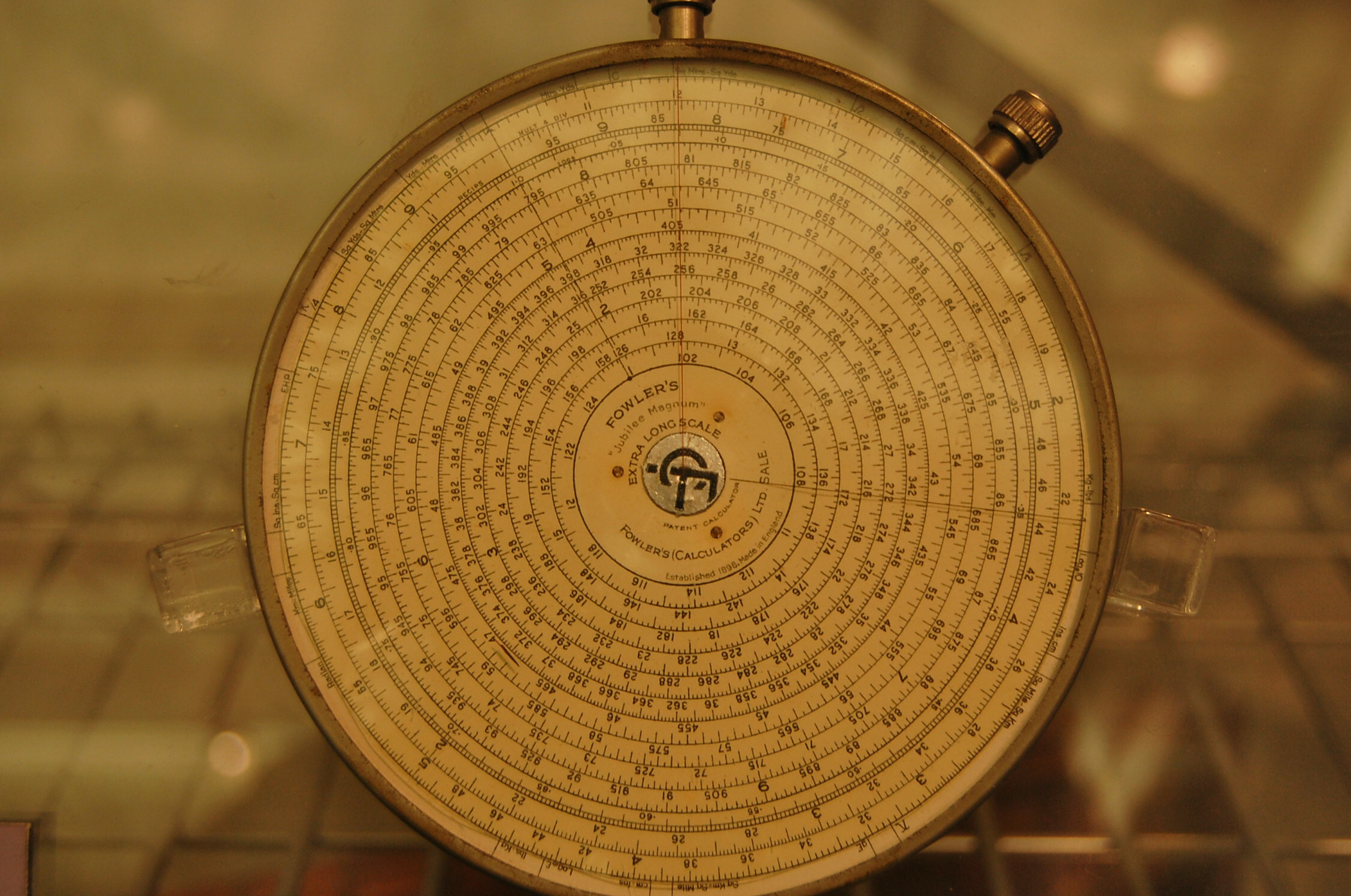
Figure 5 — The dial of a Jubilee Magnum Extra Long Scale with the “FC” axle cap of about 1948. The red datum line runs up from the centre; the long scale spirals inward through ten circles. Image: “Fowler’s Calculator (2103057744)” by vonguard from Oakland, CC BY-SA 2.0, via Wikimedia Commons, https://commons.wikimedia.org/w/index.php?curid=80478041.
2.4 What the Long Scales Buy
The precision of any slide rule is set by how finely a person can place a hairline against a scale, and that is fixed in inches, not in numbers. If a setting can be made to about 0.01 inch, the relative error on a logarithmic scale of length L inches is about ln(10) × 0.01 / L:
Table 3 — The precision of any slide rule is set by how finely a person can place a hairline against a scale, and that is fixed in inches, not in numbers. If a setting can be made to about 0.01 inch, the relative error on a logarithmic scale of length L inches is about ln(10) × 0.01 / L
| Scale | Length | Relative error at 0.01 in | Usable figures |
|---|---|---|---|
| Ten-inch straight rule (C/D) | 10 in | about 0.23% | three |
| Long Scale, front short scale | 6.7 in | about 0.34% | two to three |
| Long Scale, six-circle long scale | 30 in | about 0.077% | three, often four |
| Magnum long scale | 49.5 in | about 0.047% | four |
| Jubilee Magnum, total scale | 76 in | about 0.030% | four, sometimes five |
That matches Fowler’s own claims — four and sometimes five figures for the Magnum — and the advertisement of 1947 that the vest-pocket models equalled a 30-inch slide rule. It also explains how the instruments were meant to be used: the short scale to find the neighbourhood of an answer and so the right circle, the long scale to read it. On the 2½-inch Long Scale, for instance, one hundredth near 7.4 occupies only 0.004 inch of short scale but 0.018 inch of long scale — the difference between guessing and reading.
Two cautions keep the table honest. A circular instrument adds errors of its own — any eccentricity of the dial on its axle, and parallax between hairline and dial — and Gano Dunn’s 1925 praise of the Fowler was precisely that it had so little of either (Vol 1). And the inner circles of a long scale are shorter than the outer ones, so their graduations are more crowded; the last figure on an inner circle is always a little less sure than on an outer one.
Sources
- Fowler’s (Calculators) Ltd. Instructions for the Use of Fowler’s Vest Pocket Calculator, List 33V (Sale, 1956), ISRM manual M437 (filed in the Library). In this site’s Reference Library.
- Fowler, William H. Fowler’s “Universal” Calculator: Instructions (Fowler & Co., Hampson Street, Sale, c. 1938–42), ISRM manual M392 (filed in the Library). In this site’s Reference Library.
- Hopp, Peter M. A Fowler’s Gallimaufry, 2nd ed. (UK Slide Rule Circle, 2021) — cases, patents, mechanism, dies, Bakelite backs. https://sliderulemuseum.com/Papers/Gallimaufry_ByPeterMHopp_UKSRC.pdf. In this site’s Reference Library.
- Blankenhorn, Richard, and Robert De Cesaris. “The Fowler Calculators — a Catalogue Raisonné.” Journal of the Oughtred Society 11:2 (2002) — scale lists by model. https://osgalleries.org/journal/pdf_files/11.2/V11.2P3.pdf. In this site’s Reference Library.
- Purcell, Bryan. “The Fascinating Tale of the Fowler Magnum Pocket Slide Rule.” Journal of the Oughtred Society 20:1 (2011) — Magnum ring table and controls. https://osgalleries.org/journal/pdf_files/20.1/V20.1P19.pdf. In this site’s Reference Library.
- Science Museum Group, Fowler & Co people record (Jubilee Magnum 76 in). https://collection.sciencemuseumgroup.org.uk/people/ap3026
- Circle boundaries (10^(k/6)), relative-error figures (ln 10 × 0.01 / L) and graduation spacings were computed directly for this volume.
Comments (0)