Fowler Circular Calculators · Volume 1
Fowler's Circular Calculators — Volume 1 — The Family
Ninety years of pocket-watch slide rules from Manchester and Sale, and how to tell one model from another
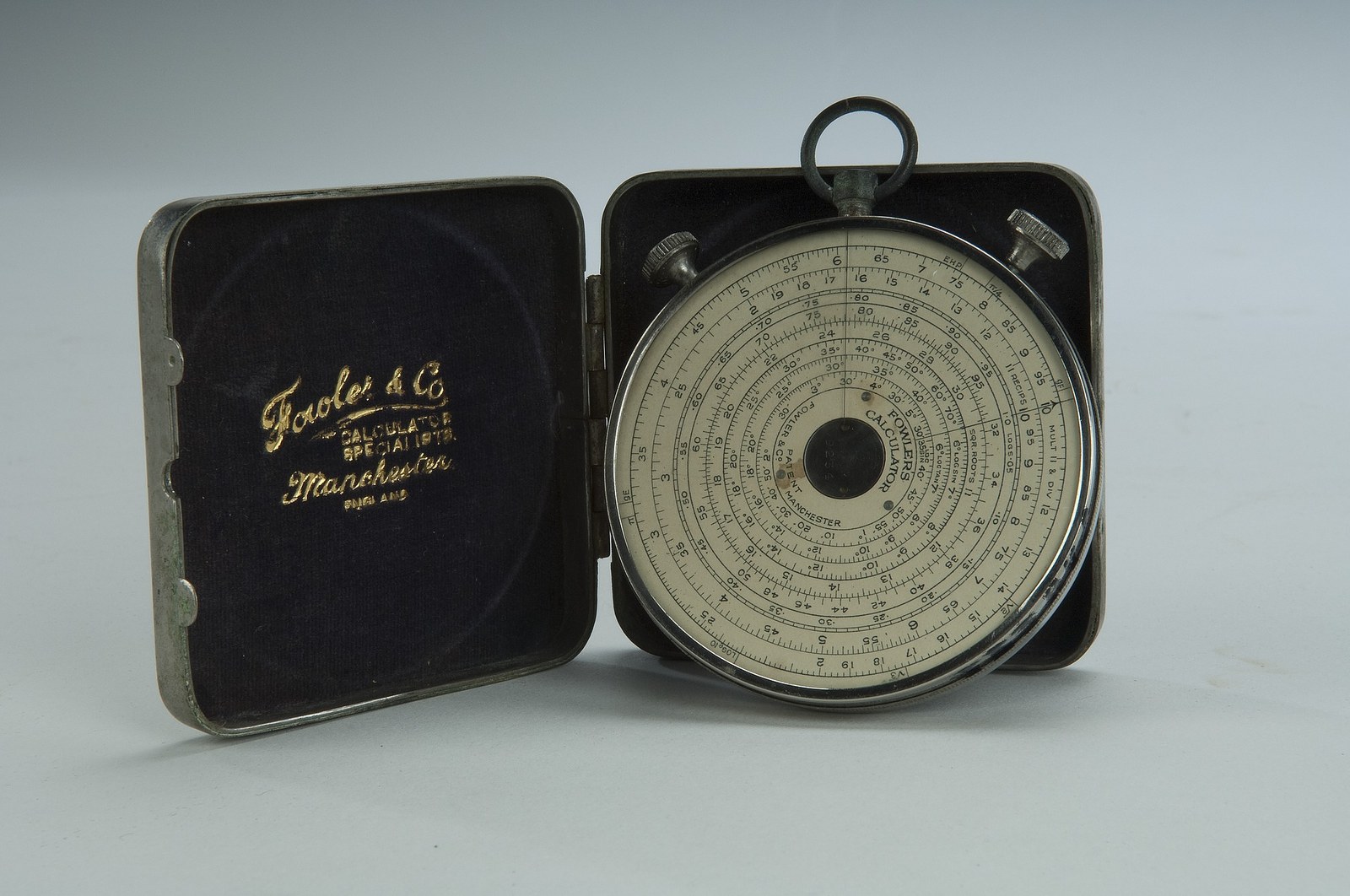
Figure 1 — A Fowler’s Long Scale Calculator in its fitted nickelled tin, showing the back dial (“Fowler’s Calculator”: reciprocals, logarithms, square roots, sines and tangents). The central loop between two side-winders is the arrangement of the 1924 patent; the gold-on-blue-velvet lid lining with the “Fowler & Co., Manchester” name dates the tin before about 1938. Image: “Long Scale calculator”, Smithsonian Institution, National Museum of American History (object 1215043), CC0, via Wikimedia Commons, https://commons.wikimedia.org/wiki/File:Long_Scale_calculator.jpg.

1.1 About This Volume
A Fowler calculator looks, at arm’s length, exactly like a pocket watch: a round nickel case, a glass crystal, a knurled crown on a short stem, often a bow-shaped loop to hang it from a chain. Close up, the “watch face” is a set of concentric logarithmic scales, and the crown turns them. For about ninety years, from 1898 to 1988, a small family firm in Manchester and then in Sale, Cheshire, made these instruments by hand, in more than fifty models and variants, for engineers, students, architects, textile mills, gunners and navigators.
I own one of them. Which one, I have not yet pinned down, and that is the practical purpose of this volume: to set out the family — the firm, the patents, the three sizes, the general-purpose and trade models — and the features that let any particular example be named and roughly dated. How the parts work and what every scale does is Vol 2; operating, cleaning and storing one is Vol 3. Why bending a scale into a circle buys precision, and where Fowler sits among the Boucher, the Gilson and the cylindrical rules, is already told in The Story of the Slide Rule Vol 4 and Using a Slide Rule Vol 5, and is not repeated here.
1.1.1 Depth-Index: The Fowler Unit
Table 1 — Depth-Index: The Fowler Unit
| Vol | Title | Primary Content |
|---|---|---|
| 1 | The Family (this volume) | W. H. and Harold Fowler, the Scientific Publishing Company, the patents, the models by size and trade, dating features, identifying mine |
| 2 | Anatomy and the Scales | Case, crystals, crown and side-winder, datum line and cursor, the dials of the Long Scale, Universal, Twelve-Ten and Magnums, scale lengths and real accuracy |
| 3 | Using It, and Caring for It | The datum-and-cursor method; multiplication, chains, division, roots and trig, all checked; cleaning the case, glass and dials; damp, storage and repair cautions |
Note — Cross-references to other units appear as “Using a Slide Rule Vol 5” or “The Story of the Slide Rule Vol 4.” Within this unit they appear as “see Vol N.”
1.2 The Firm
1.2.1 William Henry Fowler and the Scientific Publishing Company
William Henry Fowler was born in Oldham in July 1853. He began an engineering apprenticeship at the textile-machinery makers Platt Brothers at fourteen, rose to draughtsman, won a Whitworth Scholarship, and studied for four years at Owens College, Manchester. He then worked as assistant engineer to the Manchester Steam Users’ Association, became general manager of the Chadderton Ironworks in 1888, and in 1891 turned to the trade press as editor of The Practical Engineer (Grace’s Guide; Hopp, 2021).
In 1898 he founded the Scientific Publishing Company in Corporation Street, Manchester (later 53 New Bailey Street, Salford). Its weekly The Mechanical Engineer and its long-running Fowler’s Pocket Books — mechanical, electrical, mechanics’ and machinists’, and later architects’ and builders’ editions — were the firm’s real business for many years. In the same year the magazine described and the company sold a circular “watch” calculator: a nickel-plated case, a revolving dial turned by a milled nut at the top, and fixed pointers over five scales. Who designed and made that first “Mechanical Engineer” calculator is not recorded. Some examples are stamped “Swiss” on the axle or “Swiss Make” on the dial, which suggests bought-in watch parts, and three dial sizes are known — 1¾, 2 and 2½ inches (Hopp, 2021; Wetton, 1997).
1.2.2 Harold Fowler and the workshop in Sale
The calculators became a manufacture through the founder’s son. Harold Fowler (born 1879) won scholarships to the Manchester School of Technology and Owens College, worked as an electrical engineer, and in 1905 joined his father’s firm as an editor. Around 1908 he set up a workshop in the family house, Sale Lodge, in Sale, south of Manchester, and began designing and assembling circular calculators of his own (Grace’s Guide; Hopp, 2021).
The patents followed in the father’s name, later in both names:
- 5,528 of 1910 — the double-sided “Long Scale” or “Pocket” construction that was the mainstay of production for some thirty years;
- 20,416 of 1913, 3,638 of 1914 (anti-backlash arrangements) and 15,990 of 1914;
- 215,648 of 1924, applied for in 1923 — independent knobs on radial shafts at the rim, with controlled friction on the wheels. This is the design with a central loop flanked by two side-winders, which appears in an advertisement in The Engineer of August 1926 (Hopp, 2021).
The workshop moved to “Oakleigh,” The Avenue, Sale, before 1914 — a photograph of January 1917 shows a pile of about a hundred cast bodies awaiting assembly — then to Station Works, Sale, around 1920, and in 1938 to Hampson Street, Sale, when the old works was demolished for the town-hall extension. The calculators were sold first as Scientific Publishing products and, from about 1915, under the name Fowler & Co. (Hopp, 2021; Grace’s Guide).
W. H. Fowler died in April 1932, and Harold became owner. During the Second World War Jim Cookson joined as manager and the business became Fowler’s (Calculators) Ltd. In 1948, the firm’s fiftieth year, it launched the Jubilee Magnum. Cookson ran the company after Harold retired, and it went into liquidation around 1988, after Cookson’s own retirement (Wikipedia, Fowler Calculators; Grace’s Guide).
1.2.3 A hand-made instrument
Fowler was never a large or very profitable business. A circular calculator has many more parts than a straight rule — a spider frame, shafts, wheels, two dials, crystals, pointers — and every one was assembled and adjusted by hand. Contemporary accounts put the cost at up to four times that of a straight slide rule, and from the hand-written dates inside two opened examples at least fifty Type E1 calculators were made in a single month (Purcell, 2011; Hopp, 2021). A Long Scale sold for 21 shillings in 1934; an undated “List 50” leaflet prices the 4½-inch Magnum at 63/- and the 3⅜-inch Universal at 42/6 (Hopp, 2021).
What the money bought was accuracy. In July 1925 Gano Dunn, president of the J. G. White Engineering Corporation of New York, wrote to Fowler that after thirty years with French, British, German and American circular calculators he found the Fowler “at least 10 times as accurate as the best circular instrument I have heretofore tried” — free of eccentricity, with less parallax and longer scales — and ordered six more Type RX (Hopp, 2021, Appendix C).
1.3 The Family by Size
Fowler’s own pocket books, from 1946 onward, describe the range as three sizes: a small instrument about 2½ inches across “for carrying in the waistcoat pocket,” with one or two dials; a medium size about 3 inches across with a single dial, of which the Universal and the 12/10 are the examples; and the Magnum, about 4½ inches, the largest, with a single dial (Hopp, 2021). Collectors’ measurements give the three case diameters as roughly 2½, 3⅜ and 4⅝ inches, and the Blankenhorn–De Cesaris Catalogue Raisonné (2002) groups the models the same way.
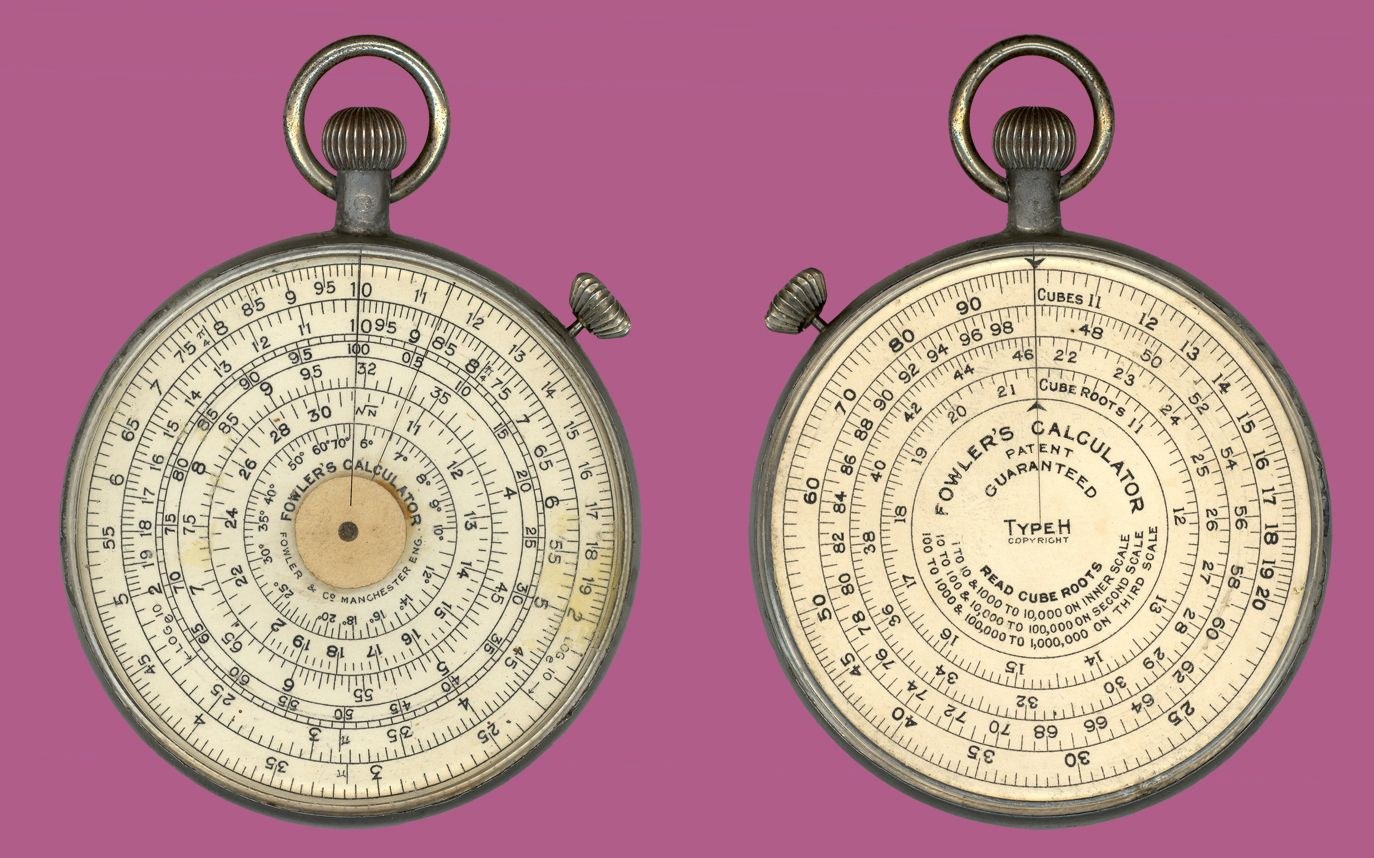
Figure 2 — A 2½-inch double-sided Fowler’s Calculator, Type H, with the central loop and two side-winders of the 1924 patent. Front dial (left): short scale, reciprocals, logarithms, square roots on two circles, sines. Back dial (right): cubes and cube roots. Fowler’s 1920s leaflet called this type “generally preferred by students.” Image: International Slide Rule Museum, Paul Tarantolo Collection, https://sliderulemuseum.com/PocketWatch.shtml.
1.3.1 The 2½-inch double-sided calculators
These are the classic Fowlers: two dials, back to back, behind two crystals. Fowler’s mid-1920s leaflet explains that the general-purpose types were built by pairing three standard dials (Hopp, 2021):
Table 2 — These are the classic Fowlers: two dials, back to back, behind two crystals. Fowler's mid-1920s leaflet explains that the general-purpose types were built by pairing three standard dials (Hopp, 2021)
| Type | Front dial | Back dial | Fowler’s own description |
|---|---|---|---|
| H | Six circles: multiplication and division (“short scale”), reciprocals, logarithms, square roots (two circles), log sines | Cubes and cube roots | ”Generally preferred by students” |
| RX | A single-circle short scale plus a six-circle scale 30 in long | The Type H front dial | ”Very useful … for engineers and draughtsmen” |
| R | As RX | Cubes and cube roots | For a long scale plus direct cubes |
| A | As H | Conversion tables: inches and millimetres, Whitworth pipe threads and bolts | — |
The Type RX evolved, without much fanfare, into the Long Scale Calculator — the most common Fowler of all. Its front dial carries the outer short scale and the six-circle long scale; its back carries the general scales (reciprocals, logarithms, square roots, two sine scales and a tangent scale). Fowler sold it in every case style the firm ever used, and in the 1940s and 1950s also as the Vest Pocket Calculator. The textile mills had their own 2½-inch models: short-scale and long-scale Textile Calculators, with a calculating dial on one side and tables of weft, looms or cloths, and reeds on the other, plus the early Types E, E1, M and T. The Artillery Calculator paired trig scales with conversion scales, and the Kearns Machine Time Computer worked out cutting times on Kearns boring machines (Blankenhorn and De Cesaris, 2002; Hopp, 2021).
1.3.2 The 3⅜-inch single-dial calculators
The middle size has one large dial and a plain back — steel, a moulded Bakelite back on some earlier examples, a Rexene-covered back on the last ones.
- The Universal — nine circles on one dial: short scale, reciprocals, logarithms, cubes and cube roots (three circles), two sine scales and a tangent scale. It came with a 48-page booklet and was, in Hopp’s words, “a mainstay of Fowler sales” through the whole of the later production.
- The Twelve-Ten (12-10) — for architects, builders, surveyors and timber merchants who worked in feet and inches as well as decimals. Alongside a decimal (“Tenths”) scale and reciprocals it carries two scales graduated in twelfths, plus sines and tangents. Grace’s Guide gives its introduction as 1936, though Hopp records a serial 366 bearing a dated Christmas greeting of 1931. Its booklet ran to 99 pages.
- The Textile Type B — a single-sided mill calculator with the short scale (also divided in sixteenths) and, in some versions, weft, looms and reeds scales or a ±percentage scale.
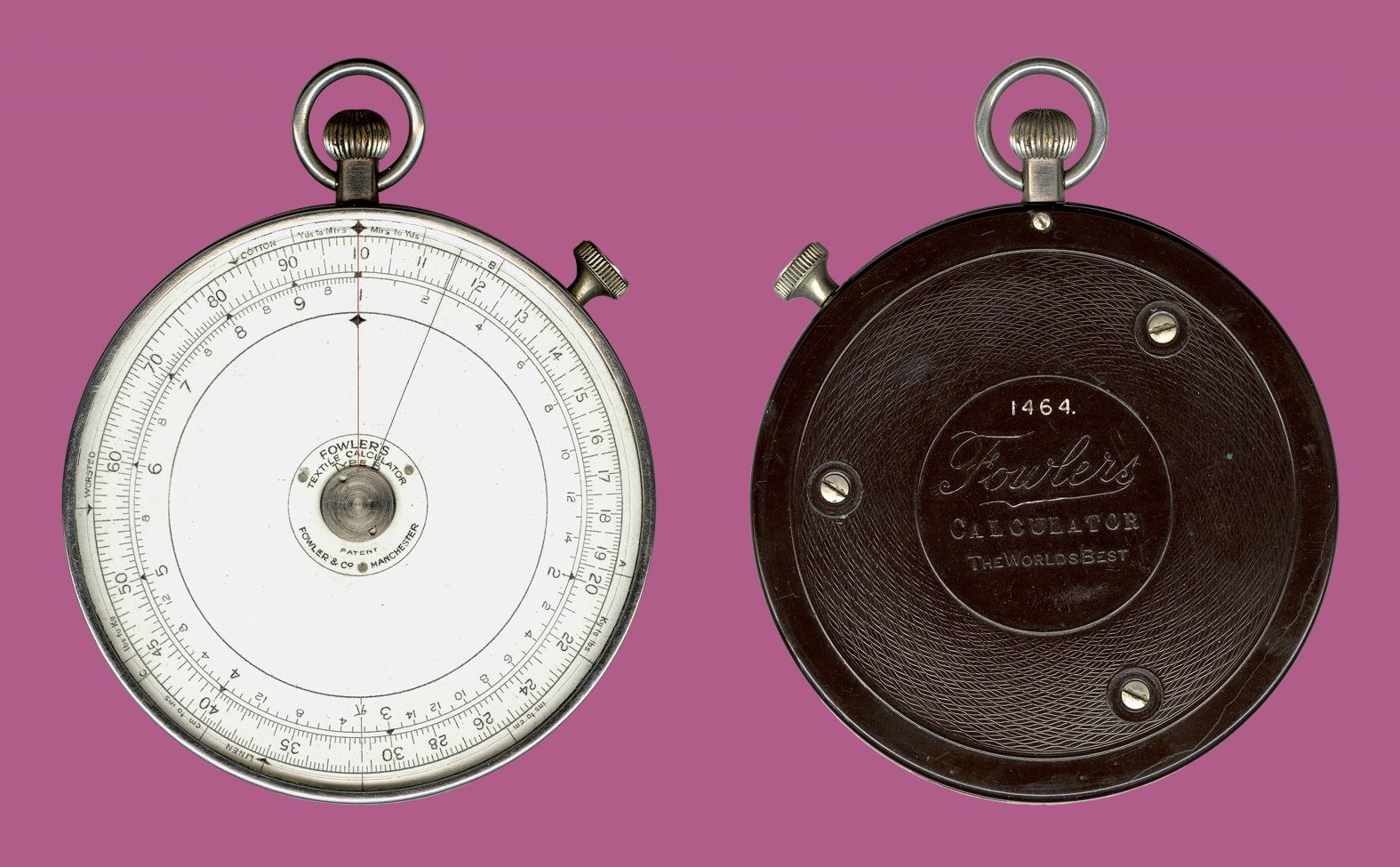
Figure 4 — A Textile Calculator Type B, 3⅜ inches, with the moulded Bakelite back used for a period on all the single-sided models; this one is serial 1464. Image: International Slide Rule Museum, Paul Tarantolo Collection, https://sliderulemuseum.com/PocketWatch.shtml.
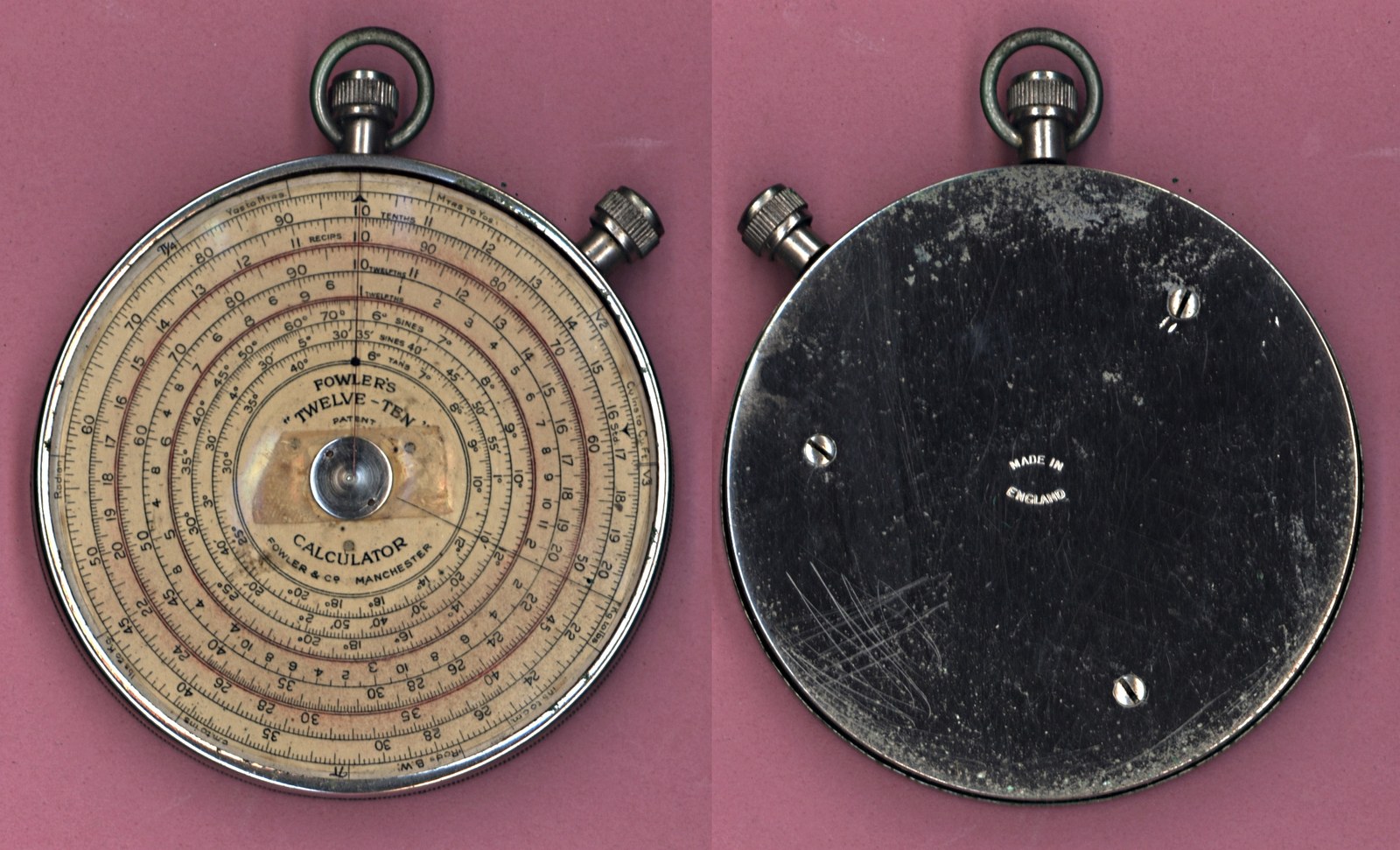
Figure 3 — A Fowler’s “Twelve-Ten” Calculator, 3⅜ inches, marked “Fowler & Co. Manchester.” The outer circles read Tenths, Recips, Twelfths (twice), then sines and tangents; the plain steel back carries the serial number on many examples. Image: International Slide Rule Museum, gift of Philip Rodley (New Zealand), https://sliderulemuseum.com/PocketWatch.shtml.
1.3.3 The 4⅝-inch Magnums
- The Magnum Long Scale (1927) — Fowler’s flagship: fourteen circles on one 4⅝-inch dial, including a long scale wound on six circles whose combined length is about 50 inches. Its booklet claimed results “to four, and sometimes five, significant figures.” The Magnum had its own run of serial numbers, separate from the rest of the range (Purcell, 2011; Hopp, 2021).
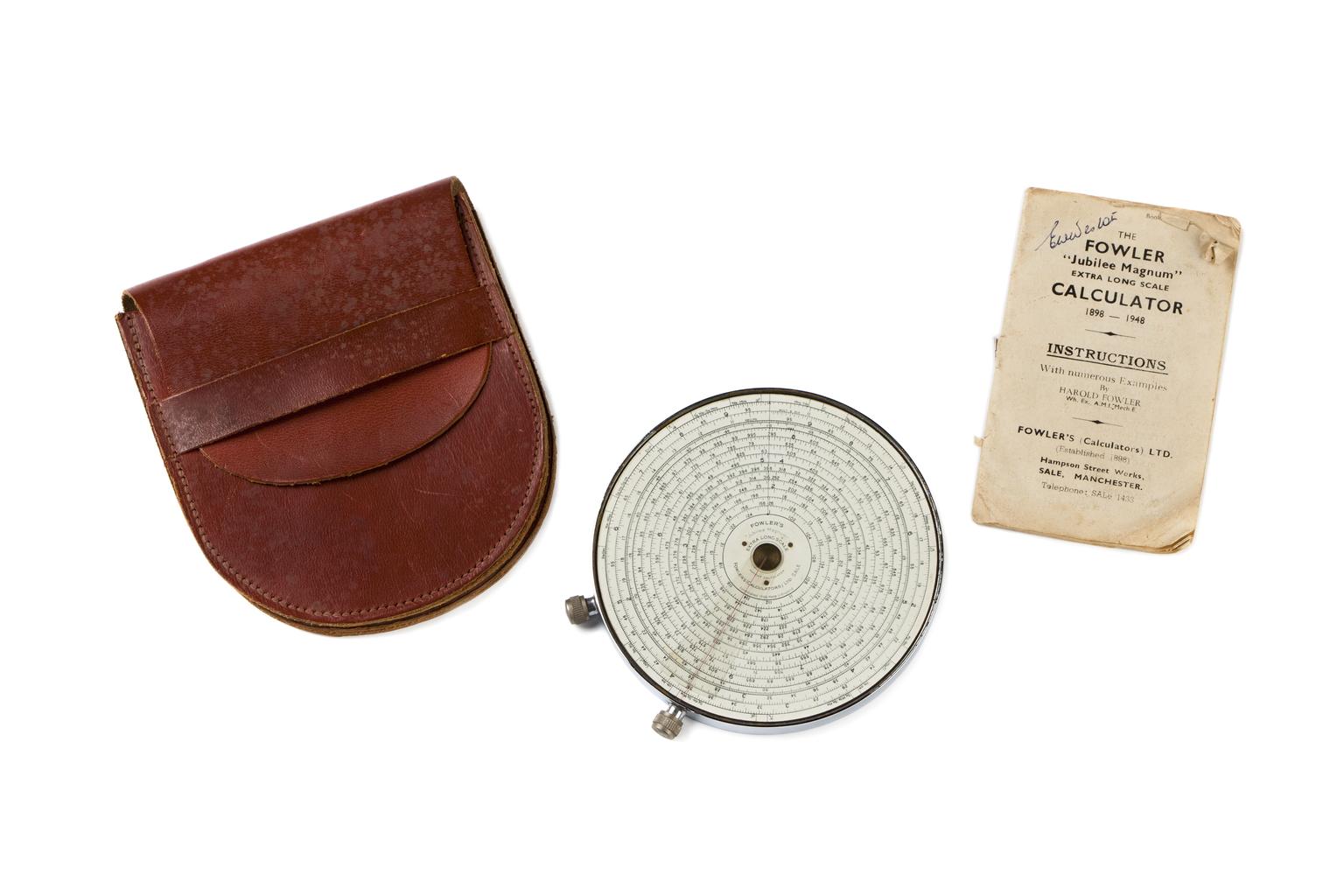
- The Jubilee Magnum Extra Long Scale (1948) — the fiftieth-anniversary model: thirteen circles, ten of them a single long scale, for a total scale length of 76 inches and results to five or six figures (Science Museum Group).
- The Magnum Textile, the Nautical Calculator (4¼ inches, double-sided, said to equal a 6 ft 6 in slide rule, for working calculated altitude and azimuth) and the Mackay Paper & Board Calculator used the same large case.
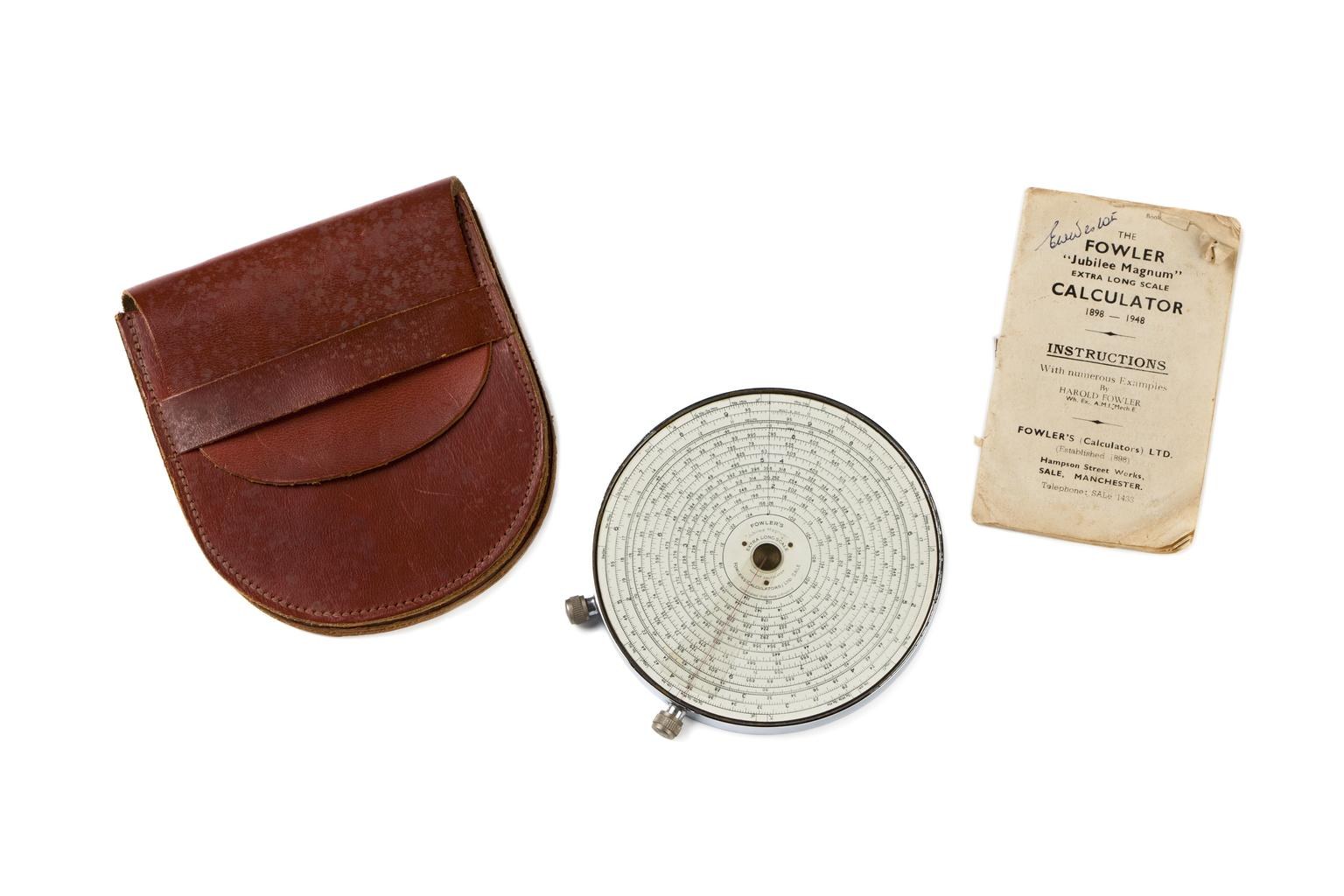
Figure 5 — A Jubilee Magnum Extra Long Scale with its saddle-leather case and instruction booklet. A Fowler that still has both is worth more, and is far easier to identify. Image: Fowler’s (Calculators) Ltd, “Fowler ‘Jubilee Magnum’ Scale Calculator,” Science Museum Group Collection, © The Board of Trustees of the Science Museum, CC BY-NC-SA 4.0, https://coimages.sciencemuseumgroup.org.uk/643/755/large_smg00249735__0001_.jpg.
Outside the watch form, Fowler also made a flat 4½-inch Junior Calculator (a disc rule with a movable celluloid centre), a Circular Slide Rule with a fixed outer scale, and at least one wall-mounted calculator for the Ribble bus company. The catalogues by Blankenhorn and De Cesaris (2002) and Hopp (2021) list them all, with the scales of each, and both are filed in the Library.
1.4 Dating a Fowler
No Fowler carries a date, and the firm’s instructions and advertisements carry almost none (Blankenhorn and De Cesaris, 2002). Dating rests on the construction, which changed in a known order. Hopp’s summary is the best guide:
Table 3 — No Fowler carries a date, and the firm's instructions and advertisements carry almost none (Blankenhorn and De Cesaris, 2002). Dating rests on the construction, which changed in a known order. Hopp's summary is the best guide
| Feature | Approximate period |
|---|---|
| ”Scientific Publishing Co., Manchester” on the dial; a knob in the centre of the back; a fine pointer; one-piece cast case | c. 1910 to the mid-1910s |
| ”Bulls-eye” central marking with a pointer; ovoid early fittings | From about 1915 |
| One-piece cast (“sintered”) alloy case, hard to open, early serial engraved on the side | 1910s to early 1920s |
| Two-part pressed-steel case with knurled (serrated) edges | 1920s to 1940s |
| Central loop between two side-winders | From the 1924 patent; advertised 1926 |
| Crown in the loop plus one side key | Common on Long Scales of the 1930s–40s (a dated case of 1943 is known) |
| “Fowler & Co., Manchester” banner on the dial | Up to about 1938 |
| ”Fowler’s (Calculators) Ltd, Sale” banner | From about 1938 to the end |
| Interlaced “FC” logo | A short period around 1948–1950 |
| Smooth, shiny “chromed” cast case, two knobs and no loop, screwed back (often Rexene-covered) | From about 1948 |
Two caveats apply. First, Fowler used up parts. The International Slide Rule Museum’s c. 1956 Long Scale carries “Fowler’s (Calculators) Ltd, Sale” on its front dial and “Fowler & Co., Manchester” on its back — so the latest feature present sets the earliest possible date, not the oldest. Second, serial numbers help less than one would hope. Most Fowlers share one continuous series, the Magnums had their own, single-sided models carry the number on the back of the case and double-sided ones usually on the rear axle, and numbering seems to stop with the late shiny cases around 1948. Even Hopp, after twenty years, has found no reliable number-to-year conversion; a few anchors exist, such as serial 16772 in a case engraved 1943 (Hopp, 2021, Appendix B).
The cases date too. The earliest calculators came in a leatherette-covered card box big enough for the booklet; then in fitted, fold-over saddle-leather cases (early ones stamped “Fowler’s”), in nickelled brass tins lined in velvet (four successive patterns of lid lining are known), and at the end in imitation leather that tends to split (Hopp, 2021).
1.5 Identifying Mine
I own a Fowler circular calculator. Until it is photographed and measured, its model is unknown. The points that will identify it, in order of usefulness:
- The name on the dial centre. Most Fowlers print the model around the axle: “Long Scale Calculator,” “Universal,” “Twelve-Ten,” “Magnum Long Scale,” “Jubilee ‘Magnum’ Extra Long Scale,” “Textile Calculator,” “Type H,” and so on. A plain “Fowler’s Calculator” means reading the scales instead.
- The diameter of the case (not counting the crown): about 2½, 3⅜ or 4⅝ inches.
- One dial or two. If the back is a plain plate (steel, Bakelite, Rexene), it is a single-sided Universal, Twelve-Ten, Type B, Magnum or Jubilee; if there is a second crystal and dial, it is one of the 2½-inch double-sided types.
- The scales. A six-circle long scale on the front of a 2½-inch double-sided instrument means a Long Scale or Type RX; two “Twelfths” scales mean a Twelve-Ten; weft, looms and reeds mean a Textile.
- The address banner — “Fowler & Co., Manchester” or “Fowler’s (Calculators) Ltd, Sale.”
- The controls — central loop with two side-winders, crown in loop with one side key, or two keys and no loop.
- The case construction and back — knurled two-part steel, early cast, or late shiny cast with a screwed back.
- Any serial number — on the rear axle, the back of the case, or the side.
- The case and any paperwork — leather, tin or box; a leaflet with its list number and date (for example “List 33V, 1956” or “Booklet MRX.3.51”).
Sources
- Hopp, Peter M. A Fowler’s Gallimaufry, 2nd ed., Version 2 (UK Slide Rule Circle, 2021) — patents, design changes, every type, dating features, cases, serial numbers, documents. https://sliderulemuseum.com/Papers/Gallimaufry_ByPeterMHopp_UKSRC.pdf (filed in the Library). In this site’s Reference Library.
- Blankenhorn, Richard, and Robert De Cesaris. “The Fowler Calculators — a Catalogue Raisonné.” Journal of the Oughtred Society 11:2 (Fall 2002), 3–7. https://osgalleries.org/journal/pdf_files/11.2/V11.2P3.pdf (filed in the Library). In this site’s Reference Library.
- Purcell, Bryan. “The Fascinating Tale of the Fowler Magnum Pocket Slide Rule.” Journal of the Oughtred Society 20:1 (Spring 2011), 19–20. https://osgalleries.org/journal/pdf_files/20.1/V20.1P19.pdf (filed in the Library). In this site’s Reference Library.
- Grace’s Guide to British Industrial History, “Fowlers (Calculators).” https://www.gracesguide.co.uk/Fowlers_(Calculators)
- Wikipedia, “Fowler Calculators.” https://en.wikipedia.org/wiki/Fowler_Calculators
- Science Museum Group, “Fowler & Co” (people record) and the Jubilee Magnum object record. https://collection.sciencemuseumgroup.org.uk/people/ap3026
- Smithsonian National Museum of American History, “Fowler’s Long Scale Calculator Circular Slide Rule” (1215043). https://si.edu/object/fowlers-long-scale-calculator-circular-slide-rule:nmah_1215043
- Wetton, Jenny. “Scientific Instrument Making in Manchester, 1870–1940, III: Flatters and Garnett Limited, and Fowler & Company.” Bulletin of the Scientific Instrument Society 53 (1997), 15–18 (as cited by Hopp).
- International Slide Rule Museum, “Pocket Watch Style Logarithmic Circular Slide Rule Calculators.” https://sliderulemuseum.com/PocketWatch.shtml
Comments (0)