Slide Rule Collection · Volume 3
Three Small Rules — Volume 3 — The U.S. Blue Co. Pocket Rule (Hemmi 32)
A Chicago dealer's name on a Japanese bamboo rule: identifying the maker, reading the Prod and Quot marks, and finding the missing cursor
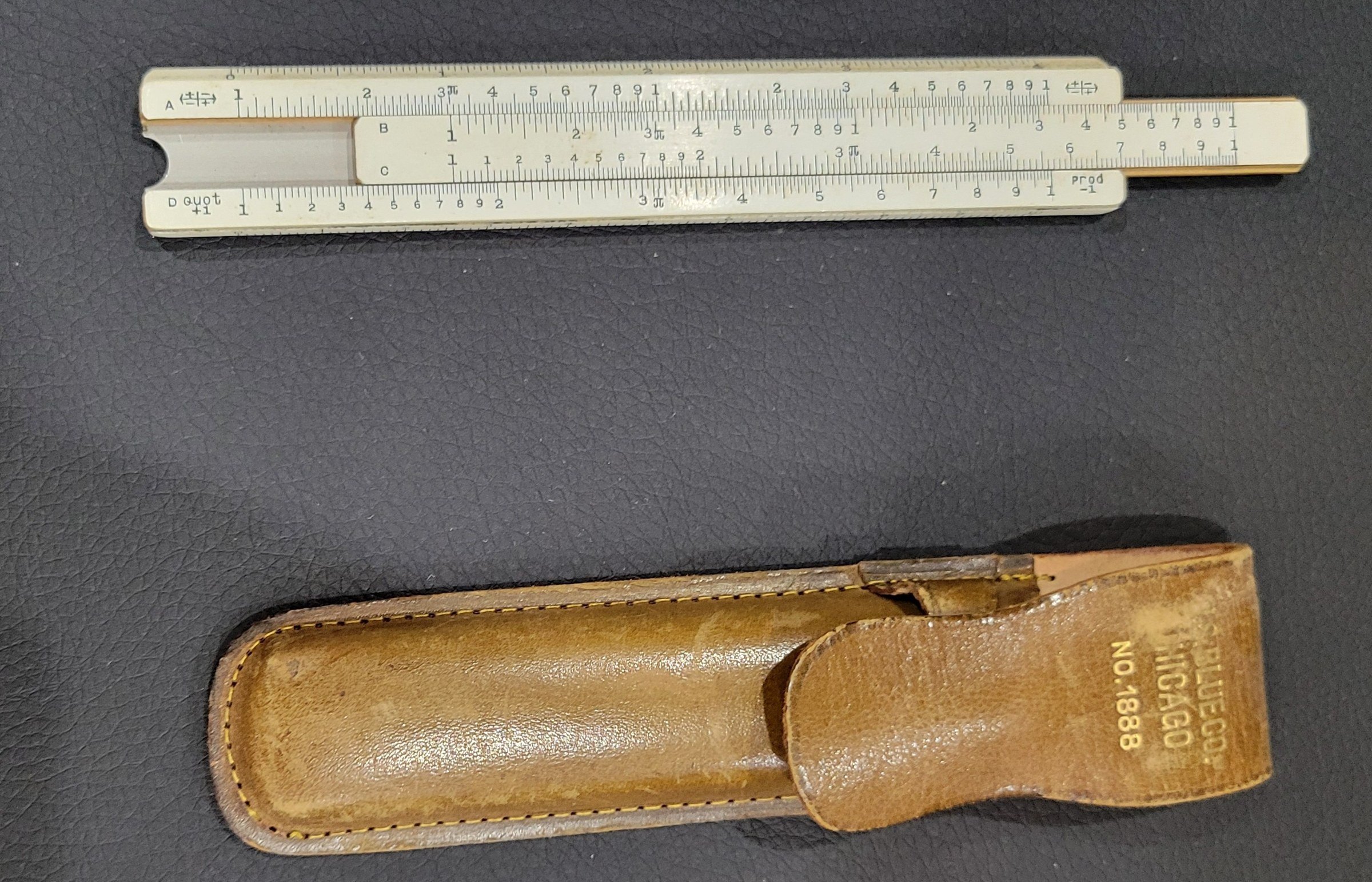
Figure 1 — My U.S. Blue Co. pocket rule and its case “No. 1888.” The scales, the typewriter-style numerals, the “Quot +1” and “Prod −1” marks and the (±|∓) signs at the ends of A are all those of a Hemmi. The cursor is missing. Photo: my own.
3.1 About This Volume
The third rule in this unit carries only a dealer’s name: “U.S. BLUE CO., CHICAGO” on the back, and “U.S. BLUE CO. CHICAGO NO. 1888” on its leather case. Nothing on it says who made it. This volume shows that it is a Hemmi model 32, a four-inch pocket rule made in Japan between 1930 and 1942, and that “1888” was the dealer’s own catalogue number for that model. It then explains the scales and the digit-counting marks that make it unusual, works examples with and without a cursor, sets out where a replacement cursor can be found, and covers the care of celluloid on bamboo — and of a leather case.
3.1.1 Depth-Index: The Three-Volume Unit
Table 1 — Depth-Index: The Three-Volume Unit
| Vol | Title | Primary Content |
|---|---|---|
| 1 | The K&E 4058C Beginner’s Slide Rule | K&E’s student line, dating, mine and its box and 1928 instructions, the pencil notes, worked examples, care of printed wood |
| 2 | The Lawrence 8-B | Lawrence Engineering Service of Wabash and Peru, identifying the 8-B, A B CI C D K, the instructions on its back, care |
| 3 | The U.S. Blue Co. Pocket Rule (Hemmi 32) (this volume) | Dealer branding, identifying the Hemmi 32, celluloid on bamboo, the Prod/Quot digit marks, finding a replacement cursor, care |
3.2 A Dealer’s Name on Someone Else’s Rule
Selling another maker’s rule under a shop’s own name was common practice. Hemmi of Tokyo, the Japanese maker of bamboo-cored rules (History Vol 3), supplied rules to American dealers from the early 1930s — most famously to the Frederick Post Company of Chicago, which sold Hemmi rules under its own model numbers for four decades, but also to others. The Hemmi catalogue raisonné maintained by the International Slide Rule Museum (ISRM) lists, for each Hemmi model, the “sibling labels” under which it was sold: Post, Tamaya, Boston Blue Print, Hughes-Owens, Teledyne-Post, Geo — and US Blue. The U.S. Blue entries are:
Table 2 — Selling another maker's rule under a shop's own name was common practice. Hemmi of Tokyo, the Japanese maker of bamboo-cored rules (History Vol 3), supplied rules to American dealers from the early 1930s — most famously to the Frederick Post Company of Chicago, which sold Hemmi rules under its own model numbers for four decades, but also to others. The Hemmi catalogue raisonné maintained by the International Slide Rule Museum (ISRM) lists, for each Hemmi model, the "sibling labels" under which it was sold: Post, Tamaya, Boston Blue Print, Hughes-Owens, Teledyne-Post, Geo — and US Blue. The U.S. Blue entries are
| Hemmi model | Type | U.S. Blue number |
|---|---|---|
| 32 (1930–42) | 4-inch pocket Mannheim, magnifying cursor | 1888 |
| 32R (1945–50, “Made in Occupied Japan”) | the same with a CI scale | 1888 |
| 34RK | 5-inch pocket Mannheim with CI and K | 1887 (1930s) |
| 40 | 10-inch Mannheim | 1876 (1930s) |
| 40RK | 10-inch with CI and K | 1877 (1940s?) |
| 50 | 10-inch | 1880 (1930s) |
| 150 | 10-inch duplex | 1881 (c.1937) |
| 152, 153 | 10-inch duplex | 1889, 1893 (1930s) |
So U.S. Blue Co. sold a whole range of Hemmi rules in the 1930s under its own numbers in the 1870s–1890s, and was still selling the pocket rule after the war. What the firm was is less clear. Nothing about a Chicago “U.S. Blue Co.” turned up in the sources consulted for this unit beyond the rules themselves; the name suggests the blueprint and drafting-supply trade, which was also how Boston Blue Print came to sell Hemmi rules, but that is an inference, not a finding.
3.3 Identifying Mine: the Hemmi 32
My rule matches the Hemmi 32 in the ISRM’s catalogue (Figure 2) feature for feature:
- Typewriter-style numerals — the slab-serif figures, like a typewriter’s, that Hemmi used on its pre-war pocket rules.
- “Quot +1” at the left end of D and “Prod −1” at the right, and small bracketed (±|∓) signs at both ends of A.
- π gauge marks at 3.1416, set beside the 3 on each of A, B, C and D.
- The back (Figure 3): two white rails held together by a grey metal backing plate fixed with small pins; a semicircular thumb notch at the left end; and at the right end a window with an index line through which the S, L and T scales on the back of the slide are read.
- The scale set: A [B, C] D on the front, S, L, T on the back of the slide — and no CI scale.
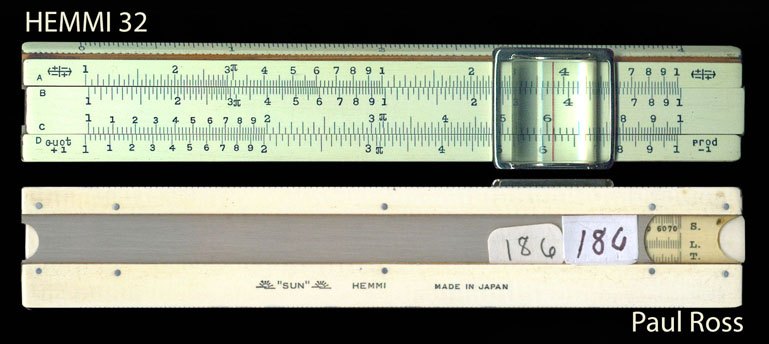
Figure 2 — A Hemmi 32 under the maker’s own name, front and back. The front is identical to mine, numeral for numeral; this one still has its magnifying cursor. The back carries “SUN” HEMMI and MADE IN JAPAN on the lower rail where mine has a worn patch. Image: Hemmi 32 (1930s), Paul Ross; Hemmi Slide Rule Catalogue Raisonné, International Slide Rule Museum, https://sliderulemuseum.com/srtco/HCR_Pics/32(1930s).jpg.

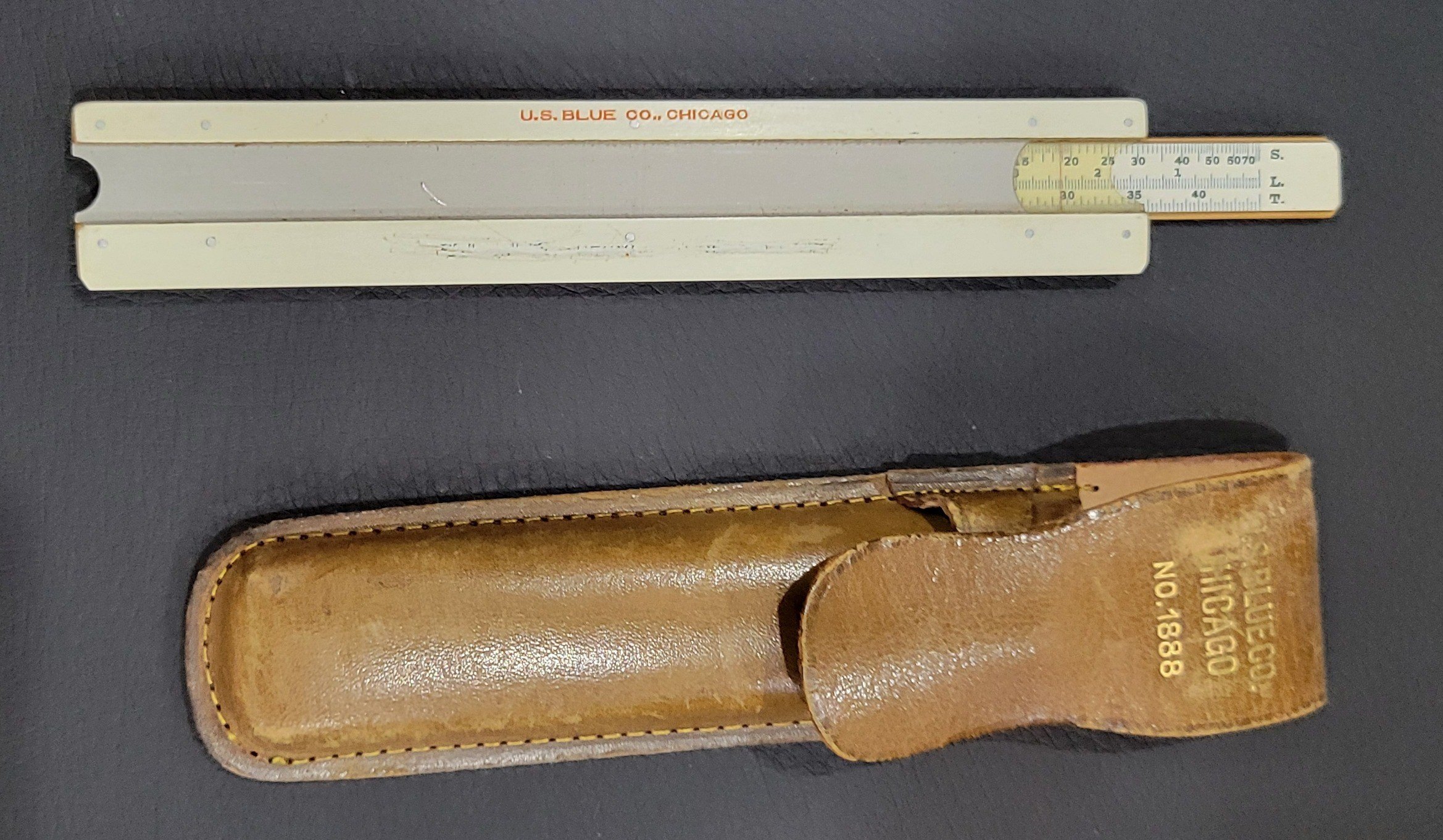
Figure 3 — The back of mine: “U.S. BLUE CO., CHICAGO” on the upper rail, the metal backing plate, the S L T window at the right, and a band of scuffing on the lower rail. Photo: my own.
The absence of a CI scale settles which Hemmi: the 32R that U.S. Blue also sold as 1888 has one; the pre-war 32 does not. Without its cursor, the body alone could also be a Hemmi 30 or 31 — the same rule fitted with a plain or a decimal-indicating cursor instead of the magnifier — but the case number “1888” is the number U.S. Blue gave the 32. The date range for the 32 is 1930–42.
The scuffed band on the lower back rail (Figure 3) sits exactly where Hemmi’s own rules print “SUN” HEMMI and MADE IN JAPAN (Figure 2). Whether anything was printed there and removed — by the dealer or an owner — is worth checking under a raking light and a magnifier.
3.4 Celluloid on Bamboo
Hemmi’s rules are built on bamboo: strips of it laminated into the stock and slide, with white celluloid faces carrying the scales (History Vol 3). Bamboo’s long, straight fibres make it unusually stable against humidity, and its natural waxiness lets the slide run smoothly without lubrication — which is why a rule like this one, nearly a century old, can still slide freely. On the pocket models the two halves of the stock are tied together by the metal backing plate, which keeps them parallel while leaving the slide free.
Celluloid (cellulose nitrate) is the material’s weak point. It yellows with age and light, it is softened or dissolved by common solvents, and as it ages it can give off acidic vapour, which in a closed space attacks metal and leather. The care section below follows from that.
3.5 The Scales and the Digit-Counting Marks
Table 3 — The Scales and the Digit-Counting Marks
| Scale | Where | What it gives |
|---|---|---|
| A | upper body | x², two cycles |
| B | slide, upper edge | x², A’s partner |
| C | slide, lower edge | x, 1–10 |
| D | lower body | x, 1–10 |
| S | back of slide | Sines |
| L | back of slide | Common logarithms (mantissas) |
| T | back of slide | Tangents |
The scales are 10 cm (four inches) long — the “four-inch” of Post’s name for the same rule, the 1441 — which is enough for two figures and a careful third.
“Prod −1” and “Quot +1” are reminders of the old digit-counting method of placing the decimal point, the alternative to estimation that Hemmi printed on the rule. Count the digits of each number before the decimal point (for a number less than 1, count the zeros straight after the point as negative digits: 0.36 has 0 digits, 0.045 has −1). Then the rule is:
Table 4 — "Prod −1" and "Quot +1" are reminders of the old digit-counting method of placing the decimal point, the alternative to estimation that Hemmi printed on the rule. Count the digits of each number before the decimal point (for a number less than 1, count the zeros straight after the point as negative digits: 0.36 has 0 digits, 0.045 has −1). Then the rule is
| Slide sticks out to the… | Product has | Quotient has |
|---|---|---|
| right | (digits of a) + (digits of b) − 1 | (digits of a) − (digits of b) + 1 |
| left | (digits of a) + (digits of b) | (digits of a) − (digits of b) |
“Prod −1” sits at the right end of D, where the slide projects when the correction applies to a product; “Quot +1” sits at the left end, beside the C index under which the quotient is then read. The (±|∓) signs at the ends of A appear to be the same system’s reminder for squares and roots.
3.6 Using It
3.6.1 Multiplication and division with the digit marks
2 × 3. Left index of C over 2 on D; under 3 on C read 6 on D. The slide sticks out to the right, so the product has 1 + 1 − 1 = 1 digit: 6.
3 × 4. With the left index over 3, the 4 on C falls off the end, so set the right index of C over 3 on D; under 4 on C read 1.2 on D. The slide now sticks out to the left, so the product has 1 + 1 = 2 digits: 12.
0.36 × 25. Left index of C over 3.6 on D; under 2.5 on C read 9 on D. Slide to the right: 0 + 2 − 1 = 1 digit: 9. Check: 0.36 × 25 = 9.
8 ÷ 2. Set 2 on C over 8 on D; read 4 on D under the left index of C. Slide to the right: 1 − 1 + 1 = 1 digit: 4.
27 ÷ 0.45. Set 4.5 on C over 2.7 on D; the quotient is under the right index of C: 6 on D. Slide to the left: 2 − 0 = 2 digits: 60. Check: 27 ÷ 0.45 = 60.
3.6.2 Without a cursor
Most of this rule’s work can be done without its cursor, which is how mine has to be used until one is found. Multiplication and division on C and D need no cursor at all, as above: the answer is read on D directly under a number on C. Squares need A and D to be compared at the same position on the body, which is possible by eye on a closed slide — the C/D and A/B joints are the guides — but a cursor makes it reliable. Square roots go the other way, A to D, with the same limitation.
3.6.3 Sines, tangents and logs from the back
The S and T scales on the back of the slide are read through the window at the right-hand end of the back, which has its own index line, so they need no cursor either. Set the angle on S under the window’s index line; then, on the front, the sine is read on the slide opposite the right index of the body. Which front scale depends on how S is keyed. For the related 30R the catalogue raisonné records S keyed to A and B (sines read on B, 0.01 to 1) except from the war years to 1955, when it was keyed to C and D (sines 0.1 to 1); the pre-war 32 has not been checked here. The rule itself shows which: if S begins at about 0°34′ at its left end, read on B; if it begins at about 5°44′, read on C.
- sin 30°. Set 30 on S at the window index. Read 5 on the right half of B (or 5 on C), giving 0.5. Check: sin 30° = 0.5.
- sin 5° (A/B-keyed S only). Set 5 on S at the index; read 8.72 on the left half of B, where the first figure falls in the second decimal place: 0.0872. Check: sin 5° = 0.08716.
- tan 20°. Set 20 on T at the index; read 0.364 on C opposite the right index of D. Check: tan 20° = 0.36397.
- log 2. Set the slide so C’s left index is over 2 on D, and read the L scale at the window index: 0.301. Check: log₁₀ 2 = 0.30103.
3.7 Finding a Replacement Cursor
The missing cursor is the one thing standing between this rule and full use, and it is a solvable problem because Hemmi used one body size for a whole family of four-inch pocket rules.
What fits. The ISRM’s parts list groups the Hemmi 30, 32 and 35 and the Post 1440, 1441 and 1447M together as “Four-inch closed body with 17 mm-wide face,” all taking the same cursor (part 1472). The catalogue raisonné gives the 30 and the 30R/32R families the same dimensions, 100 mm × 11⁄16 in × 7⁄32 in. Any cursor from a rule on that list — or from the same rule under another label (Boston Blue Print 1441; Tamaya 4453, 4454, 4455; Hughes-Owens 1760; Teledyne-Post 44DA-410) — should fit. Before buying, measure the face of mine: it should be 17 mm (about 11⁄16 in) across.
Where to look.
- The ISRM parts service. At the time of writing (October 2026) its Hemmi and Post page lists, for this body: a complete flat cursor, part 1472, new, $25; a flat cursor window alone, 1472G, $6; and the magnifying cursor, 1472M, as not available (https://www.sliderulemuseum.com/PartsHemmi.shtml). A flat cursor is the practical choice; it reads the same scales, without magnification.
- A donor rule. Hemmi 30, 32 and 32R and Post 1440, 1441 and 1447 pocket rules turn up often and cheaply, and a damaged one with a good cursor is the way to get an original magnifying cursor like the one my rule was sold with (Figure 4).
- Replica glass. If a cursor frame turns up with its glass broken, the ISRM also supplies laser-cut acrylic replacement lenses in Hemmi/Post sizes, blank or with a hairline scribed and inked.
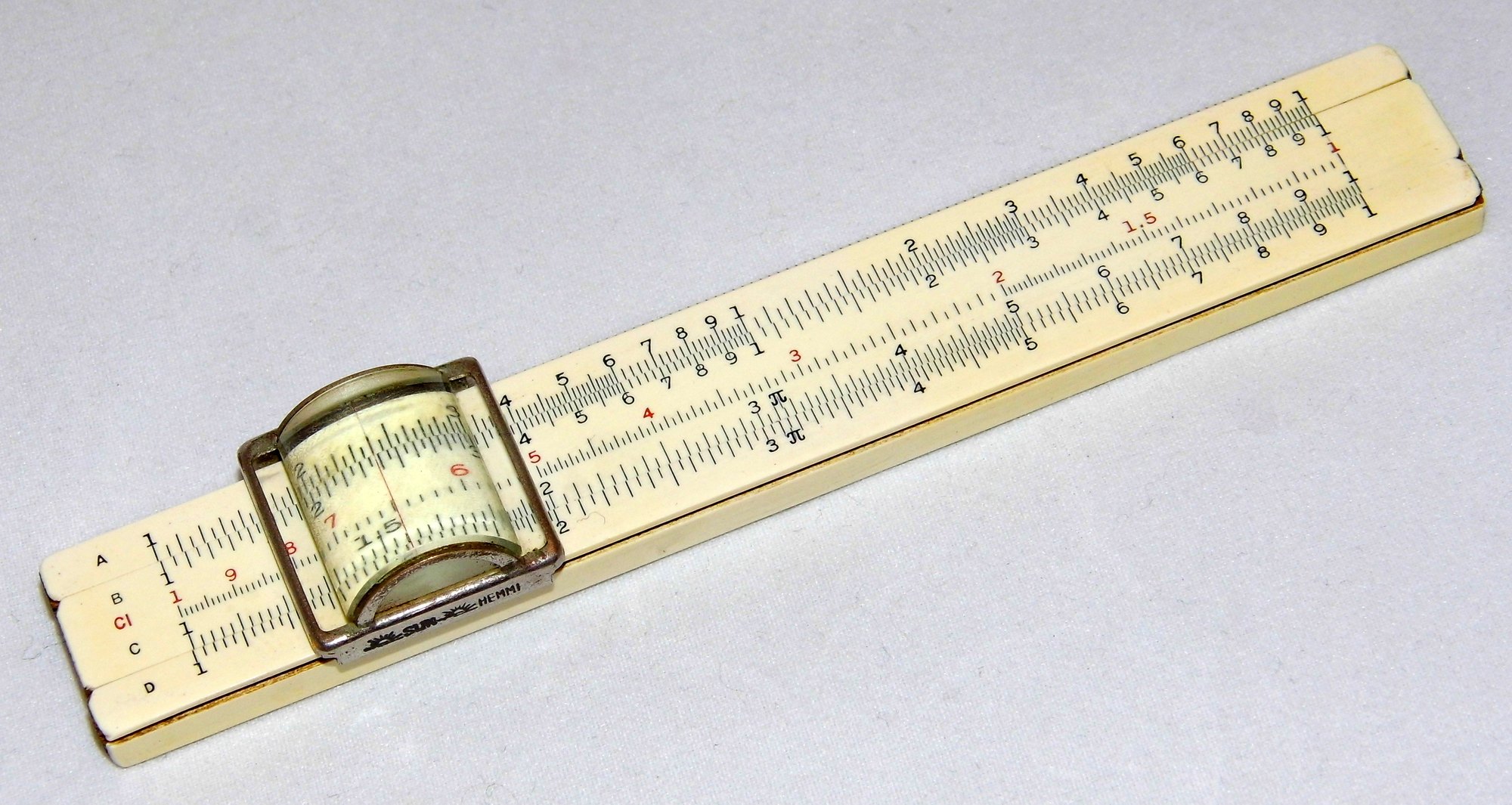
Figure 4 — The cursor my rule is missing, on its post-war sibling: a Post 1441 (the Hemmi 32R, with a CI scale) with the cylindrical magnifying cursor in a frame stamped “SUN HEMMI.” Image: “Vintage Frederick Post Co. No. 1441 Four Inch Slide Rule With Magnifier, Made By Hemmi In Occupied Japan” by Joe Haupt, CC BY-SA 2.0, via Wikimedia Commons, https://commons.wikimedia.org/wiki/File:Vintage_Frederick_Post_Co._No._1441_Four_Inch_Slide_Rule_With_Magnifier,_Made_By_Hemmi_In_Occupied_Japan_(23033854602).jpg.

Fitting it. These cursors slide onto the closed body from one end. It should move with light, even friction along the whole length, without rocking. Check the hairline before relying on it: with the slide closed, the hairline should cover the left indexes of A, B, C and D at once, and the right indexes too. As a test of the whole rule, put the hairline on 2 on D; it should read exactly 4 on A.
3.8 Caring for Celluloid on Bamboo
3.8.1 What to use
- Dust: a soft brush, especially along the slide’s grooves and in the S L T window.
- Grime: a soft cotton cloth barely damp with water and a drop of mild soap, wiped along the scales; then plain water; then dry at once. Test first on the blank back of the slide.
- The metal backing plate: dry cloth only. If it shows corrosion, do not scrape or polish it; a trace of microcrystalline wax on a cloth will slow it.
- A stiff slide: bamboo rarely needs lubrication. Clean the grooves first. If it still binds, a very little paraffin wax on the slide’s edges, buffed off, is the most that is needed. Post’s own early instruction leaflet suggested “oil of paraffin, paraffin wax, or sandpaper”; collectors today use the wax and avoid the other two — oil collects dirt in the grooves, and sanding removes bamboo that cannot be put back.
3.8.2 What not to do
- No acetone, nail-polish remover, lacquer thinner or MEK: they dissolve celluloid.
- No alcohol or household sprays on the faces: they can soften, cloud or craze old celluloid and take the ink out of the graduations.
- No abrasives — toothpaste, polish, erasers, melamine sponges — which wear the ink from the scale lines and leave the celluloid dull.
- No soaking and no heat. Water reaching the bamboo can lift the celluloid faces; heat warps celluloid and accelerates its decay.
- Do not seal it up. Celluloid in an airtight bag or box concentrates its own acid vapour. Store the rule where air can reach it.
3.8.3 The leather case
The case is soft brown leather, stitched with yellow thread, with a tuck-in flap gold-stamped “[U.]S. BLUE CO. CHICAGO NO. 1888” — the most important piece of evidence for what the rule is. Keep it. Brush it clean; if the leather is dry, a little neutral leather conditioner applied with the rule out of the case, buffed off, and left a day to dry is enough. For long-term storage, keeping the rule and case side by side rather than the rule inside the case lets both breathe — leather holds moisture, and celluloid gives off acid; neither is good for the other in a closed space.
Sources
- International Slide Rule Museum, Hemmi Slide Rule Catalogue Raisonné — models 30, 31, 32, 32R, 34RK, 40, 50, 150, 152, 153, their dates, dimensions, cursors and sibling labels including the U.S. Blue numbers; photograph of the Hemmi 32 by Paul Ross (https://sliderulemuseum.com/srtco/HemmiCat1.shtml).
- International Slide Rule Museum, “Parts for Hemmi and Post Slide Rules” — four-inch closed-body cursor 1472, 1472G, 1472M (https://www.sliderulemuseum.com/PartsHemmi.shtml); “Restoring and Repairing Slide Rules” — replica Hemmi/Post lenses.
- Frederick Post Co., A Mannheim Type Slide Rule instruction leaflet (ISRM M236) — care of the slide; Teledyne Post, Slide Rule Instructions for models 1441, 1444, 1447, 1452 (ISRM M226). In this site’s Reference Library. In this site’s Reference Library.
- Science History Institute, Hemmi “Sun” slide rule record; Smithsonian National Museum of American History, Post 1441 and 1446 (Hemmi-made) records — the “Quot +1 / Prod −1” markings.
- Worked examples checked by calculation: 2 × 3 = 6; 3 × 4 = 12; 0.36 × 25 = 9; 8 ÷ 2 = 4; 27 ÷ 0.45 = 60; sin 30° = 0.5; sin 5° = 0.08716; tan 20° = 0.36397; log₁₀ 2 = 0.30103; the digit-count rule was checked against each of these and against 2 ÷ 8 = 0.25 (slide to the left: 1 − 1 = 0 digits) and 4.5 × 6 = 27 (slide to the left: 1 + 1 = 2 digits).
Comments (0)