Slide Rule Collection · Volume 2
Three Small Rules — Volume 2 — The Lawrence 8-B
A cheap wooden rule from a small Indiana workshop, its instructions printed on its back, and the family that made it

Figure 1 — My Lawrence rule: “LAWRENCE ENGINEERING SERVICE, WABASH, IND.” and “PAT. PEND.” along the top, scales A, B, CI, C, D and K, and a metal-framed cursor. The slide is drawn out to the left, which hides the model number printed on its right-hand end. Photo: my own.
2.1 About This Volume
The second rule in this unit is the opposite of the K&E in Vol 1 in almost every way: not a great maker’s entry model but the product of a one-man firm in a small Indiana town, sold for pocket money and made to a price that no one else could match. It is also, on close inspection, a more interesting instrument than its reputation suggests — it carries a CI and a K scale that K&E’s beginner’s rule lacked, and a complete set of instructions printed on its back. This volume identifies it, tells the company’s story, transcribes the back, works the problems the back describes, and covers the care of a painted-and-printed wooden rule.
2.1.1 Depth-Index: The Three-Volume Unit
Table 1 — Depth-Index: The Three-Volume Unit
| Vol | Title | Primary Content |
|---|---|---|
| 1 | The K&E 4058C Beginner’s Slide Rule | K&E’s student line, dating, mine and its box and 1928 instructions, the pencil notes, worked examples, care of printed wood |
| 2 | The Lawrence 8-B (this volume) | Lawrence Engineering Service of Wabash and Peru, identifying the 8-B, A B CI C D K, the instructions printed on its back, care |
| 3 | The U.S. Blue Co. Pocket Rule (Hemmi 32) | Dealer branding, identifying the Hemmi 32, celluloid on bamboo, the Prod/Quot digit marks, finding a replacement cursor, care |
2.2 Lawrence Engineering Service
The company’s history has been worked out by Bruce Babcock (Journal of the Oughtred Society, 1996) and, in much more detail, by David Rance in “The Unique Lawrence” (2011, revised 2017), and is summarised by the International Slide Rule Museum (ISRM) and the Smithsonian.
George Lee Lawrence (1901–1976) was the son of George Raymond Lawrence, the Chicago photographer famous for aerial pictures taken from cameras slung under kites and balloons — including the celebrated view of San Francisco in ruins after the 1906 earthquake — and later a builder of biplanes. Around 1930 the younger Lawrence, who went by Lee, ran two small Chicago businesses: a Lawrence Slide Rule Company that made photographic calculators (no example is known to survive) and Lawrence Airplane Models, which sold balsa-wood kits. Rance suggests that cutting many small wooden parts cheaply for the kits taught him what he needed for slide rules.
In 1935 Lee Lawrence moved to Wabash, Indiana, and founded Lawrence Engineering Service to make general-purpose slide rules. Sales grew quickly, and in 1938 the business moved thirteen miles west to larger premises in Peru, Indiana. That move is why every branded Lawrence rule names one town or the other after the company name. In 1947 Lee and his second wife Vivian divorced; the business went to her, and under her new husband, the Rev. Frank Bozarth, it became Engineering Instruments, Inc. It ran until a fire destroyed the building on 5 July 1967. Lee Lawrence went on to make plastic toys — Rance credits his AGP Corporation as the original-equipment maker of the Etch-a-Sketch.
Lawrence is remembered as the originator of the 25-cent slide rule. The Smithsonian records that the 10-inch model 10-B sold for 25 cents in the years 1938–47. Rance’s study of more than fifty examples shows how it was done: every Lawrence rule, whatever its length or purpose, was milled from the same standard wooden blanks — the stock always 1⅛ inches wide and 5⁄16 inch thick, the slide always 9⁄16 inch wide and ⅛ inch thick, the stock’s edges always grooved for the same one-size cursor, and the back of the stock never painted. The wood was probably inexpensive poplar. The scales were printed, not engraved, at first directly onto the wood and later onto a white-painted face.
2.3 Identifying Mine: the 8-B
Rance cracked Lawrence’s model numbers. In the firm’s “imperial range,” the number before the dash is the length of the stock in inches, and the letter after it is the type. Type A is a plain Mannheim (A, B, C, D); type B is what he calls an Enhanced Mannheim — A, B, CI, C, D and K, with no trig scales. So an 8-B is an 8-inch Enhanced Mannheim and a 10-B a 10-inch one. The model number is printed on the right-hand end of the slide.
My rule is an 8-B, on the following evidence:
- The scale set is A, B, CI, C, D, K — type B (Figure 1).
- The proportions of the stock in my photographs are those of an 8-inch rule: assuming Lawrence’s standard 1⅛-inch width, the stock measures a little under 8 inches long in the photographs, not 10.
- The artwork matches the 8-B exactly. The two 8-Bs in the ISRM collection (Figure 2) have the same front — “MADE IN U.S.A.” at the top left, “LAWRENCE ENGINEERING SERVICE, WABASH, IND.” in the middle, “PAT. PEND.” at the right — and, on the back, the same table of operations and the same paragraph of text, down to its misprint “This instument is an indispensable aid…” (Figure 3).
The number itself is hidden in my photographs because the slide is drawn out to the left; it should read “8-B” on the right-hand end of the slide.
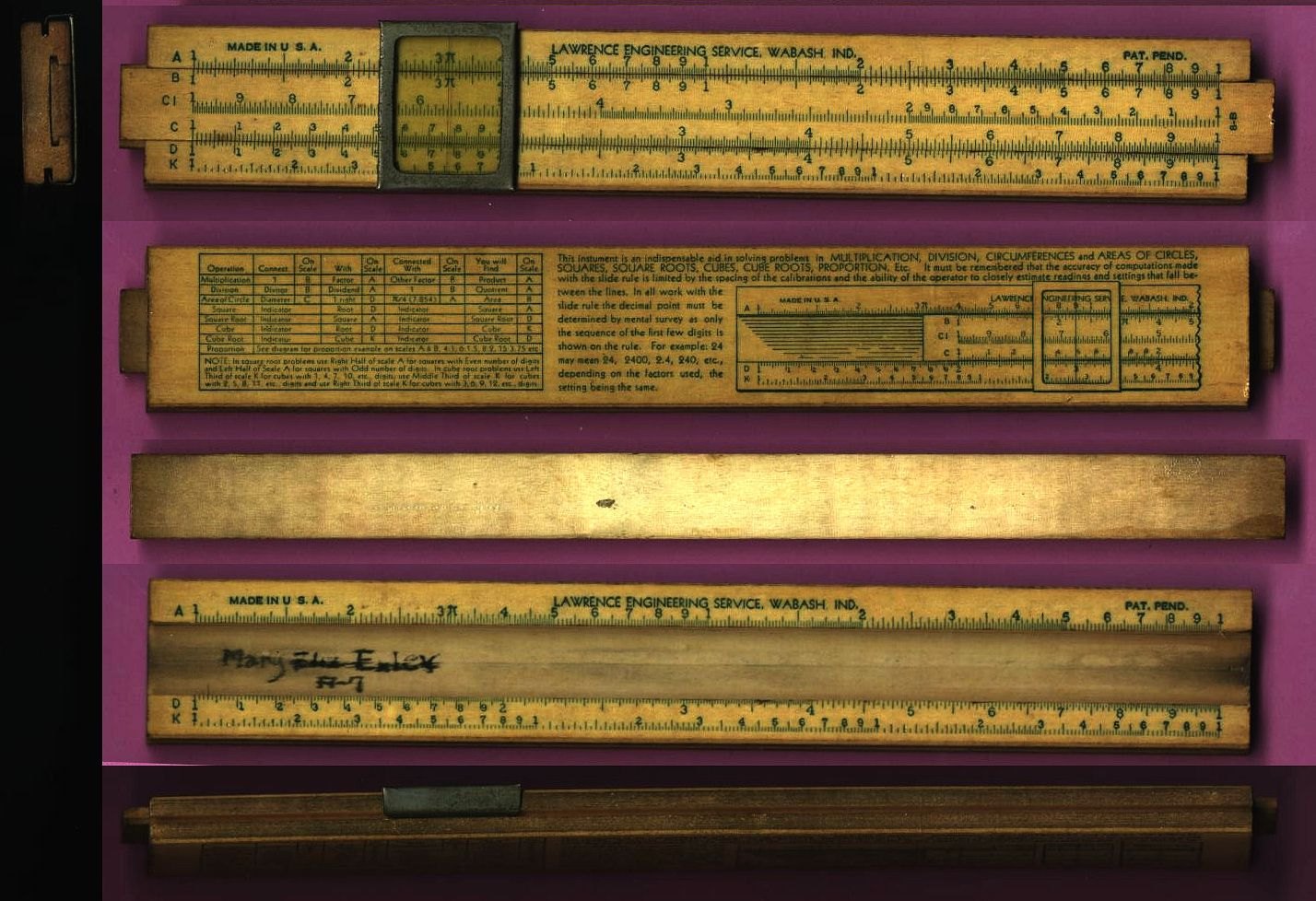
Figure 2 — A Lawrence 8-B in the International Slide Rule Museum, shown front, back, slide back, stock without slide (with its first owner’s name, Mary Exley, in pencil) and edge. Note “8-B” on the right-hand end of the slide. Image: Lawrence 8-B, donated by Henry Eck, International Slide Rule Museum, https://www.sliderulemuseum.com/Lawrence/Lawrence_8-B_SlideRule_DonatedByHenryEck.jpg.

“PAT. PEND.” appears on many Wabash-made Lawrence rules and some later ones, but, as Rance found, no Lawrence patent was ever granted; filing an application bought some protection, and it was then allowed to lapse.
Date. The Wabash imprint belongs to the Wabash years, 1935–38; the Cambridge Whipple Museum dates its own Wabash-marked Lawrence to that span. Two cautions apply. Lawrence went on using some Wabash artwork after the move — the ISRM has 10-B rules printed with the 8-B’s Wabash artwork — and the ISRM dates the 8-B model as a whole to 1938–47. My rule’s unpainted, natural-wood face matches Rance’s description of the earliest production, with the white-painted faces coming later. Late 1930s is the best estimate.
The cursor on mine is a clear window in a pressed-metal frame — Lawrence cursors were always metal-framed glass or plastic, or all-plastic (Rance). In my photographs the window catches the light like a domed lens. Lawrence did make magnifying cursors — a glass magnifier around 1940 and a moulded plastic one from about 1942, sold on the “DeLuxe” version of the 10-B — so this one may be a magnifier; that, and whether the window is glass or plastic, is still to be checked with the rule in hand.
2.4 The Scales
Table 2 — The Scales
| Scale | Where | What it gives |
|---|---|---|
| A | upper body | x², two cycles, 1–100 |
| B | slide | x², A’s partner |
| CI | slide | 1/x, running right to left |
| C | slide | x, 1–10 |
| D | lower body | x, 1–10 |
| K | lower body, bottom edge | x³, three cycles, 1–1000 |
π is marked on A and B. The ink is a dark green-black printed directly onto the wood. There are no S, L or T scales anywhere, and no scale on the back of the slide; Lawrence’s type-B rules were simplex, and Rance notes that for simplex models the slide’s tongues were cut at the bottom edge to make the rabbeting simpler.
Compared with the K&E 4058C, the 8-B is shorter (an 8-inch stock against 10) and less precisely divided, but more capable: the CI scale makes reciprocals and chained multiplication easier, and the K scale gives cubes and cube roots, which the K&E cannot do at all.
2.5 The Instructions Printed on the Back
The whole back of the stock is a printed instruction card (Figure 3). Its table reads, as printed:
Table 3 — The whole back of the stock is a printed instruction card (Figure 3). Its table reads, as printed
| Operation | Connect | On scale | With | On scale | Connected with | On scale | You will find | On scale |
|---|---|---|---|---|---|---|---|---|
| Multiplication | 1 | B | Factor | A | Other factor | B | Product | A |
| Division | Divisor | B | Dividend | A | 1 | B | Quotient | A |
| Area of circle | Diameter | C | 1 right | D | π/4 (7.854) | A | Area | B |
| Square | Indicator | Root | D | Indicator | Square | A | ||
| Square root | Indicator | Square | A | Indicator | Square root | D | ||
| Cube | Indicator | Root | D | Indicator | Cube | K | ||
| Cube root | Indicator | Cube | K | Indicator | Cube root | D | ||
| Proportion | See diagram for proportion example on scales A & B, 4:1, 6:1.5, 8:2, 15:3.75 etc. |
Beneath it: “NOTE: In square root problems use Right Half of scale A for squares with Even number of digits and Left Half of Scale A for squares with Odd number of digits. In cube root problems use Left Third of scale K for cubes with 1, 4, 7, 10, etc., digits, use Middle Third of scale K for cubes with 2, 5, 8, 11, etc., digits and use Right Third of scale K for cubes with 3, 6, 9, 12, etc., digits.” (The “(7.854)” in the area row is a misprint for 0.7854.)
Beside the table, a paragraph: “This instument is an indispensable aid in solving problems in MULTIPLICATION, DIVISION, CIRCUMFERENCES and AREAS OF CIRCLES, SQUARES, SQUARE ROOTS, CUBES, CUBE ROOTS, PROPORTION, Etc. It must be remembered that the accuracy of computations made with the slide rule is limited by the spacing of the calibrations and the ability of the operator to closely estimate readings and settings that fall between the lines. In all work with the slide rule the decimal point must be determined by mental survey as only the sequence of the first few digits is shown on the rule. For example: 24 may mean 24, 2400, 2.4, 240, etc., depending on the factors used, the setting being the same.” A small diagram of the front of the rule, with lines fanning across from A to B, illustrates the proportion example.

Figure 3 — The back of my 8-B: the table of operations at the left, the paragraph beginning “This instument is an indispensable aid…” and the proportion diagram at the right. Photo: my own.
The striking thing is that the table does multiplication and division on A and B, not on C and D. Because A and B each hold two cycles, a factor set on B’s left cycle always lands somewhere on A, so the slide never runs off the end and the beginner never has to swap indexes — the problem that the K&E sheet in Vol 1 had to explain with its 72 × 51 example. The price is precision: A and B are half-length scales, so products are read to two figures or so rather than three. Lawrence chose simplicity for a 25-cent customer.
2.6 Using It: the Back of the Rule, Worked
Multiplication on A and B — 3.5 × 2.4. Set 1 on B against 3.5 on A. Move the cursor to 2.4 on B; read 8.4 on A. Check: 3.5 × 2.4 = 8.4.
Division on A and B — 8.4 ÷ 2.4. Set 2.4 on B against 8.4 on A; opposite 1 on B read 3.5 on A.
The same multiplication on C and D, more precisely. Set the left index of C over 3.5 on D; under 2.4 on C read 8.40 on D — the full-length scales give the third figure.
Multiplying with CI — 2.5 × 3.2. Cursor to 2.5 on D; move the slide until 3.2 on CI is under the hairline; read 8 on D under the index of C. Multiplying by 3.2 is dividing by its reciprocal, which is what CI holds. Check: 2.5 × 3.2 = 8. CI alone gives reciprocals: opposite 4 on C, CI reads 2.5, so 1/4 = 0.25.
Area of a circle — diameter 3. Set 3 on C against the right index of D (“1 right”). Move the cursor to 0.7854 on A; read 7.07 on B. Check: (π/4) × 3² = 7.069. The setting works because B is then offset from A by exactly the square of the diameter.
Square and square root. Cursor to 7 on D; read 49 on A. For √625, 625 has three digits — odd — so set the cursor to 625 on the left half of A and read 25 on D; for √4,900 (four digits, even) use the right half: 70. This is the rule pencilled on the K&E in Vol 1 as “odd = LEFT.”
Cube and cube root. Cursor to 4 on D; read 64 on K. For cube roots, count the digits: ∛1,728 (four digits — left third of K) gives 12 on D; ∛64 (two digits — middle third) gives 4; ∛343 (three digits — right third) gives 7. Check: 12³ = 1,728; 4³ = 64; 7³ = 343.
Proportion — the back’s own example. Set 1 on B against 4 on A. Every pair of numbers that faces each other across A and B is now in the ratio 4 : 1: opposite 1.5 on B read 6 on A, opposite 2 read 8, opposite 3.75 read 15 — exactly the back’s “4:1, 6:1.5, 8:2, 15:3.75.” Any unknown in a proportion is found the same way.
2.7 Caring for a Lawrence
A Lawrence is solid soft wood with printed scales: the front printed on a thin clear finish, the back printed on bare, unsealed wood. It is cheap, light and easily dented, and it cannot be restored once the printing is gone.
2.7.1 What to use
- Dust: a soft brush and a dry cotton cloth, along the scales.
- Grime on the front: a cloth barely damp with water and a drop of mild soap, tested first on a blank area; then a cloth damp with plain water; dry at once.
- The back: dry methods only. Bare wood drinks water and lifts the printing with the grain; a soft brush, and at most a dry cloth.
- The cursor: the frame is pressed metal crimped around the window and was not made to come apart; clean it in place. Wipe the window with a barely damp cloth and dry it. If it is plastic it will scratch, so no paper towels or polish. If the frame shows rust, wipe it with a cloth carrying the faintest trace of light machine oil and wipe dry, keeping the oil off the wood.
- A sticky slide: brush out the grooves; if needed, rub a plain paraffin candle along the slide’s tongues and buff off the excess.
2.7.2 What not to do
- No solvents and no abrasives — alcohol, acetone, cleaners, erasers, melamine sponges or polish will take the printing off.
- No water on the back, no soaking anywhere, no heat. Poplar swells, warps and checks; a warped Lawrence slide will not run true again.
- Do not sand or shave a binding slide. Wait for drier weather, or store the rule in a stable room for a few weeks.
- Do not force the cursor past a tight spot; the metal frame bends and then rattles.
- Pencilled owners’ names on the inner faces of the stock (as on the ISRM’s 8-B in Figure 2) are worth leaving and recording.
Store the rule flat, out of the sun and away from heat and damp. If the cursor is ever lost, the right replacement is a Lawrence one — every Lawrence-made rule used the same one-size cursor, so a cursor from any damaged 8-B, 10-B or 250-BT of the right era will fit.
Sources
- David G. Rance, “The Unique Lawrence” (version 9, 2017; originally in the Proceedings of IM2011, Oughtred Society) — family and company history, standard blanks and dimensions, the model-number system, PAT. PEND., cursors (https://www.sliderulemuseum.com/Papers/TheUniqueLawrenceV9_ByDavidRance.pdf). In this site’s Reference Library.
- International Slide Rule Museum, Lawrence gallery and chronology — 8-A, 8-B, 10-B and variants, cursor types, the 1939 instruction book (https://sliderulemuseum.com/Lawrence.shtml).
- Smithsonian National Museum of American History, “Lawrence Engineering Service 10-B Mannheim Simplex Slide Rule” (NMAH 1215021) — company dates and the 25-cent price, citing Bruce Babcock, “Lawrence Engineering Service — A Tale from an American Small Town,” Journal of the Oughtred Society 5:2 (1996).
- Whipple Museum of the History of Science, Cambridge, Lawrence slide rule (Wabash, 1935–38).
- Lawrence Engineering Service, The Quick and Easy “Lawrence” Slide Rule Instruction Book (1939; ISRM M89). In this site’s Reference Library.
- Worked examples checked by calculation: 3.5 × 2.4 = 8.4; 8.4 ÷ 2.4 = 3.5; 2.5 × 3.2 = 8; 1/4 = 0.25; (π/4) × 3² = 7.0686; 7² = 49; √625 = 25; √4,900 = 70; 4³ = 64; ∛1,728 = 12; ∛64 = 4; ∛343 = 7; 6/1.5 = 8/2 = 15/3.75 = 4.
Comments (0)