Slide Rule Collection · Volume 1
Three Small Rules — Volume 1 — The K&E 4058C Beginner's Slide Rule
Keuffel & Esser's cheapest ten-inch rule, with its box, its 1928 instruction sheet and a student's pencil notes still on the face
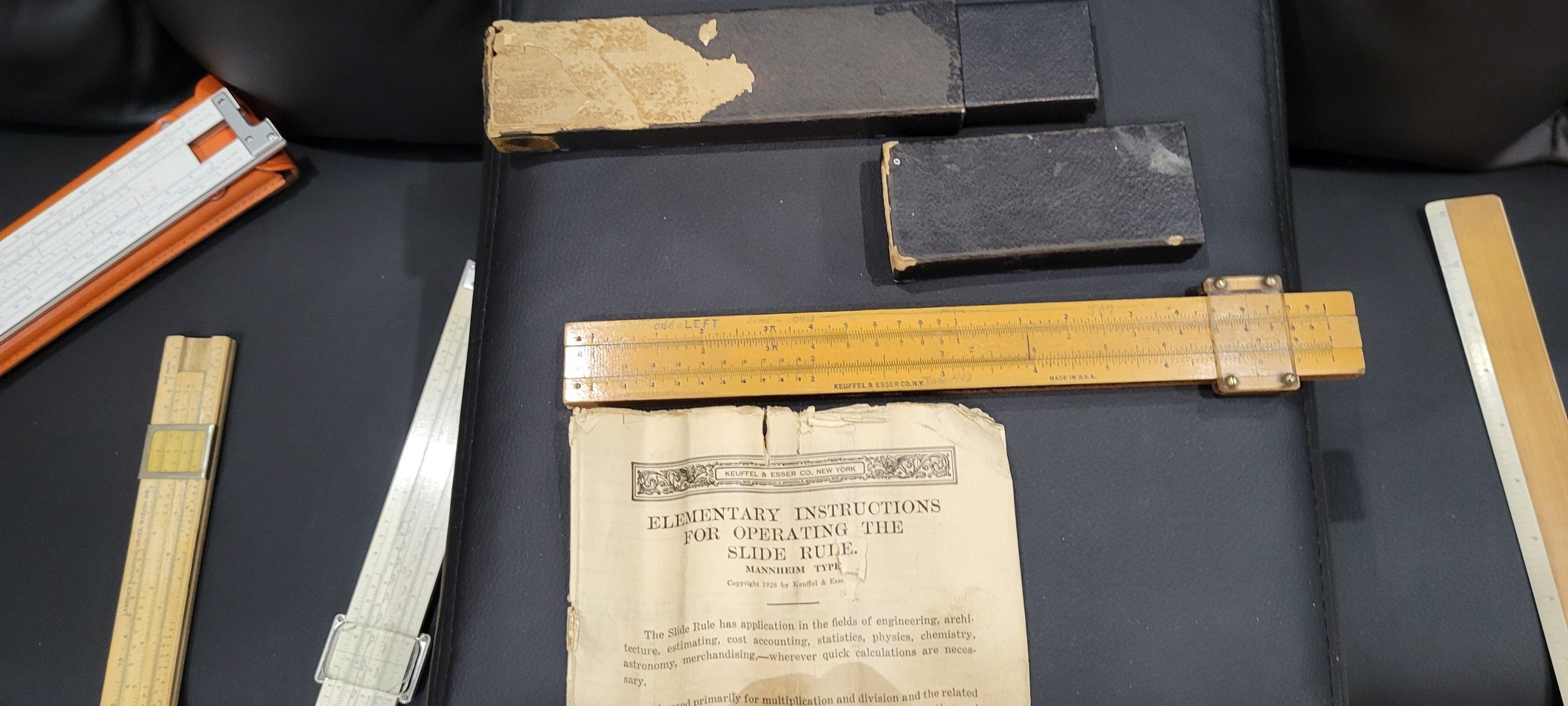
Figure 1 — My K&E 4058C with what came with it: two black pasteboard boxes and K&E’s Elementary Instructions for Operating the Slide Rule, Mannheim Type, copyright 1928. The orange case at upper left and the rules at the edges belong to other rules in the collection. Photo: my own.
1.1 About This Volume
This unit covers three small, inexpensive rules that I own and that do not each need a unit of their own: a Keuffel & Esser 4058C “Beginner’s Slide Rule” (this volume), a Lawrence Engineering Service 8-B from Wabash, Indiana (Vol 2), and a four-inch pocket rule sold by the U.S. Blue Co. of Chicago, which turns out to be a Japanese Hemmi (Vol 3). They span the cheap end of the American market from the 1920s to the 1940s — a student’s rule from the country’s biggest maker, a 25-cent rule from a small-town workshop, and an imported pocket rule under a dealer’s name — and between them they show the three materials such rules were made of: printed wood, painted and printed wood, and celluloid on bamboo. Each volume covers the model, its scales, how to use it, and how to clean and keep it.
1.1.1 Depth-Index: The Three-Volume Unit
Table 1 — Depth-Index: The Three-Volume Unit
| Vol | Title | Primary Content |
|---|---|---|
| 1 | The K&E 4058C Beginner’s Slide Rule (this volume) | K&E’s student line, dating, mine and its box and 1928 instructions, the pencil notes, A B C D and S L T, worked examples, care of printed wood |
| 2 | The Lawrence 8-B | Lawrence Engineering Service of Wabash and Peru, identifying the 8-B, A B CI C D K, the instructions printed on its back, care of a painted wooden rule |
| 3 | The U.S. Blue Co. Pocket Rule (Hemmi 32) | Dealer branding, identifying the Hemmi 32, celluloid on bamboo, the Prod/Quot digit marks, finding a replacement cursor, care |
Note — “History Vol N” and “Using Slide Rules Vol N” refer to the other units of this site. K&E’s history is in History Vol 3; the Mannheim A B C D layout that all three rules use is described in History Vol 2.
1.2 K&E’s Student Line
Keuffel & Esser sold a cheap ten-inch rule for students for three-quarters of a century, and the 4058C is one stage of it. The line’s history, as reconstructed from K&E catalogues by Clark McCoy, runs:
Table 2 — Keuffel & Esser sold a cheap ten-inch rule for students for three-quarters of a century, and the 4058C is one stage of it. The line's history, as reconstructed from K&E catalogues by Clark McCoy, runs
| Date | Model | Notes |
|---|---|---|
| 1897 | 1749-1 “Student’s Slide Rule” | White paper face, celluloid cursor in a metal frame |
| 1901 | renumbered 4058 | Cursor changed |
| 1915 | 4058 | Scales printed directly on a boxwood frame; bent celluloid cursor with a steel spring |
| c.1925 | N4058C | All-glass cursor with wood blocks; name changes from “Student’s” to “Beginner’s” |
| 1930 | 4058W | White painted finish under the printing |
| 1936 | 4058C | Replaces the N4058C in the catalogue; McCoy cannot tell whether anything changed |
| 1942 | 4058D | Replaces the 4058 and 4058C; celluloid cursor again |
| 1944–59 | N4058W | 4053 scale set, plain-frame glass cursor; all-plastic cursor by 1954 |
| 1962–72 | 68 1892 “K12 Prep” | The last of the line |
The 4058C itself is described in McCoy’s list as a “10-inch Mannheim with 4041 scale set. Glass cursor with wood blocks.” The 4041 was K&E’s standard Mannheim rule — A, B, C and D on the front, S, L and T on the back of the slide — so the beginner got the same scales as the professional rule, printed on plain wood instead of engraved on celluloid. The difference showed in the price. A 1929 K&E price list quoted by Bruce Babcock gives the 4058 at $0.75, the 4058C at $1.00 and the white 4058W at $1.25, against $6.50 for the 4041. The same list describes the 4058C as having “the frameless indicator”: a plain glass plate held between two wooden end blocks, with no metal frame.
The “C” designation was in use by 1929, then, even though the catalogues McCoy examined show “N4058C” until 1936; and the model ended in 1942. A 4058C marked simply “4058 C” is therefore from roughly the late 1920s to 1942.
1.3 Mine
I own a 4058C with its original instructions and two black pasteboard boxes (Figure 1). The back of the stock is printed “BEGINNER’S SLIDE RULE. 4058 C” and the face “KEUFFEL & ESSER CO. N.Y.” and “MADE IN U.S.A.” (Figures 2 and 3). The cursor is the frameless indicator described above — a glass plate between two wooden blocks, held by four brass screws. The instruction sheet is K&E’s Elementary Instructions for Operating the Slide Rule, Mannheim Type, “Copyright 1928 by Keuffel & Esser Co.,” which fits the date range of the rule.
The two boxes are a long one with its black paper covering partly torn away from the card underneath, and a shorter, closed black box. Which of them is the 4058C’s own box, and what the shorter one held, is still to be checked.

Figure 2 — The front of my 4058C: A and B above, C and D below, printed directly on the wood, with a previous owner’s pencil notes along the top rail and beside the maker’s name. Photo: my own.

Figure 3 — The back of mine: tables of “Equivalents” and “Settings,” with the footnote “Equivalents and abbreviations from U.S. Bureau of Standards Circular No. 47,” and a cut-out at the right end through which the S, L and T scales on the back of the slide show against index marks. Photo: my own.
1.4 The Pencil Notes
The face of my rule carries a previous owner’s pencil notes. As far as they can be read from my photographs (Figure 4):
- “odd = LEFT” — on the upper rail above the left half of A, in the clearest hand.
- “SINE – .0413” — to the right of it, fainter. The last figures could also be read “.043”; “.0413” is the more likely reading.
- A small bracket ”|—|” centred over the 1 in the middle of the A scale, with a long, faint pencil line running along the rail to the right of it.
- “707” — over the right half of A, between 2 and 3.
- “TAN. 403” — on the lower rail, immediately after “KEUFFEL & ESSER CO. N.Y.”
- A small “2” on the slide between C 3 and 4, and a dark vertical stroke across the slide just to the left of C 4. The stroke may be pencil or a scratch.
- Cross-hatched pencil marks on the back of the slide near the S L T cut-out (Figure 3, right).
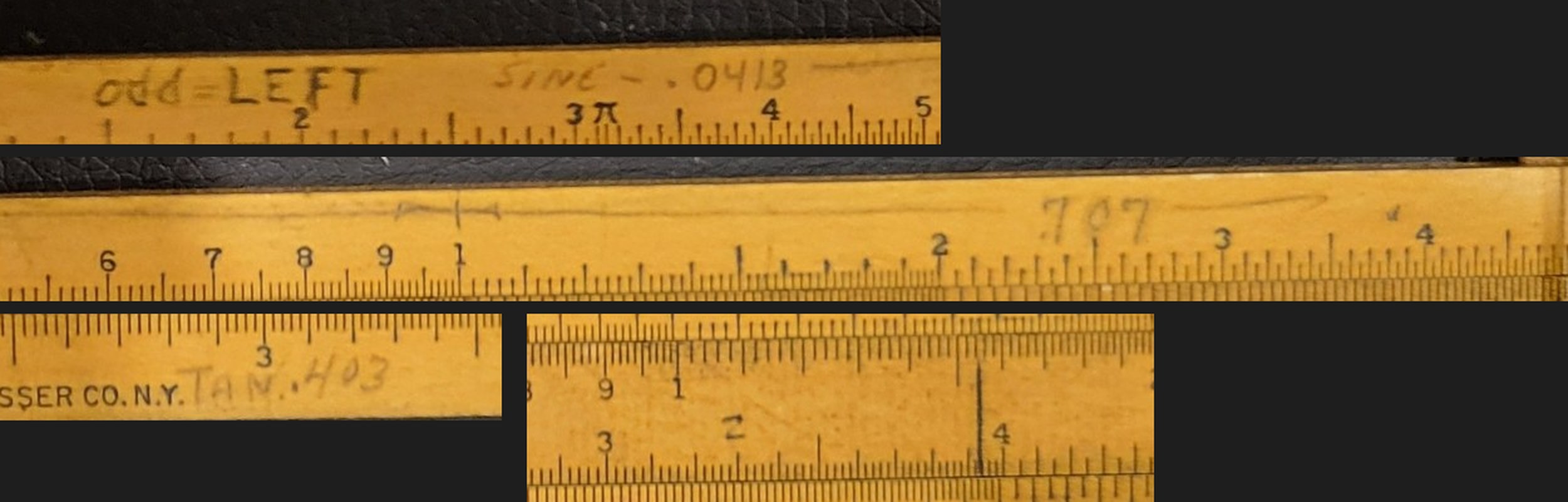
Figure 4 — The notes enlarged: (top) “odd = LEFT” and “SINE – .0413”; (middle) the bracket over the centre index of A and “707”; (bottom left) “TAN. 403”; (bottom right) the “2” and the vertical stroke on the slide. Photo: my own.
What they mean can only be inferred, but most of them line up with exactly the lessons a beginner’s rule was bought for:
- “odd = LEFT” with the bracket over the middle of A is the rule for square roots: a number with an odd number of digits is set on the left half of A, one with an even number on the right half, and the root is read on D. The student marked where the halves meet and wrote the rule beside it. The same rule is printed on the back of the Lawrence 8-B in Vol 2.
- “707” is the digit string of 0.7071 — √0.5, which is also sin 45° and cos 45° — and of √50 = 7.071. Either way it is the classic first answer in roots and trigonometry.
- “SINE – .0413” has the form of a sine read from the left half of the A/B scales, where (as K&E’s manual puts it) “the first significant figure [is] in the second decimal place.” A sine of 0.0413 belongs to an angle of about 2°22′ (sin 2°22′ = 0.04129).
- “TAN. 403” has the form of a tangent read on D, where all values lie between 0.1 and 1. A tangent of 0.403 belongs to about 21°57′ (tan 21°57′ = 0.4030; tan 22° = 0.4040).
The last two look like answers to particular exercises rather than rules to remember. The notes are part of the rule’s history and are best left alone; the care section below explains why erasing them would also risk the printing beneath.
1.5 The Scales
The 4058C carries the Mannheim layout that K&E used on its 4041 (History Vol 2; Using Slide Rules Vols 1–4):
Table 3 — The 4058C carries the Mannheim layout that K&E used on its 4041 (History Vol 2; Using Slide Rules Vols 1–4)
| Scale | Where | What it gives |
|---|---|---|
| A | upper body | x², two cycles, 1–100 |
| B | slide, upper edge | x², A’s partner on the slide |
| C | slide, lower edge | x, 1–10 |
| D | lower body | x, 1–10 |
| S | back of slide | Sines, about 0°34′ to 90°, read against A (or B) |
| L | back of slide | Common logarithms (mantissas), read against D (or C) |
| T | back of slide | Tangents, about 5°43′ to 45°, read against D (or C) |
Both A and B carry π gauge marks at 3.1416. There is no CI scale and no K scale; cubes and cube roots are not provided for, which is one of the things that marks it as a beginner’s rule.
The back of the slide is used in two ways, as K&E’s manuals explain. The slide can be pulled out, turned over and put back so that S, L and T face the front against A and D. Or, with the slide in its normal position, the angle on S (or T) is set to the index mark in the cut-out at the right-hand end of the back, and the answer read on the front — the sine on B opposite the right index of A, the tangent on C opposite the right index of D. The cut-out and its index marks are visible at the right of Figure 3.
The back of the stock is a reference card. “Equivalents” give conversions such as 1 in. = 2.54 cm, 1 U.S. gal. = 3.785 litres, 1 H.P. = .746 K.W.; the “Settings” columns beside them turn each conversion into a slide setting, written as “1 opp. 2.54” or “292 opp. 89” — set the first number on C opposite the second on D and every number on C then reads its converted value on D. A final column gives area and volume formulas, e = 2.718, √(2g) = 8.02, 1 radian = 57.3° and sin 1′ = .0002909. A footnote credits the equivalents to the U.S. Bureau of Standards Circular No. 47.
Rules of this model were printed with more than one layout. Joe Haupt’s 4058C (Figure 5) has the same tables, but with the Bureau of Standards credit and “Keuffel & Esser Co., New York” stacked in a block at the left end rather than in a line along the bottom as on mine. Which layout is earlier is not established here.
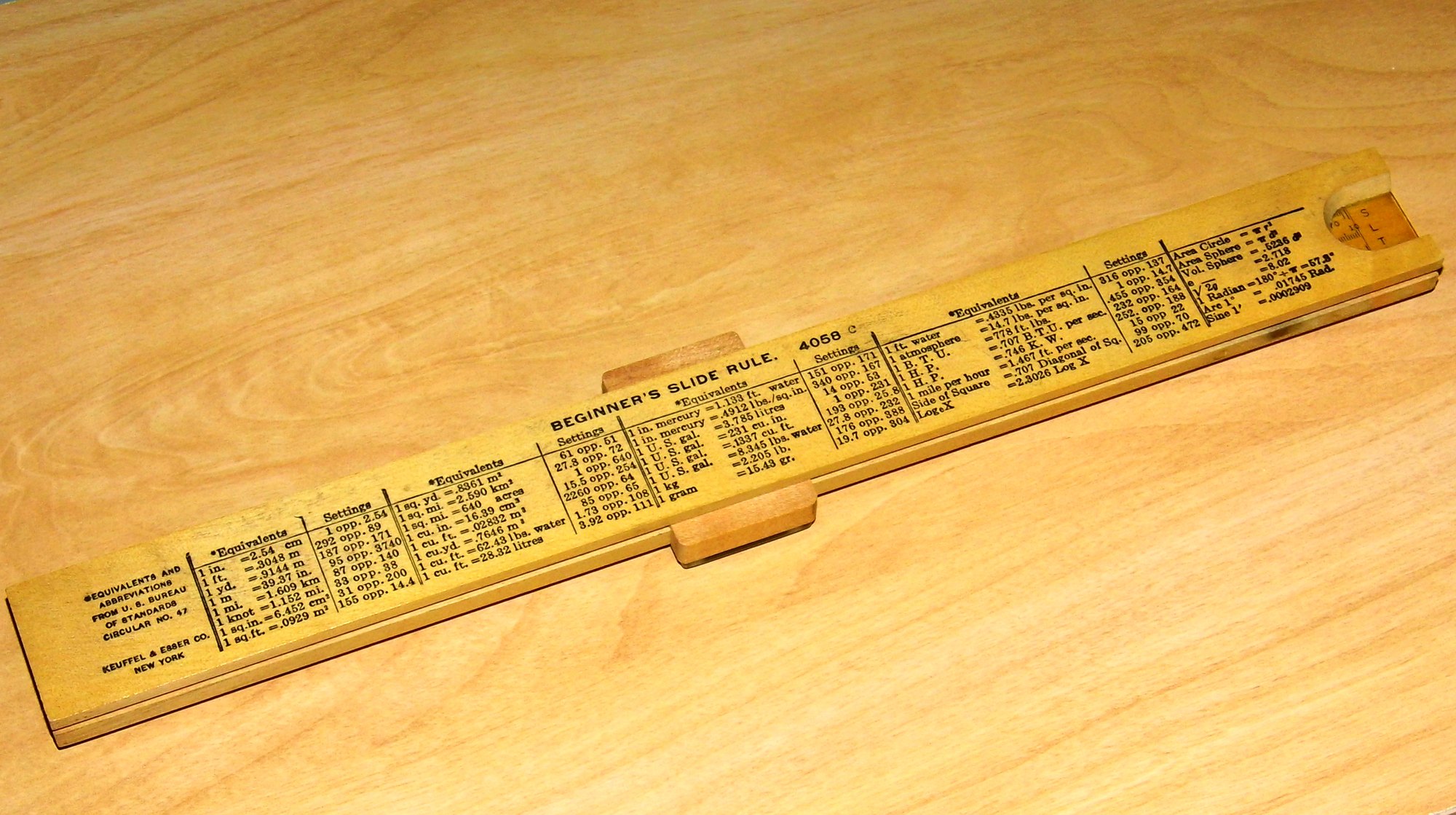
Figure 5 — Another 4058C’s back, for comparison: same tables, different layout of the credit lines; the wooden end blocks of the frameless cursor show above and below. Image: “Vintage Keuffel & Esser Company Beginner’s Slide Rule (Reverse Side), No. 4058C, All Wood Framed Cursor, Made In USA, Circa 1930s” by Joe Haupt, CC BY-SA 2.0, via Wikimedia Commons, https://commons.wikimedia.org/wiki/File:Vintage_Keuffel_%26_Esser_Company_Beginner%27s_Slide_Rule_(Reverse_Side),_No._4058C,_All_Wood_Framed_Cursor,_Made_In_USA,_Circa_1930s_(31955561837).jpg.

1.6 Using It: the 1928 Instructions
The sheet that came with my rule teaches in a deliberate order. It advises “the beginner … to confine his study to the simple operations of multiplication and division on the ‘C’ and ‘D’ scales,” and only then moves on. Its own first examples are worth working on the rule itself, because they were chosen for it.
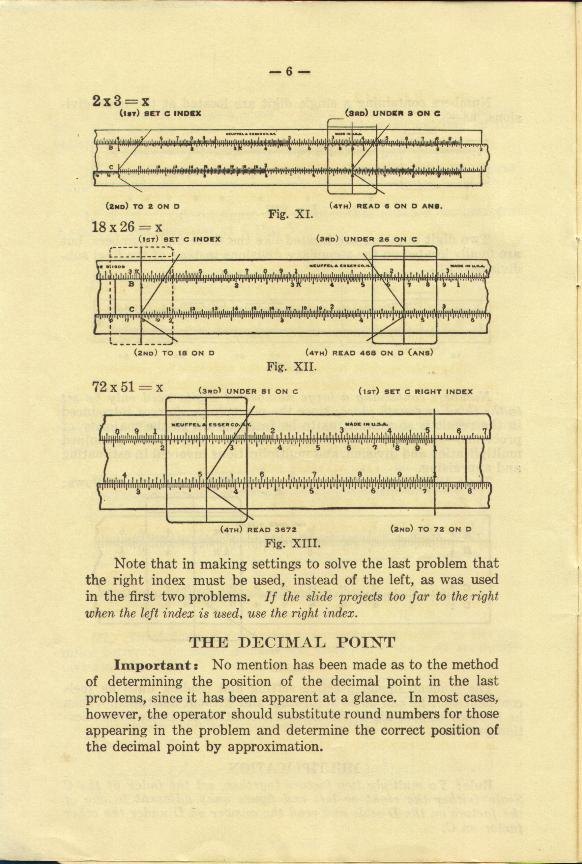
Figure 6 — Page 6 of the 1928 Elementary Instructions: 2 × 3, 18 × 26 and 72 × 51, the last needing the right index. This scan is from another copy of the same sheet as mine. Image: Keuffel & Esser, Elementary Instructions for Operating the Slide Rule, Mannheim Type (1928), scan by Clark McCoy, https://www.mccoys-kecatalogs.com/KEManuals/4058-1928/4058-1928.htm.
Reading a number. The sheet locates 246 in three steps: the first figure, 2, puts it between the main divisions 2 and 3; the second, 4, between the fourth and fifth secondary divisions after 2; the third, 6, three small spaces on, since between 2 and 3 each small space is worth 2. It then repeats the exercise for 478 with the glass “indicator” (the cursor), where between 4 and 5 the small spaces are worth 5 and the 8 must be estimated three-fifths of the way through a space.
2 × 3. Set the left index of C over 2 on D; under 3 on C read 6 on D.
18 × 26. Set the left index of C over 18 on D; under 26 on C read 468 on D. Check: 18 × 26 = 468.
72 × 51. With the left index over 72 the slide projects too far, so set the right index of C over 72 on D; under 51 on C read 3672, and place the decimal point by approximation (70 × 50 = 3,500). The sheet’s rule: “If the slide projects too far to the right when the left index is used, use the right index.” Check: 72 × 51 = 3,672 — a 10-inch rule reads this as 3,670.
Division reverses the setting: 3,672 ÷ 51 — set 51 on C over 3,672 on D and read 72 on D under the C index.
Square roots — the pencil rule. √625: 625 has three digits, odd, so set the hairline over 625 on the left half of A and read 25 on D. √4,900: four digits, even, so the right half: 70 on D.
Sines and tangents from the back. Method I of K&E’s manual: turn the slide over so S faces A. Opposite 20 on S, read 342 on A; the right half of A puts the first figure in the first decimal place, so sin 20° = 0.342. Opposite 2 on S the reading is on the left half of A, so the first figure is in the second decimal place: sin 2° = 0.0349. With T against D, opposite 20 on T read tan 20° = 0.364. Check: sin 20° = 0.34202, sin 2° = 0.03490, tan 20° = 0.36397.
Using the Settings table. To turn inches into centimetres, set 1 on C opposite 2.54 on D (the first line of the table). Then opposite 12 on C read 30.5 on D: 12 in. = 30.48 cm. The table’s “292 opp. 89” does feet to metres the same way, because 89/292 = 0.3048.
1.7 Caring for a Printed Wooden Rule
The 4058C is the simplest kind of rule to look after and the easiest to damage. Its scales are not engraved; they are printed on the varnished surface of the wood, so the ink and the finish are all that hold them.
1.7.1 What to use
- Dust and loose dirt: a soft brush, then a dry, soft cotton cloth along (not across) the scales.
- Grime: a cloth dampened with water and a drop of mild soap and wrung out until barely damp. Work on a small area, then wipe with a cloth damp with plain water, and dry immediately. Test first on the blank end of the stock. If any ink or colour shows on the cloth, stop.
- The glass cursor: take the four brass screws out, lift the glass from between the wooden blocks, and wash it alone in soapy water; dry, and refit with the hairline square to the scales (check it against the C and D indexes with the slide closed). Do not wet the wooden blocks.
- A sticky slide: clean the groove with a dry brush. If it still binds, rub a little paraffin wax (a plain white candle) on the slide’s tongues and buff off the excess. Do not use oil, silicone spray or graphite on wood: oil soaks in and darkens the wood; graphite blackens everything it touches.
1.7.2 What not to do
- No solvents. Alcohol, acetone, thinners and household cleaners can dissolve or soften both the varnish and the printing ink.
- No abrasives. Not erasers, melamine sponges, toothpaste or polish — on a printed face they remove the scales with the dirt. This is also why the pencil notes should stay: a pencil eraser that lifts graphite lifts printing too.
- No soaking and no heat. Water swells the wood, raises the grain under the print and can loosen the slide’s fit for good; heat dries and checks it.
- Do not sand or plane a binding slide. A wooden rule that binds in damp weather usually frees itself when the air dries; removing wood makes it loose for ever.
1.7.3 Glass, boxes and paper
- If the glass breaks, the cursor can be rebuilt: the International Slide Rule Museum supplies laser-cut acrylic replica lenses for K&E’s pre-1936 all-glass cursors in five sizes, blank or with a hairline added (ISRM restoration page, 2026). Keep the original wooden blocks.
- The pasteboard boxes and the 1928 sheet are worth as much care as the rule. Store them flat, dry and dark, in an acid-free folder or box. Do not tape the tears; a conservator’s wheat-starch paste or Japanese tissue is the reversible repair if one is ever needed.
- Store the rule out of direct sun (it darkens varnished wood and fades pencil) and away from radiators and outside walls, where humidity swings are greatest.
Sources
- Clark McCoy, “Collection of pages from K&E catalogs for the 4058 Family” and the 1928 Elementary Instructions preview pages (https://mccoys-kecatalogs.com/KEModels/ke4058family.htm; https://www.mccoys-kecatalogs.com/KEManuals/4058-1928/4058-1928.htm).
- “K+E Beginner’s Rules,” Following the Rules (https://followingtherules.info/ke-beginners-rules.html) — 1925 introduction of the N4058C, the 1936 change, and the 1929 price list as quoted by Bruce Babcock.
- Keuffel & Esser, Elementary Instructions for Operating the Slide Rule, Mannheim Type (1928) — my own copy, and the McCoy scan of pages 1–6. In this site’s Reference Library.
- William E. Breckenridge, The Mannheim Slide Rule (N4041), Keuffel & Esser (1938; ISRM M129) — the S, L and T scales and Methods I and II for sines. In this site’s Reference Library.
- International Slide Rule Museum, “Restoring and Repairing Slide Rules” — replica K&E all-glass cursor lenses (https://www.sliderulemuseum.com/Restoration.shtml).
- Worked examples checked by calculation: 18 × 26 = 468; 72 × 51 = 3,672; 3,672 ÷ 51 = 72; √625 = 25; √4,900 = 70; sin 20° = 0.34202; sin 2° = 0.03490; tan 20° = 0.36397; 12 × 2.54 = 30.48; 89/292 = 0.30479; √0.5 = 0.70711; √50 = 7.0711; sin 2°22′ = 0.04129; tan 21°57′ = 0.40301; tan 22° = 0.40403.
Comments (0)